Introduction
A Data Clean Room is a secure, privacy-safe environment that allows multiple parties—such as an advertiser and a publisher—to combine their first-party datasets for joint analysis while ensuring that raw, individual-level data is never exposed to either party. Think of it as a “neutral ground” where data goes in, gets analyzed according to pre-defined mathematical rules, and only aggregated, anonymized insights come out. This technology allows brands to perform sophisticated audience overlap analysis, multi-touch attribution, and measurement without compromising consumer privacy or violating data residency laws.
The importance of Data Clean Rooms cannot be overstated in a “privacy-first” world. Without them, companies are forced to either operate in silos or risk the massive legal and reputational fallout of unauthorized data sharing. Key real-world use cases include a retailer matching its transaction data with a streaming service’s viewership data to measure ad effectiveness, or a bank collaborating with a travel brand to offer personalized rewards without exchanging sensitive financial IDs. When evaluating DCR tools, users should look for “privacy-by-design” features like differential privacy, multi-party computation (MPC), and the ability to integrate seamlessly with existing cloud warehouses.
Best for: Large-scale advertisers, media owners, retail media networks, and financial services firms that possess vast amounts of first-party data and need to collaborate with partners for measurement and targeting. It is essential for organizations operating in highly regulated regions (EU, California) or sectors (Healthcare, Finance).
Not ideal for: Small businesses with minimal first-party data or companies that do not have active data partnerships. For these users, traditional aggregated reporting from ad platforms is usually sufficient and far less costly than the significant technical and financial investment required for a DCR.
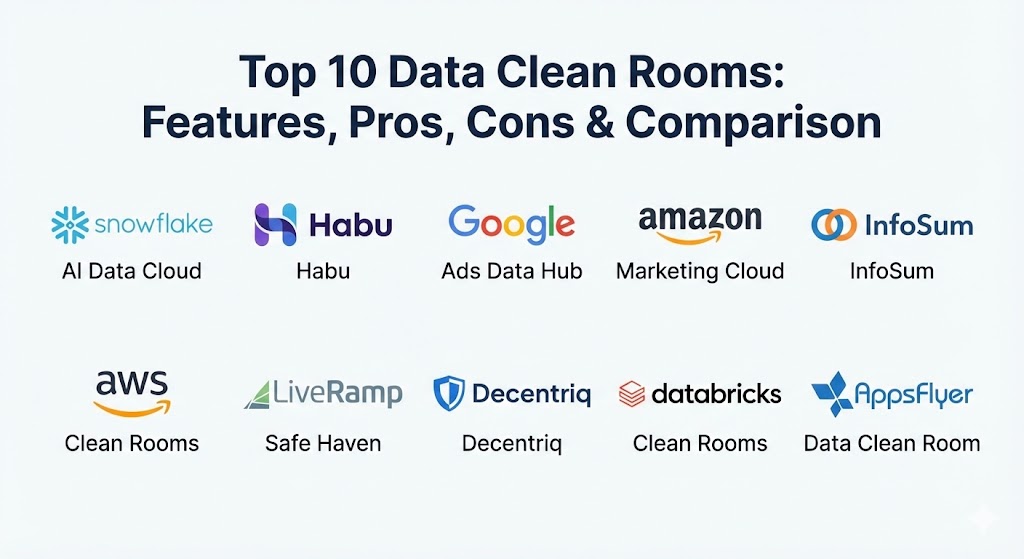
Top 10 Data Clean Rooms
1 — Snowflake AI Data Cloud
Snowflake has rapidly become a leader in the DCR space by leveraging its “Data Cloud” architecture, which allows users to share data across accounts without actually moving it. Its clean room functionality is built on the principle of “secure data sharing” combined with sophisticated governance.
- Key features:
- Native SQL-based collaboration environment within the Snowflake interface.
- Secure Data Sharing that avoids the risks and costs of data movement.
- Differential Privacy and k-anonymity safeguards to prevent re-identification.
- Multi-party collaboration support for more than two participants.
- Integration with Snowflake Marketplace for third-party data enrichment.
- Highly customizable governance policies for fine-grained access control.
- Pros:
- Exceptional performance as it runs on Snowflake’s high-speed compute engine.
- If you already use Snowflake, the “zero-copy” cloning makes setup incredibly efficient.
- Cons:
- Requires partners to also be on the Snowflake platform (or use a managed account).
- Can be technically daunting for marketers who aren’t familiar with SQL.
- Security & compliance: SOC 1/2 Type II, HIPAA, HITRUST, PCI DSS, and GDPR compliant. Uses row-access policies and data masking.
- Support & community: Enterprise-grade support with a massive global community and extensive documentation on Snowflake University.
2 — Habu (by LiveRamp)
Recently acquired by LiveRamp, Habu is an independent, cloud-agnostic platform that focuses on making data collaboration easy and scalable. It is designed to sit on top of various cloud environments to provide a unified management layer.
- Key features:
- Multi-cloud interoperability (works across AWS, Azure, Google Cloud, and Snowflake).
- Automated workflow templates for common use cases like audience overlap.
- “No-code” interface options for business users alongside SQL for analysts.
- Identity-agnostic framework that supports various ID solutions (RampID, UID2).
- Built-in privacy “clean room” checks that automatically block risky queries.
- Seamless activation directly into DSPs and social platforms.
- Pros:
- Excellent for “vendor-neutral” scenarios where partners are on different clouds.
- The UI is significantly more user-friendly for non-technical marketing teams.
- Cons:
- Adding an abstraction layer can sometimes lead to minor latency in query results.
- Acquisition by LiveRamp might lead to deeper coupling with the LiveRamp ecosystem.
- Security & compliance: ISO 27001, SOC 2 Type II, and GDPR compliant. Features patented privacy-preserving technology.
- Support & community: Strong professional services team; known for high-touch onboarding and strategic guidance.
3 — Google Ads Data Hub (ADH)
Google Ads Data Hub is the most widely used “walled garden” clean room. It is the only way for advertisers to access granular, event-level data from YouTube and Google Search in a privacy-safe way.
- Key features:
- Access to Google’s massive, event-level campaign data (YouTube, Search, Display).
- Built-in privacy thresholds that suppress results for small cohorts.
- Integration with BigQuery for sophisticated data analysis.
- Support for multi-touch attribution (MTA) across Google properties.
- Automated checks to ensure queries comply with Google’s privacy policies.
- Custom audience creation for activation within Google Ads.
- Pros:
- The only source for true “Google-native” measurement insights.
- Highly scalable, leveraging Google Cloud’s massive infrastructure.
- Cons:
- Restricted strictly to the Google ecosystem; you cannot bring in non-Google media data.
- Steep learning curve requiring proficiency in BigQuery SQL.
- Security & compliance: Google’s internal privacy standards (among the world’s strictest), GDPR, and CCPA aligned.
- Support & community: Extensive documentation and support through the Google Cloud and Google Marketing Platform channels.
4 — Amazon Marketing Cloud (AMC)
Amazon Marketing Cloud is the retail giant’s answer to the need for deep advertising insights. It allows advertisers to analyze their first-party data alongside Amazon’s pseudonymized ad signals.
- Key features:
- Event-level analysis of Amazon DSP and Sponsored Ads performance.
- Ability to join internal CRM data with Amazon’s verified purchase signals.
- SQL-based query interface for custom measurement and attribution.
- Support for “New-to-Brand” and “Customer Lifetime Value” analysis.
- Flexible reporting that allows for cross-channel insights within Amazon.
- Direct audience creation based on clean room insights for remarketing.
- Pros:
- Invaluable for CPG and retail brands looking to understand the “Amazon path to purchase.”
- Rapidly evolving feature set with new “Beta” capabilities added frequently.
- Cons:
- Like ADH, it is a walled garden limited to Amazon-related data.
- Output is limited to aggregate reporting only (no row-level exports).
- Security & compliance: AWS-backed security infrastructure, GDPR, and CCPA compliant.
- Support & community: Growing library of “AMC Instructional Queries” (IQ) and dedicated AWS support teams.
5 — InfoSum
InfoSum is a unique player that champions a “non-movement” architecture. It focuses on connecting data without ever actually aggregating it in a central location, making it a favorite for privacy purists.
- Key features:
- Patented “Bunker” technology that keeps data decentralized.
- Statistical anonymization that eliminates the need for a common ID.
- Real-time audience discovery and overlap analysis.
- Multi-party collaboration across unlimited “Bunkers.”
- Instant activation to major media platforms via pre-built connectors.
- Privacy-safe “bridge” for identity resolution across partners.
- Pros:
- Zero data movement makes it one of the most secure architectures available.
- Faster setup for partners who are wary of “uploading” data to a third party.
- Cons:
- The decentralized nature can make highly complex, multi-join queries more difficult.
- Smaller ecosystem compared to the giant cloud providers.
- Security & compliance: GDPR “Privacy by Design,” SOC 2 Type II, ISO 27001, and HIPAA compliant.
- Support & community: Highly praised customer success team; extensive training for publishers and agencies.
6 — AWS Clean Rooms
AWS Clean Rooms is a relatively new but powerful service that helps companies collaborate without moving their data out of the AWS ecosystem. It is designed to be a “builder-friendly” tool.
- Key features:
- Direct integration with Amazon S3 and AWS Glue.
- Flexible query logs and analysis templates to control what partners see.
- Support for cryptographic computing (C3) for enhanced privacy.
- Automated data handling and transformation via AWS native tools.
- Pay-as-you-go pricing integrated with your existing AWS bill.
- Fine-grained permissions for each member of the collaboration.
- Pros:
- Extremely cost-effective for organizations already heavily invested in AWS.
- High flexibility for developers to build custom clean room applications.
- Cons:
- Lacks the “out-of-the-box” marketing workflows found in Habu or InfoSum.
- Requires significant AWS technical expertise to configure properly.
- Security & compliance: AWS Identity and Access Management (IAM), FIPS 140-2, and GDPR compliant.
- Support & community: Backed by the vast AWS documentation library and Premium Support tiers.
7 — LiveRamp Safe Haven
Safe Haven is LiveRamp’s comprehensive environment for data collaboration, emphasizing identity resolution and the “RampID” ecosystem to connect disparate datasets accurately.
- Key features:
- Built-in identity resolution powered by LiveRamp’s AbiliTec.
- Advanced measurement and attribution modules for retail and CPG.
- Access to the LiveRamp partner network for easy collaboration.
- Governance tools for managing data permissions and usage.
- Support for multi-cloud and hybrid-cloud deployments.
- Integrated “Safe Haven” UI for managing collaboration workflows.
- Pros:
- Strongest “Identity” play; excellent at matching data with low-quality identifiers.
- Massive network of existing users (retailers/publishers) makes finding partners easy.
- Cons:
- Can be very expensive; primarily targeted at the largest enterprise brands.
- Heavy reliance on LiveRamp’s proprietary identity framework.
- Security & compliance: SOC 2 Type II, HIPAA, GDPR, and rigorous internal audits.
- Support & community: Extensive global support and a dedicated consulting arm for data strategy.
8 — Decentriq
Decentriq is a Swiss-based platform that uses Confidential Computing (Hardware Enclaves) to ensure that data is encrypted even while it is being processed. This provides a “trustless” environment.
- Key features:
- Use of Intel SGX technology for hardware-level data isolation.
- No-code interface for non-technical users to run pre-defined analyses.
- Support for Python and R for data scientists requiring advanced modeling.
- Interoperability across any cloud provider (Azure, AWS, On-prem).
- Built-in privacy tools like Differential Privacy and Synthetic Data.
- Audit logs that are verifiably immutable.
- Pros:
- Highest level of technical privacy (data is never visible to the platform owner).
- Very popular in the EU due to its “Swiss-standard” privacy focus.
- Cons:
- Hardware-based enclaves can impose limits on very large dataset sizes.
- Lesser-known brand in the North American marketing ecosystem.
- Security & compliance: GDPR compliant, ISO 27001, and Swiss Data Protection Act aligned.
- Support & community: Highly responsive technical support; strong focus on banking and healthcare sectors.
9 — Databricks Clean Rooms
Databricks offers clean room capabilities as part of its “Lakehouse” platform, focusing on high-performance analytics and machine learning on top of Delta Lake.
- Key features:
- Built on “Delta Sharing,” an open-source protocol for secure data sharing.
- Support for complex AI and ML workloads within the clean room.
- Seamless integration with Spark and Python for data science.
- Unified governance through Databricks Unity Catalog.
- Ability to handle unstructured and semi-structured data.
- Collaborative notebooks for data scientists to work together safely.
- Pros:
- The best choice for organizations that need to run “Heavy AI” on shared data.
- Open-standard approach (Delta Sharing) reduces the risk of vendor lock-in.
- Cons:
- Extremely technical; lacks the “Marketer UI” found in dedicated DCR tools.
- Setup requires a deep understanding of the Databricks ecosystem.
- Security & compliance: FedRAMP, HIPAA, SOC 2, and GDPR compliant.
- Support & community: World-class support for data engineers; active open-source community.
10 — AppsFlyer Data Clean Room
Designed specifically for the mobile app ecosystem, AppsFlyer’s DCR helps app developers and advertisers measure marketing impact in the era of Apple’s ATT and Google’s Privacy Sandbox.
- Key features:
- Native integration with AppsFlyer’s Mobile Measurement Partner (MMP) data.
- Support for cross-platform measurement (Mobile, Web, CTV).
- Pre-defined “Measurement Templates” for ROAS and LTV analysis.
- Privacy-safe conversion data matching with ad networks.
- Aggregated reporting that meets mobile platform privacy requirements.
- High-speed processing for real-time campaign optimization.
- Pros:
- Essential for mobile-first brands navigating iOS/Android privacy changes.
- Very easy to “turn on” if you are already using AppsFlyer for attribution.
- Cons:
- Narrow focus on mobile and performance marketing.
- Not suitable for non-marketing use cases like supply chain or finance.
- Security & compliance: ePrivacyseal, SOC 2, GDPR, and CCPA compliant.
- Support & community: Leading mobile attribution community and global support presence.
Comparison Table
| Tool Name | Best For | Platform(s) Supported | Standout Feature | Rating (Gartner) |
| Snowflake DCR | Cross-industry analytics | Snowflake Native | Zero-copy data sharing | 4.6 / 5 |
| Habu | Multi-cloud Marketers | AWS, Azure, GCP, SF | Cloud-agnostic UI | 4.7 / 5 |
| Google ADH | Google Media Insights | Google Ads / Cloud | YouTube Event-level Data | 4.4 / 5 |
| Amazon AMC | Retailers & CPG | Amazon Ads / AWS | Verified Purchase Signals | 4.3 / 5 |
| InfoSum | Decentralized Privacy | Multi-Cloud | No data movement architecture | 4.5 / 5 |
| AWS Clean Rooms | AWS Power Users | AWS Native | Cryptographic Computing | 4.2 / 5 |
| LiveRamp Safe Haven | Identity-led Marketing | Multi-Cloud | RampID Identity Resolution | 4.5 / 5 |
| Decentriq | Highly Regulated Sectors | Multi-Cloud | Hardware Enclave Security | 4.8 / 5 |
| Databricks | Shared Machine Learning | Multi-Cloud | AI/ML on Delta Lake | 4.6 / 5 |
| AppsFlyer DCR | Mobile App Developers | AppsFlyer Native | Mobile-First Privacy Safety | 4.5 / 5 |
Evaluation & Scoring of Data Clean Rooms
When scoring these tools, we weight the ability to maintain privacy without sacrificing the ability to generate “granular-enough” insights.
| Category | Weight | Evaluation Notes |
| Core Features | 25% | Multi-party support, SQL/No-code options, and use-case templates. |
| Ease of Use | 15% | How quickly a marketer can generate a report without calling an engineer. |
| Integrations | 15% | Native connectors to CDPs, DSPs, and existing cloud data warehouses. |
| Security & Compliance | 10% | Encryption methods, differential privacy, and regional certifications. |
| Performance | 10% | Query speed on massive datasets and data refresh frequency. |
| Support & Community | 10% | Documentation quality and the availability of professional services. |
| Price / Value | 15% | Total cost of ownership, including compute fees and licensing. |
Which Data Clean Room Tool Is Right for You?
The “DCR landscape” is highly segmented. Your choice should be driven by where your data currently lives and who your primary partners are.
- Solo Users & Small Teams: You generally do not need a DCR. Stick to the built-in, aggregated reporting tools provided by Google, Meta, and Amazon.
- Mid-Market Brands: If you are primarily concerned with YouTube and Search, start with Google Ads Data Hub. If you need to work with multiple publishers across different clouds, Habu is the most flexible starting point.
- Retailers & CPGs: Amazon Marketing Cloud is non-negotiable for anyone selling on Amazon. For external partnerships, Snowflake or LiveRamp Safe Haven offer the most robust retailer-publisher matching frameworks.
- Financial & Healthcare Firms: If you handle extremely sensitive PII (Personally Identifiable Information), Decentriq’s hardware enclaves or InfoSum’s non-movement architecture provide the highest levels of legal and technical safety.
- Data Science Heavy Teams: If you need to build custom ML models on shared data, Databricks is the superior choice due to its open-source roots and Spark integration.
Frequently Asked Questions (FAQs)
1. Does a Data Clean Room store my data?
Most third-party DCRs do not store your data long-term. They act as a “processing layer.” However, walled gardens like Google ADH or Amazon AMC use data already residing in their cloud environments.
2. Is a DCR the same as a CDP (Customer Data Platform)?
No. A CDP centralizes your own data for marketing activation. A DCR is a secure space to collaborate with another party’s data without actually seeing it.
3. Do I need a common identifier (like email) to use a DCR?
Typically, yes. Most DCRs match data using hashed emails or phone numbers. However, tools like InfoSum can use statistical modeling to match audiences without a direct PII link.
4. How much do Data Clean Rooms cost?
They are expensive. Annual licenses can range from $50,000 to $500,000+, plus the additional cloud compute costs for running queries.
5. Can I use a DCR to get around the “Death of the Cookie”?
Yes. DCRs rely on first-party data (which is not going away) rather than third-party cookies, making them a future-proof measurement solution.
6. What is “Differential Privacy” in a clean room?
It is a mathematical technique that adds “noise” to the results to ensure that no individual user can be identified, even if someone tries to reverse-engineer the query.
7. Can I export user-level data from a clean room?
No. The core purpose of a DCR is to prevent user-level exports. You only get aggregate numbers (e.g., “The overlap between our audiences is 15,000 users”).
8. Are DCRs only for marketing?
While marketing is the #1 use case, they are increasingly used in finance (fraud detection), healthcare (research), and retail (supply chain optimization).
9. How hard is it to set up a DCR?
It is complex. It involves legal agreements between parties, data mapping (schema alignment), and technical configuration of the clean room environment.
10. Do I need to move my data into the clean room?
Ideally, no. Modern solutions like Snowflake and AWS Clean Rooms allow the “clean room” to access the data where it sits (data-in-place), which is much more secure.
Conclusion
Data Clean Rooms have evolved from a niche security tool into the central “clearinghouse” for modern data partnerships. As we move deeper into 2026, the brands that succeed will be those that have moved past the “fear” of data collaboration and embraced the “safety” of clean room technology. Choosing the “best” tool isn’t about the most features—it’s about finding the environment where you and your partners feel safest and most productive. Prioritize interoperability and technical privacy, and your data collaboration strategy will remain resilient for years to come.