Introduction
Customer Identity and Access Management (CIAM) is a specialized subset of identity management designed specifically for external users—your customers. Unlike traditional IAM, which focuses on employee productivity and internal security, CIAM is built to handle millions of users, varied devices, and high-frequency interactions. It manages the entire lifecycle of a customer’s digital identity, from self-service registration and social login to profile management and data privacy consent.
The importance of CIAM lies in its ability to build trust while reducing “cart abandonment” caused by complex security. Key real-world use cases include Single Sign-On (SSO) across a brand’s multiple apps, Progressive Profiling (gathering user data gradually rather than all at once), and Multi-Factor Authentication (MFA) that only triggers during high-risk actions. When evaluating tools, users should look for scalability, ease of integration (SDKs), compliance with global privacy laws, and advanced fraud detection.
Best for: B2C companies, global e-commerce retailers, digital banking platforms, and media streaming services. It is essential for Product Managers and Developers who need to scale to millions of users while maintaining a high-conversion user journey.
Not ideal for: Internal employee management (Workforce IAM is better suited here) or small, static websites with no authenticated user area. If you only have a few hundred users, the complexity and cost of a dedicated CIAM suite might outweigh the benefits compared to simple built-in CMS authentication.
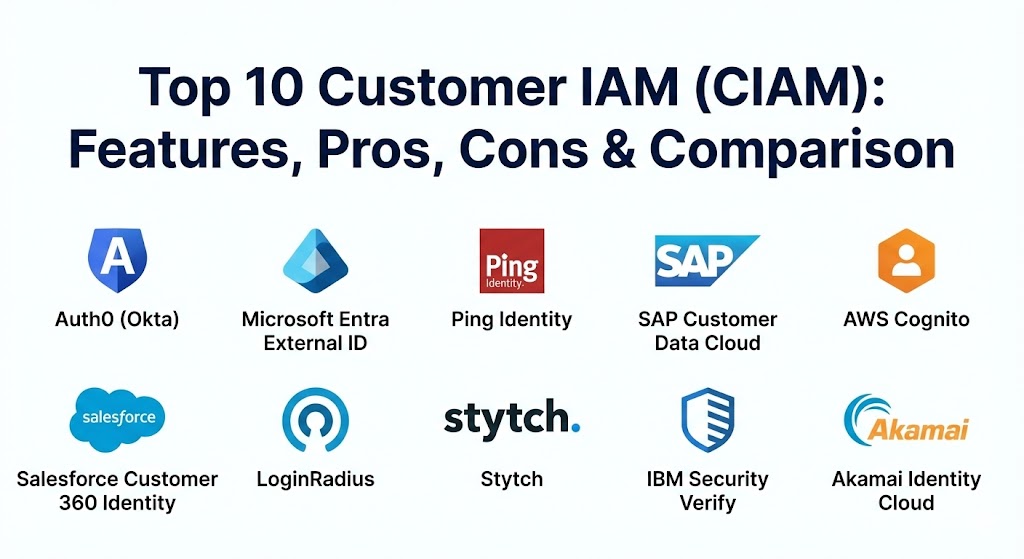
Top 10 Customer IAM (CIAM) Tools
1 — Okta Customer Identity Cloud (Auth0)
Auth0, now under the Okta umbrella, is widely considered the gold standard for developer-centric CIAM. It is designed to be highly customizable via code while providing “out of the box” security features.
- Key features:
- Universal Login: A pre-built, customizable login page that handles all authentication flows.
- Extensibility (Actions): Use serverless functions to customize the login/signup logic.
- Social Login: One-click integration with dozens of providers like Google, Apple, and LinkedIn.
- Anomalous Activity Detection: Automatically blocks brute-force and credential-stuffing attacks.
- Passwordless Authentication: Support for Magic Links, biometrics, and WebAuthn.
- Branding Customization: Full control over the look and feel of the user experience.
- Multi-tenant Support: Ideal for SaaS companies managing multiple customer organizations.
- Pros:
- The best documentation in the industry, making it a favorite for developers.
- Extremely flexible; if you can dream of a login flow, you can code it in Auth0.
- Cons:
- Pricing can escalate quickly as your Monthly Active Users (MAU) grow.
- Some advanced enterprise features are locked behind high-tier plans.
- Security & compliance: SOC 2 Type II, ISO 27001, HIPAA, GDPR, and PCI DSS compliant.
- Support & community: Massive community forum, extensive SDK library, and 24/7 enterprise support.
2 — Microsoft Entra External ID
Microsoft’s evolution of Azure AD B2C, Entra External ID is a high-scale cloud identity service that leverages the massive reliability of the Microsoft ecosystem.
- Key features:
- Native Mobile Integration: Specialized SDKs for iOS and Android applications.
- Identity Protection: Uses Microsoft’s global threat intelligence to block suspicious logins.
- Conditional Access: Dynamically requires MFA based on user location or device risk.
- Custom User Attributes: Easily store and manage unique data points for your customers.
- Self-Service Password Reset: Reduces support tickets by letting users help themselves.
- Verified ID: Support for decentralized identity and verifiable credentials.
- Pros:
- Highly cost-effective for organizations already using the Microsoft/Azure stack.
- Massive scalability, proven to handle hundreds of millions of identities.
- Cons:
- The configuration interface (Azure Portal) is notoriously complex and has a steep learning curve.
- Customizing the UI templates can be more restrictive than developer-first tools.
- Security & compliance: FedRAMP High, SOC 1/2/3, ISO 27001, HIPAA, and GDPR.
- Support & community: Extensive documentation and global enterprise support through Microsoft Unified Support.
3 — Ping Identity (PingOne for Customers)
Ping Identity specializes in large-scale enterprise CIAM, particularly for organizations with complex hybrid-cloud requirements and high security needs.
- Key features:
- DaVinci Orchestration: A no-code visual designer to build complex user journeys.
- Fraud Depict: Real-time AI analysis to identify bot behavior and account takeovers.
- High-Performance Directory: Built to handle thousands of transactions per second.
- Social Login & OIDC: Full support for modern federation standards.
- API Security: Specialized protection for the APIs that power your mobile apps.
- Progressive Profiling: Collects data over time to keep initial sign-up friction low.
- Pros:
- The DaVinci tool is revolutionary for non-technical stakeholders to design UX flows.
- Excellent for hybrid environments where some data stays on-prem and some in the cloud.
- Cons:
- Implementation often requires specialized consultants due to the tool’s depth.
- Can be more expensive than “cloud-only” competitors.
- Security & compliance: SOC 2, ISO 27001, HIPAA, and GDPR. Strong focus on data residency.
- Support & community: High-touch enterprise support and a professional services network.
4 — SAP Customer Data Cloud (Gigya)
Originally Gigya, this platform is now the centerpiece of SAP’s customer experience strategy, focusing heavily on marketing data and consent.
- Key features:
- Identity Sync: Seamlessly moves customer data into SAP’s CRM and marketing tools.
- Consent & Preference Management: Robust tools for GDPR/CCPA compliance.
- Social Logins & Gamification: Tools to increase user engagement during the login process.
- Customer Insights: Detailed analytics on user demographics and behavior.
- Risk-Based Authentication: Context-aware security that doesn’t annoy legitimate users.
- Pros:
- The best choice for organizations where CIAM data directly drives marketing campaigns.
- Strongest consent management features for global regulatory compliance.
- Cons:
- Can feel “over-engineered” for teams that just want a simple login box.
- Best value is only realized if you are already in the SAP ecosystem.
- Security & compliance: ISO 27001, SOC 2, HIPAA, and GDPR. Extremely strong privacy controls.
- Support & community: Dedicated enterprise support and global SAP partner network.
5 — AWS Cognito
AWS Cognito is the go-to CIAM for developers building on Amazon Web Services. It is a cost-effective, “no-frills” solution that scales effortlessly.
- Key features:
- User Pools: A managed user directory for sign-up and sign-in.
- Identity Pools: Grants users access to other AWS services like S3 or DynamoDB.
- Hosted UI: A basic, ready-to-use web interface for authentication.
- Lambda Triggers: Use AWS Lambda to customize flows (e.g., custom welcome emails).
- MFA & Encryption: Built-in support for SMS and TOTP-based multi-factor.
- Pros:
- The most cost-effective solution for high-volume applications (very generous free tier).
- Integration with AWS infrastructure is seamless.
- Cons:
- The documentation can be technical and difficult for beginners to navigate.
- The hosted UI is very basic and almost always requires significant custom coding for branding.
- Security & compliance: FedRAMP, SOC 2, ISO 27001, HIPAA, and PCI DSS.
- Support & community: Supported via AWS Support plans; massive community on StackOverflow.
6 — Salesforce Customer 360 Identity
Salesforce Identity provides a unified view of the customer, connecting their login experience directly to their sales and support records.
- Key features:
- Community Cloud Integration: Native identity for Salesforce-powered portals.
- Social Sign-On: Easy setup for Google, Facebook, and Twitter.
- Branded Login: High-level customization of the login page via the Lightning platform.
- Two-Factor Authentication: Integrated with Salesforce Authenticator.
- Login Discovery: Allows users to log in via email or phone number for simplicity.
- Pros:
- If your support and sales teams live in Salesforce, this is the logical choice.
- Excellent at providing a “360-degree” view of the user from their first login.
- Cons:
- High licensing costs compared to standalone CIAM tools.
- Can be slower to implement if you aren’t already deep in the Salesforce ecosystem.
- Security & compliance: SOC 1/2/3, ISO 27001, HIPAA, and GDPR.
- Support & community: World-class support and the massive “Trailblazer” community.
7 — LoginRadius
LoginRadius is a SaaS-first CIAM platform that prides itself on speed of implementation and a wide array of built-in features for mid-market companies.
- Key features:
- Turnkey CIAM: Pre-built modules for almost every common customer identity need.
- Data Mapping: Easily migrate legacy user data into the platform.
- Social Analytics: Deep data on how users interact with your social login options.
- Single Sign-On (SSO): Connects web, mobile, and third-party apps effortlessly.
- Cloud Directory: Highly available, geo-distributed user storage.
- Pros:
- Very fast “Time to Market”—often implemented in weeks, not months.
- Great balance of technical features and marketing-friendly analytics.
- Cons:
- Less “developer flexibility” than Auth0 for highly unique, custom logic.
- Pricing can be opaque for larger enterprise deployments.
- Security & compliance: SOC 2 Type II, ISO 27001, HIPAA, and GDPR.
- Support & community: High-quality customer success managers and 24/7 technical help.
8 — Stytch
Stytch is the modern “challenger” in the space, focusing heavily on the future of authentication: Passwordless.
- Key features:
- Passwordless First: Specialized in Magic Links, Email/SMS OTP, and biometrics.
- B2B & B2C: Handles both simple consumer logins and complex business-to-business orgs.
- Device Fingerprinting: Identifies suspicious devices before they can attempt a login.
- Clean APIs: Modern, RESTful design that developers find refreshing.
- Fraud Protection: Integrated bot detection and prevention.
- Pros:
- The best choice for startups wanting to skip “passwords” entirely.
- Very sleek, modern developer experience and documentation.
- Cons:
- Newer to the market, so the enterprise “legacy” integration list is shorter.
- Less focus on the “marketing/consent” side compared to SAP or Salesforce.
- Security & compliance: SOC 2, GDPR, and HIPAA compliant.
- Support & community: Highly active on Slack and GitHub; fast-moving engineering support.
9 — IBM Security Verify (CIAM)
IBM provides a heavy-duty, AI-powered CIAM solution designed for global institutions like banks and healthcare providers.
- Key features:
- Adaptive Access: Uses IBM’s “Watson” AI to calculate a risk score for every login.
- Fraud Detection: Specialized tools to identify account takeover (ATO) in real-time.
- Consent Management: Built-in portal for users to manage their own data privacy.
- Passwordless Options: QR code login, FIDO2, and biometric support.
- High-Scale Performance: Built for “Black Friday” level traffic spikes.
- Pros:
- Unmatched AI-driven fraud prevention for high-stakes industries.
- Very strong support for “Government-grade” security requirements.
- Cons:
- The user interface for administrators can feel dated and corporate.
- Complexity can make implementation slow for smaller, agile teams.
- Security & compliance: FIPS 140-2, FedRAMP, SOC 2, ISO 27001, and GDPR.
- Support & community: Global 24/7 support and extensive enterprise training.
10 — Akamai Identity Cloud (Janrain)
Akamai (having acquired CIAM pioneer Janrain) offers a globally distributed identity platform designed for the highest-traffic sites on the web.
- Key features:
- Edge-Based Identity: Leverages Akamai’s global CDN nodes for ultra-low latency.
- Massive Scalability: Designed for global media events and high-traffic retail.
- Customer Profile Management: A flexible, schema-less database for user data.
- Social Login & Sharing: Encourages users to share content while staying authenticated.
- Security Monitoring: Integrated with Akamai’s broader security and DDoS suites.
- Pros:
- If you already use Akamai for CDN/Security, the integration is a major performance win.
- Reliability is top-tier; built to never go down during a traffic surge.
- Cons:
- Can be very expensive; targeted specifically at the large enterprise market.
- Less focus on the “developer playground” feel than Auth0 or Stytch.
- Security & compliance: ISO 27001, SOC 2, PCI DSS, and GDPR.
- Support & community: Professional enterprise support with dedicated account teams.
Comparison Table
| Tool Name | Best For | Platform(s) Supported | Standout Feature | Rating (Gartner) |
| Auth0 (Okta) | Developers / SaaS | SaaS, Cloud, SDKs | Extensible Actions (Code) | 4.8 / 5 |
| Entra External ID | Microsoft Ecosystem | Azure, Cloud | Threat Intel Integration | 4.7 / 5 |
| Ping Identity | Large Enterprises | Hybrid, On-prem | DaVinci Visual Flows | 4.6 / 5 |
| SAP Gigya | Marketing / Consent | SaaS, Cloud | Consent Preference Mgmt | 4.5 / 5 |
| AWS Cognito | AWS-Native Apps | AWS Only | Direct AWS Resource Auth | 4.2 / 5 |
| Salesforce | CRM-heavy Orgs | Salesforce Cloud | 360 Customer Record Sync | 4.4 / 5 |
| LoginRadius | Fast SMB/Mid-market | SaaS, Cloud | Turnkey Social Analytics | 4.5 / 5 |
| Stytch | Passwordless Startups | SaaS, API-First | Magic Link / SDK Focus | 4.7 / 5 |
| IBM Security | Banks / High-Fraud | Hybrid, Cloud | Watson AI Risk Scoring | 4.4 / 5 |
| Akamai | High-Traffic Global | Edge / CDN | Edge-based Auth Speed | 4.3 / 5 |
Evaluation & Scoring of Customer IAM (CIAM)
Choosing a CIAM tool requires balancing the needs of the developer (who has to build it) with the needs of the customer (who has to use it). We evaluate these tools using the following weighted scoring rubric:
| Category | Weight | Evaluation Criteria |
| Core Features | 25% | Social login, MFA, progressive profiling, and directory depth. |
| Ease of Use | 15% | Quality of documentation, SDKs, and admin UI intuitiveness. |
| Integrations | 15% | Support for CRMs, CDPs, and modern cloud infrastructures. |
| Security & Compliance | 10% | Encryption, bot detection, and global privacy certifications. |
| Performance | 10% | Latency of the login process and platform uptime history. |
| Support & Community | 10% | Depth of the developer ecosystem and technical support speed. |
| Price / Value | 15% | Transparency and scalability of the MAU pricing model. |
Which Customer IAM (CIAM) Tool Is Right for You?
Solo Users vs SMB vs Mid-market vs Enterprise
- Solo Users/Small Devs: AWS Cognito is the most logical choice. It’s nearly free for small volumes and integrates with the AWS tools you likely already use.
- Growing SMBs: LoginRadius or Stytch provide the fastest path to a professional login screen without needing a dedicated security team.
- Mid-market: Auth0 (Okta) is the gold standard here. It offers the flexibility to grow with your product while handling the heavy lifting of security.
- Global Enterprise: Ping Identity, SAP, or IBM. These companies need the governance, hybrid-cloud support, and advanced fraud detection that small SaaS tools lack.
Budget-conscious vs Premium solutions
- Budget-conscious: AWS Cognito is the pricing winner. You pay only for what you use, and the free tier is generous.
- Premium: Okta/Auth0 and Akamai. You are paying for a premium brand, world-class documentation, and the peace of mind that your login screen will never be the cause of an outage.
Feature depth vs Ease of use
- Feature Depth: Ping Identity and IBM offer the most “knobs to turn” for complex security architectures.
- Ease of Use: Auth0 and Stytch are the clear winners. They prioritize the “Developer Experience” (DX) so you can get a working login in minutes.
Frequently Asked Questions (FAQs)
1. What is the difference between IAM and CIAM?
IAM is for employees (focus on productivity/control). CIAM is for customers (focus on experience/revenue). Employees must use the tools you give them; customers will leave if the login process is too difficult.
2. Why shouldn’t I just build my own login system?
Building “Login” is easy. Building secure MFA, social login, account recovery, password hashing, bot protection, and GDPR compliance is incredibly hard. Using a CIAM tool offloads this risk to experts.
3. Is social login secure?
Yes. In many cases, it is more secure than a username/password. By using Google or Apple, you leverage their multi-billion dollar security infrastructure and MFA rather than relying on a weak password stored on your own server.
4. What is “Progressive Profiling”?
It’s the practice of asking for user data over time. On day one, you only ask for an email. On day ten, you ask for their city. This prevents “registration fatigue” and increases conversion rates.
5. How much does CIAM cost?
Most providers charge based on “Monthly Active Users” (MAU). It can range from free (AWS Cognito) to several dollars per user per month for high-end enterprise features.
6. Do I need MFA for my customers?
In 2026, yes. However, you should use “Adaptive MFA.” Don’t ask for a code every time—only when they are logging in from a new device or trying to change their credit card info.
7. Can CIAM help with GDPR compliance?
Yes. Tools like SAP Gigya and Ping have built-in “Consent Managers” that track exactly what the user agreed to and give them a portal to delete their data.
8. What is “Passwordless” authentication?
It uses biometrics (FaceID), security keys, or email “Magic Links” instead of a password. It is faster for the user and more secure because there is no password for a hacker to steal.
9. Can I move my users from one CIAM to another?
Yes, but it’s a technical process. Most tools provide “Migration APIs” that allow you to move user data (and sometimes password hashes) without forcing everyone to reset their passwords.
10. How long does implementation take?
For a simple site using Auth0 or Stytch, you can be done in a few hours. For a global enterprise bank using IBM, it can take 6–12 months.
Conclusion
Your customer’s identity is the most valuable asset you manage. In 2026, a login screen is no longer a barrier; it’s a chance to prove to your users that you value their time and their security.
If you are a developer looking for the best “playground” to build a unique experience, Auth0 and Stytch are your best bets. If you are a global giant managing complex compliance and marketing data, Ping Identity and SAP will provide the structure you need. Ultimately, the “best” CIAM tool is the one that disappears—making the transition from “visitor” to “customer” so smooth that the user doesn’t even notice it’s there.