Introduction
Creator monetization platforms are software ecosystems that enable content creators to generate revenue directly from their followers through various models, including subscriptions, one-time tips, digital product sales, and gated content.1 Unlike social media platforms that rely primarily on ad-revenue sharing, these tools give creators ownership over their audience data and financial destiny.
The importance of these platforms lies in their ability to provide financial stability in an era of “algorithm anxiety.” Key real-world use cases include journalists launching independent paid newsletters, fitness instructors hosting private video libraries, and digital artists selling custom brushes or presets. When evaluating these tools, users should look for low transaction fees, ease of use for the end-user, robust integration with marketing stacks, and ownership of the email list.2
Best for: Independent writers, educators, podcasters, and “influencer-entrepreneurs” who want to diversify their income beyond brand deals. It is ideal for those with a loyal “1,000 True Fans” base looking for recurring revenue.
Not ideal for: Hobbyists who do not intend to sell products or memberships, or creators who prefer a “set and forget” approach solely through automated ad networks like Google AdSense or Mediavine.
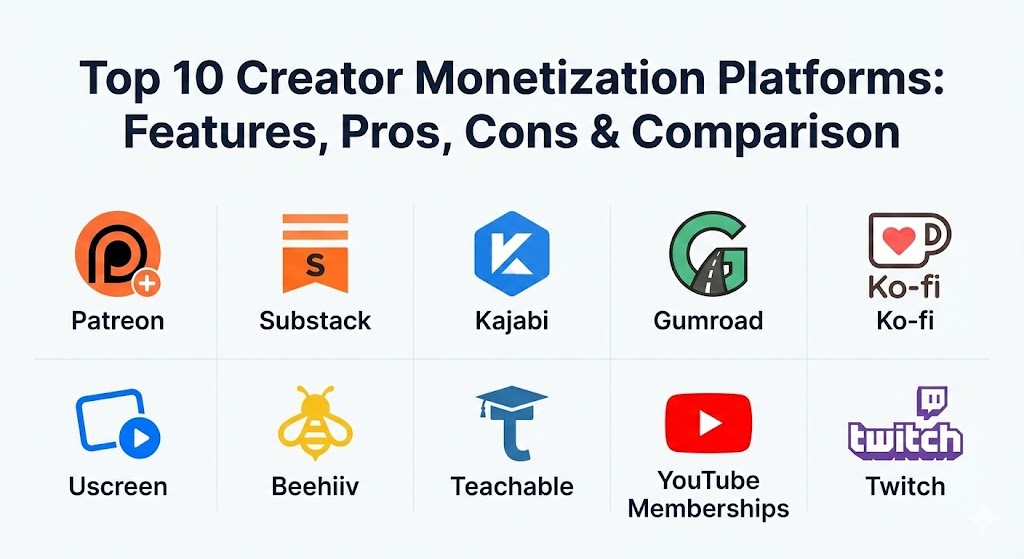
Top 10 Creator Monetization Platforms
1 — Patreon
Patreon remains the industry standard for membership-based monetization. It allows creators to set up tiered subscription levels where fans (patrons) pay a monthly fee in exchange for exclusive perks, early access, or community interaction.3
- Key features:
- Multi-tier membership levels with customizable rewards.4
- Integrated community “Lounge” for patron-only discussions.5
- Robust mobile app for on-the-go creator-fan interaction.
- Seamless integration with Discord for gated chat rooms.6
- Detailed analytics on subscriber growth and churn rates.7
- Native video hosting for premium content (Patreon Video).
- Pros:
- Massive brand recognition that builds instant trust with fans.
- Excellent for building long-term, predictable recurring revenue.8
- Cons:
- Platform fees (up to 12%) can feel steep for high earners.
- Limited “storefront” capabilities for selling one-off physical goods.
- Security & compliance: SOC 2, GDPR, and PCI DSS compliant. Includes secure payment processing via Stripe and PayPal.
- Support & community: Extensive “Creator Hub” with educational resources; active community forums and high-tier enterprise support.
2 — Substack
Substack revolutionized the newsletter industry by combining a simple blogging platform with a built-in payment gateway. It is the go-to choice for writers and journalists who want to monetize their expertise via email.
- Key features:
- Combined email newsletter and website hosting.
- Frictionless “one-click” subscription process for readers.
- Support for paid podcasts and video posts.
- “Recommendations” engine to help creators discover each other’s audiences.
- Simple dashboard for managing free vs. paid subscriber lists.
- Detailed post-level engagement and open-rate analytics.
- Pros:
- Completely free to start; you only pay when you start making money.9
- High SEO value for posts, helping with organic discovery.
- Cons:
- Takes a flat 10% cut of all revenue, which is high for large-scale operations.
- Limited design customization for the website/newsletter layout.10
- Security & compliance: GDPR compliant; SSL encryption and secure payouts via Stripe.
- Support & community: Strong documentation and “Substack Grow” workshops for aspiring writers.
3 — Kajabi
Kajabi is an all-in-one powerhouse designed for “knowledge entrepreneurs.”11 It goes far beyond simple monetization, offering a full suite of marketing and business management tools.
- Key features:
- Advanced online course builder with quizzes and certificates.
- Automated marketing funnels (Blueprints) and email sequences.
- Integrated CRM for managing lead generation and student data.
- Native mobile app for students to consume content on the go.
- Built-in website and landing page builders.
- Community product for hosting private, gated discussions.12
- Pros:
- Replaces 5–10 other tools, saving money on a fragmented tech stack.
- Exceptional for scaling a professional education or coaching business.
- Cons:
- High monthly starting price can be a barrier for beginners.
- Steeper learning curve due to the sheer number of features.
- Security & compliance: ISO 27001, SOC 2, and HIPAA (with specific configurations) compliant.
- Support & community: 24/7 “Kajabi University” support and a very active, professional user community.
4 — Gumroad
Gumroad is a minimalist e-commerce platform that allows creators to sell almost anything—from e-books and software to physical merchandise and subscriptions—with a simple link.13
- Key features:
- Super-fast setup; go from “idea to sale” in minutes.
- “Pay what you want” pricing options for donations or flexible sales.
- Automated VAT and sales tax handling for international transactions.14
- Affiliate management system to let others sell your products.
- Subscription and license key management for software creators.
- “Gumroad Discover” marketplace to help new users find your work.15
- Pros:
- The most frictionless checkout experience for digital products.
- Great for creators who want to stay lean and avoid complex site builders.
- Cons:
- Flat 10% platform fee (plus transaction fees) can be high for high-volume sellers.
- Limited built-in marketing automation compared to Kajabi or Teachable.
- Security & compliance: PCI DSS Level 1 compliant; SSL encryption for all transactions.
- Support & community: Solid documentation and an active “Gumroad University” educational series.
5 — Ko-fi
Ko-fi is a “friendly” monetization tool that started as a way for fans to “buy a coffee” for creators but has evolved into a full-featured shop and membership platform.16
- Key features:
- 0% platform fee on one-time donations (on the free plan).
- Integrated digital storefront for selling files and services.
- Commissions system for custom requests (e.g., custom art).
- Subscription membership tiers with gated content.17
- Stream alerts and goal-tracking overlays for live broadcasters.
- Direct and instant payouts to PayPal or Stripe.
- Pros:
- Lowest fees in the industry, making it perfect for beginners.
- Very low pressure; fans don’t feel forced into a subscription.
- Cons:
- Fewer advanced automation and marketing features than its rivals.
- The “coffee” branding might feel too informal for high-end professional services.
- Security & compliance: GDPR compliant; standard SSL and secure payment processing.
- Support & community: Friendly community support and clear, easy-to-follow setup guides.
6 — Uscreen
Uscreen is a video-first monetization platform that allows creators to launch their own “Netflix-style” streaming service.18 It is the premier choice for fitness, yoga, and educational video creators.
- Key features:
- Branded Video-on-Demand (VOD) library with categorization.
- Fully branded OTT apps for iOS, Android, Roku, and Apple TV.
- Live streaming capabilities with integrated chat and paywalls.
- Churn reduction tools and automated “win-back” emails.
- Gift card and coupon code management.
- In-depth video analytics (watch time, heatmaps, and retention).19
- Pros:
- Provides a premium, high-end feel that justifies higher subscription prices.
- Owning your own “TV app” is a massive differentiator for creators.
- Cons:
- Requires a significant volume of video content to be effective.
- Higher monthly fee plus per-subscriber fees can add up quickly.
- Security & compliance: SOC 2, GDPR, and PCI DSS compliant; secure SSL for all video delivery.
- Support & community: Dedicated account managers for higher tiers and a robust video marketing blog.
7 — Beehiiv
Beehiiv is the “new kid on the block” in the newsletter space, built by the early team at Morning Brew. It focuses heavily on growth tools and advanced data for serious newsletter publishers.
- Key features:
- Advanced audience segmentation and tagging.
- Built-in referral program to incentivize subscribers to share.
- “Boosts” feature to earn money by recommending other newsletters.
- Integrated ad network to easily sell space in your newsletter.20
- Custom domains and advanced styling for the web version.
- High-level analytics on acquisition sources (where subscribers come from).
- Pros:
- Far more powerful growth and referral tools than Substack.
- Flat monthly pricing (on paid tiers) rather than a percentage cut of revenue.
- Cons:
- Less “built-in” discovery for new creators compared to Substack.
- Can feel slightly more technical and overwhelming for casual writers.
- Security & compliance: GDPR compliant; SSO options for enterprise users.
- Support & community: High-quality documentation and a growing community of “growth hackers.”
8 — Teachable
Teachable is a veteran in the online course space, offering a balanced platform that is easy for instructors to set up but powerful enough to handle thousands of students.21
- Key features:
- Drag-and-drop course curriculum builder.
- Integrated quizzes, course completion certificates, and student feedback.
- Bulk student enrollment and coaching session management.
- Advanced sales page builder with conversion-focused templates.
- “Teachable BackOffice” to handle all instructor taxes and payouts.
- Support for multiple media types, including video, audio, and PDF.
- Pros:
- The most reliable “middle-ground” for creators who aren’t ready for Kajabi.
- Excellent student experience that feels professional and academic.
- Cons:
- Free plan has high transaction fees ($1 + 10%).
- Lacks the advanced “Funnel” logic of competitors like Kajabi.
- Security & compliance: PCI DSS Level 1, GDPR, and SOC 2 Type II compliant.
- Support & community: Extensive knowledge base and “Teachable:U” for learning the business of courses.
9 — YouTube Memberships
For creators already on YouTube, Channel Memberships offer a native way to monetize without forcing users to leave the platform.22
- Key features:
- Integrated directly into the YouTube player and community tab.
- Custom badges and emojis for members in live chats.
- Members-only videos, community posts, and livestreams.
- Tiered pricing (levels) ranging from $0.99 to $499.
- Easy “Join” button located right next to the “Subscribe” button.
- Automated recognition of members during livestreams (shoutouts).
- Pros:
- Zero friction; users don’t have to create a new account or enter a new credit card.
- Helps boost the YouTube algorithm by increasing “session time.”
- Cons:
- YouTube takes a massive 30% cut of all membership revenue.
- You do not own the email addresses of your members.
- Security & compliance: Managed by Google’s world-class security and compliance framework.
- Support & community: Access to the YouTube Creator Studio and global Creator Liaison.
10 — Twitch
While primarily for gamers, Twitch has become a general-interest live-streaming hub where “subs” and “bits” allow creators to earn a significant living through live interaction.23
- Key features:
- Subscription tiers ($4.99, $9.99, $24.99) with ad-free viewing.
- “Bits” (virtual currency) for “cheering” and tipping during streams.24
- Integration with Prime Gaming (one free sub per month for Amazon Prime users).
- Custom channel emotes and badges to drive community identity.
- Hype Trains and Leaderboards to gamify the donation process.
- Creator Dashboard with real-time stream and revenue metrics.
- Pros:
- The best platform for “real-time” monetization and engagement.
- “Prime Subs” allow fans to support you for free (via their Amazon Prime).
- Cons:
- Requires a massive time commitment to be live for hours a day.
- Traditional 50/50 revenue split on subs (though this is slowly changing).
- Security & compliance: HIPAA (for specific categories), GDPR, and SOC 2 compliant via Amazon/Twitch.
- Support & community: Robust help center and a massive, global community of fellow streamers.
Comparison Table
| Tool Name | Best For | Platform(s) Supported | Standout Feature | Rating (Gartner / Review) |
| Patreon | Community/Membership | Web, iOS, Android | Discord Integration | 4.6 / 5 |
| Substack | Writers/Newsletters | Web, iOS, Android | Discovery Network | 4.5 / 5 |
| Kajabi | All-in-One Business | Web, iOS, Android | Marketing Pipelines | 4.8 / 5 |
| Gumroad | Digital Product Sales | Web, Mobile | Tax/VAT Handling | 4.4 / 5 |
| Ko-fi | Low-Fee Tipping | Web | 0% Fee on Tips | 4.7 / 5 |
| Uscreen | Video Subscriptions | Web, OTT (TV) | Branded TV Apps | 4.8 / 5 |
| Beehiiv | Growth Newsletters | Web | Referral Engine | 4.6 / 5 |
| Teachable | Online Educators | Web, iOS | Tax Management | 4.4 / 5 |
| YouTube | Native YT Creators | Web, Mobile | One-Tap “Join” | 4.7 / 5 |
| Twitch | Live Streamers | Web, Mobile, Console | Prime Subscriptions | 4.5 / 5 |
Evaluation & Scoring of Creator Monetization Platforms
Selecting a platform depends on where your audience lives and what you are selling. Below is our weighted scoring rubric for 2026.
| Category | Weight | Evaluation Criteria |
| Core Features | 25% | Membership tiers, digital products, tipping, and video hosting. |
| Ease of Use | 15% | Frictionless checkout for fans and intuitive dashboard for creators. |
| Integrations | 15% | Connectivity with CRM, Email, Discord, and Analytics. |
| Security & Compliance | 10% | SSL, GDPR, tax handling, and secure payouts. |
| Performance | 10% | Uptime, video playback quality, and mobile app stability. |
| Support & Community | 10% | Educational resources, response time, and peer forums. |
| Price / Value | 15% | Revenue share percentage vs. monthly flat fees. |
Which Creator Monetization Platform Is Right for You?
The right choice depends on the maturity of your business and your primary medium of content.
- Solo Users & Beginners: Start with Ko-fi or Gumroad.25 They are low-risk, have minimal fees, and allow you to test the waters without a monthly commitment.
- Writers & Thought Leaders: If you prioritize simplicity, Substack is the winner. If you want to aggressively grow your list via referrals, Beehiiv is superior.
- Video Creators: If you already have a YouTube audience, start with YouTube Memberships.26 However, if you want to own your data and charge a premium, migrate your “best” content to Uscreen.
- Education Businesses: For single courses, Teachable is great.27 For a full-scale empire with emails, funnels, and memberships, Kajabi is the only logical choice.
- Community-Heavy Creators: Patreon remains the undisputed king of the “membership club” feel, especially for podcasters and hobbyist communities.
Frequently Asked Questions (FAQs)
1. Do I have to pay taxes on my platform earnings?
Yes. Most platforms will require you to fill out a tax form (like a W-9 in the US). Some tools, like Gumroad or Teachable, help calculate and collect VAT/Sales tax on your behalf.28
2. Can I use multiple platforms at once?
Yes, but it can be confusing. Many creators use YouTube for reach, Substack for their newsletter, and Gumroad for selling individual digital products.
3. What is “audience ownership”?
It means having access to your fans’ email addresses.29 Platforms like Substack and Kajabi allow you to download your list, whereas YouTube and Twitch keep that data for themselves.
4. Which platform has the lowest fees?
Ko-fi offers 0% fees on one-time donations.30 Beehiiv and Kajabi offer flat monthly fees, which can be cheaper than a 10% cut once you earn over a certain amount.
5. Is Managed File Transfer related to these tools?
No. While they both involve moving data, MFT is for secure enterprise data exchange, whereas Creator Platforms are for public-facing monetization and community.
6. Do I need a large following to start?
No. The “1,000 True Fans” theory proves that a small, highly engaged audience is more profitable than a million passive followers.31
7. Can I sell physical merch on these sites?
Patreon and Gumroad have some physical product support, but most creators integrate these platforms with third-party tools like Printful or Shopify.
8. How do I get paid?
Most platforms pay out via Stripe or PayPal. You can usually choose between instant payouts or monthly schedules.
9. What happens if a platform shuts down?
This is why audience ownership matters. If you own your email list (via Substack, Beehiiv, or Kajabi), you can simply move your fans to a new service.
10. Are these platforms safe from hackers?
Yes, they use bank-level encryption. However, you should always enable Two-Factor Authentication (2FA) on your creator account to protect your earnings.
Conclusion
The “best” creator monetization platform is not the one with the most features, but the one that your audience is most likely to use. In 2026, the key to success is diversification. Don’t rely solely on one platform; use a combination that allows you to own your audience while maximizing your reach.32 Whether you choose the simplicity of a “coffee” tip or the complexity of a branded TV app, the goal remains the same: turning your passion into a sustainable, independent business.