Introduction
Contract analytics refers to the process of using software to extract, analyze, and visualize data points from within a contract repository. Unlike traditional digital storage, which treats a contract as a simple PDF, analytics tools “read” the document to identify key clauses, expiration dates, termination rights, and financial obligations. By centralizing this data, organizations can move from reactive firefighting to proactive strategy, ensuring they never miss a renewal or fall out of compliance with changing regulations.
The importance of these tools has skyrocketed as data privacy laws (like GDPR) and economic volatility demand faster response times from legal and procurement teams. Key real-world use cases include identifying force majeure clauses during global disruptions, auditing thousands of legacy contracts during a merger, and tracking spend against contractual discounts. When evaluating tools, users should look for high OCR (Optical Character Recognition) accuracy, the ability to train the AI on custom clauses, and seamless integration with existing CRM and ERP ecosystems.
Best for: General Counsel (GC), legal operations teams, procurement managers, and finance departments in mid-market to enterprise-level organizations. It is especially beneficial for industries with high contract volumes, such as healthcare, technology, manufacturing, and financial services.
Not ideal for: Small businesses with fewer than 50 active contracts or simple, one-off agreements. In these cases, a basic spreadsheet or a standard cloud storage folder with manual tagging is usually more cost-effective than an advanced AI-driven analytics suite.
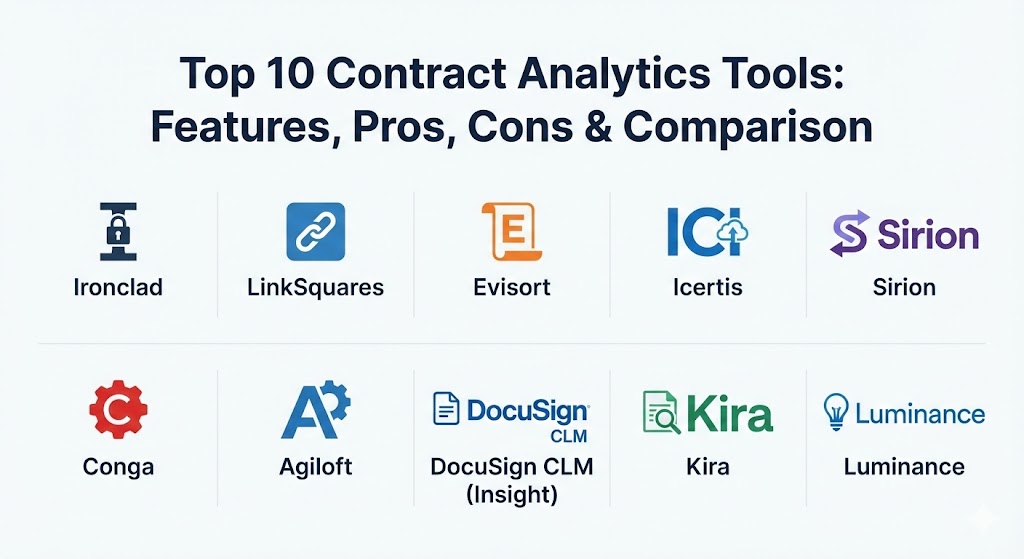
Top 10 Contract Analytics Tools
1 — Ironclad
Ironclad is a leading Contract Lifecycle Management (CLM) platform that places a heavy emphasis on “Contract Intelligence.” Its analytics engine is designed to help legal teams turn their repository into a searchable, dynamic database.
- Key features:
- Ironclad Insights for real-time data visualization and custom reporting.
- AI-powered metadata extraction that identifies over 190 contract properties.
- Smart repository with full-text search and OCR for legacy paper documents.
- Dynamic “Playbooks” that flag non-standard language during negotiations.
- Integration with Salesforce, Slack, and Coupa for cross-functional visibility.
- Automated alerts for key milestones like expirations and auto-renewals.
- Pros:
- One of the most modern and intuitive user interfaces on the market.
- Exceptional community support and “Legal Ops” focused features.
- Cons:
- Can be expensive for smaller organizations looking only for analytics.
- Setup for complex custom workflows requires a dedicated administrative lead.
- Security & compliance: SOC 2 Type II, HIPAA, GDPR, and ISO 27001 compliant. Includes SSO and AES-256 encryption.
- Support & community: Extensive documentation, Ironclad Academy, and a vibrant “Ironclad Community” for legal ops professionals.
2 — LinkSquares
LinkSquares is known for its high-speed AI that specializes in post-signature contract analysis. It is designed to give legal teams instant answers to complex business questions without manual review.
- Key features:
- “LinkSquares Analyze” module for automated data extraction and risk assessment.
- High-performance OCR that handles low-quality scans and images.
- Global search across the entire repository using natural language queries.
- Customizable dashboards for tracking liability, governing law, and more.
- Bulk actions for updating metadata or tagging large groups of files.
- Automated renewal and obligation tracking with email notifications.
- Pros:
- Known for very high accuracy rates in AI extraction out of the box.
- Implementation time is generally faster than broader, complex CLM suites.
- Cons:
- The “Finalize” (pre-signature) module is separate and may require additional licensing.
- Reporting can be less granular than some high-end enterprise competitors.
- Security & compliance: SOC 2 Type II, HIPAA, and GDPR. Data is encrypted both in transit and at rest.
- Support & community: Dedicated customer success managers and a comprehensive online help center.
3 — Evisort (by Workday)
Evisort was one of the first “AI-native” contract tools and was recently acquired by Workday. It is built to analyze contracts at a massive scale, often processing thousands of documents in minutes.
- Key features:
- Proprietary AI trained on over 10 million contracts for deep contextual understanding.
- No-code AI training, allowing users to teach the system new clauses without IT help.
- Portfolio-wide risk scoring that highlights deviations from company standards.
- Automated document summaries for quick executive reviews.
- Seamless integration with Workday, Salesforce, and Microsoft 365.
- Multi-currency and multi-language support for global operations.
- Pros:
- Superior at handling messy, disorganized legacy contract data.
- Does not require contracts to be created in the system to analyze them effectively.
- Cons:
- Pricing is strictly enterprise-level and can be opaque for newcomers.
- Integration with non-Workday systems may be less prioritized post-acquisition.
- Security & compliance: ISO 27001, ISO 27701, SOC 2 Type II, and GDPR compliant.
- Support & community: Strong enterprise support with 24/7 technical assistance and digital training resources.
4 — Icertis Contract Intelligence (ICI)
Icertis is the “heavyweight” of the industry, offering deep, vertical-specific analytics for the world’s largest corporations. It focuses on turning contracts into strategic business assets.
- Key features:
- Icertis “DiscoverAI” for high-volume legacy data ingestion and mapping.
- Advanced obligation management that tracks performance against contract terms.
- Sector-specific AI models (e.g., Healthcare, Manufacturing, Public Sector).
- Integrated risk management that monitors third-party data and sanctions.
- Highly configurable dashboards for executive-level KPIs.
- Governance and compliance tracking for multi-national regulatory shifts.
- Pros:
- Unmatched scalability for organizations with millions of active contracts.
- Deepest “enterprise-grade” features for compliance and governance.
- Cons:
- Steep learning curve and potentially long implementation times.
- The interface can feel “cluttered” due to the sheer number of features.
- Security & compliance: FIPS 140-2, SOC 1/2, HIPAA, GDPR, and ISO certifications.
- Support & community: Global professional services and an extensive network of implementation partners.
5 — Sirion (formerly SirionLabs)
Sirion focuses on “360-degree” contract visibility, merging contract analytics with actual performance data from invoices and service level agreements (SLAs).
- Key features:
- AI-driven extraction of clauses, tables, and financial data.
- Automated invoice reconciliation against contractual price lists.
- Performance monitoring that tracks SLAs and milestones in real time.
- Contract value leakage detection to identify missed savings.
- Integrated risk scoring and deviation flagging during the drafting phase.
- Natural Language Processing (NLP) for conversational search queries.
- Pros:
- Unique focus on post-signature commercial management and “revenue leakage.”
- Excellent for complex service-based contracts with many moving parts.
- Cons:
- May be “over-featured” for legal teams only interested in simple clause search.
- Implementation requires significant data cleanup of existing invoices/SLAs.
- Security & compliance: SOC 2 Type II, ISO 27001, GDPR, and HIPAA.
- Support & community: High-touch customer support and a dedicated “Sirion University” for user training.
6 — Conga Contract Intelligence
Conga (which acquired Apttus) provides a powerful analytics engine that integrates natively with Salesforce. It is a top choice for sales-heavy organizations.
- Key features:
- AI-powered data extraction that syncs directly with Salesforce records.
- Automated risk reports that compare incoming contracts against pre-set playbooks.
- Clause library that suggests “fallback” language based on past performance.
- Unified view of customer health, combining contract terms with CRM data.
- Bulk migration tools for cleaning and organizing legacy data repositories.
- Customizable alerts for contract health and upcoming negotiations.
- Pros:
- The best option for organizations already “all-in” on the Salesforce ecosystem.
- Provides a very strong “buy-side” and “sell-side” unified view.
- Cons:
- The administrative back-end can be complex and requires Salesforce expertise.
- Some legacy components (like X-Author) can be prone to technical glitches.
- Security & compliance: SOC 2, HIPAA, GDPR, and various regional data residency certifications.
- Support & community: Large user base, extensive third-party consultant network, and online community forums.
7 — Agiloft
Agiloft is famous for its highly customizable “no-code” platform. Its analytics capabilities allow users to build precisely the reporting structures they need without calling a developer.
- Key features:
- AI Core that automates metadata extraction and clause classification.
- Fully customizable dashboards with drag-and-drop reporting widgets.
- Advanced search that supports Boolean logic and wildcard parameters.
- Integration with Microsoft Word for AI-assisted redlining.
- Automated workflow routing based on extracted contract value or risk.
- Multi-tenant architecture for managing different business units separately.
- Pros:
- Extreme flexibility; the system can be molded to any specific business process.
- Strong “value for money” given the breadth of the platform.
- Cons:
- The user interface, while improved, can still feel a bit “utilitarian.”
- Requires a dedicated internal “admin” to manage the extensive customizations.
- Security & compliance: SOC 2, HIPAA, GDPR, and FIPS-ready encryption options.
- Support & community: Highly rated support team and a robust training program via Agiloft University.
8 — DocuSign CLM (Insight)
DocuSign, the leader in e-signature, offers “DocuSign Insight” as its advanced analytics engine. It is designed to help users understand what they are signing and what they have signed in the past.
- Key features:
- AI-powered search that finds concepts, not just keywords (e.g., searching for “indemnity”).
- Comprehensive risk scoring across the entire contract portfolio.
- Automated extraction of over 100 common contract terms.
- Seamless integration with DocuSign eSignature for a frictionless flow.
- Bulk document comparison to identify variations across a template.
- Policy-driven alerts for non-compliant clauses in incoming documents.
- Pros:
- Unmatched brand trust and ease of adoption for existing DocuSign users.
- Very strong conceptual search capabilities that reduce manual reading time.
- Cons:
- Analytics features are often sold as separate “Insight” modules.
- Can be one of the more expensive options at scale.
- Security & compliance: FedRAMP, SOC 2, ISO 27001, HIPAA, and GDPR.
- Support & community: World-class enterprise support and a massive global partner ecosystem.
9 — Kira (by Litera)
Kira is widely considered the gold standard for M&A (mergers and acquisitions) due diligence and high-volume contract review. It is a “pure-play” analytics powerhouse.
- Key features:
- Over 1,400 built-in “smart fields” for instant data extraction.
- “Quick Study” tool to train the AI on proprietary or niche clauses in minutes.
- Detailed project management dashboards for large-scale review teams.
- Export-ready data summaries in Excel, PDF, or Word.
- Integration with leading law firm project management tools.
- Superior handling of complex document structures and tables.
- Pros:
- The fastest tool for “one-off” massive review projects (e.g., a merger).
- Extremely high accuracy in identifying obscure legal provisions.
- Cons:
- Less focused on “lifecycle” management (drafting/signing) than other tools.
- Pricing is often project-based or high-volume based, making it niche.
- Security & compliance: SOC 2 Type II, ISO 27001, and GDPR compliant.
- Support & community: High-quality technical support and deep expertise in the legal/M&A space.
10 — Luminance
Luminance is a UK-based “Legal-Grade” AI that uses a unique “probabilistic consensus” model to ensure extreme accuracy in contract analysis and discovery.
- Key features:
- AI that reads and understands contracts in over 80 languages.
- “Luminance Diligence” for M&A and “Luminance Corporate” for everyday legal.
- Automatic anomaly detection that flags “outlier” contracts in a repository.
- Real-time collaboration tools for internal and external legal teams.
- Integration with Microsoft 365 and various VDR (Virtual Data Room) providers.
- Visual data mapping of the entire contractual landscape.
- Pros:
- Excellent for global companies dealing with multi-lingual agreements.
- Very strong at finding “hidden” risks that standard keyword search misses.
- Cons:
- Steeper onboarding process compared to “plug-and-play” SaaS tools.
- Primarily focused on the legal/discovery aspect rather than procurement operations.
- Security & compliance: ISO 27001, SOC 2, and rigorous data anonymization protocols.
- Support & community: 24/7 global support and a dedicated account management model.
Comparison Table
| Tool Name | Best For | Platform(s) Supported | Standout Feature | Rating (Gartner) |
| Ironclad | Modern Legal Ops | Cloud / SaaS | Ironclad Insights | 4.5 / 5 |
| LinkSquares | Post-Signature Speed | Cloud / SaaS | High-Speed AI Extraction | 4.6 / 5 |
| Evisort | Enterprise Scale | Cloud / Workday | No-Code AI Training | 4.5 / 5 |
| Icertis | Global Conglomerates | Cloud / Microsoft | Industry-Specific AI | 4.4 / 5 |
| Sirion | Performance Tracking | Cloud / SaaS | Revenue Leakage Audit | 4.4 / 5 |
| Conga | Salesforce Users | SaaS / Salesforce | CRM Native Integration | 4.2 / 5 |
| Agiloft | Customization | Cloud / On-Prem | No-Code Flexibility | 4.6 / 5 |
| DocuSign Insight | Conceptual Search | Cloud / SaaS | eSignature Integration | 4.3 / 5 |
| Kira | M&A Due Diligence | Cloud / SaaS | 1,400+ Smart Fields | 4.5 / 5 |
| Luminance | Multi-lingual Risk | Cloud / SaaS | Anomaly Detection | 4.4 / 5 |
Evaluation & Scoring of Contract Analytics Tools
To help you decide, we have evaluated these tools across seven key dimensions using a weighted scoring model.
| Criteria | Weight | Evaluation Highlights |
| Core Features | 25% | Extraction accuracy, OCR quality, and metadata management. |
| Ease of Use | 15% | Intuitiveness of UI and the learning curve for non-legal users. |
| Integrations | 15% | Strength of CRM, ERP, and e-signature ecosystem connectivity. |
| Security & Compliance | 10% | Certifications (SOC2/ISO) and data encryption standards. |
| Performance | 10% | System speed when processing thousands of documents. |
| Support & Community | 10% | Quality of documentation and customer success responsiveness. |
| Price / Value | 15% | ROI relative to the complexity and volume of contracts. |
Which Contract Analytics Tool Is Right for You?
Selecting the right tool depends on your organization’s specific “pain points” and technical maturity.
- Solo Users vs SMBs: If you are a small team, avoid the heavy enterprise suites. Look for tools like LinkSquares or the basic tiers of Agiloft that offer high value without requiring a year-long implementation.
- Mid-Market Companies: This is the “sweet spot” for tools like Ironclad. You need a tool that grows with you and offers a modern experience for your sales and finance teams.
- Enterprise Giants: If you are managing a global portfolio with deep regulatory needs, Icertis or Evisort (Workday) are the leading choices due to their scalability and multi-layered security.
- M&A and Project-Based Needs: If your goal is a massive, one-time audit (like a merger or a GDPR review), Kira or Luminance are the specialized surgical tools designed for that exact mission.
- CRM-Centric Teams: If your company “lives” in Salesforce, choosing Conga provides a level of data synchronization that is difficult to replicate with third-party connectors.
Frequently Asked Questions (FAQs)
1. What is the difference between CLM and Contract Analytics?
CLM (Contract Lifecycle Management) covers the whole journey from drafting to signing. Contract Analytics is a specific capability within (or separate from) CLM that focuses on extracting and interpreting the data inside those contracts.
2. Can these tools read scanned PDF files?
Yes, most top-tier tools use advanced OCR (Optical Character Recognition) to convert “flat” images or low-quality scans into searchable text for the AI to analyze.
3. Do I need to be a lawyer to use contract analytics?
No. While legal teams define the “rules,” the dashboards and reports are designed for procurement, sales, and finance users to find the information they need without waiting for legal review.
4. How accurate is the AI in these tools?
Accuracy varies by vendor but typically ranges from 85% to 95% out of the box. Most systems allow for “human-in-the-loop” verification to reach near-perfect accuracy for critical data points.
5. Is contract analytics software secure?
Yes, enterprise-grade tools prioritize security, offering SOC 2 Type II compliance, encryption at rest and in transit, and role-based access controls to protect sensitive legal data.
6. Can I train the AI to find unique clauses specific to my industry?
Yes. Tools like Evisort and Kira offer “user-trainable AI” where you can provide examples of a unique clause, and the system learns how to find it across your entire repository.
7. How long does implementation take?
It ranges from a few weeks for simpler SaaS tools to six months or more for full-scale enterprise deployments involving legacy data cleanup.
8. What is “Metadata” in a contract?
Metadata is the “data about the data.” In a contract, this includes the counterparty name, the effective date, the total contract value, and the governing law.
9. Will contract analytics replace legal teams?
No. These tools are meant to augment legal professionals by handling the “grunt work” of data extraction, allowing lawyers to focus on high-value advisory work and negotiation.
10. Do these tools support languages other than English?
Many do. Tools like Luminance and Icertis have robust support for dozens of languages, allowing global companies to analyze international agreements in one place.
Conclusion
Contract analytics tools have transitioned from a “nice-to-have” luxury to a fundamental requirement for the modern enterprise. By choosing a tool that aligns with your volume, industry, and existing software stack, you can turn your legal department from a bottleneck into a strategic data hub. Whether you prioritize the “no-code” flexibility of Agiloft, the Salesforce-native power of Conga, or the high-speed intelligence of LinkSquares, the goal remains the same: total visibility over the promises your company has made and received.