Introduction
A Consumer Loan Origination System (LOS) is a centralized software platform designed to automate and streamline the lifecycle of a consumer loan. Whether a borrower is seeking an auto loan, a personal line of credit, or a credit card, the LOS provides the framework for lenders to ingest data, assess risk via integrated credit bureaus, and ensure compliance with ever-changing federal and state regulations. By replacing manual data entry and fragmented spreadsheets with automated workflows, an LOS reduces the “time-to-money,” which is the single most important factor for modern borrowers.
The importance of a robust LOS cannot be overstated in a high-interest-rate environment where margins are thin and consumer expectations are high. Key real-world use cases include instant “buy now, pay later” (BNPL) decisioning at point-of-sale, automated “indirect” lending for car dealerships, and omnichannel application processing where a user starts a loan on their phone and finishes it with a branch officer. When evaluating these tools, organizations must look for high levels of API connectivity, modularity to support different loan products, and advanced AI/ML capabilities for alternative credit scoring.
Best for: Commercial banks, credit unions, digital-first fintechs, and retail lenders who need to scale their lending volume while maintaining a low overhead and a high degree of regulatory compliance.
Not ideal for: Micro-lenders with extremely low volume who can manage via basic manual processing, or peer-to-peer platforms that require highly bespoke, internally developed algorithmic engines that don’t fit standard software-as-a-service (SaaS) models.
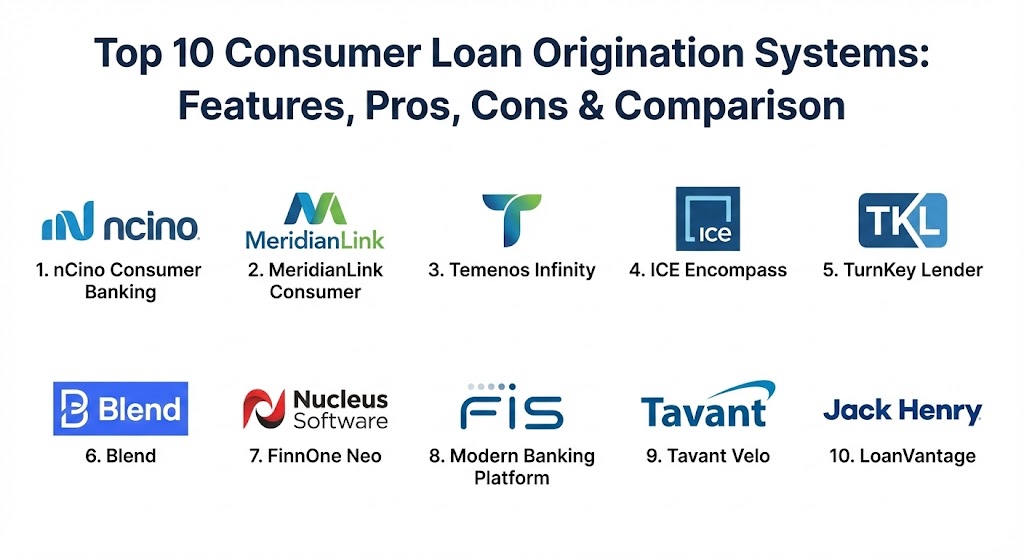
Top 10 Consumer Loan Origination Systems Tools
1 — nCino Consumer Banking
nCino is a global leader in cloud banking, built entirely on the Salesforce platform. It provides a seamless “single pane of glass” experience that connects the borrower, the loan officer, and the back-office credit team in one unified ecosystem.
- Key features:
- Built on Salesforce, offering unmatched CRM integration and data visibility.
- Automated document tracking and a secure customer portal for document uploads.
- Configurable credit memo generation and automated decisioning workflows.
- Integration with major credit bureaus and alternative data providers.
- Omnichannel application experience (mobile, web, and in-person).
- Robust analytics and reporting via nCino IQ (AI-driven insights).
- Pros:
- Unrivaled scalability for large financial institutions.
- Extremely high levels of customization due to the Salesforce foundation.
- Cons:
- Implementation is a significant undertaking that often requires specialized consultants.
- Pricing is at the premium end of the market, making it less accessible for small credit unions.
- Security & compliance: SOC 2 Type II, GDPR, CCPA, and Salesforce-backed encryption standards. Includes comprehensive audit trails for every user action.
- Support & community: Extensive documentation via the nCino Community portal, dedicated success managers for enterprise clients, and a global network of certified implementation partners.
2 — MeridianLink Consumer
MeridianLink is a staple in the North American lending market, particularly among credit unions. It is known for its “MeridianLink One” philosophy, which aims to unify the entire lending and account opening experience.
- Key features:
- Highly automated decisioning engine with customizable “rule-based” logic.
- Seamless integration with over 200+ third-party service providers.
- Integrated cross-selling engine that suggests additional products to borrowers.
- Support for multiple loan types, including auto, personal, and credit card.
- Automated document generation and electronic signature integration.
- Cloud-based architecture with high uptime and reliability.
- Pros:
- Excellent balance of features and ease of use for mid-market institutions.
- The vendor ecosystem is one of the most mature in the industry.
- Cons:
- The user interface for administrators can feel slightly dated compared to “fintech-first” rivals.
- Customization can be limited if you want to stray far from their standard workflows.
- Security & compliance: SOC 2, PCI DSS compliant, and regular third-party vulnerability assessments.
- Support & community: Strong user community with regular regional user groups and a dedicated customer support portal.
3 — Temenos Infinity
Temenos is a global banking software powerhouse. Their Infinity platform is a digital banking product that includes a highly sophisticated, cloud-native loan origination component designed for high-volume, digital-first lending.
- Key features:
- Composable banking architecture, allowing lenders to pick and choose specific modules.
- AI-driven “Explainable AI” (XAI) for transparent credit decisioning.
- Support for global multi-currency and multi-language lending operations.
- Real-time integration with core banking systems via open APIs.
- Automated KYC (Know Your Customer) and AML (Anti-Money Laundering) checks.
- Advanced journey analytics to identify where borrowers drop off in the application.
- Pros:
- Exceptionally modern, cloud-native tech stack that is built for the future.
- Best-in-class for international banks operating across different regulatory regimes.
- Cons:
- Can be overly complex for localized US community banks.
- Requires a high level of internal technical expertise to manage the “composable” nature.
- Security & compliance: ISO 27001, GDPR, SOC 2, and localized compliance modules for over 150 countries.
- Support & community: Global 24/7 support, extensive developer portal (Temenos Base Camp), and a massive global user base.
4 — ICE Encompass (Consumer Connect)
While primarily known for mortgages, ICE Mortgage Technology (formerly Ellie Mae) has expanded its Encompass platform to handle a wider array of consumer lending products through Consumer Connect.
- Key features:
- Single platform for both mortgage and high-value consumer loans.
- Deep integration with the ICE data ecosystem for valuation and credit.
- Automated task management and lead distribution for loan officers.
- Secure borrower portal with mobile-responsive design.
- Comprehensive compliance engine that monitors for state and federal changes.
- Robust e-closing and e-vaulting capabilities.
- Pros:
- If an institution already uses Encompass for mortgages, the consumer add-on provides massive operational synergy.
- Industry-leading compliance updates.
- Cons:
- Can feel “mortgage-centric,” which may add unnecessary steps for simple personal loans.
- Licensing can be expensive and complex.
- Security & compliance: SOC 2 Type II, FIPS 140-2 encryption, and rigorous penetration testing.
- Support & community: Massive user community, annual “Experience” conference, and a dedicated support desk.
5 — TurnKey Lender
TurnKey Lender is a modern, AI-first platform that is designed to be “ready-to-use” out of the box. It is particularly popular among fintechs and non-traditional lenders who need to get to market quickly.
- Key features:
- Proprietary AI-driven credit scoring engine that uses alternative data.
- Fully automated, end-to-end lending lifecycle management.
- White-label borrower portal with an emphasis on “one-click” applications.
- Support for “embedded finance” where lending is integrated into non-financial websites.
- Built-in servicing module (not just origination).
- Drag-and-drop workflow editor for non-technical users.
- Pros:
- One of the fastest implementation times in the industry.
- The AI scoring is highly effective for “thin-file” or subprime borrowers.
- Cons:
- May lack the “deep banking” features required by massive, legacy institutions.
- Support for complex, multi-tiered commercial-style consumer loans is thinner.
- Security & compliance: ISO 27001, SOC 2 Type II, GDPR, and PCI DSS.
- Support & community: Strong online documentation and a responsive digital support team.
6 — Blend
Blend is famous for revolutionizing the borrower experience. It acts as a digital “wrapper” that sits on top of legacy core systems to provide a high-end, modern interface for consumers.
- Key features:
- Consumer-grade UI/UX that feels like a modern mobile app.
- One-tap data connectivity to verify income, assets, and employment.
- “Co-pilot” mode allows loan officers to see exactly what the borrower sees in real-time.
- Intelligent “pre-fill” of applications to reduce friction.
- Cross-sell triggers based on real-time data analysis.
- Support for personal loans, auto, and deposit account opening.
- Pros:
- Borrower conversion rates are typically much higher than traditional systems.
- Rapid deployment that doesn’t require replacing your core banking system.
- Cons:
- It is often a “front-end” solution, meaning you still need a back-end system to handle some accounting tasks.
- Per-application pricing can become costly as volume grows.
- Security & compliance: SOC 2 Type II, HIPAA (if relevant), and CCPA. Uses advanced data masking for sensitive fields.
- Support & community: High-touch customer success teams and an excellent help center for end-users.
7 — Nucleus Software FinnOne Neo
FinnOne Neo is a dominant player in the Asian and African markets and has been making significant inroads into the West. It is built for massive scale and multi-product lending.
- Key features:
- Support for a vast array of loan products: auto, home, personal, education, and gold loans.
- Advanced rule-based engine for credit appraisal and risk grading.
- Integrated document management with optical character recognition (OCR).
- Mobile-first “Lending-on-the-go” apps for field officers.
- Comprehensive debt collection and recovery module integrated with the LOS.
- Highly configurable dashboards for executive-level visibility.
- Pros:
- Unmatched product breadth; can handle virtually any loan type.
- Proven at massive scale with some of the world’s largest banks.
- Cons:
- The sheer number of options can lead to a “configuration nightmare” without proper planning.
- The UI is functional but can feel corporate and dense.
- Security & compliance: ISO 27001, PCI DSS, and localized compliance for dozens of global jurisdictions.
- Support & community: Global 24/7 support and a well-established professional services team.
8 — FIS Modern Banking Platform (LOS)
FIS is a titan of the financial world. Their modern LOS is part of a broader banking suite designed for large-scale institutional reliability and deep integration into the FIS ecosystem.
- Key features:
- Native integration with FIS core systems (Horizons, IBS).
- Real-time data synchronization between the LOS and the general ledger.
- Automated compliance monitoring via the FIS regulatory suite.
- Support for high-volume batch processing and real-time decisioning.
- Integrated fraud detection and identity verification.
- Scalable cloud or on-premise deployment options.
- Pros:
- The ultimate “safe” choice for large, traditional banks.
- No one matches FIS for deep regulatory and fraud integration.
- Cons:
- Can be slow to innovate compared to agile fintech rivals.
- The sales and implementation cycles are notoriously long.
- Security & compliance: FFIEC regulated, SOC 1/2/3, ISO 27001, and global data privacy standards.
- Support & community: World-class enterprise support with dedicated on-site teams for large installations.
9 — Tavant Velo
Tavant is a tech-centric player that focuses on modularity and AI. Their Velo platform is designed for lenders who want to pick and choose specific components of the lending journey.
- Key features:
- Modular “Lending-as-a-Service” architecture.
- Advanced ML models for propensity modeling and churn prediction.
- “FinLeads” module for high-performance lead management.
- Seamless integration with third-party data providers via a unified API gateway.
- High-speed automated underwriting for simple consumer products.
- Dynamic document generation based on borrower data.
- Pros:
- Excellent for lenders who want to build a “custom” experience using modular parts.
- The AI insights are more actionable than simple “yes/no” decisioning.
- Cons:
- Not as well-known as the legacy brands, which can be a hurdle for conservative boards.
- Requires a degree of technical maturity to manage the API-first approach.
- Security & compliance: SOC 2 Type II, GDPR, and rigorous internal audit protocols.
- Support & community: Strong focus on “partnership” support with dedicated engineering resources.
10 — Jack Henry LoanVantage
Jack Henry is the primary partner for thousands of community banks across the US. LoanVantage is their flagship lending platform that emphasizes the “relationship-based” lending model.
- Key features:
- Tailored for the specific needs of community banks and regional credit unions.
- Integrated financial statement analysis and spreading for small business/consumer hybrid loans.
- Native integration with Jack Henry core platforms (SilverLake, CIF 20/20).
- Simple, streamlined application portal for borrowers.
- Comprehensive exception tracking and document management.
- Built-in compliance checkpoints for consumer disclosure regulations.
- Pros:
- Perfect for institutions where “personal service” is the primary value proposition.
- Very high customer satisfaction among existing Jack Henry core users.
- Cons:
- Not designed for high-frequency, global digital lending.
- Features are more traditional; lacks the cutting-edge “alternative data” AI of fintech rivals.
- Security & compliance: FFIEC compliant, SOC 2, and localized US state regulatory modules.
- Support & community: Highly praised US-based support team and a very active user community focused on community banking.
Comparison Table
| Tool Name | Best For | Platform(s) Supported | Standout Feature | Rating (Gartner/TrueReview) |
| nCino | Enterprise Banks | Cloud (Salesforce) | Unmatched Customization | 4.6 / 5 |
| MeridianLink | Mid-market CUs | Cloud / Web | Mature Partner Ecosystem | 4.4 / 5 |
| Temenos Infinity | Global / Digital-First | Cloud-Native / Web | Explainable AI (XAI) | 4.5 / 5 |
| ICE Encompass | Mortgage-Heavy Firms | Cloud / Windows | Industry-Leading Compliance | 4.3 / 5 |
| TurnKey Lender | Fintechs / SMEs | Cloud / SaaS | AI Credit Scoring | 4.7 / 5 |
| Blend | Borrower UX | Cloud / Mobile | One-Tap Verifications | 4.8 / 5 |
| FinnOne Neo | Multi-Product High Vol | Cloud / On-Prem | 24/7 Field App | 4.4 / 5 |
| FIS Modern | Tier-1 Institutions | Cloud / Hybrid | FFIEC-Level Security | 4.2 / 5 |
| Tavant Velo | Modular Tech Teams | API-First / Cloud | ML Propensity Modeling | 4.5 / 5 |
| Jack Henry | Community Banks | Cloud / Hybrid | Spreading & Analysis | 4.4 / 5 |
Evaluation & Scoring of Consumer Loan Origination Systems
Selecting an LOS requires a rigorous objective framework. The following weighted scoring rubric is used by modern IT procurement teams to ensure all critical business needs are met.
| Category | Weight | Evaluation Criteria |
| Core Features | 25% | Application intake, credit decisioning, document generation, and funding. |
| Ease of Use | 15% | UX for borrowers and UI for loan officers/back-office staff. |
| Integrations | 15% | Breadth of API support and compatibility with existing core banking systems. |
| Security | 10% | Encryption, SOC 2 compliance, audit trails, and multi-factor authentication. |
| Performance | 10% | Uptime, system latency, and ability to handle peak application volumes. |
| Support | 10% | Quality of documentation, speed of response, and community resources. |
| Price / Value | 15% | Transparency of licensing and TCO (Total Cost of Ownership) over 5 years. |
Which Consumer Loan Origination System Tool Is Right for You?
The “perfect” LOS is a moving target that depends heavily on your institution’s size, your technical debt, and your growth strategy.
- Solo Fintech Founders vs. Early-Stage Fintechs: If you are a startup looking to launch a lending product in weeks rather than months, TurnKey Lender is your best bet. It provides the “full stack” without requiring you to build the engine from scratch.
- Small Credit Unions & Community Banks: For institutions where the staff wears many hats, ease of use and local support are paramount. Jack Henry LoanVantage and MeridianLink are the dominant choices here because they understand the community banking ethos and have pre-built integrations with the most common cores.
- Mid-Market Lenders: If you are looking to aggressively grow your borrower base, Blend is the most effective “front-end” to drive conversions, while nCino provides the most powerful back-end if you are already invested in the Salesforce ecosystem.
- Enterprise & Global Banks: Massive institutions with hundreds of branches and millions of customers require FIS or Temenos. These platforms are built for the complexity of multi-country regulations and high-concurrency environments that would crush smaller systems.
- Modularity and Innovation: If your internal IT team is strong and you want to build a unique, “best-of-breed” stack, Tavant Velo offers the modularity to build a custom lending engine without the “all-or-nothing” lock-in of traditional legacy suites.
Frequently Asked Questions (FAQs)
1. What is the difference between an LOS and a Loan Servicing System?
The LOS manages the “birth” of a loan—from application to funding. Once the money is in the borrower’s hands, the Loan Servicing System takes over to manage payments, interest, escrow, and collections.
2. Can these systems handle both consumer and commercial loans?
Some platforms (like nCino and Filevine) are designed for both. However, consumer lending is usually high-volume/low-complexity, while commercial lending is low-volume/high-complexity. Using a specialized consumer LOS is often more efficient.
3. Do these tools integrate with alternative credit data?
Yes, modern LOS platforms like TurnKey Lender and Temenos integrate with “alternative” data providers (like rent payments, utility bills, or bank transaction history) to score borrowers with no formal credit history.
4. How long does a typical implementation take?
Implementation can range from 3 months for a “plug-and-play” cloud LOS to 18+ months for a major core conversion at a Tier-1 bank involving millions of records.
5. How do these systems help with regulatory compliance?
They have “compliance engines” that automatically update disclosure forms (like TRID or TILA) whenever laws change. They also enforce mandatory “waiting periods” and provide immutable audit logs for regulators.
6. Is a cloud-based LOS as secure as an on-premise one?
In many cases, cloud-based systems are more secure because vendors like Microsoft (Azure) and Salesforce spend billions on security that individual banks cannot match. However, “On-Prem” is still preferred by some institutions for data sovereignty reasons.
7. What is “Omnichannel” lending?
It means a borrower can start an application on a smartphone, continue it on a laptop at home, and walk into a branch to sign papers, with the data following them seamlessly across all touchpoints.
8. Can an LOS help reduce “Application Drop-off”?
Yes. Tools like Blend use “instant verification” to pull data directly from employers and banks, meaning the borrower doesn’t have to go find paper paystubs. This drastically increases the completion rate.
9. Do I need to replace my Core Banking System to use a new LOS?
No. Most modern LOS platforms are designed to sit “on top” of your core. They communicate via APIs or batch files to update the general ledger once a loan is funded.
10. What is the cost model for most LOS software?
It is typically a “SaaS” model where you pay an annual platform fee plus a “per-application” or “per-funded-loan” fee. This allows the cost to scale up or down based on your lending volume.
Conclusion
Selecting a Consumer Loan Origination System is one of the most consequential decisions a financial executive will make. The right system does not just process paperwork—it defines the customer experience and the firm’s risk profile. As we move deeper into 2026, the trend is clear: the winners in the lending space will be those who prioritize high-speed automation and seamless digital experiences over manual, legacy-heavy processes. Focus on a system that offers the best balance of “Time to Market,” “Compliance Rigor,” and “Borrower UX” for your specific audience.