Introduction
Collections automation tools are specialized software platforms designed to streamline and digitize the accounts receivable (AR) and debt recovery process. By integrating directly with an organization’s ERP (Enterprise Resource Planning) or accounting system, these tools automate the repetitive tasks of sending payment reminders, prioritizing follow-ups based on risk, and providing a self-service portal for customers to settle their debts.
The importance of these tools lies in their ability to significantly reduce Days Sales Outstanding (DSO)—the average number of days it takes for a company to get paid after a sale. In a volatile economy, reducing DSO by even a few days can unlock millions in working capital. Key real-world use cases include automating dunning (collections) sequences for thousands of customers simultaneously, using AI to predict which clients are likely to default, and providing a centralized “shared inbox” so that sales and finance can collaborate on customer disputes without information silos. When evaluating these tools, users should look for deep ERP integration, multi-channel communication (email, SMS, mail), and robust reporting that provides real-time visibility into the aging of receivables.
Best for: Finance teams, Credit Managers, and CFOs in B2B companies ranging from fast-growing startups to global enterprises. They are essential for industries with high transaction volumes, complex billing cycles, or international operations requiring multi-currency support.
Not ideal for: B2C retail businesses where payments are collected at the point of sale (POS) or micro-businesses with fewer than 10-20 active invoices per month, where manual follow-up is still manageable and software costs might exceed the recovery benefits.
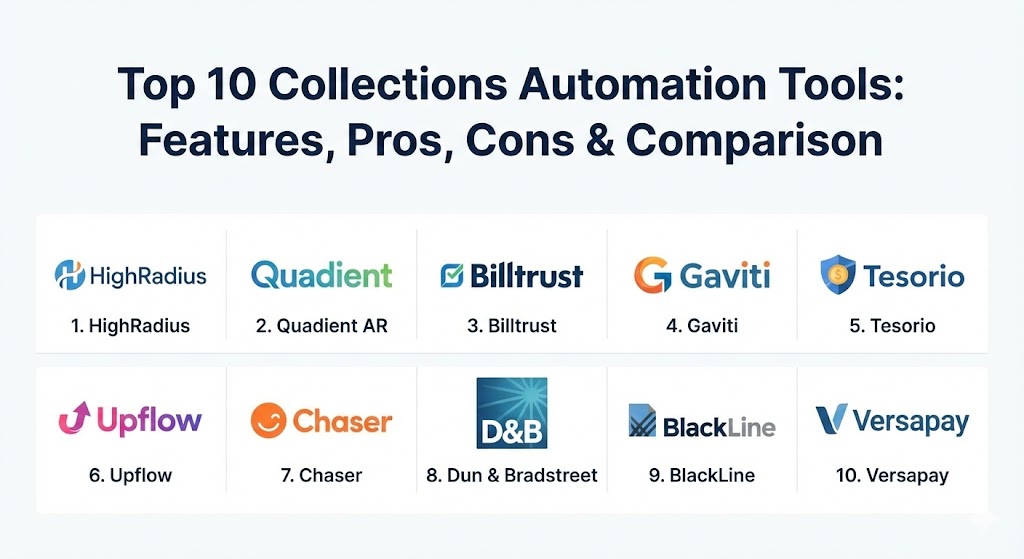
Top 10 Collections Automation Tools
1 — HighRadius (AI-Powered Collections)
HighRadius is a global leader in AI-driven “Autonomous Finance.” Its collections module uses machine learning to predict payment dates and automate the entire dunning process for massive, complex enterprises.
- Key features:
- AI-based credit scoring and real-time risk monitoring.
- Autonomous dunning with personalized, multi-language email sequences.
- Predictive cash forecasting based on historical payment patterns.
- Integrated dispute and deduction management workflows.
- Self-service payment portal for B2B customers.
- Native integration with major ERPs like SAP, Oracle, and S/4HANA.
- Automated task prioritization for collections agents.
- Pros:
- The most sophisticated AI on the market, drastically reducing manual effort in large-scale operations.
- Highly scalable for multi-entity, global organizations with complex hierarchies.
- Cons:
- High implementation cost and long onboarding time (often months).
- Can be overly complex for mid-market companies that don’t need a “full suite.”
- Security & compliance: SOC 1 Type II, SOC 2 Type II, ISO 27001, PCI DSS, GDPR, and HIPAA compliant.
- Support & community: Comprehensive enterprise support with HighRadius University for training and a vast global user community.
2 — Quadient AR (formerly YayPay)
Quadient AR is a highly collaborative accounts receivable management platform that focuses on making the collections process more predictable and transparent for mid-market finance teams.
- Key features:
- Automated, customizable “Playbooks” for different customer segments.
- Real-time AR aging dashboards with drill-down capabilities.
- Collaborative notes and task management for finance and sales teams.
- Predictive analytics to identify at-risk customers early.
- “Click-to-pay” links embedded directly in reminder emails.
- Advanced reporting on team productivity and collection effectiveness.
- Broad integration with Sage, NetSuite, and Microsoft Dynamics.
- Pros:
- Exceptional user interface that is easy to navigate even for non-finance staff.
- Strong emphasis on collaboration, reducing the friction between sales and collections.
- Cons:
- Some users report that custom reporting can be less flexible than desired.
- Pricing can scale quickly as more “advanced” modules are added.
- Security & compliance: SOC 2 Type II, GDPR, and AES-256 encryption for data at rest.
- Support & community: Fast, responsive support and a clear, well-documented help center.
3 — Billtrust
Billtrust is a comprehensive order-to-cash (O2C) platform that excels in automating the transition from paper to digital invoicing and payments, serving mid-to-large sized firms.
- Key features:
- Multi-channel invoice delivery (email, AP portal, and physical mail).
- AI-powered cash application to automatically match payments to invoices.
- Intelligent collections prioritizing accounts based on value and risk.
- Integrated payment processing for credit cards and ACH.
- Automated deduction management to resolve payment discrepancies.
- Detailed payment behavior analytics.
- Pros:
- Strongest “cash application” features in the industry, saving thousands of hours in reconciliation.
- Integrated payment rail makes it a “one-stop shop” for billing and collections.
- Cons:
- The interface can feel more traditional compared to “SaaS-native” startups.
- Integration with smaller or legacy ERPs can sometimes be challenging.
- Security & compliance: PCI DSS Level 1, SOC 1 and SOC 2, and GDPR compliant.
- Support & community: Robust technical support and a dedicated client success program.
4 — Gaviti
Gavit is a modular collections automation platform designed to fit around a company’s existing processes. It is known for its extreme flexibility and rapid “time-to-value.”
- Key features:
- Modular workflows that allow users to pick and choose specific features.
- Multi-channel dunning including email, SMS, and phone call reminders.
- Self-service customer payment portal with real-time balance views.
- Smart escalation rules to involve management automatically.
- Seamless integration with any ERP, including custom-built legacy systems.
- Dispute management dashboard for tracking and resolving issues.
- Pros:
- “Built around you” philosophy—the software is highly adaptable to unique business rules.
- Implementation is significantly faster than most enterprise-grade competitors.
- Cons:
- Fewer built-in “AI-predictive” features than HighRadius or Tesorio.
- Reporting, while solid, may lack the extreme depth required by global conglomerates.
- Security & compliance: SOC 2 Type II and GDPR compliant. Uses industry-standard encryption.
- Support & community: High customer satisfaction scores; often praised for the “partnership” approach of their support team.
5 — Tesorio
Tesorio is a “Cash Flow Performance” platform that focuses on connecting accounts receivable automation to real-time cash forecasting and liquidity management.
- Key features:
- Real-time cash flow forecasting and variance analysis.
- Automated dunning sequences with personal “from-address” masking.
- “Smart Notifications” that alert teams to shifts in customer payment behavior.
- Collaborative workspaces for remote finance teams.
- Deep, bi-directional integration with NetSuite, Sage Intacct, and Oracle.
- Customer health scores based on multiple engagement metrics.
- Pros:
- The best tool for companies where cash flow forecasting is as important as the collection itself.
- Very modern, clean UX that feels like using a contemporary consumer app.
- Cons:
- Primarily optimized for specific ERPs (like NetSuite), which may limit its use for some firms.
- Some smaller companies might find the forecasting features “more than they need.”
- Security & compliance: SOC 2 Type II, GDPR, and CCPA compliant.
- Support & community: Strong focus on the “Modern Finance” community with regular webinars and educational content.
6 — Upflow
Upflow is a sleek, SaaS-native collections tool that prioritizes the “customer experience” during the payment process, making it a favorite for modern B2B tech and service firms.
- Key features:
- Beautifully branded customer payment portals.
- Automated reminders that feel like personal emails, not “bot” messages.
- Real-time AR aging analytics that are easy for non-finance managers to read.
- Multi-currency support for global operations.
- Simple integration with billing tools like Stripe, Chargebee, and Xero.
- Collaborative internal notes for tracking customer interactions.
- Pros:
- The best UX in the category; it requires almost zero training to use.
- Focuses on maintaining the relationship while getting paid, avoiding “aggressive” tones.
- Cons:
- Lacks some of the deep “heavy-duty” features (like legal escalation) found in enterprise tools.
- Not designed for massive manufacturing or industrial firms with multi-entity complexities.
- Security & compliance: GDPR compliant, SOC 2 Type II, and uses secure SSL/TLS encryption.
- Support & community: Very responsive startup-style support; excellent documentation.
7 — Chaser
Chaser is a market leader for SMBs and mid-market companies that want to automate their accounts receivable while maintaining a highly personal touch.
- Key features:
- Highly personalized automated email “chasing” schedules.
- “Record of Chasing” for every invoice, providing a full audit trail.
- Built-in collections agency services for “last resort” recovery.
- Credit checking and risk monitoring for new and existing customers.
- Deep integrations with QuickBooks, Xero, Sage, and Microsoft Dynamics.
- Automated “thank you for paying” messages.
- Pros:
- Most affordable tool for smaller teams, offering a massive ROI.
- The software is so effective at “mimicking” human behavior that customers often don’t realize they are being automated.
- Cons:
- Lacks complex AI-driven predictive modeling for large enterprises.
- Limited workflow automation for multi-step dispute resolution.
- Security & compliance: ISO 27001 certified, GDPR compliant, and secure data encryption.
- Support & community: Dedicated customer success managers and a very helpful online knowledge base.
8 — Dun & Bradstreet (D&B Finance Analytics)
D&B Finance Analytics combines the power of collections automation with Dun & Bradstreet’s world-class commercial data, allowing firms to make credit decisions based on global insights.
- Key features:
- Integration of D&B’s global data (credit scores, failure scores) into the AR dashboard.
- Automated prioritization of collections based on “propensity to pay” scores.
- Segmented dunning strategies based on customer risk profiles.
- Advanced AI-powered cash application.
- Comprehensive reporting on portfolio risk.
- Pros:
- Unmatched data insights—you aren’t just looking at your data, but the world’s data on that customer.
- High level of trust and stability from an established global brand.
- Cons:
- The platform can feel very technical and may have a steeper learning curve.
- Can be one of the more expensive options due to the high-value data feeds.
- Security & compliance: ISO 27001, SOC 2, GDPR, and enterprise-grade security protocols.
- Support & community: Extensive global support network and professional consulting services.
9 — BlackLine (AR Automation)
BlackLine is primarily known for its financial close software, but its AR automation module is highly regarded for its precision in cash application and its focus on audit readiness.
- Key features:
- “Intelligent” cash application that matches complex remittances to invoices.
- Automated dunning and collections workflows.
- Strong emphasis on audit trails and internal controls.
- Detailed dashboards for DSO, CEI (Collection Effectiveness Index), and aging.
- Collaborative dispute management with automated workflow routing.
- Deep integration with SAP and other large-scale ERPs.
- Pros:
- Ideal for public companies that need to meet strict SOX (Sarbanes-Oxley) requirements.
- Unrivaled accuracy in cash application, even for “messy” payments.
- Cons:
- The user interface is more traditional and “professional” than “modern.”
- Not a standalone tool; best utilized as part of the broader BlackLine ecosystem.
- Security & compliance: SOC 1/2/3, ISO 27001, HIPAA, and GDPR compliant.
- Support & community: “BlackLine University” provides comprehensive training; strong global support infrastructure.
10 — Versapay
Versapay is a collaborative accounts receivable platform that focuses on eliminating the “friction” between buyers and sellers through a shared cloud workspace.
- Key features:
- Collaborative portal where buyers and sellers can chat directly on an invoice.
- Automated reminders and credit management workflows.
- Integrated payment processing with support for “Straight-Through Processing.”
- Advanced cash application with OCR (Optical Character Recognition) for paper checks.
- Real-time insights into customer engagement and payment trends.
- Pros:
- “Social” approach to collections—it turns an invoice into a conversation, resolving disputes faster.
- Strongest collaborative features for teams that deal with high volumes of questions from customers.
- Cons:
- Requires customers to be willing to log into a portal for the “full” experience.
- Can be complex to set up if you have highly customized business rules.
- Security & compliance: PCI DSS Level 1, SOC 2 Type II, and GDPR compliant.
- Support & community: Very strong implementation and onboarding support; active user community.
Comparison Table
| Tool Name | Best For | Platform(s) Supported | Standout Feature | Rating (Gartner / G2) |
| HighRadius | Global Enterprises | SAP, Oracle, S/4HANA | Autonomous AI Agent | 4.6 / 5 |
| Quadient AR | Mid-Market Teams | NetSuite, Sage, MS Dynamics | Collection Playbooks | 4.5 / 5 |
| Billtrust | Billing & Cash App | Any ERP (Proprietary) | High-Match Cash App | 4.4 / 5 |
| Gaviti | Workflow Flexibility | Universal ERP Sync | Modular Feature Set | 4.7 / 5 |
| Tesorio | Cash Forecasting | NetSuite, Intacct | Liquidity Predictor | 4.5 / 5 |
| Upflow | B2B SaaS / Tech | Stripe, Chargebee, Xero | Branded Payment Portal | 4.8 / 5 |
| Chaser | SMB / SMB+ | QuickBooks, Xero, Sage | Personal Touch Automation | 4.9 / 5 |
| Dun & Bradstreet | Credit Data Users | Multi-ERP / Global Data | D&B Global Data Integration | 4.3 / 5 |
| BlackLine | Public / Audit-Focus | SAP, Oracle, NetSuite | Audit-Ready Workflows | 4.4 / 5 |
| Versapay | Collaboration | Any ERP / Cloud | “Invoice-as-a-Chat” | 4.5 / 5 |
Evaluation & Scoring of Collections Automation Tools
To provide an objective ranking, we have evaluated these tools across several critical dimensions weighted by their importance to a modern finance team.
| Category | Weight | Evaluation Criteria |
| Core Features | 25% | Dunning automation, cash application, dispute management, and portals. |
| Ease of Use | 15% | Intuitiveness of the UI for both the finance team and the end customer. |
| Integrations | 15% | Depth and stability of the “plug-and-play” sync with ERPs and accounting tools. |
| Security & Compliance | 10% | Certifications (SOC, ISO), data encryption, and audit trail quality. |
| Performance | 10% | Speed of syncing data and accuracy of AI-driven predictions. |
| Support & Community | 10% | Onboarding quality, technical support speed, and educational resources. |
| Price / Value | 15% | Estimated ROI based on DSO reduction vs. the cost of licensing. |
Which Collections Automation Tool Is Right for You?
The “right” tool depends on where your finance team is today and where you want to be in three years.
- Solo Users & Small Businesses: If you are a small team (1-2 finance people) managing a few hundred invoices, Chaser is your best friend. It’s affordable, integrates with small-biz tools like QuickBooks, and acts like a virtual employee.
- Growing Mid-Market Firms: If you are scaling fast and need to maintain customer relationships while professionalizing your back office, Upflow or Quadient AR offer the best balance of “sleek UX” and “robust automation.”
- Large Enterprises ($1B+): If you are a global organization dealing with thousands of transactions and complex deductions, you need the “heavy artillery.” HighRadius or Billtrust are the industry standards for handling scale and complexity.
- Audit and Compliance Focused: If your company is public or preparing for an IPO, BlackLine is the superior choice for ensuring that every cent is accounted for with an airtight audit trail.
- Data-Driven Strategy: If your goal is to decide who to sell to (and who to avoid) based on global financial trends, Dun & Bradstreet provides insights that internal data alone cannot match.
Frequently Asked Questions (FAQs)
1. How does collections automation reduce DSO? By ensuring that every customer receives a polite reminder the moment a payment is overdue, rather than weeks later. Consistency alone typically reduces DSO by 15-30% within the first six months.
2. Will my customers find automated emails annoying or cold? Not if you choose the right tool. Modern platforms like Upflow and Chaser allow you to customize the tone and timing so that reminders look like they were typed by a human, maintaining a positive relationship.
3. How long does implementation take? For SMB tools like Chaser, it can be as fast as 24 hours. For mid-market tools, expect 2-4 weeks. Large enterprise systems like HighRadius can take 3-6 months due to complex ERP mapping.
4. Can these tools handle disputes? Yes. Most mid-to-enterprise tools have a dedicated “Dispute Management” module where a customer can flag an issue (e.g., damaged goods) and the system automatically pauses dunning and notifies the right team member.
5. Do I need to change my ERP to use these tools? No. These tools are designed to sit “on top” of your ERP. They pull data out, handle the collections, and (in most cases) push the status and payment details back into your ERP.
6. What is “Cash Application” automation? This is the process of taking an incoming payment (like a check or ACH) and matching it to the correct open invoice in your books. AI-driven tools can do this with up to 95% accuracy without human intervention.
7. Is my financial data safe in the cloud? Top-tier tools use enterprise-grade security (AES-256 encryption) and hold certifications like SOC 2 Type II. Your data is often safer in these platforms than in manual spreadsheets or locally hosted servers.
8. Can these tools send physical letters? Yes. Many enterprise tools like Billtrust and HighRadius have automated “mail-house” integrations to send physical dunning letters to customers who don’t respond to digital outreach.
9. How do these tools help with “Sales vs. Finance” friction? By providing a shared view of the customer. Sales can see if a client is overdue before trying to sell them more, and they can add context (like a pending deal) to pause dunning, so they don’t look out of the loop.
10. What is the typical ROI for these tools? Most companies see the software pay for itself within 6-12 months through reduced interest costs (due to more cash on hand), lower bad-debt write-offs, and reduced administrative headcount.
Conclusion
The shift from manual collections to automated intelligence is no longer optional for businesses that want to stay competitive. The “best” tool is the one that aligns with your specific volume, customer type, and technical ecosystem. While HighRadius might be the “titan” of the industry, a smaller firm might find more success with the user-friendly approach of Upflow or Chaser. Ultimately, the goal is simple: get paid faster, reduce errors, and treat your customers with the professionalism they expect—all while letting your finance team focus on high-value strategy instead of chasing invoices.