Introduction
Clinical Terminology Management (CTM) tools are enterprise software platforms designed to centralize, map, and govern medical vocabularies and code systems. These tools manage standardized terminologies such as SNOMED CT, ICD-10/11, LOINC, and RxNorm, alongside an organization’s proprietary local codes. By providing a single source of truth for medical concepts, CTM tools eliminate “semantic drift”—where the meaning of data changes as it moves between different IT systems.
The importance of CTM tools has skyrocketed with the mandate for interoperability and the rise of AI in healthcare. Without precise terminology management, AI models can fail due to “dirty” data, and clinicians face increased burnout from manual data reconciliation. Key real-world use cases include mapping legacy EHR data during a system migration, normalizing lab results for population health reporting, and ensuring accurate risk adjustment for insurance billing. When evaluating these tools, organizations should look for FHIR-native support, automated mapping capabilities (often AI-assisted), and robust version control to handle the thousands of code updates released by standards bodies every year.
Best for: Large health systems, Health Information Exchanges (HIEs), life sciences companies, and government health agencies that manage data across disparate platforms. It is also essential for health tech developers who need to embed standardized medical content into their own applications.
Not ideal for: Small, independent practices with a single, standalone EHR system. For these users, the terminology services natively embedded in their EHR are usually sufficient, and the cost of a dedicated CTM platform would likely outweigh the benefits.
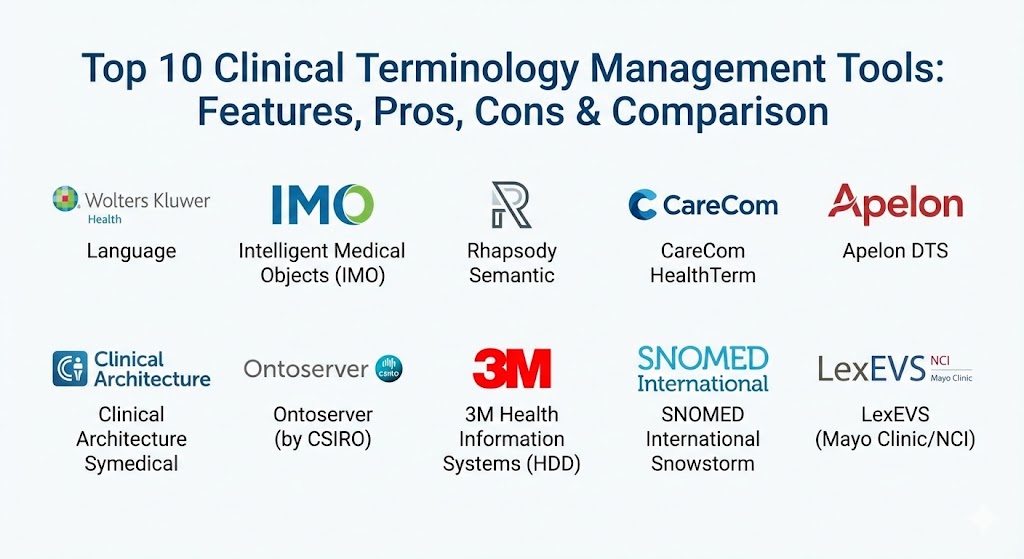
Top 10 Clinical Terminology Management Tools
1 — Wolters Kluwer Health Language
Health Language is a powerhouse in the CTM space, providing comprehensive data normalization and terminology management solutions. It is designed to help organizations improve data quality for better clinical, financial, and operational outcomes.
- Key features:
- Extensive library of 650+ standardized and proprietary medical terminologies.
- AI-powered Data Quality Workbench for automated mapping and normalization.
- Advanced Value Set Management for quality reporting and analytics.
- Direct integration with major EHRs like Epic, Cerner, and Meditech.
- FHIR Terminology Server for real-time interoperability.
- Automated content updates to keep pace with evolving standards.
- Pros:
- One of the most mature platforms with deep clinical content expertise.
- Highly scalable for the world’s largest healthcare enterprises and payers.
- Cons:
- The breadth of features can lead to a steep learning curve for new administrators.
- Premium pricing reflects its position as a top-tier market leader.
- Security & compliance: SOC 2 Type II, HIPAA, GDPR, and ISO 27001 compliant.
- Support & community: Exceptional enterprise support, dedicated account managers, and a robust online training academy.
2 — Intelligent Medical Objects (IMO)
IMO is best known for its “Clinical Interface Terminology,” which bridges the gap between how clinicians talk and how computers code. It is the gold standard for clinical documentation accuracy.
- Key features:
- Clinician-friendly search terms that map directly to billing codes (ICD-10, SNOMED).
- IMO Precision Normalizer for standardizing messy, disparate data sets.
- Maintenance-free terminology sets that update automatically.
- Deeply embedded in the workflow of nearly every major EHR.
- Specialized modules for surgical documentation and lab normalization.
- Semantic keyword tagging for improved data retrieval.
- Pros:
- Significantly reduces “coding fatigue” for clinicians by allowing natural language entry.
- Unrivaled mapping accuracy between clinical intent and administrative codes.
- Cons:
- Primarily focused on the “front-end” interface; may need to be paired with other tools for deep back-end research.
- Limited flexibility for organizations that want to build highly custom, proprietary code systems.
- Security & compliance: HIPAA, SOC 2, and rigorous internal data privacy protocols.
- Support & community: High customer satisfaction; extensive technical documentation and developer APIs.
3 — Rhapsody Semantic
Rhapsody (formerly part of Orion Health and Corepoint) offers a high-performance semantic integration engine. It is designed for high-volume data environments that require real-time terminology translation.
- Key features:
- Native FHIR-based terminology server for modern healthcare apps.
- Automated “Map-to-Standard” logic for incoming HL7 and JSON messages.
- Centralized repository for managing local, national, and international code sets.
- Collaborative workflow tools for terminology governance and approval.
- Real-time health monitoring of terminology services.
- Deployment flexibility (On-premise, SaaS, or Private Cloud).
- Pros:
- Best-in-class integration capabilities; it is an integration engine and CTM in one.
- Excellent for HIEs that need to normalize data from dozens of different hospitals.
- Cons:
- Requires a high level of technical expertise to configure complex mappings.
- Can be overkill for organizations not already using Rhapsody for integration.
- Security & compliance: HITRUST certified, HIPAA, and SOC 2 Type II.
- Support & community: Known for highly responsive technical support and an active global user community.
4 — CareCom HealthTerm
HealthTerm is a flexible, web-based terminology management platform used by national health departments and large private enterprises globally to create a “single source of truth.”
- Key features:
- User-friendly web interface for non-technical terminology managers.
- Support for massive-scale national code sets (SNOMED extensions).
- Automated crosswalks and historical versioning.
- Advanced subset and value set creation tools.
- Real-time API access for downstream application consumption.
- Customizable governance workflows with multi-user approvals.
- Pros:
- Exceptionally clean UI compared to legacy competitors.
- Highly scalable—proven at the national level in several European countries.
- Cons:
- Lacks some of the AI-driven “auto-mapping” features of Wolters Kluwer.
- Smaller footprint in the North American market compared to IMO or Health Language.
- Security & compliance: GDPR, HIPAA, and ISO 27001 compliant.
- Support & community: Excellent onboarding and personalized customer service for large-scale projects.
5 — Apelon Distributed Terminology System (DTS)
Apelon DTS is a veteran in the field, offering a robust, open-source-based framework for terminology governance. It is a favorite for government and academic research projects.
- Key features:
- Comprehensive Knowledgebase for managing complex relationships between terms.
- Workflow module for tracking modeling efforts in distributed projects.
- Advanced search algorithms (stemming, word permutations) for term matching.
- Modular architecture allowing for custom plugin development.
- Strong support for legacy standards (ICD-9) and modern ones (SNOMED CT).
- Available in both commercial and open-source versions.
- Pros:
- One of the most flexible tools for custom terminology development and research.
- Long history of use in government (VA, CDC) ensures high reliability.
- Cons:
- The user interface is traditional and can feel dated.
- Commercial support is necessary for large-scale enterprise deployments.
- Security & compliance: Varies by deployment; commercial versions offer HIPAA and SOC 2 alignment.
- Support & community: Large open-source community; commercial support provided by Apelon experts.
6 — Clinical Architecture Symedical
Symedical is an advanced clinical content management platform focused on the “runtime” of healthcare—ensuring data is accurate the moment it is generated.
- Key features:
- Landa: An AI-powered engine for automated mapping and normalization.
- Semantic interoperability at scale for massive data warehouses.
- Integrated clinical decision support (CDS) hooks based on terminology.
- Tools for managing Social Determinants of Health (SDOH) data sets.
- Real-time term recognition for unstructured text (NLP).
- “What-if” analysis for terminology changes.
- Pros:
- Leading the market in applying AI and NLP to terminology management.
- Great for organizations building large-scale “Real-World Evidence” (RWE) databases.
- Cons:
- Complex implementation that requires significant data engineering resources.
- The platform’s power comes with a higher price point.
- Security & compliance: SOC 2, HIPAA, and GDPR compliant.
- Support & community: Professional service-heavy; excellent technical documentation and partner support.
7 — Ontoserver (by CSIRO)
Ontoserver is a highly specialized FHIR-native terminology server developed by Australia’s national science agency. It is the “gold standard” for FHIR-based terminology operations.
- Key features:
- Optimized for the HL7 FHIR Terminology Service specification.
- High-performance searching and filtering of SNOMED CT.
- “Syndication” feature for distributing terminologies across a network.
- Lightweight containerized deployment (Docker).
- Advanced support for ECL (Expression Constraint Language).
- Automated handling of complex SNOMED CT post-coordination.
- Pros:
- The fastest and most compliant tool for FHIR-based environments.
- Very efficient resource usage; easy to deploy in modern cloud architectures.
- Cons:
- Focused strictly on the “server” side; lacks the deep “editor” UI of tools like HealthTerm.
- Support is more technical and developer-oriented.
- Security & compliance: HIPAA and GDPR ready; security depends on the hosting environment.
- Support & community: Growing international community; supported by CSIRO and several global partners.
8 — 3M Health Information Systems (HDD)
3M’s Healthcare Data Dictionary (HDD) is a cornerstone for organizations focused on the intersection of clinical care and revenue cycle management.
- Key features:
- Direct link between clinical terms and coding for reimbursement.
- Centralized repository for all clinical and administrative code sets.
- Built-in logic for DRG (Diagnosis Related Group) assignment.
- Detailed audit trails for regulatory compliance.
- Integration with 3M’s market-leading encoder tools.
- Support for global terminology standards and local extensions.
- Pros:
- Unrivaled for financial accuracy and billing-related terminology needs.
- Extremely stable and backed by a global leader in healthcare technology.
- Cons:
- Lacks the “modern API-first” feel of Ontoserver or Symedical.
- Can be difficult to integrate with non-3M billing systems.
- Security & compliance: ISO 27001, SOC 2, and HIPAA.
- Support & community: Robust enterprise support and formal training certifications.
9 — SNOMED International Snowstorm
Snowstorm is the official, open-source SNOMED CT terminology server. It is the baseline tool for any organization working heavily with SNOMED CT.
- Key features:
- Full support for SNOMED CT versioning and extensions.
- RESTful API based on FHIR specifications.
- Multi-lingual support for international implementations.
- Native support for the SNOMED CT RF2 release format.
- Scalable architecture designed for high-concurrency environments.
- Pros:
- Free and open-source; the reference implementation for SNOMED CT.
- Directly maintained by the organization that creates SNOMED CT.
- Cons:
- Lacks “out-of-the-box” support for non-SNOMED terminologies (like RxNorm or ICD).
- No commercial GUI; requires developer expertise to implement and manage.
- Security & compliance: Open source; compliance depends on organizational implementation.
- Support & community: Strong developer community on GitHub and SNOMED International forums.
10 — LexEVS (Mayo Clinic/NCI)
LexEVS is a long-standing, open-source terminology service developed through a collaboration between Mayo Clinic and the National Cancer Institute (NCI).
- Key features:
- Optimized for large-scale biomedical research vocabularies.
- Multi-terminology support (SNOMED, LOINC, MeSH, GO).
- Rich API for querying complex hierarchical relationships.
- Integrated with the NCI Thesaurus for cancer research.
- Extensible architecture for custom terminology models.
- Pros:
- The standard for academic and government biomedical research.
- Completely free and extremely well-documented for research use.
- Cons:
- High technical barrier to entry for commercial IT teams.
- User interface is outdated compared to modern SaaS platforms.
- Security & compliance: Varies by implementation; widely used in secure federal environments.
- Support & community: Backed by NCI and Mayo Clinic; strong academic support.
Comparison Table
| Tool Name | Best For | Platform(s) Supported | Standout Feature | Rating (Gartner/TrueReview) |
| Wolters Kluwer | Large Health Systems | Cloud / SaaS | AI Data Quality Workbench | 4.7 / 5 |
| IMO | Clinical Documentation | EHR-Embedded / API | Clinician-Friendly UI | 4.8 / 5 |
| Rhapsody Semantic | HIEs / Integration | SaaS / On-Prem | Semantic Integration Engine | 4.5 / 5 |
| HealthTerm | National Gov / Large Org | Web-based / Cloud | Collaborative Governance | 4.4 / 5 |
| Apelon DTS | Research / Gov | Server / Open Source | Complex Knowledgebase | 4.3 / 5 |
| Symedical | AI / RWE Research | SaaS / Cloud | AI-Powered Auto-Mapping | 4.6 / 5 |
| Ontoserver | FHIR-First Developers | Cloud / Docker | FHIR-Native Performance | 4.8 / 5 |
| 3M HDD | Billing / Finance | Server / Cloud | Billing Code Alignment | 4.4 / 5 |
| Snowstorm | SNOMED-Only Projects | Open Source / API | Official SNOMED Server | 4.2 / 5 |
| LexEVS | Biomedical Research | Open Source / Server | NCI Thesaurus Integration | 4.1 / 5 |
Evaluation & Scoring of Clinical Terminology Management Tools
The following weighted scoring rubric is used to evaluate the overall value of a CTM tool for an enterprise environment.
| Category | Weight | Evaluation Criteria |
| Core Features | 25% | Multi-terminology support, mapping, version control, and value set management. |
| Ease of Use | 15% | Administrative UI, clinical search intuitiveness, and dashboard clarity. |
| Integrations | 15% | EHR native support, FHIR/HL7 connectivity, and API robustness. |
| Security & Compliance | 10% | HIPAA, GDPR, SOC 2, and audit trail detailedness. |
| Performance | 10% | Search latency, mapping speed, and high availability (uptime). |
| Support & Community | 10% | Availability of certified experts, documentation, and training. |
| Price / Value | 15% | TCO (licensing + implementation) relative to accuracy/efficiency gains. |
Which Clinical Terminology Management Tool Is Right for You?
Selecting a CTM tool requires a clear understanding of your data’s ultimate destination.
- Solo Users & Small Practices: Dedicated CTM tools are rarely needed. Rely on your EHR vendor’s native terminology services.
- Health Tech Developers: If you are building a modern FHIR-based app, Ontoserver is the specialized engine you need. For general-purpose coding, IMO’s APIs are the easiest to integrate.
- Small to Mid-Sized Hospitals: Look for EHR-native extensions or tools with lower overhead like SolarWinds Serv-U (for simple transfers) or a modular version of HealthTerm.
- Large Enterprises & Payers: Wolters Kluwer Health Language and Clinical Architecture Symedical provide the high-end automation and governance required to manage millions of patient records across diverse systems.
- Research & Government Entities: Apelon DTS and LexEVS offer the deep, customizable knowledge models required for scientific research and national policy.
Frequently Asked Questions (FAQs)
1. What is the difference between a “Terminology Server” and “Terminology Management”? A terminology server (like Ontoserver) is the engine that provides codes to other apps via API. Terminology management refers to the broader platform and human processes used to map, govern, and update those codes.
2. Why is mapping to SNOMED CT so important? SNOMED CT is the world’s most comprehensive clinical terminology. Mapping to it allows clinical data to be used for advanced decision support and international research that simpler codes (like ICD) cannot support.
3. Can these tools automate the mapping of local lab codes to LOINC? Yes. Tools like Wolters Kluwer and Symedical use AI and pattern matching to analyze local lab descriptions and automatically suggest the correct LOINC standard code.
4. How do these tools handle the annual ICD-10 or CPT updates? Commercial tools (Health Language, IMO) provide “maintenance-free” updates, where the vendor pushes the new codes and maps directly into your system, saving your team hundreds of hours of manual work.
5. What is “Semantic Interoperability”? It is the ability of two systems to exchange data and have the meaning of that data be preserved exactly as intended, without any human intervention.
6. Do I need an MFT tool if I have a CTM tool? Usually, yes. A CTM tool ensures the data is correct, while a Managed File Transfer (MFT) tool ensures the file containing that data is moved securely from one organization to another.
7. Is there an open-source option for terminology management? Yes, Apelon DTS, Snowstorm, and LexEVS are powerful open-source options, though they often require significant technical expertise to implement.
8. What are “Value Sets”? A value set is a subset of codes (e.g., all codes representing “Diabetes”) used for a specific purpose, like clinical quality reporting or creating a patient registry.
9. Can CTM tools help with Social Determinants of Health (SDOH)? Modern tools like Symedical now include mappings for SDOH data (housing status, food security), which are increasingly important for holistic patient care and reimbursement.
10. How long does a typical implementation take? For an enterprise system, expect 3 to 9 months. This includes integrating the tool with your EHR/Data Warehouse and mapping your existing local codes to global standards.
Conclusion
Clinical Terminology Management tools are no longer a “nice-to-have” luxury; they are the foundation of a data-driven healthcare strategy. Whether your goal is to reduce clinician burnout with IMO, achieve FHIR-native interoperability with Ontoserver, or drive enterprise-wide data quality with Wolters Kluwer, the key is to choose a tool that grows with the evolving standards of global medicine.