Introduction
Chatbot Builder Platforms are specialized software environments that enable users—often without any coding background—to design, build, and deploy automated conversational agents. These platforms provide a visual workspace where logic is mapped out through “drag-and-drop” blocks or AI-driven training models. By abstracting the complexities of Natural Language Processing (NLP) and Large Language Models (LLMs), these tools have democratized sophisticated AI technology, making it accessible to marketing, sales, and support teams alike.
The importance of these tools is rooted in scalability. A single chatbot can handle thousands of simultaneous inquiries, performing tasks such as lead qualification, appointment scheduling, and resolving frequently asked questions (FAQs). Real-world use cases span from e-commerce bots that track orders on WhatsApp to enterprise-grade virtual assistants that automate internal IT helpdesk tickets. When evaluating these platforms, users should look for robust NLP/LLM integration, multi-channel deployment capabilities (Web, SMS, Social), seamless CRM/ERP integrations, and advanced analytics to track resolution rates and user sentiment.
Best for: Customer support teams looking to reduce ticket volume, marketing departments aiming to increase lead conversion, and e-commerce brands needing 24/7 sales assistance. They are ideal for companies of all sizes—from small startups needing a basic FAQ bot to global enterprises requiring complex, multi-language virtual assistants.
Not ideal for: Organizations with highly unique, specialized hardware-specific communication needs that require custom-coded socket programming, or very small businesses with such low traffic that a simple “contact us” form is still more cost-effective than an automated solution.
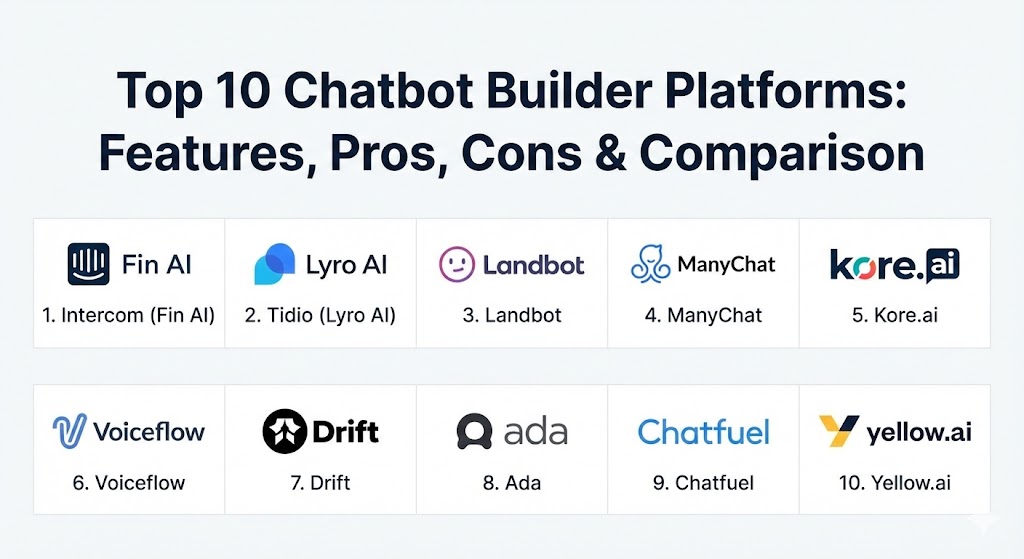
Top 10 Chatbot Builder Platforms
1 — Intercom (Fin AI)
Intercom has evolved from a simple live chat bubble into a complete “AI-first” customer service platform. Its standout feature is Fin, an AI agent that uses sophisticated LLMs to answer customer questions based on your existing help center content.
- Key features:
- Fin AI Agent: Automatically resolves queries using your knowledge base.
- Visual Flow Builder: Design complex paths for lead routing and onboarding.
- Omnichannel Inbox: Manage Web, WhatsApp, Email, and SMS in one place.
- Proactive Support: Send targeted messages based on user behavior.
- App Store: 300+ native integrations with tools like Salesforce and Jira.
- Detailed AI reporting: Tracks exactly how much money Fin is saving you.
- Pros:
- The most integrated “Live Chat + AI Bot” experience on the market.
- Fin is remarkably easy to “train”—just point it at a URL.
- Cons:
- Pricing is modular and can become very expensive as you scale.
- The platform is massive, leading to a steeper learning curve for new admins.
- Security & compliance: SOC 2 Type II, HIPAA (on Expert plans), GDPR, and ISO 27001. Features SSO and advanced identity verification.
- Support & community: Extensive “Intercom Academy” training, a large peer community, and 24/7 premium support for enterprise tiers.
2 — Tidio (Lyro AI)
Tidio is the go-to solution for small and medium-sized e-commerce businesses. Its AI agent, Lyro, is designed to handle common customer inquiries with almost zero setup time, making it highly effective for fast-moving brands.
- Key features:
- Lyro AI Agent: A conversational bot that learns from your website in seconds.
- Shopify & Wix Integration: Real-time order tracking and product recommendations.
- Drag-and-drop Builder: 35+ pre-built templates for common scenarios.
- Multi-channel support: Connects Messenger, Instagram, and Web.
- Live Chat Integration: Seamless handover from AI to human agents.
- Intent recognition: Understands when a user wants to buy vs. return an item.
- Pros:
- One of the fastest setup times in the industry.
- Very affordable for small businesses, including a generous free tier.
- Cons:
- Less suited for complex, multi-departmental enterprise workflows.
- Deep customization of the NLP engine is limited compared to high-end tools.
- Security & compliance: GDPR compliant, data encryption at rest and in transit, and secure data centers in the EU/US.
- Support & community: High-quality documentation and responsive live chat support (often under 2 minutes).
3 — Landbot
Landbot popularized the “no-code” movement for chatbots by focusing on visual logic. It is particularly strong for lead generation and building interactive “conversational landing pages.”
- Key features:
- Visual Workflow Builder: A “mind-map” style interface for building logic.
- WhatsApp Business API: Native, powerful integration for WhatsApp automation.
- Brick System: Save and reuse “sub-flows” to build complex bots faster.
- AI Agents: Modern LLM-powered bots that can ingest help docs.
- Stripe Integration: Process payments directly within the chat interface.
- Google Sheets/Zapier Integration: Sync data in real-time without coding.
- Pros:
- Exceptional UI/UX; building a bot feels like playing with Lego blocks.
- Highly effective at replacing boring web forms with high-converting chat flows.
- Cons:
- The mobile app experience for human agents could be more robust.
- Limited built-in “live chat” features compared to Intercom or Zendesk.
- Security & compliance: GDPR compliant and SOC 2 Type II certified. Supports SSO and data anonymization.
- Support & community: Great technical documentation and an active community of no-code builders.
4 — ManyChat
ManyChat is the undisputed leader for social media automation. If your business lives on Instagram, Facebook, or WhatsApp, ManyChat is the specific tool designed to turn followers into customers.
- Key features:
- Comment-to-DM Triggers: Automatically message users who comment on your posts.
- Instagram Story Mentions: Trigger a thank-you or discount when tagged.
- Keyword Triggers: Launch specific flows based on words like “Price” or “Book.”
- CRM Sync: Direct integrations with HubSpot, Mailchimp, and ActiveCampaign.
- Visual Flow Builder: Easy-to-use canvas for social messaging paths.
- Growth Tools: Ref URLs and QR codes to drive traffic into your bot.
- Pros:
- Unmatched features for social media marketing and viral growth.
- Simple, affordable pricing based on the number of contacts.
- Cons:
- Not designed for complex “knowledge base” support bots.
- Limited to Meta-owned channels (Instagram, Facebook, WhatsApp) and SMS/Email.
- Security & compliance: Varies; Meta-platform compliant, basic data encryption, and GDPR tools.
- Support & community: Massive community (ManyChat Facebook group is huge) and extensive video training.
5 — Kore.ai
Kore.ai is a heavyweight enterprise platform. It is designed for large-scale organizations that need a centralized “AI Brain” to power everything from customer service to internal HR and IT bots.
- Key features:
- XO (Experience Optimization) Platform: A unified environment for all AI needs.
- Agentic RAG: Advanced retrieval of information from enterprise documents.
- Voice AI: Native support for phone-based IVR and voice assistants.
- Enterprise Governance: Detailed roles, permissions, and audit logs.
- Omnichannel Deployment: 30+ channels including Teams, Slack, and Web.
- Hybrid NLP: Combines traditional rules with modern Generative AI.
- Pros:
- Capable of handling millions of interactions for global brands.
- Extremely high levels of security and IT control.
- Cons:
- Very steep learning curve; usually requires a dedicated team to manage.
- Overkill for simple lead-gen or basic support needs.
- Security & compliance: SOC 2, HIPAA, ISO 27001, PCI-DSS, and GDPR. High-level encryption and data residency options.
- Support & community: Dedicated enterprise account managers and professional services for implementation.
6 — Voiceflow
Voiceflow has become the standard for conversation designers. It allows teams to prototype, build, and launch high-end AI agents that use modern LLMs (OpenAI, Anthropic) while maintaining tight control over the logic.
- Key features:
- Real-time Collaboration: Multiple team members can build in the same canvas.
- Knowledge Base: Upload PDFs or URLs to ground your AI in your data.
- Multi-LLM Support: Choose between GPT-4o, Claude 3, and others.
- Version Control: Roll back to previous versions of your bot with one click.
- API Step: Easily call external databases or custom code during a chat.
- Prototyping: Test the bot with internal stakeholders before going live.
- Pros:
- The best interface for professional conversation designers.
- Extremely flexible; if you can dream of a flow, you can build it.
- Cons:
- Does not include a built-in “Shared Inbox” for human agents.
- Requires a bit more technical knowledge to set up complex API calls.
- Security & compliance: SOC 2 Type II, GDPR, and enterprise-grade data security protocols.
- Support & community: Vibrant Discord community and world-class video tutorials (Voiceflow University).
7 — Drift
Drift is the pioneer of “Conversational Marketing.” It is built specifically for B2B sales teams who want to identify high-value website visitors and fast-track them to a sales call.
- Key features:
- Fastlane: Real-time lead qualification based on form submissions.
- Salesforce/HubSpot Integration: Real-time data sync with your CRM.
- Meeting Scheduler: Prospects can book directly into a rep’s calendar.
- Targeted Playbooks: Show different bots to different accounts (ABM).
- AI Chat: Understands open-ended questions and qualifies leads.
- Revenue Dashboards: Shows exactly how much pipeline the bot generated.
- Pros:
- The most powerful tool for B2B sales and Account-Based Marketing (ABM).
- Exceptional at turning anonymous website traffic into sales meetings.
- Cons:
- One of the most expensive platforms on this list.
- Support and service have mixed reviews regarding response times.
- Security & compliance: SOC 2 Type II, GDPR, and ISO 27001. Advanced SSO options for enterprise.
- Support & community: Dedicated customer success managers for higher tiers and a rich knowledge base.
8 — Ada
Ada is an AI-native customer service automation platform. It is designed for massive enterprises that want to automate the majority of their support inquiries across every possible language.
- Key features:
- Reasoning Engine: AI that figures out the best way to solve a problem.
- Automated Resolution Measurement: Focuses on “Resolved” tickets, not just “Sent” messages.
- Multilingual: Supports 50+ languages automatically.
- Smart Routing: Hands off to the right human agent based on skill set.
- Knowledge Hub: Centralizes all your company data for the AI to use.
- Advanced Personalization: Uses user data to provide specific answers (e.g., account balance).
- Pros:
- Can automate up to 70-80% of support volume for massive brands.
- Very strong focus on “Actual Resolution” rather than just deflecting tickets.
- Cons:
- High price point makes it inaccessible for small businesses.
- Requires significant data (knowledge base) to perform at its best.
- Security & compliance: GDPR, HIPAA, SOC 2, and ISO 27001. Built for regulated industries like Finance and Health.
- Support & community: High-touch enterprise support and dedicated training for “AI Coaches.”
9 — Chatfuel
Chatfuel is another powerhouse in the Meta ecosystem, focusing on ease of use and high-volume messaging for Facebook, Instagram, and WhatsApp.
- Key features:
- Visual Flow Builder: Simple and effective for marketing flows.
- ChatGPT Integration: Easily add “smart” responses to your social bots.
- E-commerce Blocks: Display product galleries and process orders.
- One-Click Templates: Hundreds of industry-specific starting points.
- Ad-to-Messenger: Seamlessly connect Facebook Ads to automated chat.
- Detailed Funnel Analytics: See where users are dropping off in the chat.
- Pros:
- Very low barrier to entry; you can have a bot live in 10 minutes.
- Excellent value for money for social media-focused businesses.
- Cons:
- Limited ability to build complex, logic-heavy enterprise workflows.
- Not a standalone website bot solution (it relies on Meta’s framework).
- Security & compliance: Varies; standard encryption and platform-level compliance with Meta’s rules.
- Support & community: Responsive help center and a very large pool of tutorials available online.
10 — Yellow.ai
Yellow.ai is an “Autonomous Service Cloud.” It uses proprietary Generative AI to automate customer and employee experiences across 35+ channels, with a strong presence in the Asian and Middle Eastern markets.
- Key features:
- Dynamic Automation Platform: Self-learning AI that improves over time.
- 35+ Channels: Telegram, Viber, Teams, Web, Voice, and more.
- Goal-based Bot: Focuses on completing tasks (e.g., “Change my flight”).
- Voice Bots: High-quality, low-latency AI voice agents for call centers.
- Campaign Manager: Send proactive messages for marketing and alerts.
- Marketplace: Pre-built industry bots for Banking, Retail, and Logistics.
- Pros:
- Exceptionally wide channel support—one of the best for global brands.
- Strong voice capabilities for companies looking to automate phone lines.
- Cons:
- The administrative interface can be overwhelming for first-time users.
- Setup for complex integrations often requires professional assistance.
- Security & compliance: ISO 27001, SOC 2, HIPAA, and GDPR. Offers high-level data privacy controls.
- Support & community: Global 24/7 support and a growing ecosystem of implementation partners.
Comparison Table
| Tool Name | Best For | Platform(s) Supported | Standout Feature | Rating (Gartner/G2) |
| Intercom (Fin) | SaaS & CX Teams | Web, WhatsApp, Mobile | AI-First Knowledge Base | 4.5 / 5 |
| Tidio (Lyro) | SMB E-commerce | Web, Shopify, Social | Zero-Training AI | 4.7 / 5 |
| Landbot | Lead Gen / Forms | Web, WhatsApp | Logic Mind-Map Builder | 4.6 / 5 |
| ManyChat | Social Marketing | IG, FB, WhatsApp, SMS | Social Growth Tools | 4.6 / 5 |
| Kore.ai | Global Enterprise | 30+ Channels, Voice | Enterprise Governance | 4.4 / 5 |
| Voiceflow | AI Agent Design | Web, API, Mobile | Designer Collaboration | 4.8 / 5 |
| Drift | B2B Sales / ABM | Web, CRM-Integrated | Salesforce Fastlane | 4.4 / 5 |
| Ada | Support Scaling | Web, Mobile, Social | Automated Resolution | 4.6 / 5 |
| Chatfuel | Social Meta Bots | FB, IG, WhatsApp | Meta Ad Integration | 4.5 / 5 |
| Yellow.ai | Omnichannel/Voice | 35+ Channels, Phone | Dynamic Goal-Based AI | 4.5 / 5 |
Evaluation & Scoring of Chatbot Builder Platforms
To help you decide, we have evaluated these platforms across several key dimensions using a weighted scoring model.
| Category | Weight | Evaluation Criteria |
| Core Features | 25% | AI accuracy, workflow builder power, and multi-channel support. |
| Ease of Use | 15% | No-code interface, onboarding speed, and template availability. |
| Integrations | 15% | Native connections to CRM (Salesforce/HubSpot), Shopify, and APIs. |
| Security | 10% | Compliance certifications (HIPAA, SOC 2) and SSO availability. |
| Reliability | 10% | Platform uptime, AI latency, and error-handling capabilities. |
| Support | 10% | Quality of documentation, community, and responsiveness. |
| Price / Value | 15% | ROI based on feature set vs. monthly cost and hidden fees. |
Which Chatbot Builder Platform Is Right for You?
The “best” platform depends entirely on your business goals and technical maturity.
- Solo Users vs. SMBs: If you are a small business owner, priority #1 is Tidio or ManyChat. These tools are affordable and can be set up in a single afternoon.
- Mid-Market Companies: Companies in the 50-500 employee range often find the best value in Intercom or Landbot. These tools scale with you and offer the sophisticated integrations your growing team needs.
- Large Enterprises: Global brands should look toward Kore.ai, Ada, or Yellow.ai. These platforms are built to handle high compliance requirements, multi-language needs, and complex data residency rules.
- Budget-Conscious vs. Premium: Chatfuel and Tidio are excellent budget choices. If you have the budget to invest in a “high-performance sales machine,” Drift is the premium choice for ROI.
- Specific Channel Needs: If 90% of your customers reach out via WhatsApp, Landbot or ManyChat have the most refined WhatsApp-specific features. If you need a phone-based bot, Kore.ai or Yellow.ai are your primary options.
Frequently Asked Questions (FAQs)
1. What is the difference between a scripted bot and an AI bot?
A scripted bot follows a fixed “if-this-then-that” logic path. An AI bot (like Intercom Fin) uses Natural Language Processing to understand the meaning behind a user’s question and can generate answers on the fly.
2. Do I need to know how to code to build a chatbot?
No. Most modern platforms (especially Landbot and Tidio) are entirely no-code. You build your bot visually by connecting blocks or uploading documents for the AI to read.
3. Can chatbots integrate with my existing CRM?
Yes. High-quality platforms offer native integrations with Salesforce, HubSpot, Zendesk, and Zoho. If a native integration doesn’t exist, most tools can connect via Zapier or Make.
4. How do chatbots handle handovers to human agents?
Most platforms have a “Human Handover” block. When the bot gets stuck or the user asks for a person, the conversation is instantly routed to a shared inbox for a live agent to take over.
5. Are chatbots GDPR and HIPAA compliant?
Many are, but you must check the specific plan. Tools like Kore.ai and Ada are built for these standards, while others like Intercom only offer HIPAA compliance on their most expensive enterprise tiers.
6. Can a chatbot take payments?
Yes. Platforms like Landbot and ManyChat have native Stripe integrations, allowing users to buy products or book paid appointments directly inside the chat.
7. How long does it take to set up a chatbot?
A basic FAQ bot using AI (like Lyro) can be live in 10 minutes. A complex enterprise bot with multiple integrations and custom logic usually takes 4 to 8 weeks to fully deploy.
8. Can one bot work on multiple channels?
Yes. Tools like Yellow.ai and Kore.ai allow you to build one “AI Brain” and deploy it simultaneously to your website, WhatsApp, Instagram, and even SMS.
9. What is the most common mistake when building a bot?
Trying to do too much at once. The best practice is to start with your Top 5 most asked questions, automate those perfectly, and then expand to more complex workflows.
10. Do chatbots really improve customer satisfaction?
Yes, but only if they work. Research shows customers prefer a fast answer from a bot over a slow answer from a human. However, a bot that doesn’t understand the user can lower satisfaction (CSAT).
Conclusion
Choosing a Chatbot Builder Platform is no longer about just “adding chat to your site”—it’s about designing a scalable digital workforce. Whether you choose the marketing-heavy features of ManyChat, the sales-driving power of Drift, or the support-scaling automation of Intercom, the key is to prioritize the user experience. The best tool is the one that your team can manage effectively and your customers find genuinely helpful. Start small, focus on the most frequent user pain points, and scale as your AI becomes more sophisticated.