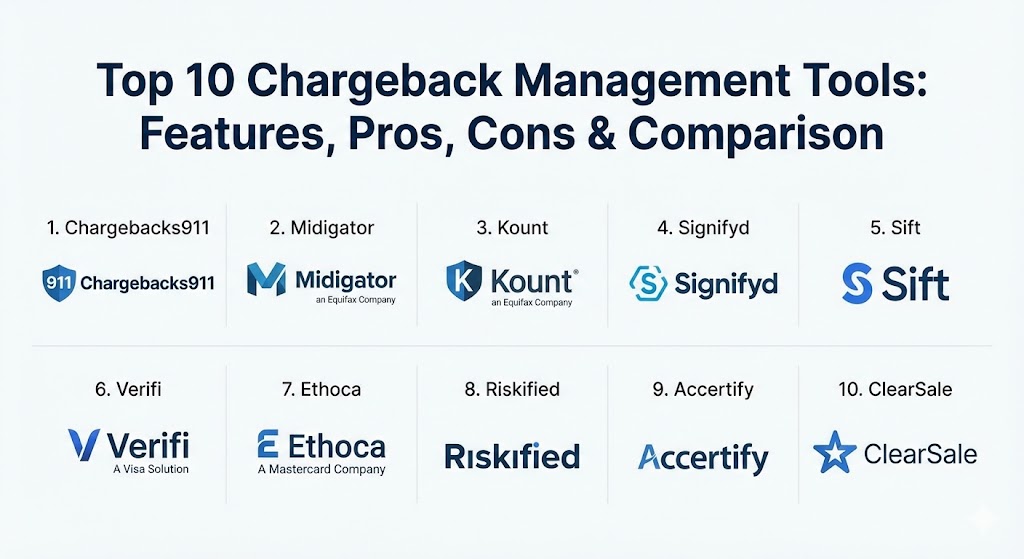
Introduction
Chargeback management tools are specialized software platforms designed to automate the lifecycle of a payment dispute. These systems sit between a merchant’s payment gateway and the card networks (like Visa and Mastercard), providing real-time alerts, automated evidence gathering, and intelligent representment—the process of fighting a chargeback. By leveraging machine learning and direct integrations with issuing banks, these tools help merchants identify fraudulent claims, correct internal operational errors, and recover lost revenue that would otherwise be forfeited.
The importance of these tools lies in their ability to protect a merchant’s “health score” with payment processors. Excessive chargeback rates can lead to heavy fines, higher processing fees, or even the total termination of merchant accounts. Key real-world use cases include stopping a fraudulent transaction before it is settled, automatically submitting shipping labels and digital signatures as evidence to banks, and analyzing dispute data to find flaws in a product’s return policy. When evaluating tools in this category, users should look for the depth of bank integrations (Order Insight and Consumer Clarity), the speed of alert notifications, and the automation level of the representment engine.
Best for: E-commerce retailers, subscription-based SaaS companies, travel and hospitality providers, and high-volume digital marketplaces. It is especially critical for businesses with a chargeback ratio approaching the 1% threshold, where processor scrutiny increases.
Not ideal for: Micro-merchants with very low transaction volumes (e.g., fewer than 50 transactions per month) where the cost of the software may exceed the potential recovered revenue. It is also less necessary for businesses that only accept non-reversible payment methods like wire transfers or certain crypto-assets.
Top 10 Chargeback Management Tools
1 — Chargebacks911
Chargebacks911 is an industry heavyweight known for offering both a robust SaaS platform and a fully managed service. It focuses on “end-to-end” management, tackling both criminal fraud and the more elusive “friendly fraud” (where customers dispute legitimate charges).
- Key features:
- Intelligent Source Detection: Identifies the true cause of a chargeback (fraud vs. merchant error).
- Tactical Representment: Automates the creation and submission of dispute packages.
- Real-Time Alerts: Integrates with Verifi and Ethoca to resolve disputes before they become chargebacks.
- Compliance Guard: Monitors card network rule changes to ensure evidence is always valid.
- Merchant Error Analysis: Pinpoints flaws in the checkout process that trigger disputes.
- Pros:
- Offers a “performance-based” pricing model for certain tiers, aligning their success with yours.
- Deep expertise in international card network rules, making it great for global brands.
- Cons:
- The interface can be complex for beginners due to the sheer volume of data.
- Full implementation often requires significant time and technical coordination.
- Security & compliance: PCI DSS Level 1 compliant, SOC 2 Type II, GDPR compliant, and utilizes end-to-end AES-256 encryption.
- Support & community: Provides dedicated account managers for enterprise clients, 24/7 technical support, and a comprehensive “Chargeback University” for training.
2 — Midigator (An Equifax Company)
Now part of Equifax, Midigator is a data-driven platform that emphasizes automation and analytics. It is designed to take the guesswork out of chargebacks by showing exactly which products or marketing campaigns are driving disputes.
- Key features:
- Automated Representment: Uses a logic-based engine to fight disputes without human intervention.
- Pre-Decision Alerts: Notifies merchants of pending disputes to allow for a refund instead of a fee.
- In-Depth Analytics: Breaks down chargeback data by BIN, geographic location, and product.
- Merchant Account Monitoring: Tracks the health of multiple MIDs (Merchant IDs) in one dashboard.
- Evidence Locker: Centralizes all transaction data for easy access during audits.
- Pros:
- Exceptionally strong reporting that helps marketing teams reduce “buyer’s remorse.”
- Smooth integration with most major CRM and gateway providers.
- Cons:
- As an Equifax company, some users find the corporate bureaucracy slower than agile startups.
- Pricing can be opaque for smaller merchants.
- Security & compliance: PCI compliant, SOC 2, and rigorous data privacy standards in line with Equifax’s global policies.
- Support & community: Robust documentation, webinars, and enterprise-level onboarding support.
3 — Kount (An Equifax Company)
While Kount is primarily a fraud prevention tool, its chargeback management component is world-class. It uses the “Kount Identity Trust Global Network” to analyze billions of signals to stop chargebacks before the customer even clicks “pay.”
- Key features:
- Order Insight Integration: Direct link to Visa’s network to provide data to customers in real-time.
- AI-Driven Decisioning: Approves or declines transactions based on risk scores.
- Post-Authorization Management: Handles the dispute process if a fraudster gets through.
- Custom Policy Engine: Allows merchants to set their own risk thresholds.
- Chargeback Protection: Offers a guarantee against fraud-related chargebacks for eligible transactions.
- Pros:
- Excellent for high-risk merchants who need proactive prevention more than reactive fighting.
- The AI learns extremely fast, reducing the “false positive” rate (declining good customers).
- Cons:
- Primarily a fraud tool; the specific “fighting” features are not as deep as Chargebacks911.
- Can be expensive for low-margin retail businesses.
- Security & compliance: SOC 2 Type II, PCI DSS, GDPR, and CCPA compliant.
- Support & community: Extensive developer documentation, 24/7 support, and an active user community focused on fraud trends.
4 — Signifyd
Signifyd changed the industry with its “Guaranteed Fraud Protection” model. They focus on total liability shift, meaning they take the hit if a transaction they approved ends up as a fraud-based chargeback.
- Key features:
- Liability Shift: If Signifyd approves an order and it’s fraudulent, they pay the merchant back.
- Decision Center: Automates the order review process to eliminate manual reviews.
- Abuse Prevention: Protects against “item not received” and “empty box” claims.
- Agent Dashboard: Provides clear reasons for every decline or approval.
- Global Coverage: Supports merchants selling in dozens of countries.
- Pros:
- Removes the financial risk of fraud entirely from the merchant’s balance sheet.
- Allows for higher order approval rates, directly increasing revenue.
- Cons:
- Does not protect against “merchant error” chargebacks or non-fraud disputes.
- High-volume merchants may find the percentage-of-sales fee model expensive.
- Security & compliance: PCI DSS, GDPR, and SOC 2. Data is anonymized for the global fraud network.
- Support & community: High-touch customer success teams and a very modern, searchable help center.
5 — Sift (Formerly Chargeback.com)
Sift is a “Digital Trust & Safety” platform. By acquiring Chargeback.com, they integrated dispute management directly into their AI-powered fraud engine, creating a seamless flow from prevention to recovery.
- Key features:
- Dispute Response Automation: Generates customized response letters based on transaction data.
- Real-Time Fraud Alerts: Uses a global network to flag compromised cards instantly.
- Behavioral Biometrics: Analyzes how users interact with the site to detect bot activity.
- Workflow Orchestration: Automates actions across various third-party apps via APIs.
- Dynamic Scoring: Risk scores that update as a user moves through the site.
- Pros:
- The most modern, developer-friendly API in the category.
- Combines content moderation, account defense, and chargeback management.
- Cons:
- May be “too much software” for a merchant only looking for dispute resolution.
- Requires technical resources to fully leverage the API and workflow features.
- Security & compliance: ISO/IEC 27001, SOC 2, GDPR, and HIPAA (where applicable).
- Support & community: Strong community on Slack/forums, detailed API docs, and dedicated technical account managers.
6 — Verifi (A Visa Solution)
As a Visa-owned company, Verifi has unique, direct access to the card network. They are the creators of “Order Insight,” a revolutionary tool that allows merchants to share order details directly with the cardholder’s banking app.
- Key features:
- Order Insight: Resolves disputes by showing the customer their receipt inside their bank app.
- Rapid Dispute Resolution (RDR): Automatically resolves disputes based on merchant-set rules.
- Inquiry Management: Intercepts customer questions before they escalate to a bank.
- Global Merchant Platform: A unified portal for all Visa-related dispute data.
- Visa Resolve Online (VROL) Integration: Direct pipes into the Visa network.
- Pros:
- Highest success rate for resolving Visa disputes before they incur fees.
- The RDR feature is a “set it and forget it” solution for low-dollar disputes.
- Cons:
- Heavily focused on the Visa ecosystem (though they support other brands).
- Can feel like a “black box” with less granular control over individual responses.
- Security & compliance: Varies by region, but follows Visa’s gold-standard global security protocols.
- Support & community: Enterprise support, global footprint, and extensive regulatory documentation.
7 — Ethoca (A Mastercard Company)
Ethoca is the Mastercard equivalent to Verifi. Their focus is on “Consumer Clarity,” providing rich merchant data (like logos and digital receipts) to banks to prevent “unrecognized transaction” disputes.
- Key features:
- Ethoca Alerts: The industry standard for pre-chargeback notifications.
- Consumer Clarity: Populates bank statements with logos and detailed merchant info.
- Ethoca Eliminator: Connects the issuer and merchant in real-time to stop disputes.
- Enhanced Data Exchange: Shares high-fidelity data to prove a purchase was legitimate.
- Collaboration Network: Connects thousands of issuers and merchants globally.
- Pros:
- The most widely used alert network in the world.
- Effectively eliminates “I don’t recognize this charge” disputes, which are 30% of cases.
- Cons:
- Requires a high volume to see the full benefit of the “Eliminator” feature.
- Some overlap with Verifi, requiring merchants to use both for full coverage.
- Security & compliance: Mastercard-standard security, GDPR, and PCI DSS Level 1.
- Support & community: Global presence with support in multiple languages; strong documentation for developers.
8 — Riskified
Riskified is an AI platform that focuses on e-commerce growth. Like Signifyd, they offer a “Chargeback Guarantee,” but they specialize in high-scale, cross-border e-commerce where fraud patterns are more complex.
- Key features:
- Chargeback Guarantee: Full reimbursement for fraud-based disputes.
- Policy Protect: Identifies customers abusing return or promotion policies.
- Deco: A specialized tool to recover lost revenue from “false declines.”
- Account Guard: Stops account takeover (ATO) attacks before they happen.
- Payment Optimization: Routes transactions to the best processor to minimize risk.
- Pros:
- Excellent for luxury goods and high-ticket items where one fraud is devastating.
- Uses a frictionless “background” check that never interrupts the customer.
- Cons:
- They “own” the decision; if they decline an order, you can’t easily override it.
- The fee structure is based on the volume of approved orders.
- Security & compliance: SOC 2 Type II, ISO 27001, and PCI DSS.
- Support & community: Detailed data-science-led insights and dedicated performance managers.
9 — Accertify (Now Independent/IGT)
Accertify is an enterprise-grade solution that has historically protected some of the world’s largest airlines and retailers. It provides a massive, multi-layered defense against disputes and fraud.
- Key features:
- Dispute Management Software: A powerful workflow tool for large-scale dispute teams.
- Community Data Map: Learns from the fraud patterns seen across all Accertify users.
- Device Intelligence: Tracks the reputation of the hardware used to make a purchase.
- Automated Evidence Collection: Pulls data from third-party logistics (3PL) providers.
- Custom Reporting: Highly detailed SQL-based reporting for data analysts.
- Pros:
- Built for scale; can handle millions of disputes without a hitch.
- Deeply ingrained in the travel and ticketing industries.
- Cons:
- The user interface is “industrial” and can feel less modern than Sift or Signifyd.
- Likely too expensive and complex for small businesses.
- Security & compliance: PCI DSS, GDPR, and SOC 2. High-level security for airline/travel data.
- Support & community: 24/7 enterprise support and formal training programs for fraud analysts.
10 — ClearSale
ClearSale is unique because it combines high-speed AI with a massive team of human fraud analysts who manually review “gray area” orders, ensuring that genuine customers are never accidentally blocked.
- Key features:
- Statistical Model: Uses AI to score orders instantly.
- Secondary Manual Review: Real humans check orders that the AI isn’t sure about.
- Total Performance Guarantee: Covers chargeback costs and offers a performance guarantee.
- International Expertise: Specialized in high-fraud regions like Latin America and Southeast Asia.
- Comprehensive Dashboard: Shows ROI and clear metrics on recovered revenue.
- Pros:
- The highest “Approval Rate” in the industry due to the human-review element.
- Zero-risk model that is perfect for expanding into new, high-risk global markets.
- Cons:
- The human review can slightly delay order processing (though usually less than 1 hour).
- Not a pure “software” solution; requires trusting their external team.
- Security & compliance: PCI DSS, SOC 2, and GDPR compliant.
- Support & community: Very strong customer service with a focus on “being an extension of your team.”
Comparison Table
| Tool Name | Best For | Platform(s) Supported | Standout Feature | Rating (Gartner / TrueReview) |
| Chargebacks911 | Enterprise Recovery | Cloud / API | Tactical Representment | 4.6 / 5 |
| Midigator | Data Analytics | Cloud / API | Marketing Attribution | 4.5 / 5 |
| Kount | Fraud Prevention | Cloud / API | Identity Trust Global Network | 4.7 / 5 |
| Signifyd | Liability Shift | Cloud / API | 100% Fraud Guarantee | 4.8 / 5 |
| Sift | Modern SaaS / Devs | Cloud / API | Workflow Orchestration | 4.7 / 5 |
| Verifi | Visa Disputes | Direct Visa Link | Order Insight (Pre-dispute) | 4.4 / 5 |
| Ethoca | Mastercard Alerts | Direct MC Link | Global Alert Network | 4.5 / 5 |
| Riskified | High-Volume Retail | Cloud / API | False Decline Recovery | 4.8 / 5 |
| Accertify | Travel & Enterprise | Cloud / On-Prem | Industrial-Scale Workflows | 4.3 / 5 |
| ClearSale | High Approval Rates | Cloud / API | Human-in-the-Loop Review | 4.7 / 5 |
Evaluation & Scoring of Chargeback Management Tools
Choosing the right tool requires a balanced look at technical capability and financial ROI. Use this weighted scoring rubric to evaluate your candidates.
| Category | Weight | Evaluation Criteria |
| Core Features | 25% | Presence of alert systems (Ethoca/Verifi), automation level, and success rates. |
| Ease of Use | 15% | Dashboard clarity, integration with existing Shopify/Magento/Stripe, and setup time. |
| Integrations | 15% | Compatibility with gateways, CRMs, and 3PL (logistics) platforms. |
| Security | 10% | PCI compliance, data encryption, and regional privacy (GDPR/CCPA) adherence. |
| Performance | 10% | Speed of alerts and accuracy of the fraud-detection AI (false positive rate). |
| Support | 10% | Quality of documentation, technical onboarding, and 24/7 availability. |
| Price / Value | 15% | Transparency of fees and the “recovered revenue vs. cost” ratio. |
Which Chargeback Management Tool Is Right for You?
The “best” tool is relative to your specific business model and transaction volume.
- Solo Users vs. SMBs: For small businesses on platforms like Shopify, Signifyd or Sift are ideal. They offer easy “app” integrations and simple pricing. If you want to stop thinking about fraud entirely, a liability-shift model is usually the best choice for a small team.
- Mid-Market vs. Enterprise: As you scale, you need data. Midigator or Chargebacks911 provide the deep analytics needed to fix the root cause of disputes. Large enterprises in specific industries like travel should look at Accertify.
- Budget-Conscious vs. Premium: If you want a “zero-cost” entry, some alert providers like Ethoca offer per-alert pricing. However, premium solutions like Riskified often pay for themselves by approving orders your team would have previously declined out of fear.
- Feature Depth vs. Ease of Use: Verifi and Ethoca are “essential utilities” that most businesses will use in the background. ClearSale is the choice if you prioritize customer experience (not blocking good people) over a purely automated, “cold” AI decision.
- Integration Needs: Always check your payment gateway first. Many tools have “one-click” integrations with Stripe, Braintree, and Adyen. If your stack is custom-built, prioritize Sift for its superior API documentation.
Frequently Asked Questions (FAQs)
1. What is “friendly fraud”?
Friendly fraud occurs when a customer makes a legitimate purchase but later disputes the charge with their bank instead of asking the merchant for a refund. This is often due to confusion or an attempt to get a free product.
2. Can these tools guarantee a 100% win rate?
No. Some disputes are legitimate (e.g., a package really was stolen). However, these tools can move a merchant’s win rate from 10–15% to over 60–70% through better evidence and automation.
3. What is a “chargeback alert”?
An alert is a notification from a network (like Ethoca or Verifi) that a customer has initiated a dispute. It gives the merchant a short window (usually 24–72 hours) to issue a refund and stop the dispute from becoming a formal chargeback.
4. How does “Liability Shift” work?
In this model, the software vendor (like Signifyd) takes over the financial responsibility for fraud. If they approve an order and it is later proven to be fraudulent, they reimburse you for the full amount.
5. Do these tools handle physical and digital goods?
Yes. While digital goods (SaaS/Software) have different evidence requirements than physical goods (shipping labels), the top-tier tools are configured to handle both.
6. Will using these tools affect my checkout speed?
No. Modern tools use “asynchronous” API calls or analyze data in the background, ensuring that the customer’s experience remains fast and frictionless.
7. Are these tools difficult to install?
For Shopify, BigCommerce, or Magento users, it’s often as simple as installing an app. For enterprise users with custom stacks, it requires an API integration which can take 1–4 weeks.
8. What is “Representment”?
Representment is the legal process of “re-presenting” a transaction to the bank with evidence to prove that the charge was valid and should not be reversed.
9. Can I use more than one tool at once?
Yes. Many merchants use a fraud prevention tool (like Kount) for the front end and a dispute alert service (like Ethoca) for the back end.
10. Do these tools help with “Item Not Received” (INR) claims?
Yes. By integrating with shipping carriers (FedEx, UPS), these tools can automatically pull tracking data that shows “Delivered” and submit it as evidence against INR claims.
Conclusion
Managing chargebacks is no longer just an “accounting task”—it is a critical part of a company’s growth strategy. Every dollar lost to a dispute is a dollar taken directly from your bottom line, and every “false decline” is a lost customer relationship. The top 10 tools listed here offer a variety of ways to fight back, from AI-driven prevention to human-led recovery. The right choice for your business will balance automation with a deep understanding of your specific customer behavior. By investing in the right infrastructure today, you ensure that your revenue is protected for the long haul.