Introduction
Certificate Management Tools are specialized software platforms designed to automate the discovery, issuance, renewal, and installation of digital certificates. In an era where a single expired certificate can bring down a global banking app or an e-commerce giant, these tools act as an automated insurance policy against outages. They provide a “single pane of glass” view into an organization’s entire certificate estate, regardless of which Certificate Authority (CA) issued them.
The importance of CLM tools lies in their ability to eliminate human error. Manual management often leads to “orphaned” certificates—security assets that everyone forgot existed until they expired and caused a service disruption. Key real-world use cases include managing machine identities in massive Kubernetes clusters, securing thousands of IoT devices, and maintaining compliance in highly regulated sectors like finance and healthcare. When evaluating these tools, users should look for automation capabilities, multi-CA support, discovery depth (finding hidden certificates), and integration with DevOps pipelines.
Best for: Security operations (SecOps) teams, infrastructure engineers, and CISOs in mid-to-large enterprises. It is particularly essential for companies with hybrid-cloud environments, thousands of machine identities, or strict regulatory compliance needs (PCI-DSS, HIPAA, GDPR).
Not ideal for: Personal bloggers, micro-businesses with only one or two websites, or small teams using a single cloud provider that offers basic, integrated auto-renewal (like a simple AWS-only setup). For these users, the cost and complexity of a dedicated CLM tool would outweigh the benefits.
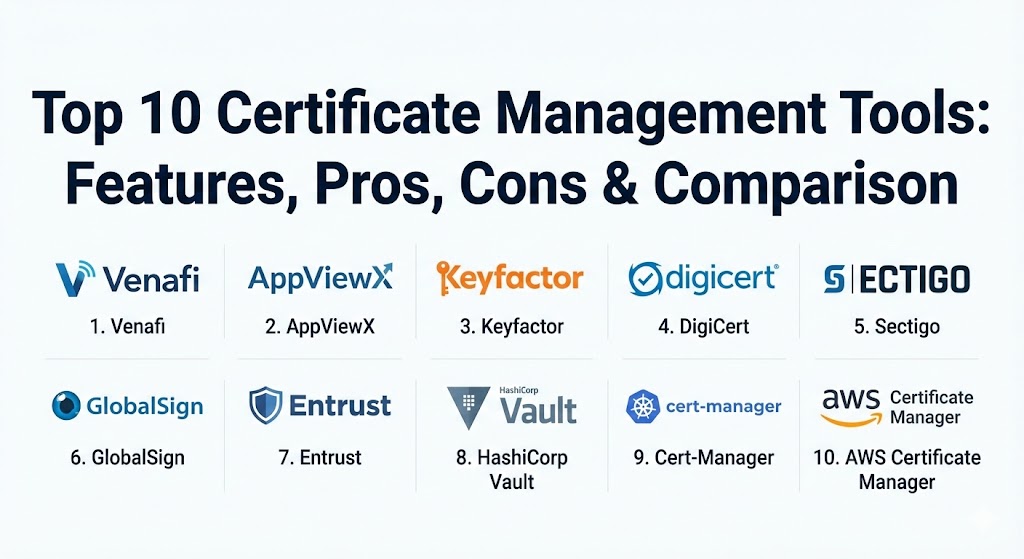
Top 10 Certificate Management Tools
1 — Venafi Control Plane
Venafi is widely regarded as the pioneer and market leader in “Machine Identity Management.” It is built for the largest global enterprises that need to manage millions of identities across complex, multi-cloud, and on-premises environments.
- Key features:
- Machine Identity Strategy: Focuses on the identity of the machine, not just the certificate.
- Comprehensive Discovery: Scans networks, cloud instances, and keystores to find every certificate.
- Universal Policy Enforcement: Sets global rules for certificate length, encryption strength, and CA choice.
- Automated Provisioning: Directly pushes certificates to web servers, load balancers, and firewalls.
- DevOps Integration: Native “Venafi Enhanced Issuer” for Kubernetes and OpenShift.
- Outage Prediction: AI-driven insights to flag certificates at risk of failing.
- Pros:
- The most robust and feature-rich platform available for enterprise-scale operations.
- Exceptional ability to handle “shadow” certificates that other tools miss.
- Cons:
- High cost of ownership; it is a premium enterprise solution.
- Can be complex to set up and requires a significant learning curve.
- Security & compliance: FIPS 140-2, SOC 2 Type II, ISO 27001, GDPR, and HIPAA compliant. Includes advanced audit trails for forensic analysis.
- Support & community: World-class enterprise support; the “Venafi Warrior” community is one of the most active for security professionals.
2 — AppViewX CERT+
AppViewX is a modular platform that focuses heavily on orchestration and automation. It is designed to bridge the gap between security requirements and infrastructure operations.
- Key features:
- Visual Workflow Automation: Drag-and-drop builder to create complex renewal workflows.
- Multi-CA Support: Manage certificates from DigiCert, Sectigo, GlobalSign, and Let’s Encrypt in one place.
- SSH Key Management: One of the few platforms that manages both SSL/TLS and SSH keys natively.
- Role-Based Access Control (RBAC): Granular permissions for different business units.
- Cloud-Native Discovery: Deep integration with AWS, Azure, and Google Cloud.
- Pros:
- Excellent user interface that simplifies the visualization of complex certificate chains.
- High degree of flexibility in automating the “last mile” of certificate installation.
- Cons:
- Performance can slow down slightly when managing extremely large (100k+) certificate volumes.
- Some advanced reporting features require custom configuration.
- Security & compliance: SOC 2, PCI-DSS, and GDPR compliant. Features hardware security module (HSM) integration.
- Support & community: Good documentation and a dedicated customer success program; responsive technical support.
3 — Keyfactor Command
Keyfactor is known for its modern, cloud-first approach and its specialized focus on the Internet of Things (IoT). It is highly scalable and designed for agility.
- Key features:
- AnyCA Gateway: Connects to any internal or public CA via a standardized gateway.
- IoT Identity Platform: Manages certificates for millions of connected devices.
- Keystore Management: Automates updates to Java Keystores, Windows stores, and F5 load balancers.
- Self-Service Portal: Allows developers to request certificates within predefined security policies.
- High-Availability Architecture: Built to ensure the management plane never goes down.
- Pros:
- Very fast deployment times compared to traditional on-premise CLM tools.
- Strongest choice for companies manufacturing or managing large-scale IoT hardware.
- Cons:
- The pricing model can be aggressive for companies with rapid growth in certificate numbers.
- Documentation for niche integrations can sometimes be less detailed than others.
- Security & compliance: FIPS 140-2 Level 3, SOC 2, and HIPAA compliant.
- Support & community: Strong community presence through their “Community Edition” (EJBCA) and active professional support.
4 — DigiCert Trust Lifecycle Manager
As one of the world’s largest Certificate Authorities, DigiCert’s own management platform offers a tightly integrated experience for those who primarily use DigiCert services but need to manage others as well.
- Key features:
- Full Lifecycle Automation: From request to renewal and revocation.
- Discovery and Inventory: Scans the internet and internal networks for all certificates.
- Unified Management: Handles both public and private PKI (Public Key Infrastructure).
- ACME Support: Native support for the ACME protocol for automated web server renewals.
- Business Unit Isolation: Segregate management tasks by department or geography.
- Pros:
- Seamless integration if your organization already uses DigiCert as its primary CA.
- Very reliable issuance speed and platform uptime.
- Cons:
- While it supports other CAs, the “best” experience is definitely tilted toward DigiCert.
- Less focus on SSH key management compared to Venafi or AppViewX.
- Security & compliance: ISO 27001, SOC 2, HIPAA, and GDPR.
- Support & community: Excellent global support with 24/7 availability; well-regarded Knowledge Base.
5 — Sectigo Certificate Manager (SCM)
Sectigo’s platform is a universal CLM solution that prides itself on being CA-agnostic, allowing users to manage any certificate regardless of the provider.
- Key features:
- Single Pane of Glass: A unified dashboard for SSL, Code Signing, and S/MIME certificates.
- Automated Installation: Support for Apache, IIS, Nginx, and popular load balancers.
- Detailed Alerting: Customizable notification schedules for upcoming expirations.
- Discovery Tools: Both agent-based and agentless scanning options.
- Cloud-Native Connectors: Automated management for Azure Key Vault and AWS ACM.
- Pros:
- One of the most straightforward and easy-to-use dashboards in the market.
- Very competitive pricing for mid-market and smaller enterprise customers.
- Cons:
- Automation for very old or extremely niche legacy systems can be difficult.
- Reporting modules are functional but less customizable than Venafi.
- Security & compliance: SOC 2 Type II, GDPR, and HIPAA compliant.
- Support & community: Strong onboarding support and a large library of tutorial videos.
6 — GlobalSign Atlas
GlobalSign Atlas is a high-velocity cloud identity engine designed to automate the issuance and management of certificates at massive scale.
- Key features:
- High-Throughput Issuance: Designed for environments that need to issue thousands of certs per minute.
- ACME Integration: Standard-based automation for Linux and Windows servers.
- Enterprise PKI: Simplifies the management of internal private certificates.
- Auto-Enrollment: Seamlessly integrates with Active Directory for employee certificates.
- Inventory Reporting: Tracks certificates across the entire organization.
- Pros:
- Exceptional performance for high-velocity environments (like auto-scaling cloud groups).
- Reduces the administrative burden of running an internal CA.
- Cons:
- Primarily focused on GlobalSign issued certificates; management of third-party CAs is more limited.
- The interface is more technical and less “polished” than some SaaS competitors.
- Security & compliance: ISO 27001, SOC 2, and WebTrust certified.
- Support & community: Highly professional technical support; strong documentation for API integrations.
7 — Entrust Certificate Hub
Entrust provides a centralized platform that focuses on visibility and risk management for enterprises with complex compliance requirements.
- Key features:
- Compliance Dashboards: Specifically tracks adherence to encryption standards.
- Expiration Tracking: Multi-stage alerts via email and API.
- Discovery Scanning: Finds certificates across local networks and multiple clouds.
- Managed PKI: Integration with Entrust’s high-assurance private PKI services.
- Workflow Management: Standardized approval processes for new certificate requests.
- Pros:
- Very strong focus on “Audit Readiness”—making life easy during compliance checks.
- Robust security foundation backed by decades of hardware security experience.
- Cons:
- The platform can feel “heavy” and traditional; not as “DevOps-fast” as tools like Keyfactor.
- Integration with non-Entrust private CAs can be a manual process.
- Security & compliance: FIPS 140-2, SOC 2, HIPAA, and GDPR.
- Support & community: High-quality enterprise support; extensive whitepapers and best-practice guides.
8 — HashiCorp Vault (PKI Secrets Engine)
While not a traditional CLM platform, HashiCorp Vault is the tool of choice for developers and DevOps engineers who need to manage dynamic, short-lived certificates in automated pipelines.
- Key features:
- Dynamic Secrets: Generates certificates on-the-fly that expire in minutes or hours.
- API-First Design: Everything is managed via code and CLI.
- Consul Integration: Automatic service-to-service encryption.
- Short-Lived Certs: Reduces the risk of a compromised certificate being useful for long.
- Cross-Cloud Compatibility: Works identically on AWS, Azure, GCP, and on-prem.
- Pros:
- The absolute best tool for “Zero Trust” architectures and ephemeral workloads.
- Completely removes the “renewal” problem because certs are created when needed and destroyed after.
- Cons:
- Does not provide the “visual inventory” or business-level reporting that a CISO needs.
- Requires high technical skill to implement and manage.
- Security & compliance: FIPS 140-2 Level 3, SOC 2, and HIPAA.
- Support & community: Massive open-source community; excellent commercial support for the Enterprise version.
9 — Cert-Manager
Cert-Manager is the open-source standard for managing certificates specifically within Kubernetes environments. It is a cloud-native must-have for modern developers.
- Key features:
- Kubernetes Native: Runs as a controller within your K8s cluster.
- ACME Support: Seamless integration with Let’s Encrypt for free, automated certs.
- Multiple Issuers: Can pull from Vault, Venafi, or a local CA.
- Certificate Ingress: Automatically secures your web traffic as you deploy services.
- Declarative Config: Manage certificates using standard YAML files.
- Pros:
- Completely free and open-source.
- Automates the most difficult part of securing microservices.
- Cons:
- Only manages certificates inside Kubernetes; it won’t help with your corporate VPN or old physical servers.
- No centralized “management console” for the whole company.
- Security & compliance: Varies / N/A (Maintained by the CNCF community).
- Support & community: Huge community support via GitHub and Slack; commercial support available from companies like Jetstack.
10 — AWS Certificate Manager (ACM)
For organizations that reside 100% within the Amazon ecosystem, ACM provides an almost “invisible” certificate management experience.
- Key features:
- One-Click Provisioning: Provision and deploy certificates directly to CloudFront or ELB.
- Automated Renewal: AWS handles the renewal and installation with zero user input.
- Private CA Integration: Manage internal certificates via AWS Private CA.
- Free Public Certs: SSL/TLS certificates for AWS services are provided at no extra cost.
- CloudWatch Integration: Monitor certificate health via standard AWS metrics.
- Pros:
- Zero management overhead for AWS-resident workloads.
- Cost-effective; you only pay for the Private CA, not the public certificates themselves.
- Cons:
- Complete vendor lock-in; it cannot manage certificates on your local servers or Azure.
- Limited visibility into certificates issued outside of the AWS console.
- Security & compliance: FedRAMP, SOC 1/2/3, HIPAA, and PCI-DSS.
- Support & community: Full AWS premium support and a vast amount of community documentation.
Comparison Table
| Tool Name | Best For | Platform(s) Supported | Standout Feature | Rating (Gartner) |
| Venafi | Large Enterprises | Hybrid, Multi-Cloud | Machine Identity Strategy | 4.8 / 5 |
| AppViewX | Automation/Orchestration | SaaS, On-prem | Visual Workflow Builder | 4.6 / 5 |
| Keyfactor | IoT and Cloud-First | SaaS, Hybrid | IoT Identity Management | 4.7 / 5 |
| DigiCert TLM | DigiCert Customers | SaaS, On-prem | Unified CA + CLM | 4.5 / 5 |
| Sectigo SCM | Mid-Market / Agnostic | SaaS, Cloud | Universal CA Management | 4.4 / 5 |
| GlobalSign | High-Velocity Issuance | Cloud-Native | Atlas Issuance Engine | 4.3 / 5 |
| Entrust Hub | Compliance/Audit | SaaS, On-prem | Audit-Ready Reporting | 4.2 / 5 |
| HashiCorp Vault | Developers / DevOps | Multi-Cloud, K8s | Dynamic Secrets | 4.7 / 5 |
| Cert-Manager | Kubernetes Users | Kubernetes | Native K8s Controller | N/A |
| AWS ACM | AWS-only Shops | AWS Cloud | Invisible Auto-Renewal | 4.5 / 5 |
Evaluation & Scoring of Certificate Management Tools
To determine the “best” tool, we must weigh different factors based on institutional needs. A developer prioritizes speed, while a CISO prioritizes visibility and compliance.
| Category | Weight | Evaluation Criteria |
| Core Features | 25% | Discovery depth, automation level, and multi-CA support. |
| Ease of Use | 15% | Dashboard quality, ease of installation, and UI intuitiveness. |
| Integrations | 15% | Native connectors for cloud (AWS/Azure) and DevOps (K8s/Jenkins). |
| Security & Compliance | 10% | Encryption, audit logs, and adherence to regulations (SOC2/GDPR). |
| Reliability | 10% | Platform uptime and success rate of automated renewals. |
| Support & Community | 10% | Documentation quality and 24/7 support availability. |
| Price / Value | 15% | Total cost relative to the risk reduction and time saved. |
Which Certificate Management Tool Is Right for You?
Selecting a tool is a decision that affects your organization’s uptime. Use this guide to match your situation:
- Solo Users & SMBs: If you are a small team with a few websites, stick with Let’s Encrypt and manual checks, or use the integrated tools from your hosting provider or AWS ACM.
- Budget-Conscious Mid-Market: Sectigo SCM or AppViewX offer a great balance of enterprise features without the price tag of Venafi.
- The “Zero Trust” Enterprise: If your goal is to eliminate static certificates entirely and move to ephemeral, short-lived identities, HashiCorp Vault is the essential foundation.
- Large, Complex Global Corporations: For organizations with massive technical debt, legacy data centers, and multiple cloud footprints, Venafi is the only tool with the “discovery” muscle to find and fix every risk.
- DevOps and Kubernetes Teams: If your world is 100% containerized, Cert-Manager is the industry standard for a reason—it’s free, automated, and speaks the language of Kubernetes.
- IoT Manufacturers: If you are building smart cars, medical devices, or sensors, Keyfactor is the specialized choice designed to handle identities for hardware that stays in the field for years.
Frequently Asked Questions (FAQs)
1. Why is everyone talking about “90-day certificates” in 2026?
Google and other major browser vendors have pushed for shorter certificate lifespans to increase security. Short-lived certificates mean that if one is stolen, it’s only useful for a few months. This makes manual management nearly impossible, as you would be renewing certificates four times a year.
2. What is “Certificate Discovery” and why do I need it?
Discovery is the process of scanning your network to find certificates you didn’t know you had. Most outages are caused by “shadow certificates”—ones installed by a developer two years ago that no one tracked.
3. Does a CLM tool replace my Certificate Authority (CA)?
No. A CLM tool is a management layer that talks to your CA (like DigiCert, GlobalSign, or Let’s Encrypt) to handle the busywork of requesting and installing the certificates.
4. Can I use a CLM tool to manage internal/private certificates?
Yes. Most of these tools (especially Venafi and Keyfactor) manage both public-facing web certificates and internal certificates used for your company’s Wi-Fi, VPN, and internal servers.
5. What is the biggest mistake in certificate management?
Relying on a spreadsheet. Human error is the #1 cause of certificate-related outages. If the person who manages the spreadsheet leaves the company or misses a calendar invite, your site goes down.
6. Is “Auto-Renewal” always safe?
Auto-renewal is generally safe but can fail if the server’s permissions change or if the network is blocked. A good CLM tool doesn’t just “try” to renew; it verifies that the new certificate is actually working.
7. Can I use these tools for SSH keys?
Some tools, like AppViewX and Venafi, have dedicated modules for SSH keys. This is important because SSH keys are essentially “permanent passwords” that are rarely rotated.
8. How do these tools help with compliance audits?
They provide a central report showing that every certificate uses strong encryption (like RSA 2048 or ECC) and that no expired certificates exist, which is a common requirement for SOC 2 and PCI-DSS.
9. What is “ACME”?
ACME is a protocol that allows a web server to talk directly to a CA to get a certificate without a human involved. Most CLM tools use ACME to automate the renewal process.
10. How much do these tools cost?
Pricing varies wildly. Open-source tools like Cert-Manager are free, while enterprise platforms like Venafi can cost tens or hundreds of thousands of dollars depending on the volume of certificates.
Conclusion
In 2026, certificate management is no longer a “back-burner” IT task—it is a core pillar of cybersecurity resilience. As certificate lifespans shrink and machine identities multiply, the organizations that continue to manage their trust manually are essentially waiting for an outage to happen.
If you are looking for the absolute gold standard in enterprise visibility, Venafi is the clear winner. If you need cloud-native agility and IoT support, Keyfactor and HashiCorp Vault are the future. For the Kubernetes-defined world, Cert-Manager remains the indispensable tool of the trade. The “best” tool is the one that allows your team to stop worrying about expirations and start focusing on innovation. Secure your identities today, before the next 90-day cycle catches you off guard.