Introduction
Brand tracking tools are specialized software platforms designed to monitor the health of a brand over time.2 Unlike a one-off market research survey, brand tracking is a continuous or recurring process.3 These tools collect data—through surveys, social media listening, media monitoring, and web analytics—to quantify how a target audience perceives a brand relative to its competitors.4
The importance of brand tracking lies in its ability to provide actionable intelligence.5 It moves branding from an art to a science. By consistently measuring metrics like brand awareness, brand usage, sentiment, and net promoter score (NPS), organizations can connect marketing activities directly to business outcomes.6 Key real-world use cases include measuring the long-term ROI of advertising campaigns, identifying early warning signs of a reputation crisis before it hits sales figures, and uncovering unmet consumer needs that competitors have missed.
When choosing tools in this category, users must evaluate the data source mix. Some tools rely heavily on traditional, rigorous survey panels, while others focus on “unsolicited” data from social media and web conversations.7 The ideal choice depends on whether you need deep, prompted answers to specific questions or a broad view of what the market is saying spontaneously.
Best for: CMOs and brand managers in medium-to-large enterprises who need longitudinal data to justify marketing spend. It is also critical for companies in highly competitive, fast-moving consumer goods (FMCG) or B2C sectors where consumer sentiment shifts rapidly.8
Not ideal for: Very small businesses or pre-revenue startups where brand awareness is statistically negligible. In these cases, direct customer feedback and basic social monitoring are often more cost-effective alternatives than a full-scale brand tracking suite.
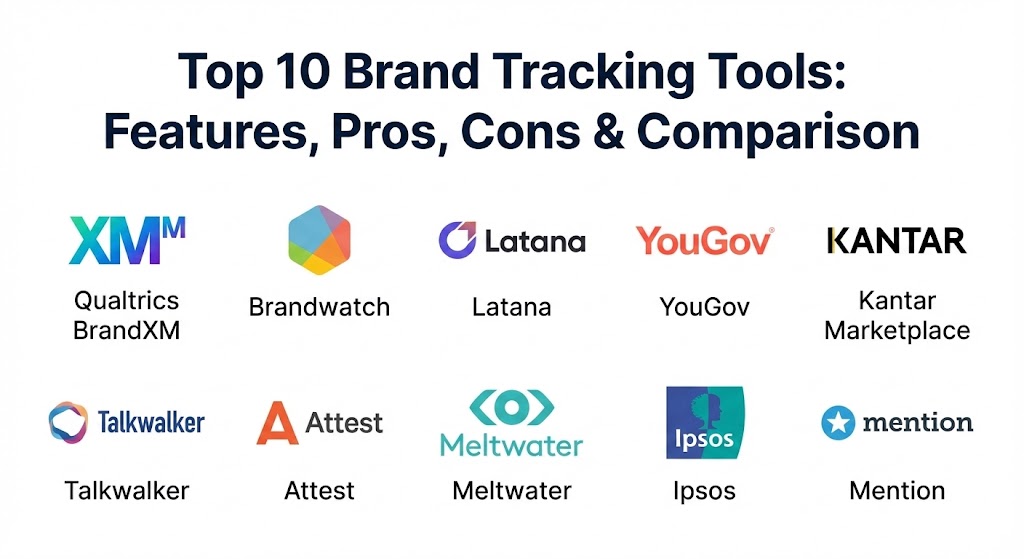
Top 10 Brand Tracking Tools
1 — Qualtrics BrandXM
Qualtrics BrandXM is part of the broader Experience Management (XM) platform.9 It is widely regarded as an enterprise-grade powerhouse for survey-based brand tracking, offering deep customization and analytical rigor.
- Key features:
- Customizable survey engines that can handle complex logic and global reach.10
- Pre-built certified brand tracking methodologies and dashboards.
- Text iQ: advanced natural language processing to analyze open-text survey responses.11
- Driver analysis to identify exactly which brand attributes are influencing key metrics like purchase intent.12
- Integration with operational data (O-data) from CRM systems to link perception to actual customer behavior.
- Pros:
- Extremely powerful analytics that can handle very complex datasets.13
- Highly customizable; you are not locked into a rigid framework.14
- Cons:
- The platform can be complex and often requires a dedicated specialist or team to manage effectively.
- It carries a premium, enterprise-level price tag.
- Security & compliance: SOC 2, ISO 27001, FedRAMP authorized, GDPR compliant with advanced enterprise security controls.
- Support & community: Extensive documentation, a massive global user community (XM Institute), and dedicated enterprise support tiers.
2 — Brandwatch Consumer Intelligence
Brandwatch is a leader in the social listening space that has evolved into a comprehensive consumer intelligence platform.15 It excels at analyzing unsolicited, spontaneous conversations across the digital web to track brand health.
- Key features:
- Access to a massive historical archive of social and web data (going back over a decade).
- AI-powered sentiment analysis that can detect emotions (joy, anger, disgust) beyond just positive/negative.16
- Logo recognition within images posted on social media, even if the brand isn’t mentioned in text.17
- Vizia: A command center visualization tool for displaying real-time brand data in offices.18
- Competitive benchmarking to compare share of voice against key rivals instantly.
- Pros:
- Unmatched depth of social data access, including obscure forums and review sites.
- Excellent visualization capabilities that make complex data easy for executives to digest.19
- Cons:
- Primarily focused on “unsolicited” social data; does not have built-in survey panel capabilities (though it integrates with them).
- The query language (writing the search strings) has a learning curve for advanced filtering.
- Security & compliance: ISO 27001 certified, GDPR compliant with robust user access controls.20
- Support & community: Strong academy for training and responsive global support teams.
3 — Latana
Latana focuses on modernizing traditional brand tracking. It uses mobile-optimized micro-surveys delivered via vast publisher networks to reach niche audiences that traditional panels often miss.
- Key features:
- Mobile-first survey design ensuring high completion rates and authentic responses.21
- Direct access to over 4 billion mobile users globally via app publisher networks.
- Modular dashboard designed for brand managers, focusing on awareness, consideration, and preference funnel metrics.
- Ability to hyper-target very specific demographics or interests (e.g., “vegan gamers in Germany”).
- Mrp (Multilevel Regression and Poststratification) statistical modeling to ensure accurate representation even with smaller sample sizes.22
- Pros:
- Excellent for reaching younger demographics (Gen Z/Millennials) who don’t participate in traditional survey panels.
- The user interface is modern, clean, and very intuitive for non-researchers.
- Cons:
- Not as deep on open-ended qualitative text analysis as competitors like Qualtrics.
- Focuses strictly on survey data, lacking integrated social listening features.
- Security & compliance: GDPR compliant with strict data anonymization protocols for respondents.
- **Support & community:**Dedicated customer success managers assist with survey setup and results interpretation.
4 — YouGov
YouGov takes a unique approach by maintaining a massive, highly engaged proprietary global panel of millions of people.23 They position their offering as “living data,” providing a continuous stream of consumer insights.24
- Key features:
- YouGov BrandIndex: A daily brand tracking service measuring public perception across 16 metrics (e.g., Buzz, Quality, Value).25
- Access to a pre-profiled panel, allowing for incredibly fast turnaround on niche questions.26
- Ability to re-contact specific respondents to dig deeper into their previous answers.
- YouGov Profiles: Connecting brand tracking data with deep audience behavioral and psychographic data.27
- Global reach with consistent methodology across dozens of markets.
- Pros:
- The daily frequency of BrandIndex data is unique, offering near real-time survey trend lines.28
- High-quality respondent data due to their proprietary panel management.
- Cons:
- Can be expensive if you require access to multiple international markets and data modules.
- The sheer volume of available data in their ecosystem can sometimes be overwhelming to navigate.
- Security & compliance: Strict adherence to global market research codes of conduct and GDPR.29
- Support & community: Strong consultant-led support model to help interpret the vast amount of data available.
5 — Kantar Marketplace
Kantar is one of the world’s largest and most historic market research firms.30 Kantar Marketplace is their on-demand platform that brings their rigorous, validated methodologies into an agile digital environment.31
- Key features:
- Access to Kantar’s gold-standard methodologies (like their “Meaningfully Different” framework) in automated solutions.
- NeedScope: An AI-powered tool within the platform for decoding brand imagery and archetype association.32
- Agile brand guidance systems that combine survey data with search and social signals.33
- Validated behavioral metrics that are proven to link to real-world sales outcomes.
- Global standardized reporting for consistent tracking across different regions.
- Pros:
- Offers the peace of mind that comes with using battle-tested, statistically validated research methods.
- Great balance of speed (automated tools) and depth (access to Kantar consultants).
- Cons:
- While faster than traditional consulting, it may still feel slower than “pure-play” tech platforms like Latana.
- The interface can feel more like a research tool than a modern SaaS product.
- Security & compliance: Enterprise-grade security standards consistent with a major global data firm; ISO certified.
- Support & community: Access to world-class research consultants for deep dives into the data.34
6 — Talkwalker
Now part of the Brandwatch/Cision family, Talkwalker remains a distinct and powerful platform focused on holistic, omni-channel brand listening and visual analytics.
- Key features:
- Coverage across social, online news, blogs, forums, and even broadcast/TV/radio monitoring.35
- Visual Listening: Proprietary AI that analyzes images and video scenes for brands, objects, and context.36
- “Blue Silk” AI engine for advanced sentiment analysis and automatic trend detection.37
- Conversation Clusters to visualize how topics intersect and what is driving brand discussions.38
- Predictive analytics to identify emerging trends before they become mainstream.
- Pros:
- One of the best platforms for visual brand tracking (analyzing images and video content).39
- Excellent coverage of non-social web sources like news and blogs.
- Cons:
- Like other listening tools, it lacks native survey capabilities for prompted brand recall.
- Reporting capabilities are powerful but can take time to configure specifically for brand health tracking.
- Security & compliance: GDPR compliant and ISO 27001 certified.40
- Support & community: Global support presence with a strong focus on client onboarding and training.
7 — Attest
Attest is a consumer research platform built for speed and scale.41 It is designed to help marketers get answers to brand questions in days or hours, rather than weeks.42
- Key features:
- Access to an audience of 125 million people in 58 markets.
- Intuitive survey builder with templates specifically for brand tracking and campaign measurement.43
- Mixed methodology capabilities, allowing for video responses alongside varied question types.
- Interactive dashboard that allows for easy filtering and crosstabulation of results on the fly.
- “Brand Intelligence” dashboard for tracking core KPIs over time.
- Pros:
- Incredibly fast turnaround times for gathering fresh survey data.
- Very user-friendly pricing and interface, making market research accessible to non-experts.
- Cons:
- Lacks the deep operational data integration found in tools like Qualtrics.
- While great for snapshots and agile tracking, it may lack the historical depth of long-running panels like YouGov.
- Security & compliance: GDPR and CCPA compliant, ensuring respondent anonymity.
- Support & community: Known for their “Research Expertise” team that helps clients design better questions.
8 — Meltwater
Meltwater started as a powerhouse in media monitoring and PR but has expanded into a full-suite platform for brand management, combining social listening with traditional media tracking.44
- Key features:
- Comprehensive monitoring of online news, print, broadcast, and social media in one platform.
- AI-driven sentiment analysis and entity extraction.45
- Influencer management tools integrated into the brand tracking workflow.
- Customizable dashboards for tracking share of voice across different media types.
- Real-time alerting for brand mentions or crisis keywords.46
- Pros:
- The best choice for teams where brand tracking sits closely with PR and communications functions.
- Excellent global news media coverage that pure social tools often miss.
- Cons:
- The social listening capabilities, while good, are sometimes considered less deep than specialist tools like Brandwatch.
- The platform is vast, and navigating between PR tools and social tools can sometimes feel disjointed.
- Security & compliance: Adheres to global privacy regulations and standard enterprise security protocols.
- Support & community: Large global footprint with local support teams in many regions.
9 — Ipsos (Simstore / Digital Platform)
Like Kantar, Ipsos is a titan of traditional market research that has digitized its offerings.47 Their solutions provide rigorous, science-backed brand tracking.
- Key features:
- Brand Value Creator (BVC): A validated methodology to measure attitudinal equity and market effects.48
- Integration of survey data with social intelligence and curation.49
- Cognitive science approaches to understand non-conscious drivers of brand choice.50
- Simstore: Virtual shelf technology to test brand impact in realistic shopping environments.51
- Global presence with deep local market expertise in dozens of countries.
- Pros:
- Provides the highest level of methodological rigor and statistical validity.
- Ability to combine brand tracking with realistic virtual shopper simulations.
- Cons:
- Engagements are often consultative and project-based rather than a pure self-serve SaaS experience.
- Can be slower and more expensive to deploy than agile survey platforms.
- Security & compliance: Top-tier enterprise security and strict adherence to global research standards (ESOMAR).
- Support & community: Heavily reliant on expert consultant support rather than community forums.
10 — Mention
Mention is a user-friendly media monitoring tool that is particularly well-suited for SMBs, mid-market companies, and agencies needing to track brands across the web and social media without high complexity.52
- Key features:
- Real-time monitoring of “the web” (blogs, forums, news sites) and major social platforms.53
- Boolean search queries for precise tracking of brand names and competitors.54
- Automated sentiment analysis and influencer identification.
- “Pulse” alerts to notify users of sudden spikes in brand mentions.
- Straightforward reporting and data export capabilities.
- Pros:
- Highly accessible price point compared to enterprise players.
- Very easy to set up; you can start tracking mentions in minutes.
- Cons:
- Data depth and historical archives are limited compared to tools like Brandwatch.
- Analytics are more descriptive (what happened) rather than predictive or deeply diagnostic.
- Security & compliance: Standard GDPR compliance and secure data handling.
- Support & community: Good online help center, webinars, and email support.
Comparison Table
| Tool Name | Best For | Key Data Source | Standout Feature | Rating (Industry Avg.) |
| Qualtrics BrandXM | Enterprise & Complex Needs | Surveys & Experience Data | Integration with operational (CRM) data. | 4.5 / 5 |
| Brandwatch | Deep Social Intelligence | Social Media & Web | Access to massive historical data archives. | 4.4 / 5 |
| Latana | Agile, Modern Brands | Mobile-Optimized Surveys | Reaching niche/younger demographics via apps. | 4.6 / 5 |
| YouGov | High-Frequency Insights | Proprietary Global Panel | Daily brand perception tracking (BrandIndex). | 4.3 / 5 |
| Kantar Marketplace | Validated Methodologies | Surveys + Search/Social | Access to “gold standard” research frameworks. | 4.2 / 5 |
| Talkwalker | Visual & Omni-channel | Social, Web, Broadcast | AI-powered visual listening (image/video). | 4.4 / 5 |
| Attest | Speed & Ease of Use | Scalable Audience Platform | Extremely fast survey turnaround times. | 4.7 / 5 |
| Meltwater | PR & Comms Teams | News Media & Social | Integrated PR and media monitoring suite. | 4.1 / 5 |
| Ipsos | Scientific Rigor | Surveys & Cognitive Sci | Combining tracking with virtual shelf testing. | 4.3 / 5 |
| Mention | SMBs & Agencies | Web & Social Monitoring | Ease of setup and accessible pricing. | 4.2 / 5 |
Evaluation & Scoring of Brand Tracking Tools
To select the right tool, it helps to understand how they are generally evaluated in the market. The following rubric represents the weighted importance of different criteria when judging a brand tracking solution.
| Category | Weight | Evaluation Criteria |
| Data Quality & Methodology | 30% | The rigor of survey panels, the accuracy of social data collection, and the statistical validity of the models used. |
| Core Features & Depth | 25% | The ability to customize trackers, depth of sentiment analysis, and historical data access. |
| Ease of Use & UI | 15% | How intuitive the dashboard is for non-researchers to extract insights quickly. |
| AI & Analytics Capabilities | 15% | Quality of NLP, automated trend detection, and predictive modeling features. |
| Integrations & Ecosystem | 10% | Ability to connect with BI tools (Tableau, PowerBI) and CRM systems. |
| Support & Consultancy | 5% | Availability of technical help and, crucially, research expertise to interpret data. |
Which Brand Tracking Tool Is Right for You?
Selecting a brand tracking tool is a significant commitment, as consistency over time is key to success. Your choice should be dictated by your specific business goals, budget, and team structure.
1. The Enterprise Innovator (Qualtrics, Kantar, Ipsos)
If you are a large multinational corporation with a dedicated insights team and a high budget, you need methodological rigor and customization. You require tools that can link brand perception directly to customer behavior data held in your CRM. Choose these if statistical validity and deep, complex modeling are paramount.
2. The Agile Marketer (Latana, Attest, YouGov)
If you work in a fast-paced environment where you need answers this week to inform next week’s campaign, traditional players will feel too slow. These tools are best if you prioritize speed, ease of use, and the ability to reach modern, mobile-first audiences quickly.
3. The Social Intelligence Leader (Brandwatch, Talkwalker)
If your brand lives and dies by online conversation, and you believe unsolicited feedback is more valuable than prompted survey answers, focus here. These are the right choices if your primary goal is to understand cultural trends, manage reputation crises in real-time, and analyze visual content.
4. The PR & Communications Pro (Meltwater, Mention)
If brand tracking sits within the communications department, you need a tool that weighs traditional media (news, broadcast) equally with social. Choose Meltwater for enterprise PR needs, or Mention if you are an SMB or agency needing a cost-effective monitoring solution.
Frequently Asked Questions (FAQs)
1. What is the difference between social listening and brand tracking?
Social listening involves monitoring spontaneous, unsolicited online conversations.55 Brand tracking is a broader discipline that usually involves prompted surveys to measure specific metrics (like awareness and preference) over time, often combined with social listening data for a holistic view.56
2. What are the most important brand tracking metrics?
The core metrics are usually: Aided and Unaided Brand Awareness, Brand Consideration, Brand Preference, Usage Frequency, and Brand Sentiment/Associations.57
3. How often should I run a brand tracker?
It depends on your industry speed. Fast-moving consumer goods (FMCG) often track continuously or monthly. B2B companies might only need quarterly or bi-annual tracking.
4. Are survey-based tools better than social listening tools?
Neither is “better”; they answer different questions. Surveys tell you what people think when asked directly. Social listening tells you how people talk about you spontaneously. The best approach often combines both.
5. How much do these tools cost?
Pricing varies wildly. Tools like Mention may start in the hundreds of dollars per month, while enterprise setups with Qualtrics or Kantar can run into the tens or hundreds of thousands annually, depending on global reach and sample size.
6. Can AI replace human analysis in brand tracking?
AI is excellent at processing vast amounts of unstructured text and identifying patterns at scale.58 However, human expertise is still required to interpret the strategic implications of those patterns and decide on business actions.59
7. What is “unaided awareness” and why does it matter?
Unaided awareness asks, “When you think of [Product Category], which brands come to mind?” without providing a list. Being top-of-mind in this metric is a strong indicator of market leadership and future purchase intent.
8. How long does it take to set up a brand tracker?
Social listening trackers can be set up in hours. Robust, multi-market survey trackers with platforms like Qualtrics or Latana typically take 2-4 weeks to design, test, and launch the initial wave.
9. Do I need a market researcher to run these tools?
For complex tools like Ipsos or Qualtrics, a researcher is highly recommended. Modern tools like Attest or Latana are designed to be used by generalist marketers, though basic research knowledge helps.60
10. How do I handle international brand tracking?
Ensure the tool you choose has global panel reach and, crucially, localized expertise. Simply translating survey questions often leads to poor data; cultural nuances in how consumers respond to surveys must be accounted for.61
Conclusion
Brand tracking is no longer an optional luxury for large corporations; it is a navigational necessity for any growing business.62 In a world where consumer sentiment can shift overnight, flying blind without data on your brand’s health is a significant risk.63
While the market offers a diverse range of tools—from the statistical titans like Kantar to the agile disruptors like Latana and the social intelligence powerhouses like Brandwatch—the “best” tool is wholly dependent on the questions you need to answer. The most successful brand tracking initiatives are those that move beyond merely reporting scores on a dashboard to providing insights that actively shape marketing strategy and business direction. Choose the tool that matches your team’s capabilities and your organization’s clockspeed, and commit to listening consistently.