Introduction
Brand monitoring is the process of tracking various channels to identify where your brand is being mentioned. These tools scan the vast expanse of the internet—including social media platforms, news outlets, blogs, forums, and even podcasts—to provide real-time alerts whenever your company, products, or key executives are discussed. It isn’t just about ego-searching; it is about gathering actionable intelligence to protect and grow your business.
The importance of these tools lies in their ability to provide a proactive stance. Instead of reacting to a crisis after it hits the mainstream news, brand monitoring allows you to catch the first spark on a niche forum or social thread. Key real-world use cases include managing customer sentiment, identifying “unbranded” trends in your industry, tracking competitor movements, and finding influencers who are already talking about your product. When choosing a tool in 2026, evaluation criteria should include the depth of data sources, the accuracy of AI-driven sentiment analysis, the speed of real-time indexing, and the ability to integrate directly with customer service or CRM platforms.
Best for: PR professionals, social media managers, and CMOs at mid-to-large enterprises who need to safeguard their reputation across multiple regions. It is also essential for agencies managing multiple client portfolios and high-growth startups that need to understand their market fit in real-time.
Not ideal for: Small local businesses with a very limited online footprint or organizations that operate entirely through word-of-mouth and have no digital presence. For these users, simple, free alternatives like basic search notifications might be more appropriate than a full-scale monitoring suite.
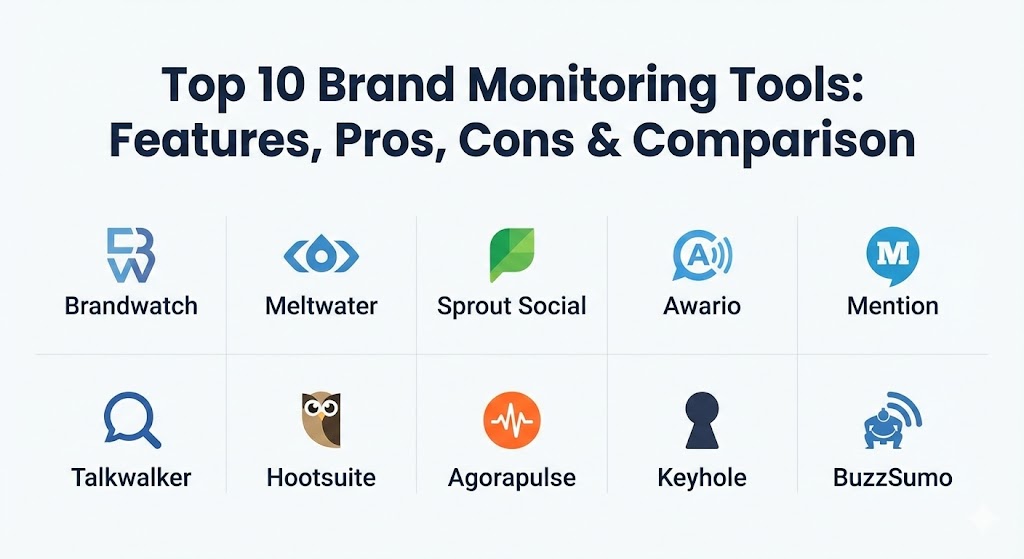
Top 10 Brand Monitoring Tools
1 — Brandwatch
Brandwatch is widely considered the gold standard for enterprise-level consumer intelligence. It offers deep historical data and sophisticated AI that goes beyond simple keyword matching to understand the “why” behind consumer behavior.
- Key features:
- Access to over 100 million data sources across the web.
- Advanced AI (Iris) that automatically identifies the root cause of “trend spikes.”
- Deep image recognition and logo detection in social media photos.
- Comprehensive competitor benchmarking and share-of-voice analysis.
- Customizable dashboards with granular filtering (demographics, location, sentiment).
- Integration with major social media management and CRM tools.
- Pros:
- Unparalleled data depth; if it’s on the internet, Brandwatch usually finds it.
- Highly sophisticated sentiment analysis that filters out sarcasm and noise effectively.
- Cons:
- One of the most expensive tools on the market, putting it out of reach for many SMBs.
- The interface is powerful but has a steep learning curve for new users.
- Security & compliance: SOC 2 Type II, GDPR, ISO 27001, and SSO integration for enterprise accounts.
- Support & community: Dedicated account managers for enterprise tiers; extensive training via Brandwatch Academy and a large global user community.
2 — Meltwater
Meltwater bridges the gap between traditional PR and modern social media monitoring. It is a favorite for communications teams that need to track both mainstream media and social conversations in a single platform.
- Key features:
- Global media monitoring covering news, print, and broadcast.
- Real-time social listening with unlimited keyword searches.
- Influencer discovery and management database.
- Automated PR reporting and media contact lists.
- Newsletter and newsfeed tools to share insights internally.
- AI-driven “Consumer Insights” module for market research.
- Pros:
- Exceptional coverage of traditional news outlets and paywalled content.
- All-in-one platform that handles both “listening” and “outreach” (PR).
- Cons:
- The platform can feel fragmented as features are often added through acquisitions.
- Long-term contracts are typically required, offering less flexibility for short-term projects.
- Security & compliance: GDPR, CCPA, SOC 2, and data encryption in transit and at rest.
- Support & community: 24/7 global support and a robust library of webinars and best-practice guides.
3 — Sprout Social
Sprout Social is primarily a social media management suite, but its “Listening” module is highly regarded for its usability and integration with daily social operations.
- Key features:
- Unified inbox to monitor and respond to brand mentions.
- Visualized sentiment tracking across Twitter, Instagram, and Reddit.
- Trend analysis to identify emerging topics in your industry.
- Competitor comparison reports based on social engagement metrics.
- Built-in CRM to track individual customer interactions over time.
- Automated “Query Builder” to simplify complex keyword monitoring.
- Pros:
- The most intuitive UI in the industry; very low training requirement.
- Seamlessly connects monitoring with action (replying to mentions).
- Cons:
- Social-heavy; not as strong for monitoring niche forums or traditional news.
- Pricing per-user can become very high for large, distributed teams.
- Security & compliance: SOC 2 Type II, SSO, GDPR, and HIPAA compliance readiness.
- Support & community: Excellent onboarding and a highly active “Sprout Stars” user community.
4 — Awario
Awario is designed for SMBs and individuals who need powerful monitoring without the enterprise price tag. It focuses on providing a “lean” experience with a focus on real-time alerts.
- Key features:
- Real-time monitoring across web, social, and news.
- “Boolean Search” capability for highly specific monitoring.
- Sentiment analysis to categorize mentions as positive, negative, or neutral.
- Reach-based sorting to prioritize mentions from influential sources.
- “Awario Leads” feature to find potential customers asking for recommendations.
- White-label reporting for small agencies.
- Pros:
- Highly affordable with a non-expiring historical data option.
- Very fast indexing; often finds mentions before larger, “heavier” tools.
- Cons:
- Limited historical data compared to Brandwatch or Talkwalker.
- Analytics dashboards are less customizable than enterprise competitors.
- Security & compliance: GDPR compliant and standard SSL encryption.
- Support & community: Responsive email and chat support; extensive documentation for DIY troubleshooting.
5 — Mention
Mention is a streamlined tool that focuses on “The Feed”—an organized stream of mentions that looks and feels like an email inbox. It is excellent for teams that prioritize responsiveness.
- Key features:
- Real-time “Pulse” alerts for sudden spikes in brand mentions.
- Competitive monitoring to track rival brands side-by-side.
- Influencer identification based on social reach.
- Automated reports delivered daily or weekly to your inbox.
- Multi-channel publishing capabilities for social media.
- Slack and Microsoft Teams integrations for instant notifications.
- Pros:
- Exceptional alert system that ensures you never miss a mention.
- Easy to use for cross-departmental teams (Sales, PR, and Support).
- Cons:
- The “noise” filter can sometimes be too aggressive, missing niche mentions.
- Higher tiers are required for advanced Boolean logic and deep analytics.
- Security & compliance: GDPR, SSO, and standard data privacy protocols.
- Support & community: Strong help center and dedicated support for “ProPlus” and “Company” tiers.
6 — Talkwalker
Talkwalker is an AI-powered social listening platform that specializes in global “Consumer Intelligence.” It is particularly strong in analyzing visual content and video.
- Key features:
- Video recognition technology to find brand logos in social clips.
- Proprietary “Blue Silk” AI for high-accuracy sentiment and context analysis.
- Coverage of over 187 languages and 30 social networks.
- “Conversation Clusters” to visualize how topics are interconnected.
- Forecasting features to predict how a trend will evolve.
- Deep integration with the Hootsuite ecosystem.
- Pros:
- Best-in-class visual and video monitoring capabilities.
- Excellent for global brands that need to monitor diverse languages and cultures.
- Cons:
- The complexity of the tool requires a dedicated power user to manage.
- Pricing is opaque and tends to be at the top end of the market.
- Security & compliance: SOC 2, GDPR, ISO 27001, and HIPAA compliance.
- Support & community: Enterprise-grade support and a structured certification program for users.
7 — Hootsuite (with Hootsuite Insights)
Hootsuite is a veteran in social media management, and its “Insights” (powered by Talkwalker) provides a deep-dive monitoring experience within the Hootsuite dashboard.
- Key features:
- Real-time social listening across all major networks.
- Visualized data streams to see “mood” changes over time.
- Automated tagging to categorize mentions (e.g., “Support,” “Lead,” “Fan”).
- Integration with over 250 apps in the Hootsuite App Directory.
- Best-of-breed scheduling and monitoring in a single view.
- Mobile app for monitoring on the go.
- Pros:
- Ideal for teams already using Hootsuite for scheduling and engagement.
- Centralizes all social activity, reducing the need to switch tabs.
- Cons:
- The “Insights” feature is a premium add-on that can be quite expensive.
- Not as strong for traditional print or deep-web monitoring.
- Security & compliance: FIPS 140-2, SOC 2 Type II, SSO, and GDPR.
- Support & community: Massive user base and one of the largest libraries of social media educational content (Hootsuite Academy).
8 — Agorapulse
Agorapulse is a social media management platform that focuses on “social inbox” efficiency, making it great for brands that view monitoring as an extension of customer service.
- Key features:
- Social listening for keywords and hashtags across Facebook, Instagram, and X.
- “Save Replies” to respond quickly to common brand mentions.
- Labeling and filtering systems to organize brand conversations.
- Detailed engagement and response-time reports.
- Mobile-friendly monitoring and management.
- Multi-user collaboration tools with internal notes on mentions.
- Pros:
- Extremely high customer satisfaction ratings for ease of use.
- Great for “closing the loop” on customer complaints found through monitoring.
- Cons:
- Limited monitoring of non-social sources (blogs, news, forums).
- Does not offer the deep AI-predictive analytics of enterprise tools.
- Security & compliance: GDPR, CCPA, and SSO for enterprise users.
- Support & community: Award-winning customer support and a very helpful “Social Media Manager” community.
9 — Keyhole
Keyhole specializes in real-time event and hashtag tracking. It is the preferred choice for brands that run many influencer campaigns or time-sensitive events.
- Key features:
- Real-time hashtag and keyword tracking.
- Influencer ROI tracking and impact analysis.
- Historical data for backdated campaign analysis.
- Sentiment and “Share of Voice” visualizations.
- Automated “Influencer Discovery” based on specific topics.
- Quick-share reporting links for stakeholders.
- Pros:
- Excellent for proving the ROI of specific marketing campaigns or events.
- Very visual reports that are ready for executive presentations.
- Cons:
- Not a “general” brand monitoring tool; very focused on hashtags and social handles.
- Limited coverage of traditional news or offline media.
- Security & compliance: GDPR compliant and standard data encryption.
- Support & community: Strong documentation and personalized onboarding for annual subscribers.
10 — BuzzSumo
BuzzSumo is unique because it focuses on content monitoring. It tracks how your brand’s content (and your competitors’) is being shared across the web and social media.
- Key features:
- “Content Alerts” for when your brand or a specific URL is mentioned.
- Backlink monitoring to see who is linking to your site in real-time.
- Trending feed to see what topics are viral in your industry.
- Influencer search based on what they share, not just their bio.
- YouTube and TikTok monitoring for video-specific trends.
- Competitive content analysis to see what your rivals are doing better.
- Pros:
- The best tool for content marketers and SEO professionals.
- Provides deep insight into “viral” potential and content resonance.
- Cons:
- Not a full “Social Listening” suite; it focuses on shares rather than conversations.
- Sentiment analysis is basic compared to Brandwatch or 6sense.
- Security & compliance: GDPR and CCPA compliant.
- Support & community: Robust help center and very helpful “how-to” guides for content strategy.
Comparison Table
| Tool Name | Best For | Platform(s) Supported | Standout Feature | Rating (Gartner/TrueReview) |
| Brandwatch | Enterprise Insights | Web, Social, News | Deep Image Recognition | 4.7 / 5 |
| Meltwater | PR & Media Intel | Global News, Social | Traditional News Depth | 4.4 / 5 |
| Sprout Social | User Experience | Social-only | Highly Intuitive UI | 4.8 / 5 |
| Awario | SMBs / Startups | Web, Social, News | Boolean Search Ease | 4.3 / 5 |
| Mention | Fast Alerts | Web, Social, News | Real-time “Pulse” Alerts | 4.2 / 5 |
| Talkwalker | Global Video/Audio | Social, Video, Pods | Video Logo Detection | 4.6 / 5 |
| Hootsuite | Unified Mgmt | Social-first | Massive App Ecosystem | 4.1 / 5 |
| Agorapulse | Customer Service | Social-only | Efficient Social Inbox | 4.7 / 5 |
| Keyhole | Influencer / Event | Social (Hashtags) | Real-time Campaign ROI | 4.4 / 5 |
| BuzzSumo | Content Marketers | Web, YouTube, TikTok | Backlink & Share Alerts | 4.5 / 5 |
Evaluation & Scoring of Brand Monitoring Tools
To select the right tool, we have applied a weighted scoring rubric that reflects the priorities of modern marketing teams in 2026.
| Category | Weight | Evaluation Criteria |
| Core Features | 25% | Data source depth, sentiment accuracy, and AI image/video recognition. |
| Ease of Use | 15% | Speed of setup, UI intuitiveness, and dashboard customization. |
| Integrations | 15% | Compatibility with CRMs, Slack, and social management platforms. |
| Security & Compliance | 10% | GDPR/HIPAA compliance, SSO, and enterprise data security. |
| Performance | 10% | Indexing speed (how fast a mention appears) and alert reliability. |
| Support & Community | 10% | Quality of documentation and speed of technical support. |
| Price / Value | 15% | Feature depth relative to cost; scalability for growing teams. |
Which Brand Monitoring Tool Is Right for You?
The “perfect” brand monitoring tool depends entirely on your organizational goals and the scale of your digital footprint.
- Solo Users vs SMBs: If you are a small team or a solo entrepreneur, start with Awario or Mention. These tools provide the essential alerts you need without the overwhelming complexity and cost of enterprise suites. They are easy to set up and provide instant value.
- Mid-Market Companies: If you have a dedicated social media or PR team, Sprout Social or Agorapulse are excellent choices. These tools offer the perfect balance of monitoring, engagement, and reporting, allowing your team to act on the data they find immediately.
- Enterprise & Global Brands: For large corporations, Brandwatch or Talkwalker are the only logical choices. The ability to monitor global trends in 100+ languages and detect your logo in background video content is essential for protecting a billion-dollar brand.
- PR and Communications Firms: If your focus is on traditional media, journalists, and print, Meltwater remains the industry leader for integrated media intelligence.
- Content and SEO Specialists: If your primary goal is to see who is sharing your articles and linking to your site, BuzzSumo is an indispensable addition to your stack.
Frequently Asked Questions (FAQs)
1. What is the difference between social listening and brand monitoring?
Brand monitoring is about finding specific mentions of your brand. Social listening is broader; it involves analyzing industry trends and competitor conversations to gain strategic insights.
2. Can these tools monitor private social media accounts?
No. Due to privacy laws (GDPR, CCPA) and platform restrictions, these tools can only monitor public profiles, pages, and mentions. Private messages and private profiles are inaccessible.
3. Do brand monitoring tools track “dark social”?
“Dark social” (links shared via private messaging apps like WhatsApp) is difficult to track directly. However, tools like BuzzSumo can estimate this impact by tracking the “sharing” activity on URLs.
4. How accurate is AI sentiment analysis?
In 2026, sentiment analysis is highly accurate (around 85-95%) but can still struggle with extreme sarcasm or highly niche industry jargon. Most enterprise tools allow for manual “sentiment correction.”
5. How much do these tools cost?
SMB tools start around $30–$100 per month. Enterprise platforms can cost anywhere from $1,000 to $10,000+ per month depending on the volume of data and number of users.
6. Do I need to know “Boolean Search” to use these tools?
Many modern tools have “Query Builders” that handle the logic for you, but knowing basic Boolean (AND, OR, NOT) helps in creating highly precise filters to reduce “noise.”
7. Can brand monitoring help with SEO?
Yes. By finding “unlinked mentions” (people talking about you without linking to your site), you can reach out and request a link, which is a powerful backlink-building strategy.
8. Is real-time monitoring actually real-time?
Most tools index the web within seconds or minutes. However, some traditional media sources (like print or niche blogs) may have a lag time of a few hours.
9. How do these tools handle “Logo Detection”?
Enterprise tools use computer vision AI to scan social media images and videos for your brand’s visual identity, even if your company name isn’t mentioned in the text caption.
10. What is the biggest mistake brands make with these tools?
The biggest mistake is “setting it and forgetting it.” Brand monitoring only works if there is a process in place to respond to or act upon the insights discovered.
Conclusion
The digital landscape of 2026 is louder and more complex than ever before. Choosing the right brand monitoring tool is not just a marketing luxury—it is a survival requirement. Whether you need the high-altitude data of an enterprise giant like Brandwatch or the surgical responsiveness of a tool like Mention, the key is to prioritize the data sources that matter most to your audience. The “best” tool is the one that transforms the noise of the internet into a clear, actionable signal for your brand.