Introduction
Bot Management Tools are specialized security solutions designed to identify, categorize, and mitigate automated traffic in real-time. Unlike traditional firewalls that rely on static IP blacklists, bot management platforms use behavioral analysis, machine learning, and device fingerprinting to distinguish between legitimate human users, helpful automated agents, and malicious scripts. They act as a sophisticated filter at the edge of your network, ensuring that your server resources are preserved for actual customers.
Why It Is Important
Bots impact more than just security; they affect the bottom line. Automated “scalping” bots can deplete inventory in seconds, leaving real customers frustrated. Scraper bots can steal proprietary pricing data or copyrighted content, eroding competitive advantages. Furthermore, the sheer volume of bot traffic can inflate infrastructure costs and skew marketing analytics, leading to poor business decisions based on “fake” engagement data.
Key Real-World Use Cases
- Credential Stuffing Prevention: Stopping bots from testing millions of leaked username/password combinations to hijack user accounts.
- Inventory Hoarding: Preventing scripts from adding items to carts to keep them away from legitimate buyers (common in ticketing and limited-release retail).
- Ad Fraud Detection: Ensuring that marketing spend is used on human clicks rather than automated scripts.
- Price Scraping: Protecting sensitive pricing strategies from competitors’ automated monitors.
Evaluation Criteria
When choosing a tool, prioritize accuracy (low false positives), performance (minimal latency impact), and evasion resistance (the tool’s ability to stay ahead of bot developers who use residential proxies and AI to mimic humans).
Best for: E-commerce platforms, airlines, financial institutions, ticketing agencies, and media companies. These tools are essential for Security Operations (SecOps) teams and CTOs of high-traffic digital properties.
Not ideal for: Small personal blogs or static informational sites with low traffic and no login portals, where the cost of an enterprise-grade bot manager would significantly outweigh the potential risk.
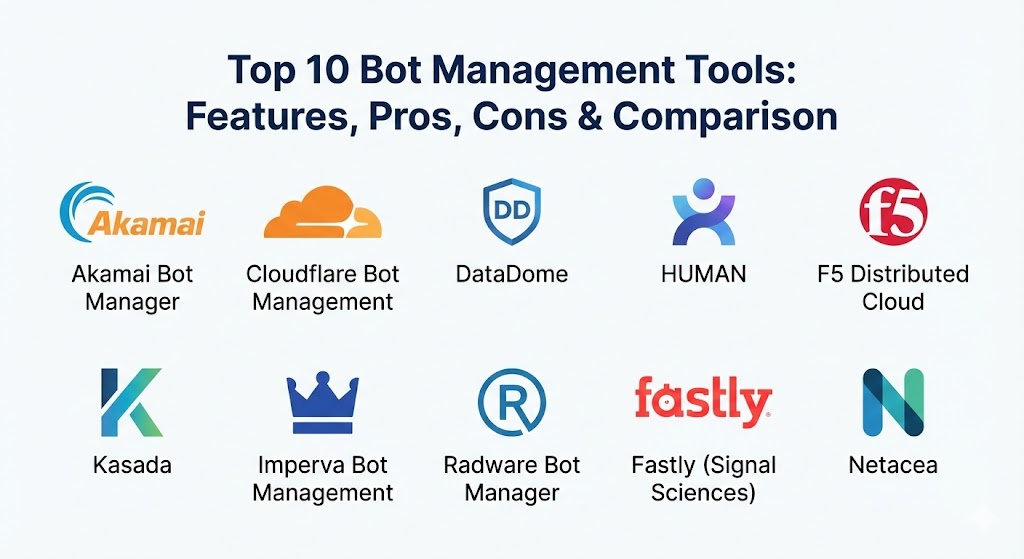
Top 10 Bot Management Tools
1 — Akamai Bot Manager
Akamai is widely considered the pioneer of the bot management category. Leveraging its massive global content delivery network (CDN), Akamai sees a significant percentage of the world’s internet traffic, allowing it to identify and categorize bot signatures before they ever reach your servers.
- Key Features:
- Bot Directory: Access to a continuously updated database of over 1,500 known “good” and “bad” bot signatures.
- Behavioral Telemetry: Collects hundreds of signals from browsers and mobile devices to detect human-like movement.
- Standardized Bot Score: Assigns a probability score to every request, allowing for granular response actions (allow, block, challenge).
- Mobile App Protection: Deep integration for native mobile applications to prevent API-based scraping.
- Tuning and Insights: Visual dashboards that show how bot traffic patterns change over time.
- Advanced Challenge Actions: Uses computational challenges rather than simple CAPTCHAs to preserve user experience.
- Pros:
- Unrivaled data visibility; they see more bot behavior than almost any other company on earth.
- Highly effective at protecting the most targeted enterprise-scale applications.
- Cons:
- One of the most expensive solutions in the market.
- Can be complex to configure without specialized Akamai training or professional services.
- Security & Compliance: SOC 2 Type II, ISO 27001, HIPAA, GDPR, and PCI DSS compliant.
- Support & Community: Enterprise-grade 24/7 support with dedicated technical account managers and a vast library of expert documentation.
2 — Cloudflare Bot Management
Cloudflare has built a reputation for making complex security accessible. Its bot management solution is natively integrated into its WAF (Web Application Firewall), allowing for a seamless “single pane of glass” experience for security administrators.
- Key Features:
- Machine Learning Models: Trained on 1/5th of the entire internet’s traffic to identify anomalies in real-time.
- Behavioral Analysis: Looks for patterns like excessive request speed or abnormal navigation paths.
- Verified Bot Program: Automatically allows “good bots” like Google and Bing to pass through without interruption.
- Fingerprinting: Uses non-PII (Personally Identifiable Information) signals to identify returning bots across different IPs.
- Workers Integration: Allows developers to write custom serverless code to handle bot traffic at the edge.
- Managed Rules: Ready-to-use rulesets that target specific bot-heavy industries.
- Pros:
- Excellent performance; the mitigation happens at the edge, meaning zero latency for the user.
- Transparent and predictable pricing for various tiers of service.
- Cons:
- The most sophisticated features are reserved for the Enterprise tier.
- Fine-tuning can sometimes be difficult if your application has very unique, non-standard traffic patterns.
- Security & Compliance: SOC 2 Type II, ISO 27001, PCI DSS, and GDPR compliant.
- Support & Community: Large community forum, extensive self-service documentation, and 24/7 technical support for higher tiers.
3 — DataDome
DataDome is a dedicated “pure-play” bot management specialist. Unlike CDN providers that offer bot management as an add-on, DataDome’s entire engineering focus is on automated threat detection, making them one of the most agile players in the space.
- Key Features:
- Real-time Detection: Analyzes every single request in under 2 milliseconds to make a block/allow decision.
- AI-Powered Engine: Combines behavioral, technical, and statistical analysis to find sophisticated bots.
- No-Code Integration: Can be deployed via simple modules for platforms like AWS, Nginx, or Cloudfront.
- Autopilot Mode: Uses AI to automatically adjust security settings without manual intervention from your team.
- CAPTCHA Integration: Features its own user-friendly, privacy-focused CAPTCHA alternative.
- Business Logic Protection: Specifically targets attacks like price scraping and account takeovers.
- Pros:
- The most developer-friendly integration process on this list.
- Highly accurate with an extremely low false-positive rate.
- Cons:
- As a standalone tool, it adds another vendor to your security stack if you already have a WAF provider.
- May be considered “too niche” for companies looking for an all-in-one infrastructure suite.
- Security & Compliance: GDPR, SOC 2 Type II, and ISO 27001 compliant.
- Support & Community: High-touch customer success, responsive 24/7 support, and detailed implementation guides.
4 — HUMAN (formerly PerimeterX)
HUMAN is a leader in modern defense against automated attacks. After their merger with PerimeterX, they became the dominant force in protecting the “digital journey,” focusing on everything from marketing fraud to account hijacking.
- Key Features:
- Human Verification Engine: Uses a “technical evidence” approach to prove a user is human without relying on CAPTCHAs.
- Credential Stuffing Defense: Deeply integrated tools to monitor and block leaked credential testing.
- Ad Fraud Protection: Specialized features to ensure ad spend is not wasted on bot-driven clicks.
- Account Takeover Protection: Monitors login behavior for signs of automated mass-testing.
- Client-side Visibility: Monitors third-party scripts running on your site for potential bot-driven data leaks.
- Pros:
- Exceptional at protecting the “user experience” by avoiding annoying traditional CAPTCHAs.
- Strongest focus on the marketing and advertising side of bot management.
- Cons:
- The transition/merger with PerimeterX created some temporary complexity in their product naming.
- Focused more on web applications than complex network-level bot management.
- Security & Compliance: SOC 2 Type II, GDPR, and HIPAA compliant.
- Support & Community: Enterprise support with specialized fraud analysts available for consulting.
5 — F5 Distributed Cloud Bot Defense
F5 acquired Shape Security to bolster its bot management capabilities. Known for protecting some of the world’s largest banks and airlines, this tool is designed for high-stakes environments where even a 1% failure rate is unacceptable.
- Key Features:
- Signal Collection: Ingests vast amounts of data from the device, network, and application layers.
- AI Root Cause Analysis: Not only blocks the bot but tells you exactly how the bot was designed to mimic a human.
- Mobile SDK: Lightweight SDK for iOS and Android to ensure mobile-app traffic is human.
- Managed Service Option: F5 engineers can manage the alerts and tuning for you.
- Retroactive Analysis: Ability to look back at previous traffic to see if a newly discovered bot signature was present in the past.
- Pros:
- The “heavy hitter” for financial services; unmatched at stopping credential stuffing.
- Excellent at handling “highly persistent” bots that change their IP and signatures constantly.
- Cons:
- Significant cost and complexity; definitely not for the SMB market.
- Integration can take longer than SaaS-only tools like Cloudflare or DataDome.
- Security & Compliance: FedRAMP authorized, SOC 2, ISO 27001, and HIPAA compliant.
- Support & Community: Elite 24/7 support with global “Security Operations Centers” (SOCs) at your disposal.
6 — Kasada
Kasada takes a radically different approach to bot management. Instead of trying to “detect” bots, they make it economically impossible for bots to attack you by increasing the computational cost for the attacker.
- Key Features:
- Dynamic Obfuscation: Changes your website’s code on every request so a bot cannot find the login button or data fields.
- Cryptographic Challenges: Forces the bot’s computer to solve complex math problems, draining the attacker’s server resources.
- Zero-Trust Approach: Assumes every request is a bot until it “proves” it is human via technical evidence.
- Invisible Defense: Operates without any user-facing challenges or CAPTCHAs.
- Rapid Response: Automatically detects and counters bot-builder adjustments in real-time.
- Pros:
- Truly unique “offensive” approach that actually deters attackers by making your site too expensive to hit.
- Zero impact on legitimate user experience since there are no puzzles to solve.
- Cons:
- The “obfuscation” approach can occasionally conflict with very specific custom JavaScript on the frontend.
- Less traditional “reporting” than tools that focus strictly on categorization.
- Security & Compliance: SOC 2 Type II, GDPR, and ISO 27001 compliant.
- Support & Community: Highly responsive technical team and a reputation for fast implementation.
7 — Imperva Bot Management
Imperva (now part of Thales) offers a highly mature bot management solution that is deeply integrated with its data-centric security suite. It is particularly strong at protecting the data layer from scrapers.
- Key Features:
- Intent-based Detection: Uses behavior to determine why a bot is on your site, not just what it is.
- Shared Threat Intelligence: Benefit from signatures identified across Imperva’s entire global customer base.
- Granular Control: Specific rules for different pages (e.g., stricter rules for login pages vs. blog pages).
- Mobile App & API Security: Specialized protection for non-browser traffic.
- API Discovery: Finds undocumented APIs that might be exposed to bot scraping.
- Pros:
- Very strong for “Data Privacy” concerns; helps align bot management with compliance like GDPR.
- Integrated beautifully with their WAF and DDoS protection.
- Cons:
- The user interface can feel a bit dated compared to modern “DevOps-first” tools.
- Some users find the configuration of custom rules to be less intuitive than competitors.
- Security & Compliance: SOC 2, HIPAA, PCI DSS, and GDPR compliant.
- Support & Community: Robust enterprise support and a large partner network for implementation.
8 — Radware Bot Manager
Radware focuses on the “Technical Signature” of bots. It is a favorite for organizations that need a highly granular, almost clinical approach to identifying bot-driven traffic.
- Key Features:
- Non-Invasive Challenges: Uses a variety of invisible challenges before falling back to CAPTCHAs.
- Device Fingerprinting: Identifies a device based on its hardware and software characteristics.
- IP Reputation: Cross-references traffic with known proxy and VPN services frequently used by botnets.
- Community Intelligence: Real-time sharing of bot signatures across the Radware network.
- Custom Mitigation Actions: Allows you to “trick” bots by feeding them fake data instead of blocking them.
- Pros:
- The “Deceptive Response” feature is excellent—you can make a scraper think it’s succeeding while giving it useless data.
- Strong technical support and high-performance hardware options for on-premise needs.
- Cons:
- The setup can be quite technical, requiring a good understanding of web protocols.
- The reporting suite is dense and might be overwhelming for non-security managers.
- Security & Compliance: ISO 27001, SOC 2, and GDPR compliant.
- Support & Community: Professional services-led onboarding and reliable 24/7 technical support.
9 — Fastly (Signal Sciences)
Fastly acquired Signal Sciences to bring next-generation WAF and bot management to its edge platform. This tool is built by developers, for developers, with a heavy emphasis on modern CI/CD workflows.
- Key Features:
- Smart Thresholds: Uses statistical analysis to identify bots without needing specific signatures.
- Proprietary Agent-based Architecture: Can be deployed in almost any environment (cloud, on-prem, containers).
- API-First Design: Every feature is accessible via an API for automated security management.
- Edge Deployment: Mitigation happens at the Fastly edge, keeping malicious traffic away from your origin.
- Low False Positives: Famous for its “Threshold-based Blocking” which minimizes accidental human blocks.
- Pros:
- The best choice for teams that want to manage security using code and DevOps tools.
- Incredibly fast and lightweight; adds almost zero latency to the request path.
- Cons:
- Requires a certain level of technical maturity to get the most out of the API.
- Not as specialized in “Marketing Fraud” as HUMAN.
- Security & Compliance: SOC 2 Type II, PCI DSS, HIPAA, and GDPR compliant.
- Support & Community: Excellent documentation and an active Discord/Slack community for developers.
10 — Netacea
Netacea is a UK-based challenger that has gained international attention for its “Intent-Based” approach. Instead of looking at how a request looks, it looks at the intent of the user’s entire session.
- Key Features:
- Session Analytics: Analyzes the entire user journey rather than individual requests.
- Business Logic Attack Protection: Focuses specifically on attacks that follow “legal” paths but with malicious intent.
- Agentless Integration: No need to install code on your web server; integrates via DNS or CDN.
- AI Data Models: Custom-built models for each client’s specific traffic patterns.
- Real-time Dashboards: Clear visualization of the economic impact of bot traffic.
- Pros:
- Very strong at catching “low and slow” bots that mimic human behavior perfectly on a single-request level.
- Does not require any JavaScript on the client-side, making it very privacy-friendly.
- Cons:
- Newer to the market, so the “Verified Bot” directory is smaller than Akamai or Cloudflare.
- May take longer to “learn” your specific traffic before it becomes highly effective.
- Security & Compliance: GDPR and ISO 27001 compliant.
- Support & Community: Known for a very collaborative, data-science-led support model.
Comparison Table
| Tool Name | Best For | Platform(s) Supported | Standout Feature | Rating (Gartner / TrueReviewnow) |
| Akamai Bot Manager | Large Enterprises | Global CDN | Massive Global Threat Data | 4.7 / 5 |
| Cloudflare Bot Mgmt | Speed & Simplicity | Global Edge | One-Click Integration | 4.6 / 5 |
| DataDome | Specialist Protection | Multi-Cloud / SaaS | 2ms Response Time | 4.8 / 5 |
| HUMAN | Marketing & Ad Fraud | SaaS / Client-side | Human Verification Engine | 4.5 / 5 |
| F5 Distributed Cloud | Financial Services | Cloud / On-Prem | Elite Credential Stuffing Def | 4.6 / 5 |
| Kasada | Frictionless Security | SaaS / Cloud | Computational Deterrence | 4.7 / 5 |
| Imperva | Data Scraping Defense | Cloud / Hybrid | Intent-based Detection | 4.4 / 5 |
| Radware | Technical Granularity | Cloud / On-Prem | Deceptive Response Action | 4.3 / 5 |
| Fastly | Modern DevOps Teams | Cloud / Edge | Threshold-based Blocking | 4.6 / 5 |
| Netacea | Session Intelligence | SaaS / Agentless | Intent-based Session Analysis | 4.4 / 5 |
Evaluation & Scoring of Bot Management Tools
The following table evaluates the bot management category based on the standard 2026 security requirements.
| Criteria | Weight | Evaluation Logic |
| Core Features | 25% | Credential stuffing defense, scraping protection, and behavioral analysis. |
| Ease of Use | 15% | Speed of integration, dashboard clarity, and automation capabilities. |
| Integrations | 15% | Native support for cloud providers (AWS/Azure), CDNs, and mobile SDKs. |
| Security & Compliance | 10% | Regulatory certifications, data privacy standards, and audit logging. |
| Performance | 10% | Latency impact on end-users and edge-processing capabilities. |
| Support & Community | 10% | Quality of technical docs, community activity, and support speed. |
| Price / Value | 15% | Transparency, ROI, and scalability of the pricing model. |
Which Bot Management Tool Is Right for You?
Choosing a bot manager is not a one-size-fits-all decision; it depends on your specific “threat profile” and technical stack.
Solo Users vs SMB vs Mid-Market vs Enterprise
- Solo Users/Devs: Cloudflare’s lower tiers are the most approachable. You get basic bot protection for a very low cost.
- SMBs: DataDome or Cloudflare are excellent. They are easy to install and don’t require a full-time security engineer to manage.
- Mid-Market: Kasada or Fastly are great choices. They offer sophisticated protection that won’t annoy your customers with CAPTCHAs.
- Enterprise: Akamai, F5, or HUMAN are the primary candidates. They offer the global scale and specialized fraud expertise that large corporations require.
Budget-Conscious vs Premium Solutions
If you have a limited budget, look for tools that bundle bot management with your existing CDN or WAF (like Cloudflare or Fastly). If budget is less of a concern than “zero failure,” F5 and Akamai are the premium solutions that provide the highest levels of deterrence.
Feature Depth vs Ease of Use
- Depth: F5 and Radware. You can tweak every single variable of the detection engine.
- Ease of Use: DataDome and Cloudflare. They are designed to be “set-and-forget” for most common threats.
Integration and Scalability Needs
If you have a complex hybrid-cloud setup, DataDome and F5 provide the most flexible deployment options. If you are 100% cloud-native and prioritize low latency, Cloudflare and Fastly‘s edge-based solutions are the most scalable.
Frequently Asked Questions (FAQs)
1. What is the difference between a WAF and a Bot Manager?
A WAF (Web Application Firewall) looks for “attacks” like SQL injection. A Bot Manager looks for “automated behavior.” A bot might not be trying to hack your server; it might just be trying to scrape your prices or buy all your sneakers.
2. Do I still need CAPTCHAs if I have a Bot Manager?
Ideally, no. Tools like Kasada and HUMAN aim to eliminate CAPTCHAs entirely. Most modern bot managers only show a challenge to the 0.1% of traffic that looks highly suspicious, significantly improving user experience.
3. Does bot management slow down my website?
If you choose an “Edge-based” provider like Cloudflare or Akamai, the impact is usually under 10ms. “Agentless” or “API-based” tools can add slightly more, but usually not enough for a human to notice.
4. How do bots bypass these tools?
Sophisticated attackers use “Residential Proxies” to make their bots look like they are coming from a normal home IP. They also use AI to mimic human mouse movements and keystroke patterns.
5. Can a Bot Manager distinguish between “Good” and “Bad” bots?
Yes. Professional tools maintain a “Verified Bot” directory. They will automatically allow Googlebot (search) or Stripe (payments) to pass through while blocking malicious scrapers.
6. Is bot management expensive?
For enterprise-level protection, yes. However, many companies find that the tool pays for itself by reducing infrastructure costs (less fake traffic) and preventing high-cost incidents like account takeovers.
7. Can I protect my mobile app from bots?
Yes. Most of the top 10 tools offer a “Mobile SDK” that you can embed in your iOS or Android app to ensure that requests are coming from a real app and not an emulator.
8. What is “Credential Stuffing”?
It is when a bot takes a list of leaked passwords from one site and tries them on your site. Bot managers are the primary defense against this type of automated account hijacking.
9. Will bot management hurt my SEO?
Not if configured correctly. High-quality tools are designed to recognize and white-list search engine crawlers (Google, Bing, etc.) automatically.
10. How long does it take to implement these tools?
Cloud-native tools like Cloudflare or DataDome can be implemented in a few hours. More complex enterprise deployments (like F5) can take several weeks of tuning and integration.
Conclusion
Bot management has become a critical battleground in the 2026 security landscape. The “best” tool is the one that successfully defends your business logic without creating a hostile experience for your human customers.
For the vast majority of companies, DataDome and Cloudflare offer the best combination of modern AI detection and ease of use. If you are a high-target enterprise or a financial institution, the deep defensive capabilities of Akamai or F5 are worth the investment. Remember, a bot manager is not just a security purchase; it’s a commitment to preserving the integrity of your digital customer journey.