Introduction
A B2B Customer Portal is a secure, web-based platform that serves as a centralized digital hub for business-to-business interactions. It provides clients with 24/7 self-service access to account information, order history, technical documentation, support ticketing, and personalized pricing. Unlike B2C portals, B2B portals are engineered to handle high-level complexities such as multi-user corporate accounts, role-based permissions, and deep integrations with backend ERP (Enterprise Resource Planning) and CRM systems.
The importance of these portals lies in their ability to drive operational efficiency and customer loyalty. By empowering buyers to track their own orders or download their own invoices, companies can reduce their cost-to-serve by up to 20% while simultaneously increasing client satisfaction. Key real-world use cases include managing complex wholesale orders, facilitating secure document exchanges in legal or financial services, and providing collaborative workspaces for long-term project milestones. When evaluating tools, users should prioritize seamless backend integration, mobile responsiveness, advanced security (SSO/MFA), and the ability to white-label the interface to maintain brand consistency.
Best for: Manufacturers, wholesalers, professional service firms (legal/consulting), and SaaS companies that manage high-value, long-term relationships requiring frequent data exchange and transactional transparency.
Not ideal for: One-time transactional businesses with very low order complexity or micro-businesses where the overhead of maintaining a portal exceeds the manual effort of direct communication.
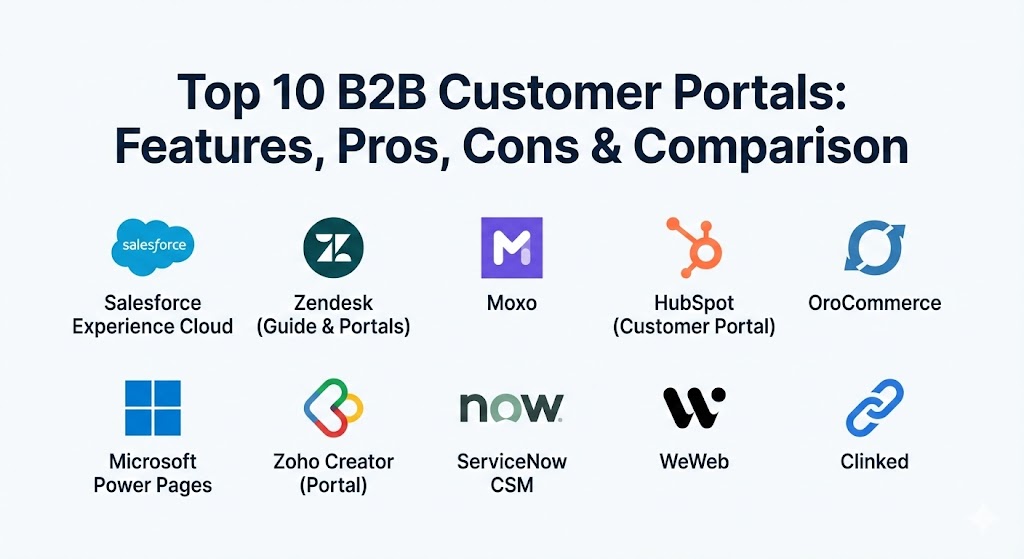
Top 10 B2B Customer Portals Tools
1 — Salesforce Experience Cloud
Salesforce Experience Cloud is the gold standard for enterprises already deeply embedded in the Salesforce ecosystem. It allows businesses to build highly customized, data-rich portals that pull directly from their CRM.
- Key features:
- Native integration with Salesforce CRM, Sales, and Service Clouds.
- Drag-and-drop “Experience Builder” with pre-built industry templates.
- Robust role-based access control (RBAC) for complex corporate hierarchies.
- AI-powered personalization and content recommendations.
- Knowledge base integration for advanced self-service.
- Support for Lightning Components for deep technical customization.
- Pros:
- Unmatched scalability and customization for large global enterprises.
- Unified data view—updates in the CRM reflect in the portal instantly.
- Cons:
- Extremely high total cost of ownership (TCO) including licensing and implementation.
- Requires specialized “Salesforce Admin” expertise to manage and build.
- Security & compliance: SOC 2 Type II, HIPAA, GDPR, ISO 27001, and advanced SSO/MFA capabilities.
- Support & community: Massive global community (Trailhead), extensive documentation, and premium enterprise support tiers.
2 — Zendesk (Guide & Portals)
While widely known for support, Zendesk offers a refined customer portal experience that excels in ticket transparency and knowledge sharing. It is ideal for service-heavy B2B relationships.
- Key features:
- Centralized ticket tracking and history for all support interactions.
- Custom branding and white-labeling for a seamless user experience.
- AI-driven “Answer Bot” to deflect common inquiries.
- Integrated community forums for peer-to-peer customer support.
- Multi-language support for international client bases.
- Granular visibility into “Team” tickets for corporate accounts.
- Pros:
- Best-in-class user interface; very intuitive for both admins and clients.
- Quick deployment compared to full-scale CRM platforms.
- Cons:
- Limited functionality for transaction-heavy needs (e.g., complex order management).
- Can feel like a “support-only” tool rather than a comprehensive business hub.
- Security & compliance: SOC 2, HIPAA, GDPR, and ISO 27001 compliant.
- Support & community: Robust documentation and a highly active global user community.
3 — Moxo (OneStop Portal)
Moxo, formerly known as Moxtra, specializes in “OneStop” portals designed specifically for high-touch service industries like banking, law, and consulting. It focuses on the “flow” of a client project.
- Key features:
- Secure messaging and video conferencing embedded within the portal.
- E-signature integration for seamless contract approvals.
- Visual task management and project timelines for clients.
- Structured file repositories with strict version control.
- Mobile-first design with native iOS and Android apps.
- Digital “binder” view for organized document collections.
- Pros:
- Excellent for “closing the loop” on projects rather than just sharing data.
- Reduces the need for fragmented tools like Slack, Zoom, and DocuSign.
- Cons:
- Less emphasis on traditional eCommerce or catalog management.
- Integration with legacy ERPs can be more challenging than SaaS-native tools.
- Security & compliance: SOC 2 Type II, HIPAA, GDPR, and AES-256 encryption.
- Support & community: Personalized onboarding and dedicated customer success managers for enterprise accounts.
4 — HubSpot (Customer Portal)
HubSpot’s customer portal is a natural extension of its “all-in-one” platform, designed to give SMBs and mid-market firms a professional way to manage support and ticket visibility.
- Key features:
- Native integration with HubSpot CRM, Marketing, and Service Hubs.
- Shared inbox visibility for customers to see all historical communication.
- Customized branding options to match company websites.
- Knowledge base integration for instant self-service.
- Automated ticket status updates.
- Mobile-responsive design for on-the-go access.
- Pros:
- Very easy to set up for existing HubSpot users.
- Offers a generous “free” tier for companies just starting their portal journey.
- Cons:
- Advanced customization requires higher-tier “Service Hub” licenses.
- Not as robust for managing complex B2B inventory or bulk order logic.
- Security & compliance: SOC 2, GDPR, and HIPAA (with Enterprise tier) compliant.
- Support & community: Extensive HubSpot Academy resources and a massive user ecosystem.
5 — OroCommerce
OroCommerce is a dedicated B2B eCommerce platform that includes a powerful, out-of-the-box customer portal. It is built specifically for manufacturers and distributors.
- Key features:
- Corporate account management (multiple users/roles per buyer).
- Custom price lists and catalogs for specific client contracts.
- RFQ (Request for Quote) workflow management.
- Native integration with ERPs like SAP and Microsoft Dynamics.
- Support for multiple websites and organizations from a single backend.
- Complex order approval workflows (e.g., manager approval for large buys).
- Pros:
- Built for B2B from the ground up; no need to “hack” B2C features.
- Extremely robust for wholesale and distribution workflows.
- Cons:
- Higher learning curve due to the complexity of features.
- Interface can feel a bit more “industrial” and less “modern” than SaaS-only tools.
- Security & compliance: GDPR, PCI DSS, and ISO compliant.
- Support & community: Strong partner network and extensive developer documentation.
6 — Microsoft Dynamics 365 Power Pages
Power Pages (formerly Power Apps Portals) is Microsoft’s low-code solution for building secure, data-driven business websites. It is the go-to for organizations running on the Microsoft stack.
- Key features:
- Deep integration with Dataverse and Dynamics 365.
- Low-code visual studio for rapid portal prototyping.
- Role-based security integrated with Azure Active Directory.
- Support for advanced business logic via Power Automate.
- Templates for partner management and customer self-service.
- Ability to expose any internal business data securely to external users.
- Pros:
- Seamless if you are already using the Microsoft Power Platform.
- Very flexible—you can build almost any type of portal logic.
- Cons:
- The licensing can be confusing and expensive as traffic grows.
- Requires a “Power Platform” mindset which has a specific learning curve.
- Security & compliance: Azure AD, SOC 2, GDPR, HIPAA, and ISO.
- Support & community: Extensive enterprise support and a huge global network of Microsoft Partners.
7 — Zoho Creator (Portal)
Zoho Creator allows businesses to build custom customer portals using a low-code environment. It is perfect for budget-conscious companies needing unique business logic.
- Key features:
- Drag-and-drop portal builder with custom branding.
- Integrated database management for unique client data.
- Workflow automation using Zoho’s Deluge scripting language.
- Native mobile apps for every portal created.
- Multi-user support with custom permission sets.
- Secure payment gateway integrations.
- Pros:
- Highly affordable compared to Salesforce or Microsoft.
- Extremely flexible for “non-standard” B2B business models.
- Cons:
- Building a portal from scratch takes more time than using a “turnkey” solution.
- Deluge scripting can be a barrier for non-technical users.
- Security & compliance: SOC 2, ISO 27001, GDPR, and HIPAA compliant.
- Support & community: Strong documentation and a supportive community of Zoho users.
8 — ServiceNow Customer Service Management (CSM)
ServiceNow is an enterprise powerhouse that treats customer service as a structured workflow. Its portal is designed for complex, technical B2B support and service request management.
- Key features:
- Unified portal for all customer requests and interactions.
- Proactive customer service with AI-driven anomaly detection.
- Deep ITSM integration for technical software/hardware clients.
- Visual workflow designer for complex service requests.
- Performance analytics and real-time dashboards for clients.
- Knowledge management with version control and approvals.
- Pros:
- Exceptional for technical B2B support (e.g., IT, hardware, telecom).
- Provides a very high level of “transparency” into internal workflows.
- Cons:
- One of the most expensive and complex tools on the list.
- Often overkill for simple “order and pay” business models.
- Security & compliance: FedRAMP, SOC 1/2, ISO, HIPAA, and GDPR.
- Support & community: World-class enterprise support and a large “Knowledge” conference community.
9 — WeWeb
WeWeb is a modern “no-code” front-end builder that allows companies to build stunning customer portals on top of their existing backends (like Airtable, Supabase, or REST APIs).
- Key features:
- Advanced UI/UX design capabilities without writing code.
- “Connect to anything” model—keep your data wherever it lives.
- Granular roles and permissions logic built into the front-end.
- Ability to export the portal as a standard Vue.js application.
- Seamless SEO and fast loading times.
- Modern, clean templates for dashboards and portals.
- Pros:
- Provides the most “modern” look and feel for a client portal.
- No vendor lock-in for your data; the portal is just the “glass” layer.
- Cons:
- Requires you to manage your own backend/database separately.
- Not a “turnkey” solution; requires some design and data-structure knowledge.
- Security & compliance: Supports SSO (Auth0/SAML), SOC 2, and GDPR-compliant data handling.
- Support & community: Excellent documentation and a very helpful Discord community.
10 — Clinked
Clinked is a secure client portal focused on collaboration and document management. It is a favorite among legal, financial, and accounting firms.
- Key features:
- Secure white-labeled file sharing and storage.
- Integrated task management and project discussions.
- Custom branding including custom domains and emails.
- “Smart Folders” for automated document organization.
- Audit logs to track every user interaction with a file.
- Mobile app availability for clients.
- Pros:
- Extremely fast setup; you can have a portal live in minutes.
- Focuses on “security-first” for regulated document sharing.
- Cons:
- Limited transactional or eCommerce functionality.
- Not designed for high-volume ticket management.
- Security & compliance: ISO 27001, FISMA, GDPR, and HIPAA compliant.
- Support & community: High-touch customer support with dedicated account managers.
Comparison Table
| Tool Name | Best For | Platform(s) Supported | Standout Feature | Rating (Gartner/TrueReview) |
| Salesforce Experience | Global Enterprises | Cloud / Mobile | Deepest CRM Integration | 4.6 / 5 |
| Zendesk Portals | Service-Heavy SMBs | Cloud / Mobile | Best Support Interface | 4.4 / 5 |
| Moxo | High-Touch Services | Cloud / Native App | Embedded Collaboration | 4.7 / 5 |
| HubSpot Portal | Growing SMBs | Cloud / Mobile | “All-in-One” Simplicity | 4.5 / 5 |
| OroCommerce | Wholesalers / Mfg | On-Prem / Cloud | B2B-Native Commerce | 4.3 / 5 |
| Power Pages | Microsoft Ecosystem | Azure / Cloud | Low-Code Dataverse Link | 4.4 / 5 |
| Zoho Creator | Unique Logic / Budget | Cloud / Native App | Affordability & Flexibility | 4.5 / 5 |
| ServiceNow CSM | Technical Support | Cloud / Mobile | Workflow Orchestration | 4.5 / 5 |
| WeWeb | Design-Focused Portals | Cloud / Self-Host | Backend-Agnostic UI | 4.8 / 5 |
| Clinked | Document Security | Cloud / Mobile | White-Label Simplicity | 4.6 / 5 |
Evaluation & Scoring of B2B Customer Portals
The following table evaluates the key categories that define a successful portal implementation.
| Category | Weight | Key Evaluation Metric |
| Core Features | 25% | Ability to handle corporate accounts, custom pricing, and roles. |
| Ease of Use | 15% | Intuitiveness for the end-client and the admin setup speed. |
| Integrations | 15% | Depth of connection to ERP, CRM, and Payment Gateways. |
| Security & Compliance | 10% | Presence of SOC 2, GDPR, HIPAA, and SSO/MFA options. |
| Performance | 10% | Load times for large catalogs and mobile responsiveness. |
| Support & Community | 10% | Quality of documentation and access to developer help. |
| Price / Value | 15% | Scalability of the pricing model as user count grows. |
Which B2B Customer Portal Tool Is Right for You?
Selecting the right portal depends on where your business data currently lives and what your customers actually need to do.
- Solo Users vs SMBs: If you are a small agency, Clinked or HubSpot offer the best balance of simplicity and professional polish. They are easy to set up and require zero coding.
- Budget-Conscious Teams: Zoho Creator is the winner for those who need custom functionality without the enterprise price tag. It allows you to build exactly what you need at a fraction of the cost.
- Enterprise Giants: If you are already on Salesforce or Microsoft Dynamics, stick to their native portal offerings (Experience Cloud or Power Pages). The cost of “switching” data sources is usually higher than the licensing fees.
- Manufacturers & Wholesalers: OroCommerce is non-negotiable if your business relies on complex price lists, bulk ordering, and deep ERP sync.
- Regulated Industries: Firms in finance or law should look at Moxo or Clinked, which prioritize secure document “binders” and e-signature workflows.
Frequently Asked Questions (FAQs)
1. What is the main difference between a B2B and B2C portal? B2C portals focus on simple, high-volume transactions. B2B portals handle high-complexity tasks like tiered pricing, credit limits, multi-user approval workflows, and contract-specific catalogs.
2. Can I build a portal without being a developer? Yes. Tools like HubSpot, Moxo, and WeWeb are designed for “no-code” or “low-code” users, allowing marketing or ops teams to manage the interface.
3. Is it possible to integrate my existing ERP? Most enterprise tools like OroCommerce and Salesforce have pre-built connectors for major ERPs like SAP, Oracle, and NetSuite. For smaller tools, you may need a middleware like Zapier.
4. How much does a B2B portal cost? Pricing ranges from $50/month for basic tools to $100,000+ per year for enterprise solutions like ServiceNow or Salesforce, depending on the number of users and complexity.
5. Are customer portals mobile-friendly? In 2026, mobile responsiveness is standard. However, if your clients need offline access or push notifications, you should look for tools that offer native mobile apps like Moxo or Zoho.
6. Is security the biggest concern for B2B portals? Yes. Because portals expose sensitive business data (pricing, invoices, PII), having SSO, MFA, and SOC 2 compliance is critical to protecting both your firm and your clients.
7. Can I white-label my portal? Almost all high-quality B2B tools allow for “White-Labeling,” meaning the portal lives on your own domain (e.g., https://www.google.com/search?q=portal.yourcompany.com) and uses your logos and colors.
8. Do portals reduce support costs? Studies show that 70% of B2B buyers prefer self-service. By letting clients find their own answers, companies often see a 20-40% reduction in simple support tickets.
9. Can I manage multiple companies in one portal? Yes, most enterprise-grade portals support “multi-tenancy” or “corporate account” structures where one master account can manage several sub-users or office locations.
10. How long does implementation take? A “plug-and-play” portal like Clinked can go live in a day. A complex Salesforce or ServiceNow implementation can take 6 to 12 months of planning and configuration.
Conclusion
A B2B Customer Portal is no longer just a “window” into your database; it is the primary interface of your modern business relationship. Choosing the right tool requires looking past the “flashy” features and ensuring the plumbing—the security, the data sync, and the user roles—is rock solid. Whether you prioritize the enterprise scale of Salesforce or the design-led agility of WeWeb, the ultimate goal remains the same: making it effortless for your customers to do business with you.