Introduction
Automated Machine Learning, or AutoML, is the process of automating the end-to-end tasks of applying machine learning to real-world problems. Historically, building a high-performing model required a specialized data scientist to manually handle data preprocessing, feature engineering, model selection, and hyperparameter tuning—a process that could take months. AutoML platforms automate these technical bottlenecks, providing a “factory line” for AI that ensures high-quality results with significantly less manual intervention.
The importance of AutoML lies in its ability to scale intelligence. By 2026, it is estimated that over 55% of all new enterprise machine learning models are created through automated pipelines. This shift allows skilled data scientists to focus on higher-level strategy while empowering business analysts and engineers to contribute to the AI lifecycle. Key real-world use cases include real-time fraud detection in fintech, predictive maintenance in manufacturing, demand forecasting for global supply chains, and personalized patient care in healthcare.
When choosing an AutoML tool, users should evaluate platforms based on several critical criteria: automation depth (does it handle feature engineering?), transparency (is it a “black box” or does it show the code?), scalability (can it handle petabytes of data?), and deployment ease (how fast can a model reach production?).
Best for: Data science teams looking to accelerate their workflow, business analysts at mid-to-large enterprises, and IT departments in highly regulated industries (finance, healthcare, insurance) that require robust governance and audit trails.
Not ideal for: Pure academic researchers who need to invent entirely new neural architectures from scratch or small startups with very limited, non-standard datasets where manual, bespoke coding is more effective than a generalized automation engine.
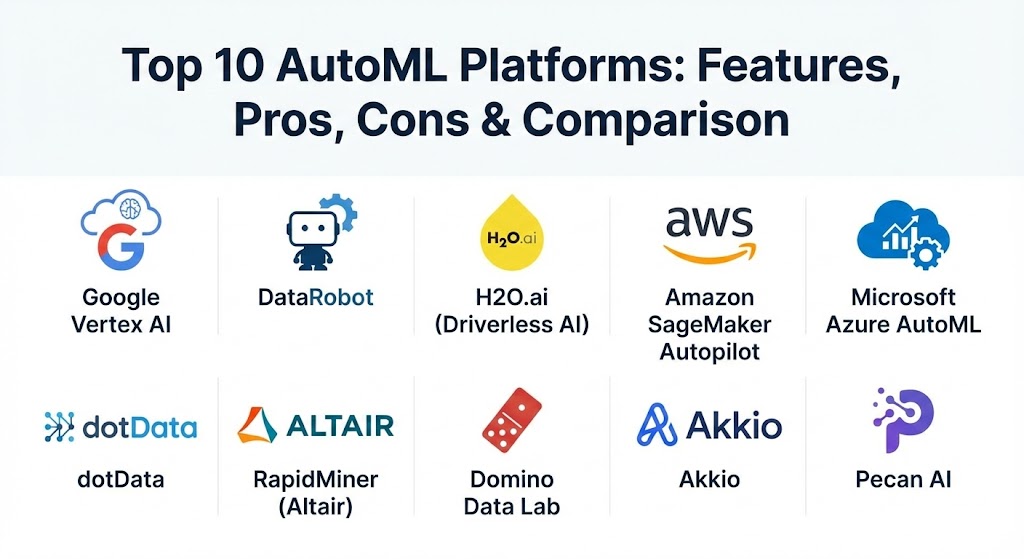
Top 10 AutoML Platforms Tools
1 — Google Vertex AI (AutoML)
Google Vertex AI is a unified machine learning platform that integrates Google Cloud’s legacy AutoML services into a single environment. It leverages Google’s world-class research in Neural Architecture Search (NAS) to build models that often outperform manually tuned ones.
- Key features:
- Native support for tabular, image, video, and text data types.
- Neural Architecture Search (NAS) for optimizing deep learning models.
- Integrated Feature Store for sharing and reusing ML features.
- Model Monitoring to detect training-serving skew and drift.
- Seamless integration with BigQuery for serverless data analysis.
- End-to-end MLOps pipelines for automated retraining and deployment.
- Pros:
- Exceptional performance for deep learning and vision-based tasks.
- Highly scalable, benefiting from Google’s global cloud infrastructure.
- Cons:
- Can become expensive for massive datasets or frequent high-performance training.
- The UI can be complex for users not already familiar with the Google Cloud ecosystem.
- Security & compliance: SOC 1/2/3, ISO 27001, HIPAA, GDPR, FedRAMP, and VPC Service Controls for data isolation.
- Support & community: Extensive documentation, Google Cloud premium support, and a massive global community of GCP developers.
2 — DataRobot
Widely considered the pioneer of the enterprise AutoML category, DataRobot offers a highly polished platform that focuses heavily on business ROI, governance, and ease of deployment across any environment.
- Key features:
- Massive library of “Blueprints” representing thousands of open-source and proprietary models.
- Advanced automated feature engineering and data preparation.
- Integrated AI Governance to manage risk and compliance throughout the lifecycle.
- Visual model interpretability tools (SHAP, Partial Dependence, Feature Importance).
- No-code application builder to turn models into business-facing tools.
- Support for time-series, location, and text data.
- Pros:
- Best-in-class “explainability” features, crucial for regulated industries.
- Extremely intuitive UI that appeals to both analysts and expert data scientists.
- Cons:
- High cost of entry; typically priced for mid-market and enterprise organizations.
- Requires a significant initial commitment to training to master the governance features.
- Security & compliance: SOC 2 Type II, ISO 27001, HIPAA, GDPR, and FedRAMP (via authorized cloud partners).
- Support & community: High-touch customer success teams, “University of DataRobot” training, and a strong enterprise-focused user community.
3 — H2O.ai (Driverless AI)
H2O.ai provides a platform that blends high-performance automation with “Kaggle-winning” methodologies. It is favored by data scientists who want high accuracy and transparency in their automated pipelines.
- Key features:
- Genetic algorithm-based automatic feature engineering.
- Machine Learning Interpretability (MLI) with diverse visualization methods.
- Low-latency “MOJO” and “POJO” deployment for real-time scoring.
- H2O LLM Studio for fine-tuning large language models without code.
- Support for a wide range of loss functions and custom scorers.
- On-premise, cloud, and hybrid deployment flexibility.
- Pros:
- Unrivaled for creating high-accuracy models for tabular and time-series data.
- Highly transparent, allowing experts to inspect and tweak every stage of the pipeline.
- Cons:
- Steeper learning curve compared to “black box” competitors.
- The open-source and enterprise versions have separate lifecycles, which can be confusing.
- Security & compliance: SOC 2 Type II, HIPAA, GDPR, and ISO 27001; supports air-gapped deployments for high-security sites.
- Support & community: Vibrant open-source community, highly technical enterprise support, and a reputation for fast response times.
4 — Amazon SageMaker Autopilot
Amazon’s AutoML offering is deeply embedded in the SageMaker ecosystem, providing high-scale automation with a focus on full visibility and developer control.
- Key features:
- Transparent model generation; Autopilot creates Python notebooks for every experiment.
- Automated data cleaning, preprocessing, and feature engineering.
- Integration with SageMaker Canvas for a no-code visual interface.
- Support for tabular datasets and regression/classification objectives.
- Built-in experiment tracking and model lineage.
- Direct connection to Amazon Bedrock for generative AI integrations.
- Pros:
- Complete visibility—you can see exactly what code the AutoML engine wrote.
- Deeply integrated with the AWS stack (S3, Redshift, Lake Formation).
- Cons:
- Lacks the vision and video AutoML depth found in Google Vertex AI.
- Mastering the full SageMaker ecosystem requires substantial AWS expertise.
- Security & compliance: SOC 1/2/3, ISO 27001, HIPAA, GDPR, and FedRAMP High.
- Support & community: AWS Enterprise Support, extensive AWS training resources, and the largest cloud developer community globally.
5 — Microsoft Azure AutoML
Azure AutoML provides a robust, cloud-integrated experience that is particularly well-suited for organizations that rely on the Microsoft software stack.
- Key features:
- Integrated “Responsible AI” dashboard for fairness and bias detection.
- Automated training for classification, regression, and time-series forecasting.
- Support for both Python SDK and a visual drag-and-drop designer.
- Native integration with Microsoft Fabric and Power BI.
- ONNX support for cross-platform model deployment.
- Automated hyperparameter tuning and model selection.
- Pros:
- Excellent governance and “responsible AI” features built into the core.
- The easiest choice for teams already using Azure Data Factory or Synapse.
- Cons:
- The user interface can feel fragmented across different Azure portal sections.
- Some advanced features are heavily locked into the Azure-specific data formats.
- Security & compliance: ISO 27001, SOC 1/2/3, HIPAA, GDPR, and FedRAMP High.
- Support & community: Microsoft Unified Support, Azure Learn resources, and a very strong enterprise user base.
6 — dotData
dotData focuses on “Full-Cycle Data Science Automation,” with a specific strength in automating the most time-consuming part of machine learning: feature engineering from complex, multi-table data.
- Key features:
- “AI-Powered Feature Engineering” that discovers patterns across hundreds of tables.
- Full-cycle automation from raw database tables to production APIs.
- dotData Stream for real-time streaming feature engineering and scoring.
- Support for time-series and transactional data.
- Transparent SQL and Python code generation for engineered features.
- Pros:
- Superior at handling complex relational databases without manual data joining.
- Highly efficient at reducing the time spent on “data munging.”
- Cons:
- Not designed for image or video data; strictly focused on tabular/structured data.
- Smaller third-party integration ecosystem compared to the big cloud providers.
- Security & compliance: SOC 2 Type II, GDPR, and strong SSO support.
- Support & community: Dedicated professional services and account management for enterprise customers.
7 — RapidMiner (Altair)
Now part of the Altair family, RapidMiner is a legacy leader that has successfully modernized into a collaborative platform offering both visual workflows and automated “Turbo Prep.”
- Key features:
- Visual workflow designer with hundreds of drag-and-drop operators.
- RapidMiner Go for simplified, web-based AutoML for business users.
- Real-time model scoring and deployment through RapidMiner AI Hub.
- Integrated data preparation and cleansing tools.
- Support for text mining and sentiment analysis.
- Strong “Project Governance” features for tracking team progress.
- Pros:
- The visual workflow makes it popular in academic and industrial settings.
- Excellent for teams that want a mix of automated and manual modeling.
- Cons:
- The client-side software can be heavy on system resources.
- Pricing transitions under Altair have led to some licensing confusion for legacy users.
- Security & compliance: SOC 2 Type II, GDPR, and ISO 27001.
- Support & community: Large user community, comprehensive documentation, and a strong focus on educational support.
8 — Domino Data Lab
Domino Data Lab acts as an orchestration layer for data science, allowing teams to use their preferred AutoML tools (like H2O or SageMaker) within a unified, governed environment.
- Key features:
- “Domino Flows” for automated and repeatable data science pipelines.
- Multi-cloud and hybrid infrastructure management.
- Integrated Model Monitoring and governance.
- Support for R, Python, SAS, and MATLAB.
- Reproducibility engine that tracks data, code, and environment snapshots.
- Pros:
- Best-in-class for “reproducibility”—vital for scientific and financial research.
- Allows teams to avoid “vendor lock-in” by using any underlying AutoML engine.
- Cons:
- It is a “platform of platforms,” which adds a layer of complexity for smaller teams.
- Not an AutoML engine itself, but a manager of them.
- Security & compliance: SOC 2 Type II, HIPAA, GDPR, and ISO 27001; highly used in defense and pharma.
- Support & community: Enterprise-grade support with a focus on highly regulated large-scale organizations.
9 — Akkio
Akkio is a modern, high-speed AutoML tool designed specifically for business users, marketing agencies, and sales operations who need to deploy models in minutes.
- Key features:
- “Chat with your Data” feature for natural language data analysis.
- Lightning-fast model training (seconds to minutes).
- Direct integrations with HubSpot, Salesforce, Snowflake, and Google Sheets.
- Simple API for embedding predictions into third-party apps.
- Automated lead scoring and churn prediction templates.
- Pros:
- The lowest barrier to entry in the entire market.
- Extremely fast time-to-value for standard business use cases.
- Cons:
- Lacks the deep “expert mode” features found in H2O.ai or SageMaker.
- Not suitable for very complex deep learning or massive unstructured datasets.
- Security & compliance: SOC 2, GDPR, and AES-256 encryption at rest and in transit.
- Support & community: Live chat support, extensive video tutorials, and a user-friendly knowledge base.
10 — Pecan AI
Pecan AI focuses on “Predictive Analytics for Business Teams,” specializing in the automated restructuring of raw data into ML-ready formats for marketing and sales.
- Key features:
- Automated “Data Restructuring” that handles the logic of time-series business data.
- Specialized for Customer Lifetime Value (LTV) and churn prediction.
- No-code interface for building and deploying models.
- Automated data quality checks and cleansing.
- Direct data connectors for common SaaS business tools.
- Pros:
- Solves the specific problem of formatting messy business data for ML.
- Highly specialized for marketing teams who don’t have internal data scientists.
- Cons:
- Narrow focus on marketing/sales analytics; not a general-purpose ML platform.
- Pricing is targeted at corporate marketing budgets.
- Security & compliance: SOC 2 Type II, HIPAA, and GDPR compliant.
- Support & community: High-touch professional services and dedicated account management for enterprise clients.
Comparison Table
| Tool Name | Best For | Platform(s) Supported | Standout Feature | Rating (Gartner / TrueReview) |
| Google Vertex AI | GCP Users / Deep Learning | Google Cloud | Neural Architecture Search | 4.6 / 5 |
| DataRobot | Enterprise ROI / Governance | Multi-Cloud, On-Prem | AI Cloud Blueprints | 4.7 / 5 |
| H2O.ai | Expert Speed / Accuracy | Multi-Cloud, On-Prem | MOJO/POJO Deployment | 4.5 / 5 |
| Amazon SageMaker | AWS Users / Developers | AWS | Python Code Visibility | 4.4 / 5 |
| Azure AutoML | Microsoft Ecosystem | Azure | Responsible AI Dashboard | 4.5 / 5 |
| dotData | Feature Engineering | Cloud, On-Prem | AI-Driven Data Joining | 4.3 / 5 |
| RapidMiner | Visual Workflows | Cloud, Desktop | Turbo Prep Tool | 4.2 / 5 |
| Domino Data Lab | Team Governance | Hybrid, Multi-Cloud | Reproducibility Engine | 4.6 / 5 |
| Akkio | Business Users / SMBs | Cloud, SaaS | Instant Chat Data Analysis | 4.8 / 5 |
| Pecan AI | Marketing / Sales | Cloud, SaaS | Automated Data Structuring | 4.4 / 5 |
Evaluation & Scoring of AutoML Platforms
To help you compare these platforms effectively, we have evaluated them across seven key dimensions using a weighted scoring model.
| Category | Weight | Evaluation Rationale |
| Core Features | 25% | Breadth of automation (feature engineering, tuning, selection). |
| Ease of Use | 15% | Intuitiveness for both non-coders and advanced data scientists. |
| Integrations | 15% | Connectivity to data sources (SaaS, Clouds, Databases). |
| Security & Compliance | 10% | Depth of certifications and data isolation capabilities. |
| Performance | 10% | Training speed, inference latency, and model accuracy benchmarks. |
| Support & Community | 10% | Quality of documentation, training materials, and peer community. |
| Price / Value | 15% | Overall ROI and transparency of the pricing model. |
Which AutoML Platforms Tool Is Right for You?
The “best” AutoML platform depends entirely on your specific organizational DNA and technical goals.
Solo Users vs. SMBs vs. Enterprises
- Solo Users & Startups: If you need to build a model this afternoon without an engineering team, Akkio is the gold standard for simplicity.
- Mid-Market Companies: RapidMiner and H2O.ai offer the best balance of power and price, providing features that grow as your data volume increases.
- Enterprises: Large-scale organizations with strict regulatory needs should prioritize DataRobot or IBM Watson AutoAI for their superior governance and risk management tools.
Budget-Conscious vs. Premium1
- Budget-Conscious: Open-source platforms like the base H2O-3 or using the basic SageMaker Autopilot (paying only for compute) are effective ways to limit costs.2
- Premium: If you have the budget to invest in a “force multiplier,” DataRobot and Vertex AI provide the 3most advanced automation that justifies their higher price tag through massive time savings.
Feature Depth vs. Ease of Use
- Feature Depth: If you want to “peek under the hood” and customize the underlying math, H2O.ai and SageMaker Autopilot are the clear winners.
- Ease of Use: If you want an “easy button” for machine learning that hides the complexity, Akkio and DataRobot offer the smoothest user journeys.
Integration and Scalability
For those heavily committed to a specific cloud provider, the native tools (Vertex, SageMaker, Azure) offer the best integration. If you need a Hybrid Cloud strategy that works across AWS and Azure, Domino Data Lab or Databricks are the better choices.
Frequently Asked Questions (FAQs)
1. What is AutoML in simple terms?
AutoML is like a “GPS for machine learning.” Instead of manually drawing a map (writing code), you tell the tool where you want to go (your goal), and it automatically finds the best route (the model) to get there.
2. Do I need coding skills to use AutoML?
In 2026, many tools (like Akkio and DataRobot) are entirely no-code. However, a basic understanding of your data and what you want to predict remains essential for success.
3. Is AutoML more accurate than a human data scientist?
It depends. AutoML can test thousands of combinations faster than any human, often leading to better results. However, humans are still better at understanding the “context” of a business problem.
4. Is AutoML suitable for production systems?
Yes. Modern platforms provide enterprise-grade deployment tools, including APIs and real-time monitoring, specifically designed for mission-critical production environments.
5. How expensive is AutoML?
Pricing varies from $100/month for basic SaaS tools like Akkio to hundreds of thousands for enterprise deployments like DataRobot. Most cloud providers offer “pay-as-you-go” models.
6. Can AutoML handle large “Big Data” sets?
Yes. Tools like Vertex AI and SageMaker are built on top of global cloud infrastructure designed to scale from a single spreadsheet to petabytes of data.
7. Does AutoML replace data scientists?
No. It acts as a “force multiplier.” It handles the repetitive, technical tasks so data scientists can focus on higher-value activities like feature discovery and strategic AI implementation.
8. What is the biggest risk of using AutoML?
The biggest risk is “garbage in, garbage out.” If you feed an AutoML tool biased or poor-quality data, it will automate the creation of a poor-quality, biased model.
9. Can AutoML help with Generative AI (LLMs)?
Yes. Platforms like H2O.ai and Google Vertex now include AutoML for “fine-tuning” large language models, allowing you to customize GPT-class models for your own data.
10. Which industry benefits the most from AutoML?
Finance and retail are the biggest adopters, but any industry with large datasets—including healthcare, manufacturing, and logistics—sees massive ROI from automated modeling.
Conclusion
The selection of an AutoML platform in 2026 is no longer about finding the only tool that works; it is about finding the tool that fits your team’s workflow. Whether you choose the massive scale of Google Vertex AI, the governed enterprise power of DataRobot, or the high-speed accessibility of Akkio, the goal remains the same: transforming raw data into competitive advantage. Remember, the “best” tool is the one that your team actually uses to drive measurable business value.