Introduction
Audit Management Software is a specialized digital platform designed to automate and centralize the entire audit lifecycle—from initial planning and scheduling to fieldwork, reporting, and the tracking of remedial actions. These tools act as a “single source of truth,” allowing internal and external auditors to collaborate in real-time while maintaining an immutable trail of evidence. By digitizing these processes, companies can move away from reactive “point-in-time” checks toward continuous monitoring and proactive risk management.
The importance of these tools lies in their ability to eliminate human error and ensure that no critical finding falls through the cracks. Real-world use cases are vast: a multinational bank might use it to manage SOX (Sarbanes-Oxley) compliance, a pharmaceutical giant might rely on it for rigorous FDA quality audits, or a construction firm might use mobile-based modules to conduct safety inspections on-site. When evaluating tools, users should prioritize automation capabilities, mobile accessibility, depth of reporting, and how well the tool integrates with broader GRC (Governance, Risk, and Compliance) ecosystems.
Best for: Internal audit teams, Chief Compliance Officers, and Quality Assurance managers in mid-market to enterprise-level organizations. It is especially critical for industries with high regulatory burdens like finance, healthcare, manufacturing, and energy.
Not ideal for: Micro-businesses or startups with minimal regulatory requirements and very small teams. For these organizations, a simple project management tool or a basic document storage system may be more cost-effective until their audit complexity grows.
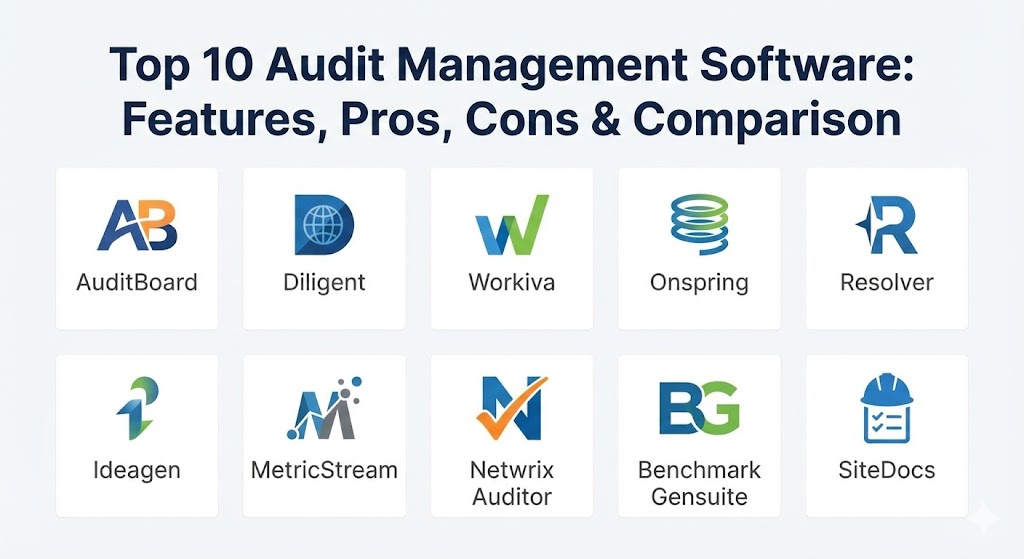
Top 10 Audit Management Software Tools
1 — AuditBoard
AuditBoard is currently one of the most popular cloud-native platforms for audit, risk, and compliance. It is designed to be highly collaborative, breaking down silos between different departments and providing executive leadership with a clear view of the organization’s risk posture.
- Key features:
- OpsAudit: Centralizes workflow management for all internal audit activities.
- SOXHUB: A dedicated module for managing Sarbanes-Oxley compliance and internal controls.
- Automated Evidence Collection: Reduces the manual burden on “document owners” by automating requests.
- Integrated Risk Management: Directly links audit findings to the enterprise risk register.
- Real-time Dashboards: Provides instant visibility into audit status and outstanding issues.
- ESG Program Management: (New for 2026) Specialized tracking for sustainability and social impact audits.
- Pros:
- Highly intuitive user interface that requires minimal training for non-audit users.
- Exceptional customer success and onboarding experience.
- Cons:
- Can be expensive for smaller organizations that only need basic audit tracking.
- Some users find the advanced reporting features have a slight learning curve.
- Security & compliance: SOC 2 Type II, GDPR, HIPAA compliant, AES-256 encryption, and SSO integration.
- Support & community: Robust online help center, active user community (“AuditBoard Community”), and dedicated enterprise account managers.
2 — Diligent (formerly HighBond)
Diligent’s audit management solution is part of its massive “One Platform” GRC suite. It is built for power users who need to process vast amounts of data and automate complex testing through AI and robotics.
- Key features:
- Robotics & AI: Automates data testing and identifies anomalies across large datasets.
- Audit Workspace: A centralized hub for managing workpapers, narratives, and evidence.
- Strategy Maps: Connects audit objectives directly to corporate strategic goals.
- Agile Audit Support: Features designed specifically for teams using agile methodologies.
- Offline Access: Mobile app allows for fieldwork in locations with poor connectivity.
- Storyboards: Advanced data visualization tools for board-level reporting.
- Pros:
- Industry-leading data analytics and automated testing capabilities.
- Seamless integration with other Diligent modules like Board Management and Risk.
- Cons:
- The platform’s sheer depth can make it feel overwhelming for simpler teams.
- Pricing is at the premium end of the market.
- Security & compliance: FedRAMP authorized, ISO 27001, SOC 1 & 2, and GDPR compliant.
- Support & community: Extensive documentation, “Diligent Institute” for certifications, and 24/7 global phone support.
3 — Workiva
Workiva is widely known for its strength in financial reporting, and its audit management capabilities are an extension of that “connected data” philosophy. It is the preferred choice for teams where financial and ESG reporting are the top priorities.
- Key features:
- Connected Reporting: Changes made in a workpaper automatically update in the final report.
- Internal Controls Management: Specifically designed for SOX and internal control testing.
- Audit Analytics: Integrated tools to identify trends and risks across financial data.
- Evidence Request Tracking: Automated workflows to chase down missing documentation.
- Direct SEC/ESG Filing: (Unique Feature) Allows for direct filing from the audit platform.
- Collaboration Tools: Real-time co-authoring and commenting on audit documents.
- Pros:
- Unmatched for accuracy in financial and regulatory reporting.
- Eliminates the risk of “version control” errors entirely.
- Cons:
- Not as specialized for “field/safety” audits as some other competitors.
- The setup process for complex reporting templates can be time-consuming.
- Security & compliance: SOC 1 & 2 Type II, HIPAA, ISO 27001, and FIPS 140-2 encryption.
- Support & community: Dedicated customer success managers and the “Workiva Community” forum.
4 — Onspring
Onspring is a highly flexible, no-code platform that allows audit teams to build a tool that fits their exact workflow, rather than forcing the team into a pre-defined software box.
- Key features:
- No-Code Engine: Drag-and-drop interface to create custom fields, forms, and workflows.
- Dynamic Reporting: Real-time charts and graphs that update as audit data flows in.
- Automated Surveying: Send out self-assessments or evidence requests to the business.
- Issue Tracking: Automated alerts for overdue remediation actions.
- Resource Management: Tools to track auditor hours and project budgets.
- Conflict of Interest Tracking: Specialized module for internal ethical audits.
- Pros:
- Incredible flexibility—you can build exactly the audit process you want.
- Very fast performance; the web interface is remarkably responsive.
- Cons:
- Because it is so customizable, it requires more “up-front” thought on process design.
- Smaller library of pre-built “content” compared to AuditBoard.
- Security & compliance: SOC 2 Type II, FedRAMP In-Process, and GDPR compliant.
- Support & community: Highly rated support team; extensive documentation and webinar series.
5 — Resolver
Resolver focuses on “Risk-Based Audit Management.” It is designed for organizations that want their audit plan to be driven by the most critical threats facing the business at any given moment.
- Key features:
- Risk-Audit Linkage: Audit plans are automatically generated based on high-risk areas.
- Incident Management Integration: Link audit findings directly to real-world security or safety incidents.
- Visual Workflows: Clear, graphical representation of the audit stages and approvals.
- Action Plan Tracking: Centralized dashboard for tracking “Management Action Plans” (MAPs).
- Evidence Repository: Secure, searchable vault for all audit-related documentation.
- Automated Notifications: Keeps the business informed of upcoming audits and tasks.
- Pros:
- Excellent for maturing an audit team from “check-the-box” to “risk-intelligent.”
- Strong “holistic” view of corporate resilience.
- Cons:
- The UI can feel more utilitarian than some of the “slicker” cloud competitors.
- Integration with third-party ERP systems can require professional services.
- Security & compliance: SOC 2 Type II, ISO 27001, and HIPAA compliant.
- Support & community: Comprehensive “Resolver Academy” and a dedicated customer support portal.
6 — Ideagen Internal Audit
Ideagen is a UK-based leader that specializes in highly regulated industries. Their internal audit software is built to handle the rigorous standards of global aviation, defense, and healthcare.
- Key features:
- Audit Planning: Multi-year and annual audit planning with resource allocation.
- Mobile Fieldwork: Full-featured mobile app for auditors on the go.
- Template Library: Extensive pre-built templates for various regulatory standards.
- Risk Heat Maps: Visual representation of audit coverage against risk.
- Time Tracking: Integrated timesheets for audit project management.
- External Auditor Portal: Secure area for third-party auditors to review evidence.
- Pros:
- Deeply rooted in “heavy” regulatory compliance; very stable platform.
- Excellent for large, global teams operating in multiple languages.
- Cons:
- The user experience can feel a bit more traditional/complex.
- Not as frequently updated with “flashy” new UI features as younger SaaS rivals.
- Security & compliance: ISO 27001, SOC 2, GDPR, and HIPAA compliant.
- Support & community: 24/7 global support and a dedicated client portal for training.
7 — MetricStream
MetricStream is an enterprise GRC giant. Its audit management tool is designed for the world’s largest companies that need a “Cognitive GRC” platform powered by artificial intelligence.
- Key features:
- AI-Powered Insights: Uses machine learning to identify audit trends and suggest focus areas.
- Unified GRC Library: Shares a common library of risks, controls, and policies across the company.
- Offline Mobile App: Supports mobile auditing in remote manufacturing or energy sites.
- Resource Optimization: AI-driven suggestions for auditor assignments.
- Multi-Tiered Audits: Supports complex audits across subsidiaries and geographic regions.
- Integrated Whistleblower Module: (Unique Feature) Link tips directly to audit investigations.
- Pros:
- One of the few platforms truly capable of “global-scale” enterprise deployment.
- Deeply integrated AI that actually provides actionable intelligence.
- Cons:
- High cost of ownership; usually requires significant implementation time.
- Can be overkill for organizations with fewer than 1,000 employees.
- Security & compliance: SOC 2 Type II, ISO 27001, and global data residency options.
- Support & community: “MetricStream GRC Summit” events and an extensive online portal.
8 — Netwrix Auditor
Netwrix Auditor is a specialized tool focused on IT Auditing and security. It is indispensable for IT managers and security auditors who need to prove that their data and systems are secure and compliant.
- Key features:
- Active Directory Auditing: Tracks every change to users and permissions.
- File Integrity Monitoring (FIM): Detects unauthorized access to sensitive files.
- Risk Assessment Reports: Automated reports for GDPR, HIPAA, and PCI DSS.
- User Behavior Analytics: Identifies anomalous behavior that might indicate a breach.
- Non-Owner Access Tracking: Alerts you when someone accesses a mailbox or file they don’t own.
- Alerting Engine: Real-time alerts for critical configuration changes.
- Pros:
- The best tool for technical IT audits and security compliance.
- Very fast to deploy compared to broader GRC platforms.
- Cons:
- Strictly an IT/Security audit tool; not designed for financial or operational audits.
- Lacks “soft” audit features like narrative management or workpaper co-authoring.
- Security & compliance: FIPS 140-2, GDPR, HIPAA, and PCI DSS compliant.
- Support & community: Excellent technical documentation and an active “SysAdmin” community.
9 — Benchmark Gensuite
Benchmark Gensuite is the industry standard for EHS (Environmental, Health, and Safety) and operational audits. It is designed for the “front lines”—factories, warehouses, and construction sites.
- Key features:
- Mobile-First Inspections: Heavy focus on tablet/phone use for physical walkthroughs.
- Action Tracking: Real-time assignment of “Corrective and Preventive Actions” (CAPA).
- Offline Data Entry: Vital for remote field sites without cellular service.
- QR Code Integration: Scan a piece of equipment to immediately see its audit history.
- Multilingual Support: Interface translates into dozens of languages for global workforces.
- Sustainability Tracking: Integrated ESG auditing for environmental impact.
- Pros:
- The “go-to” for physical safety and quality audits.
- Very strong reporting on leading indicators (e.g., “near-miss” reports).
- Cons:
- UI is built for functionality, not beauty; can feel “industrial.”
- Not suitable for corporate financial or SOX audits.
- Security & compliance: ISO 27001, SOC 2 Type II, and GDPR.
- Support & community: High-touch customer service and an annual “User Conference.”
10 — SiteDocs
SiteDocs is a specialized, paperless audit and safety management tool designed specifically for the construction and trades industries. It is the best choice for companies that need to move from “paper clipboards” to digital.
- Key features:
- Digital Form Builder: Easily convert your paper safety forms into digital versions.
- Photo Documentation: Attach photos directly to audit findings for visual proof.
- Electronic Signatures: Collect legally binding signatures on-site.
- Safety Certifications: Track employee certifications and link them to audit requirements.
- Real-time Monitoring: Head office can see safety audits as they are completed in the field.
- Simple Dashboard: A clear “Safety Score” for the entire company.
- Pros:
- Extremely user-friendly; workers in the field actually enjoy using it.
- Dramatically reduces the time spent on manual data entry at the office.
- Cons:
- Strictly for safety and operational audits.
- Lacks the complex risk-mapping and AI found in enterprise tools.
- Security & compliance: SSAE 16 (SOC 1) and SOC 2 Type II; data is stored in Tier 3 data centers.
- Support & community: Excellent onboarding training and a very responsive chat support team.
Comparison Table
| Tool Name | Best For | Platform(s) Supported | Standout Feature | Rating (Gartner Peer Insights) |
| AuditBoard | Large Enterprise GRC | Cloud (SaaS) | Seamless UI & Collaboration | 4.8 / 5 |
| Diligent | AI-Driven Analytics | Cloud / Hybrid | Advanced Robotics & AI | 4.5 / 5 |
| Workiva | Financial/SOX Audits | Cloud (SaaS) | “Connected Data” Tech | 4.6 / 5 |
| Onspring | Custom Workflows | Cloud (SaaS) | No-Code Flexibility | 4.8 / 5 |
| Resolver | Risk-Based Audit | Cloud (SaaS) | Risk-to-Audit Linkage | 4.4 / 5 |
| Ideagen | Highly Regulated Sectors | Cloud / On-Prem | Depth of Compliance Content | 4.5 / 5 |
| MetricStream | Global GRC Strategy | Cloud / Hybrid | “Cognitive GRC” AI | 4.3 / 5 |
| Netwrix Auditor | IT & Security Auditing | On-Prem / Cloud | Active Directory Auditing | 4.6 / 5 |
| Benchmark Gensuite | EHS & Field Audits | Mobile / Cloud | Operational Depth | 4.4 / 5 |
| SiteDocs | Construction Safety | Mobile / Cloud | “Paperless” Field UI | 4.7 / 5 |
Evaluation & Scoring of Audit Management Software
To evaluate these tools, we utilize a weighted scoring rubric that prioritizes the core functionality required for an audit team to be successful in a modern environment.
| Category | Weight | Evaluation Criteria |
| Core Features | 25% | Scheduling, fieldwork, reporting, action tracking, and evidence storage. |
| Ease of Use | 15% | Intuitiveness for both the audit team and the business “owners.” |
| Integrations | 15% | Ability to connect with ERPs, HRIS, Cloud Storage, and SIEM tools. |
| Security | 10% | Encryption, audit logs, and compliance with data privacy (GDPR). |
| Performance | 10% | Speed of the interface and reliability of mobile/offline sync. |
| Support | 10% | Documentation quality, speed of support, and user community. |
| Price / Value | 15% | ROI based on time saved and risk mitigated. |
Which Audit Management Software Tool Is Right for You?
Choosing a tool is not about finding the most features; it is about finding the tool that solves your specific regulatory “pain point.”
- Solo Users vs SMB: If you are a small firm or a consultant, SiteDocs or Logikcull (for legal/audit) are better choices than a massive GRC engine. Look for tools that have a low “setup” cost.
- Mid-Market Companies: If you have 500–2,000 employees, AuditBoard and Onspring are the current market leaders. They offer enterprise-grade security but are easy enough for a small audit team of 2–5 people to manage.
- Large Enterprises: For organizations with 5,000+ employees and a global footprint, Diligent or MetricStream are the only tools that can truly scale to your needs and provide the “board-level” AI insights required.
- Budget-Conscious vs Premium: Netwrix Auditor is a very cost-effective way to handle IT compliance. If you need a premium, “all-in-one” experience for financial reporting, Workiva is worth the higher investment.
- Feature Depth vs Ease of Use: If you need depth, go with Ideagen. If you need ease of use for the non-auditors in your company (who have to provide evidence), AuditBoard is the clear winner.
Frequently Asked Questions (FAQs)
1. What is the difference between GRC software and Audit software?
Audit software is a subset of GRC (Governance, Risk, and Compliance). GRC is the umbrella that covers the entire business strategy, while Audit software is the specific engine that tests whether those GRC policies are actually working.
2. Can these tools handle SOX compliance?
Yes, tools like Workiva and AuditBoard have modules specifically built for Sarbanes-Oxley, including control testing, 302/404 certifications, and automated evidence requests.
3. Does the software work for external auditors too?
Most modern platforms (like Ideagen or MetricStream) offer an “External Auditor Portal.” This allows your external firm (e.g., Big 4) to securely log in and review your workpapers without you having to email zip files.
4. How long does implementation typically take?
For a mid-market tool like AuditBoard, implementation usually takes 6–12 weeks. For a massive enterprise GRC suite like MetricStream, it can take 6 months to a year.
5. Is my data safe in the cloud?
Yes, top-tier vendors use AES-256 encryption and are hosted in secure data centers (AWS/Azure). Look for SOC 2 Type II certification as a non-negotiable requirement.
6. Can I conduct audits on my smartphone?
Yes, field-focused tools like Benchmark Gensuite and SiteDocs have excellent mobile apps. Enterprise tools like Diligent also have apps, though they are usually for reviewing reports rather than doing fieldwork.
7. Does the software automatically find risks?
“Cognitive” platforms like MetricStream and Diligent use AI to flag anomalies in your data that might indicate a risk, but a human auditor still needs to verify and “risk-rate” these findings.
8. Can I integrate the software with my ERP (like SAP or Oracle)?
Yes, most enterprise-level tools use APIs to pull data directly from your ERP, which is essential for “Continuous Auditing.”
9. Why shouldn’t I just use Excel and SharePoint?
Excel lacks an audit trail (anyone can change a cell without proof), has no automated workflow, and doesn’t provide a centralized dashboard. It is “un-auditable” by modern standards.
10. What is “Remediation Tracking”?
This is one of the most important features. It automatically follows up with the people responsible for fixing an audit finding and alerts the audit manager if the deadline is missed.
Conclusion
The right audit management software doesn’t just make the auditor’s life easier; it protects the entire organization. In 2026, the goal is to shift the audit function from being a “historical reporter” to a “strategic advisor.” By choosing a tool that fits your industry and your team’s technical maturity, you can turn your audit process into a competitive advantage rather than a regulatory burden.
Whether you need the custom flexibility of Onspring, the financial precision of Workiva, or the field-ready safety of SiteDocs, the move to a digital platform is the single most important step you can take for your compliance strategy this year.