Introduction
Attack Surface Management (ASM) is the continuous process of discovering, analyzing, and managing the vulnerabilities and potential entry points that make up an organization’s public-facing digital footprint. Unlike traditional vulnerability scanners that require you to tell them what to scan, ASM tools work like an attacker. They start with a single piece of information—like a company domain—and use it to map out the entire ecosystem, including “shadow IT,” forgotten cloud buckets, and orphaned subdomains.
The importance of ASM lies in its proactive nature. In 2026, the average enterprise manages thousands of assets, many of which are unknown to the central IT team. ASM provides the visibility needed to prevent data breaches caused by misconfigured cloud instances or unpatched legacy servers. Key real-world use cases include managing the security risks of a merger and acquisition (M&A) by mapping the target’s footprint, ensuring compliance with data residency laws, and identifying high-risk exposures like open RDP ports. When choosing an ASM tool, evaluation criteria should include the depth of “seedless” discovery, the accuracy of asset attribution (ensuring the tool doesn’t pull in assets you don’t own), and the quality of risk-based prioritization.
Best for: Large enterprises with complex, multi-cloud environments, security operations centers (SOCs) looking to reduce manual asset tracking, and CISOs who need to quantify external risk for the board. It is also indispensable for government agencies and financial institutions managing highly dispersed digital assets.
Not ideal for: Small businesses with a very simple web presence (e.g., a single website and one SaaS suite) where the attack surface is already well-mapped. For these organizations, standard vulnerability scanners or managed security providers are often more cost-effective.
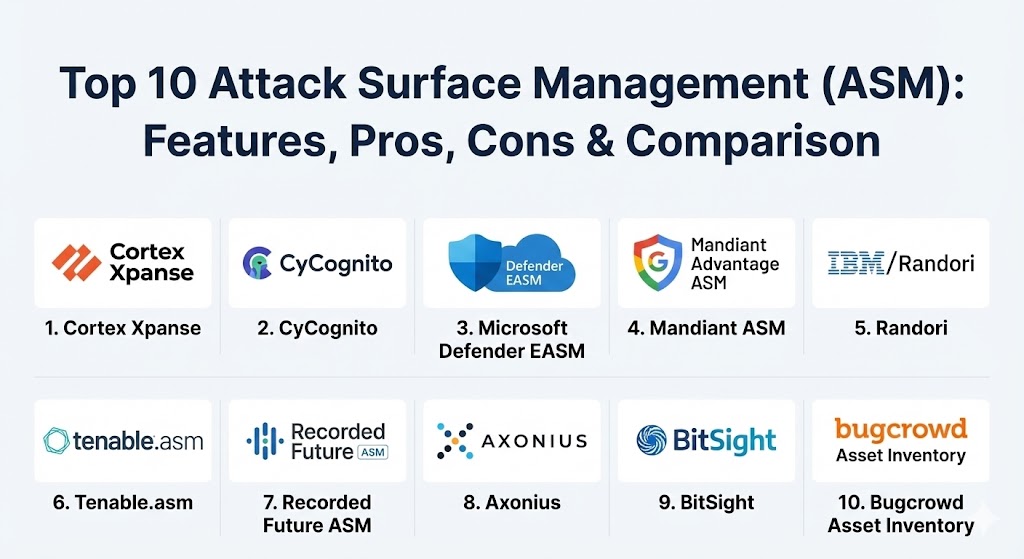
Top 10 Attack Surface Management (ASM) Tools
1 — Palo Alto Networks Cortex Xpanse
Cortex Xpanse is the enterprise powerhouse of the ASM world. It focuses on the “attacker’s view” by continuously scanning the entire global internet to identify every asset associated with an organization, providing a real-time, dynamic inventory.
- Key features:
- Global Internet Mapping: Scans 5 billion+ IP addresses daily to find unknown exposures.
- Automated Remediation: Built-in playbooks that integrate with XSOAR to fix issues without human intervention.
- Cloud Infrastructure Discovery: Identifies rogue or unsanctioned cloud instances across AWS, Azure, and GCP.
- Adversary Intelligence: Maps your vulnerabilities against active exploit trends used by threat actors.
- M&A Due Diligence: Quickly maps the attack surface of potential acquisition targets.
- Zero-Day Assessment: Rapidly identifies which of your external assets are vulnerable to newly released CVEs.
- Pros:
- Unmatched scale; if it’s on the internet and belongs to you, Xpanse will find it.
- Highly accurate attribution that minimizes “false positives” of assets that don’t belong to the user.
- Cons:
- Significant cost; it is positioned as a premium solution for large enterprises.
- Can be complex to fully integrate into a mature security workflow.
- Security & compliance: SOC 2, GDPR, HIPAA, and FIPS 140-2 compliant. Includes deep audit logs and SSO integration.
- Support & community: Top-tier enterprise support; extensive documentation and a robust user community within the Palo Alto ecosystem.
2 — CyCognito
CyCognito takes an autonomous, black-box approach to ASM. It is designed to act exactly like a sophisticated attacker, performing “seedless” discovery to find the “unknown unknowns” that other tools might miss.
- Key features:
- Autonomous Testing: Performs unauthenticated security testing to validate if an exposure is actually exploitable.
- Business Context Mapping: Automatically links discovered assets to specific business units or subsidiaries.
- Risk-Based Prioritization: Scores risks based on discoverability, attractiveness, and exploitability.
- Subsidiary Discovery: Exceptional at finding assets owned by remote branches or recently acquired companies.
- Remediation Validation: Automatically checks if a fix was successful after an IT team closes a ticket.
- Pros:
- “Zero-input” discovery means you don’t have to provide lists of IPs or domains to start.
- The platform provides clear, actionable evidence for every vulnerability found.
- Cons:
- The autonomous scanning can occasionally trigger internal “noise” in other security monitoring tools.
- Some of the deeper automated pentesting features require higher-tier licensing.
- Security & compliance: ISO 27001, SOC 2 Type II, and GDPR compliant.
- Support & community: Known for high-touch customer success and personalized onboarding for new clients.
3 — Microsoft Defender External ASM
Formerly RiskIQ, Microsoft has integrated this world-class EASM technology directly into the Defender suite. It leverages Microsoft’s massive global telemetry to provide an outside-in view of an organization’s digital footprint.
- Key features:
- Recursive Discovery: Uses observed connections to find “hidden” infrastructure linked to known assets.
- Inventory Indexing: Classifies assets into domains, IP blocks, hosts, and even email contacts.
- Azure Integration: Seamlessly feeds external asset data into the broader Microsoft Security stack.
- Security Hygiene Dashboards: Provides at-a-glance metrics on expired certificates and open ports.
- Historical Data: Access to years of internet infrastructure data to track the evolution of an attack surface.
- Pros:
- Extremely competitive pricing, especially for organizations already on the Azure platform.
- The integration with Defender for Cloud makes it a powerful “single pane of glass” solution.
- Cons:
- Best suited for the Microsoft ecosystem; users of other primary clouds may find integrations less native.
- The user interface can sometimes feel fragmented between different Azure portals.
- Security & compliance: Meets all major Azure compliance standards including FedRAMP, HIPAA, and ISO 27001.
- Support & community: Backed by Microsoft’s global support network and a massive technical community.
4 — Mandiant Advantage ASM (Google Cloud)
Mandiant Advantage ASM provides an adversary-focused view of the attack surface, leveraging Google’s massive data processing power and Mandiant’s frontline threat intelligence.
- Key features:
- Intel-Driven Discovery: Uses Mandiant’s real-world incident response data to look for specific “attacker-favored” paths.
- Active Verification: Safely tests assets to confirm if vulnerabilities are real and exploitable.
- Cloud and DNS Integration: Directly pulls data from cloud providers to compare “known” vs. “discovered” assets.
- Role-Based Workspaces: Allows different subsidiaries to manage their own attack surface while the parent company retains oversight.
- Shadow IT Alerts: Real-time notifications when a new, unmanaged asset appears on the internet.
- Pros:
- The depth of threat intelligence context is arguably the best in the industry.
- Google Cloud’s infrastructure ensures the scanning is incredibly fast and reliable.
- Cons:
- The interface can be technical and may require a dedicated security analyst to interpret.
- Reporting can be rigid for users who need highly customized executive summaries.
- Security & compliance: FIPS 140-2, SOC 2, GDPR, and ISO 27001.
- Support & community: High-end professional services are available for architecture and response; extensive documentation.
5 — IBM Security Randori
Randori stands out for its “Target Temptation” model. Instead of just listing vulnerabilities, it tells you which assets are most likely to be targeted next based on how “tempting” they look to a human hacker.
- Key features:
- Black Box Discovery: Identifies assets with high fidelity and low impact on system performance.
- Target Temptation Scoring: Prioritizes remediation based on an asset’s attractiveness to adversaries.
- Discovery Path Visualization: Shows exactly how an asset was found on the perimeter.
- Automated Red Teaming: Can simulate an attack to see if your internal defenses (like a WAF) actually block it.
- Continuous Monitoring: Real-time alerts for changes in asset status or new vulnerabilities.
- Pros:
- Unique scoring model helps teams focus on the “reachable” risks that actually matter.
- Very low false-positive rate; the tool is excellent at weeding out assets that don’t belong to you.
- Cons:
- Focuses primarily on the external surface; less emphasis on internal asset correlation.
- Can be expensive when compared to simpler asset inventory tools.
- Security & compliance: ISO 27001, SOC 2, HIPAA, and GDPR compliant.
- Support & community: Backed by IBM’s global support infrastructure and the “Randori Recon” technical team.
6 — Tenable.asm
Tenable.asm (built on Bit Discovery technology) integrates external attack surface management directly into the Tenable Exposure Management platform, providing a unified view of internal and external risks.
- Key features:
- Internet-Scale Mapping: Monitors over 5 billion assets across the global web.
- Seamless Tenable One Integration: Combines ASM data with vulnerability management and AD security data.
- Business Context Attribution: Links domains and IPs to specific organization names and brands.
- Continuous Change Tracking: Daily notifications when a new subdomain or service is detected.
- PII Detection: Identifies where personally identifiable information might be exposed on web pages.
- Pros:
- Ideal for current Tenable users who want to avoid tool sprawl and keep everything in one dashboard.
- Very easy to set up and start getting results within minutes.
- Cons:
- Lacks some of the “autonomous pentesting” depth found in competitors like CyCognito.
- Primarily focused on discovery; remediation workflows are often handled in other Tenable modules.
- Security & compliance: SOC 2 Type II, ISO 27001, and HIPAA compliant.
- Support & community: Strong community presence and world-class enterprise support plans.
7 — Recorded Future ASM
Recorded Future ASM takes a data-first approach, combining asset discovery with their world-leading “Intelligence Graph” to identify risks that are actively being discussed on the dark web.
- Key features:
- Dark Web Intelligence: Alerts you if your discovered assets are mentioned in hacker forums or leak sites.
- Automated Asset Inventory: Continuously updates your digital footprint with zero manual input.
- Domain Risk Monitoring: Tracks domain registration trends to spot “typosquatting” and phishing sites.
- Vulnerability Correlation: Automatically maps your external assets to current high-profile CVE exploits.
- API-First Architecture: Designed for deep integration into SOAR and SIEM platforms.
- Pros:
- Provides the best external context on why a certain asset is high-risk (e.g., “attackers are currently buying credentials for this app”).
- Excellent for brand protection and anti-phishing use cases.
- Cons:
- The intelligence-heavy focus can sometimes feel like a separate discipline from traditional asset management.
- High price point reflecting its status as a specialized intelligence tool.
- Security & compliance: ISO 27001, SOC 2, and GDPR compliant.
- Support & community: Offers dedicated intelligence analysts for enterprise clients; extensive online training.
8 — Axonius
Axonius is the leader in Cyber Asset Attack Surface Management (CAASM). While most ASM tools look from the outside-in, Axonius connects to all your internal tools to find the gap between what you think you have and what is actually there.
- Key features:
- 600+ Tool Integrations: Connects to EDR, cloud providers, directories, and networking gear.
- External + Internal View: Provides a truly unified inventory of every asset, no matter where it is.
- Policy Enforcement: Automatically identifies assets that are missing an agent or have an outdated OS.
- Query Wizard: Powerful, human-readable search to find specific asset combinations (e.g., “exposed DB with no encryption”).
- Automated Actions: Can trigger tickets in ServiceNow or Jira when a policy violation is found.
- Pros:
- The absolute best tool for “asset visibility” and compliance auditing.
- Solves the problem of “siloed data” by correlating information from every security tool you own.
- Cons:
- Not a “scanning” tool; it relies on the data provided by your other tools.
- Implementation takes time because you have to connect it to your entire tech stack.
- Security & compliance: SOC 2 Type II, GDPR, and HIPAA compliant.
- Support & community: Known for being extremely responsive; active user community and regular “power user” webinars.
9 — BitSight
BitSight is a pioneer in security ratings. Their ASM capabilities are designed to help organizations manage their own risk while also keeping an eye on the security posture of their third-party vendors and supply chain.
- Key features:
- Security Ratings: Provides a credit-score-like grade (250-900) for your organization’s security.
- Third-Party Risk Management: Continuously monitors the attack surface of your partners and vendors.
- Peer Benchmarking: Compare your security performance against industry competitors.
- Forensic-Grade Data: Deep telemetry on malware infections and open ports.
- Financial Analysis: Quantifies cyber risk in terms of potential monetary loss.
- Pros:
- The standard for “Board-level” reporting; easy for non-technical executives to understand.
- Invaluable for vendor risk management and cyber insurance applications.
- Cons:
- The rating system can sometimes be slow to reflect remediation efforts.
- Less granular for the “day-to-day” technical work of an IT administrator.
- Security & compliance: ISO 27001, SOC 2, and rigorous internal data privacy standards.
- Support & community: Large global customer base with dedicated support and professional service teams.
10 — Bugcrowd Asset Inventory
Bugcrowd leverages the power of its global “crowd” of security researchers to find assets and vulnerabilities that automated scanners simply cannot see.
- Key features:
- Crowd-Enhanced Discovery: Humans find the forgotten subdomains and “clever” shadow IT that AI misses.
- Integration with Bug Bounty: Discovered assets can be immediately funneled into a private bug bounty program.
- Technology Fingerprinting: Identifies the exact software and versions running on every discovered host.
- Smart Folder Organization: Automatically categorizes assets based on custom rules and business criticality.
- Near Real-Time Population: Inventory updates within seconds of a new discovery being verified.
- Pros:
- Combines automated speed with human ingenuity; the best of both worlds.
- Excellent for finding high-value, “low-noise” vulnerabilities.
- Cons:
- The “crowd” aspect introduces a human variable that some highly rigid organizations may find difficult to manage.
- Managed services model can be more expensive than pure software-only solutions.
- Security & compliance: ISO 27001, SOC 2, and GDPR compliant.
- Support & community: Unmatched community of security researchers; dedicated account managers for enterprise clients.
Comparison Table
| Tool Name | Best For | Platform(s) Supported | Standout Feature | Rating (Gartner Peer Insights) |
| Cortex Xpanse | Global Scale / Fortune 500 | Multi-Cloud / On-Prem | Internet-Wide Active Scanning | 4.6 / 5 |
| CyCognito | Autonomous / Seedless | Cloud-Native | Unauthenticated Pentesting | 4.8 / 5 |
| Microsoft EASM | Azure Users | Azure / Hybrid | Microsoft Global Data Integration | 4.4 / 5 |
| Mandiant ASM | Threat Intel Focus | Google Cloud / Multi | Adversary View (Mandiant Intel) | 4.4 / 5 |
| Randori | Offensive Prioritization | Cloud-Native | “Target Temptation” Scoring | 4.5 / 5 |
| Tenable.asm | Exposure Management | Multi-Cloud / Hybrid | Tenable One Platform Sync | 4.6 / 5 |
| Recorded Future | Intelligence-First | Cloud-Native | Dark Web Risk Correlation | 4.7 / 5 |
| Axonius | Full Inventory (CAASM) | 600+ Integrations | Correlated Tool Visibility | 4.4 / 5 |
| BitSight | Ratings / Vendor Risk | Cloud-Native | Security Performance Ratings | 4.5 / 5 |
| Bugcrowd | Human Ingenuity | Managed Service | Crowd-Powered Asset Discovery | 4.6 / 5 |
Evaluation & Scoring of Attack Surface Management (ASM)
To choose the right tool, it is helpful to understand how they are judged by industry analysts. The following table evaluates the ASM category using a weighted scoring rubric designed for enterprise needs.
| Category | Weight | Evaluation Criteria |
| Core Features | 25% | Depth of discovery, “seedless” capability, and accuracy of asset attribution. |
| Ease of Use | 15% | Dashboard clarity, quality of visualization, and setup time for initial results. |
| Integrations | 15% | Native connectivity with SIEM, SOAR, cloud providers, and ticketing systems. |
| Security & Compliance | 10% | Encryption standards, SOC 2/GDPR compliance, and audit trail quality. |
| Performance & Reliability | 10% | Speed of global scans, uptime, and minimal impact on scanned systems. |
| Support & Community | 10% | Quality of documentation, technical support response time, and user base. |
| Price / Value | 15% | Total cost of ownership relative to the reduction in manual effort and risk. |
Which Attack Surface Management (ASM) Tool Is Right for You?
The “best” tool is the one that fits your current infrastructure and the skill level of your security team.
- Solo Users & Researchers: Most high-end ASM tools are cost-prohibitive for individuals. For research purposes, open-source alternatives or the “free” tier of tools like Shodan or Censys are often sufficient.
- Small to Medium Businesses (SMBs): If you have a manageable number of domains, Microsoft Defender EASM or Tenable.asm provide powerful discovery without requiring a seven-figure budget. They are also easier to manage for IT generalists.
- Mid-Market Companies: If you are growing rapidly and concerned about “Shadow IT,” CyCognito is an excellent choice due to its autonomous, low-maintenance discovery process.
- Large Enterprises & High-Security Environments: If you manage global infrastructure and have a dedicated SOC, Cortex Xpanse or Mandiant Advantage ASM provide the level of scale and adversary intelligence needed to stay ahead of nation-state threat actors.
- Teams Focused on Compliance & Governance: If your main goal is to report to the board and manage vendor risk, BitSight or Axonius are the gold standards. Axonius, in particular, will help you pass an audit by proving you have a 100% accurate inventory of your internal and external assets.
Frequently Asked Questions (FAQs)
1. What is the difference between EASM and CAASM?
EASM (External Attack Surface Management) looks at your organization from the outside-in (internet-facing). CAASM (Cyber Asset Attack Surface Management) looks from the inside-out, connecting to your internal tools to find all assets, including internal ones.
2. Can ASM replace my vulnerability scanner?
No. ASM finds the “assets” (the what), while vulnerability scanners find the “holes” (the how). They are complementary. Modern platforms like Tenable and Palo Alto combine both for a full view.
3. Does ASM require an agent to be installed?
Almost never. The primary benefit of ASM is that it is “agentless.” It scans public-facing infrastructure the same way an attacker would—without needing permission or software installed on the target.
4. How does ASM help with “Shadow IT”?
By scanning the internet for your company’s identifiers (SSL certificates, domain registration, IP ranges), ASM finds web servers or cloud buckets that were set up by employees without the IT team’s knowledge.
5. What is “Seedless Discovery”?
This is the ability of an ASM tool to find your infrastructure starting with just your brand name or a single domain, rather than you having to upload a list of IPs or subdomains manually.
6. Is ASM useful for Merger and Acquisition (M&A)?
Yes, it is one of the top use cases. You can map out a target company’s attack surface during due diligence to see what “security debt” or high-risk exposures you are about to inherit.
7. How often does an ASM tool scan?
Most enterprise tools scan continuously or daily. Because the internet changes every few minutes, a weekly scan is often considered too slow to catch a newly opened port or a cloud misconfiguration.
8. Can ASM find my data on the Dark Web?
Specialized tools like Recorded Future can. While standard ASM finds your “infrastructure,” intelligence-led ASM finds mentions of your credentials or leaked data on forums and marketplaces.
9. Does ASM affect website performance?
No. Enterprise ASM tools use non-intrusive scanning techniques (benign payloads) that are designed to identify services and versions without causing a crash or slowing down user traffic.
10. Why is asset attribution so difficult?
Because many companies share IP space (like on AWS or Azure). A good ASM tool must use multiple data points (like SSL certs and DNS records) to ensure it only alerts you about assets that actually belong to you.
Conclusion
Attack Surface Management is no longer an optional “extra” for security teams; it is the foundation of modern cyber resilience. As we have seen, the “best” tool depends entirely on your context—whether you need the global scale of Cortex Xpanse, the autonomous ease of CyCognito, or the internal visibility of Axonius. The ultimate goal remains the same: eliminating the blind spots before an adversary finds them. In a world where the only constant is change, visibility is your strongest defense.