Introduction
Application Security Testing platforms are specialized suites designed to identify vulnerabilities in software at different stages of the lifecycle. SAST (often called “white-box testing”) analyzes source code, byte code, or binaries while the application is at rest, pinpointing the exact line of code where a security flaw exists. DAST (“black-box testing”) interacts with the running application from the outside, simulating how an attacker might exploit vulnerabilities like SQL injection or Cross-Site Scripting (XSS).
The importance of these tools is rooted in the “Shift Left” philosophy—identifying bugs early in the development phase to reduce the cost of remediation and prevent catastrophic data breaches. Real-world use cases include automating security checks in CI/CD pipelines, ensuring compliance with standards like OWASP Top 10, and managing third-party risk. When evaluating platforms, users should prioritize accuracy (low false positives), language support, integration depth with IDEs and repositories, and the ability to provide actionable remediation advice.
Best for: Security engineers, DevOps teams, and software developers in enterprises of all sizes, particularly in finance, healthcare, and SaaS industries where data protection is paramount.
Not ideal for: Organizations that do not build their own software or very small teams with static websites that do not handle user data, where simple vulnerability scanners or basic firewall configurations might suffice.
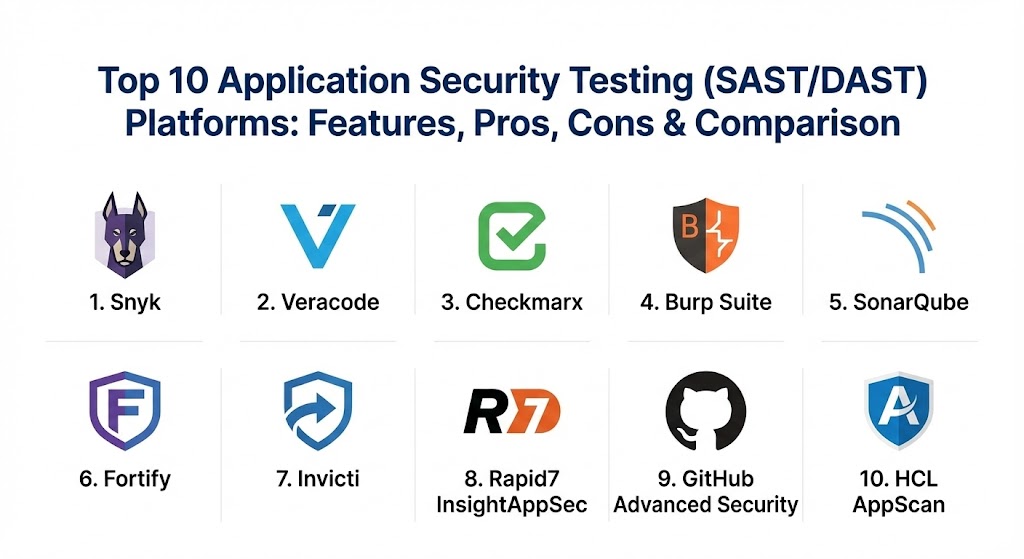
Top 10 Application Security Testing (SAST/DAST) Platforms
1 — Snyk
Snyk is a developer-centric security platform that has revolutionized the market by focusing on ease of use and rapid integration. It provides SAST, SCA (Software Composition Analysis), and container security within a single interface.
- Key features:
- Snyk Code (SAST) provides real-time scanning within the IDE.
- Industry-leading vulnerability database with proprietary research.
- Automated remediation suggestions and “one-click” PR fixes.
- Deep integration with GitHub, GitLab, Bitbucket, and Jira.
- Support for over 40 programming languages and frameworks.
- Native integration with CI/CD tools like Jenkins and CircleCI.
- Pros:
- Extremely high adoption rate among developers due to its intuitive UI.
- Rapid scanning speeds that don’t bottleneck the deployment pipeline.
- Cons:
- DAST capabilities are not as native or robust as specialized legacy tools.
- The cost can scale quickly as you add more developers and modules.
- Security & compliance: SOC 2 Type II, GDPR, ISO 27001, and HIPAA compliant.
- Support & community: Extensive documentation, a vast free user community, and dedicated enterprise support for high-tier plans.
2 — Veracode
Veracode is a comprehensive, cloud-native AST platform known for its rigorous analysis and “five-tier” security assessment approach. It is a long-standing leader in the Gartner Magic Quadrant.
- Key features:
- Unified platform for SAST, DAST, SCA, and IAST.
- Pipeline Scan for ultra-fast feedback during the build process.
- Binary Static Analysis (no source code access required).
- Dynamic Analysis (DAST) with scalable cloud scanning.
- Veracode Fix (AI-generated code fixes).
- Governance and policy management for large-scale enterprise oversight.
- Pros:
- Exceptional depth of analysis, especially for complex, legacy applications.
- Centralized dashboards provide a clear view of an entire organization’s risk posture.
- Cons:
- Can have a higher rate of false positives compared to newer AI-driven tools.
- The interface can feel “enterprise-heavy” and complex for solo developers.
- Security & compliance: FedRAMP authorized, SOC 2, HIPAA, and GDPR compliant.
- Support & community: High-tier enterprise support, including “Security Labs” for developer training and 24/7 technical assistance.
3 — Checkmarx One
Checkmarx provides a holistic security platform that integrates seamlessly into the developer’s ecosystem. It is famous for its “Checkmarx SAST,” which pioneered many of the industry’s standard scanning techniques.
- Key features:
- Checkmarx SAST with support for 50+ languages.
- Checkmarx DAST for automated web application vulnerability scanning.
- KICS (Keeping Infrastructure as Code Secure) for IaC scanning.
- API Security module for identifying exposed or vulnerable endpoints.
- Integrated developer training (Codebashing).
- Fusion engine that correlates results across SAST, DAST, and SCA.
- Pros:
- Excellent at mapping data flow and identifying complex “logic” vulnerabilities.
- Highly customizable query language for advanced security teams.
- Cons:
- Full scans can be slow, making them better suited for overnight builds than real-time IDE work.
- Higher pricing tiers often make it a better fit for large enterprises than SMBs.
- Security & compliance: ISO 27001, SOC 2, GDPR, and HIPAA compliant.
- Support & community: Global professional services, comprehensive documentation, and an active partner ecosystem.
4 — Burp Suite (by PortSwigger)
While primarily known as the world’s leading DAST tool for manual penetration testers, Burp Suite Enterprise Edition provides automated, scalable DAST for the entire organization.
- Key features:
- Industry-standard web vulnerability scanner.
- Burp Suite Enterprise Edition for automated, scheduled CI/CD scanning.
- Extremely deep “Burp Scanner” logic for complex XSS and SQLi.
- Compliance-specific reporting (OWASP, PCI DSS).
- Extensive BApp Store for community-developed extensions.
- Integration with Jira and Slack for automated ticket creation.
- Pros:
- Widely considered the most accurate DAST tool for identifying web-based exploits.
- Very affordable compared to full-suite AST platforms.
- Cons:
- Does not offer native SAST (source code analysis).
- Burp Suite Professional is a desktop app, requiring the Enterprise version for true CI/CD automation.
- Security & compliance: SOC 2 Type II compliant (Enterprise Edition).
- Support & community: The most active DAST community in the world; extensive Burp Suite Academy for learning.
5 — SonarQube (by Sonar)
SonarQube is a staple in the development world, focusing on “Clean Code.” While it started as a code quality tool, its SAST capabilities have become highly advanced.
- Key features:
- Deep SAST analysis for security hotspots and vulnerabilities.
- Integration with SonarLint for “in-IDE” real-time feedback.
- “Quality Gates” to prevent vulnerable code from being merged.
- Support for 30+ languages, including COBOL and Apex.
- Historical tracking of technical debt and security issues.
- Multi-branch analysis for complex repository structures.
- Pros:
- Bridges the gap between “clean code” and “secure code” perfectly.
- The community edition is free and powerful enough for many small teams.
- Cons:
- Lacks native DAST capabilities (focused strictly on static analysis).
- Managing a large self-hosted instance can be resource-intensive.
- Security & compliance: SOC 2 Type II (SonarCloud), GDPR, and HIPAA compliant.
- Support & community: Massive global community; paid enterprise support for self-hosted and cloud versions.
6 — Fortify (by OpenText)
Fortify is one of the most established names in the industry, offering a massive array of features for organizations that need rigorous, high-compliance security testing.
- Key features:
- Fortify Static Code Analyzer (SCA) for market-leading SAST.
- Fortify WebInspect for high-end DAST and API testing.
- Fortify on Demand (SaaS version) for quick deployment.
- AI-driven “ScanCentral” to speed up the analysis of large codebases.
- Deep vulnerability research from the Fortify Research team.
- Pros:
- Unmatched depth of analysis for “hard to find” vulnerabilities.
- Highly suitable for government and defense contractors with extreme requirements.
- Cons:
- Steep learning curve; usually requires a dedicated security professional to manage.
- Can be quite expensive once all modules are included.
- Security & compliance: FedRAMP, FIPS 140-2, SOC 2, and ISO 27001.
- Support & community: High-tier enterprise support and extensive professional service options.
7 — Invicti (formerly Netsparker)
Invicti is a DAST-first platform that focuses on automation and accuracy. Its “Proof-Based Scanning” technology is designed to eliminate false positives.
- Key features:
- Proof-Based Scanning (automatically verifies vulnerabilities).
- Combined DAST and IAST for deeper insights into the running app.
- Advanced discovery for identifying forgotten or “shadow” web assets.
- Seamless CI/CD integration with over 50 tools.
- API scanning (REST, SOAP, GraphQL).
- Pros:
- Almost zero false positives on major vulnerabilities because the tool “proves” the exploit.
- Very easy to scale across thousands of web applications.
- Cons:
- No native SAST module; needs to be paired with a separate tool for code analysis.
- Pricing is on the premium side for the DAST market.
- Security & compliance: SOC 2, ISO 27001, GDPR, and HIPAA.
- Support & community: Highly rated customer success team and detailed online training.
8 — Rapid7 InsightAppSec
Rapid7 is a cybersecurity powerhouse, and InsightAppSec is their flagship DAST solution, built for modern web applications and DevOps speed.
- Key features:
- Cloud-based DAST with high-speed scanning engines.
- “Universal Translator” for modern JS frameworks (React, Angular).
- Replay-attack functionality for manual verification of findings.
- Integrated vulnerability management via the Rapid7 Insight platform.
- Extensive pre-built reports for compliance (HIPAA, PCI).
- Pros:
- Excellent integration with the broader Rapid7 ecosystem (InsightVM, InsightIDR).
- Very effective at handling single-page applications (SPAs).
- Cons:
- SAST is not the primary focus; Rapid7 is much stronger in DAST/IAST.
- Monthly scan limits can be a hurdle for large-scale continuous testing.
- Security & compliance: SOC 2, ISO 27001, and GDPR compliant.
- Support & community: Strong community presence and 24/7 global support.
9 — GitHub Advanced Security
For organizations already living in GitHub, GitHub Advanced Security (GHAS) provides a native, integrated security experience without leaving the repository.
- Key features:
- CodeQL (the powerful SAST engine that powers GitHub scans).
- Secret scanning (detecting leaked API keys and tokens).
- Dependency Graph and Dependabot for SCA.
- Native integration into GitHub Actions.
- Security Overview dashboard for organization-wide visibility.
- Pros:
- Zero context-switching for developers; security lives where the code lives.
- CodeQL is incredibly powerful for custom security research.
- Cons:
- Only available for GitHub Enterprise users; no support for GitLab or Bitbucket.
- DAST is currently limited compared to specialized tools like Burp or Invicti.
- Security & compliance: SOC 2, ISO 27001, and FedRAMP (for Enterprise managed instances).
- Support & community: Powered by the world’s largest developer community; documentation is top-tier.
10 — HCL AppScan
HCL AppScan is an enterprise-grade suite that offers deep SAST, DAST, IAST, and SCA. It is a robust alternative for teams moving away from IBM or HP legacy tools.
- Key features:
- AppScan Source (SAST) for deep code analysis.
- AppScan Standard (DAST) for manual and automated web scanning.
- AppScan Enterprise for centralized governance and reporting.
- “Intelligent Finding Analytics” (IFA) to reduce false positives using AI.
- Native integration with IDEs and build systems.
- Pros:
- Very mature toolset that handles virtually any application type (Mobile, Web, Desktop).
- Excellent for large enterprises that need a single vendor for all AST types.
- Cons:
- The UI can feel more traditional and less “SaaS-native” than Snyk or CloudZero.
- Setup can be time-consuming for large, distributed teams.
- Security & compliance: ISO 27001, SOC 2, and FIPS 140-2 support.
- Support & community: Reliable enterprise support with a strong history in the security market.
Comparison Table
| Tool Name | Best For | Platform(s) Supported | Standout Feature | Rating (Gartner Peer Insights) |
| Snyk | Developer Adoption | SaaS, Hybrid | Developer-First UI & Auto-Fix | 4.7 / 5 |
| Veracode | Full-Suite Enterprise | Cloud-Native | Binary Static Analysis | 4.6 / 5 |
| Checkmarx | Large Enterprise SAST | On-Prem, Cloud | Logic-Path Mapping | 4.5 / 5 |
| Burp Suite | DAST / Pen-Testing | Windows, Linux, Mac | Best-in-Class DAST Logic | 4.8 / 5 |
| SonarQube | Clean Code / Quality | On-Prem, Cloud | Quality Gate Integration | 4.6 / 5 |
| Fortify | High-Compliance | On-Prem, Cloud | Security Research Depth | 4.3 / 5 |
| Invicti | Scalable DAST | SaaS, On-Prem | Proof-Based Scanning | 4.5 / 5 |
| Rapid7 Insight | Modern Web / SPAs | Cloud-Based | SPA & React/Angular Support | 4.4 / 5 |
| GitHub Adv. Sec. | GitHub Ecosystem | GitHub Native | CodeQL Engine | 4.7 / 5 |
| HCL AppScan | Multi-Methodology | On-Prem, Cloud | Intelligent Finding Analytics | 4.4 / 5 |
Evaluation & Scoring of AST Platforms
To help you make an objective decision, we have evaluated these platforms based on a weighted rubric that reflects the priorities of modern engineering teams.
| Category | Weight | Evaluation Criteria |
| Core Features | 25% | Breadth of SAST/DAST coverage, language support, and API testing. |
| Ease of Use | 15% | Developer onboarding speed, UI clarity, and real-time IDE feedback. |
| Integrations | 15% | Native support for GitHub, GitLab, Jira, Jenkins, and Kubernetes. |
| Security & Compliance | 10% | Depth of audit logs, compliance reporting (OWASP, HIPAA), and SSO. |
| Performance | 10% | Scan speed and impact on CI/CD build times. |
| Support & Community | 10% | Quality of documentation, forums, and enterprise response times. |
| Price / Value | 15% | ROI regarding false positive reduction and vulnerability prevention. |
Which AST Platform Is Right for You?
Choosing an Application Security tool is a strategic decision that depends heavily on your team’s culture and technical stack.
- Solo Developers & Small Teams: Start with the free tier of Snyk or the community edition of SonarQube. These provide immediate value without complex infrastructure requirements.
- Mid-Market SaaS Companies: Look for tools that focus on speed and integration. Invicti is excellent for keeping your web presence secure without a large security team, while Snyk keeps your developers moving fast.
- Large Enterprises with High Compliance: Veracode or Fortify are the traditional choices for a reason; they provide the governance, binary analysis, and audit trails required for heavily regulated industries.
- GitHub-First Organizations: If your entire codebase lives in GitHub, GitHub Advanced Security is almost a no-brainer due to its seamless integration, though you may still want to pair it with Burp Suite Enterprise for specialized DAST.
- Budget-Conscious Teams: If you need deep DAST without the full platform price tag, Burp Suite Enterprise offers incredible value for the money.
Frequently Asked Questions (FAQs)
1. What is the main difference between SAST and DAST? SAST (Static) looks at the code from the inside without running it. DAST (Dynamic) looks at the running application from the outside, testing it like an attacker would.
2. Why do I need both SAST and DAST? SAST is great at finding coding errors (like hardcoded passwords) but can’t see server configuration issues. DAST finds runtime issues (like insecure cookies) but can’t tell you which line of code to fix. Using both provides full coverage.
3. Does SAST cause slow build times? It can. Modern tools offer “incremental” or “delta” scans that only check changed code, significantly speeding up the process.
4. Can these tools find vulnerabilities in my open-source libraries? Usually, this is handled by SCA (Software Composition Analysis). Most top-tier platforms (like Snyk, Veracode, and Checkmarx) include SCA as part of their suite.
5. What are “False Positives” and why are they bad? A false positive is when a tool flags a vulnerability that isn’t actually a risk. Too many false positives lead to “alert fatigue,” where developers stop trusting the tool altogether.
6. Do these tools support mobile app testing? Yes, but coverage varies. Checkmarx, HCL AppScan, and Veracode have strong support for iOS and Android binary and source code analysis.
7. Is cloud-based AST safe? Yes, top-tier vendors use encryption and SOC 2-compliant environments. If your code is highly sensitive, many vendors (like Fortify or Checkmarx) offer on-premises versions.
8. How do these tools help with OWASP Top 10 compliance? Most AST tools have pre-built “compliance profiles” that specifically scan for the vulnerabilities listed in the OWASP Top 10, providing dedicated reports for auditors.
9. Can I automate these tools in Jenkins? Yes, virtually every tool on this list has a Jenkins plugin or a CLI (Command Line Interface) that allows you to fail a build if high-severity vulnerabilities are found.
10. What is IAST? Interactive Application Security Testing (IAST) is a newer hybrid that sits inside the application (like an agent) and monitors it during testing, combining the benefits of both SAST and DAST.
Conclusion
The “best” Application Security Testing platform is the one that your developers will actually use. While legacy tools offer unmatched depth for the most sensitive environments, modern platforms like Snyk and GitHub Advanced Security have proven that moving security directly into the development workflow is the most effective way to build resilient software. Whether you prioritize deep binary analysis or rapid “in-IDE” feedback, the key is to stop treating security as a final gate and start treating it as a core part of the code quality process.
AST now uses automated, real-time detection to catch vulnerabilities in both source code and running applications. The contrast between Snyk’s developer-first SAST and Checkmarx’s deep enterprise analysis highlights the “shift left” security trend. This guide is a solid resource for maintaining strict protection without slowing down the CI/CD pipeline.