Introduction
Airline Crew Scheduling Tools are comprehensive management platforms that handle the entire lifecycle of a crew member’s duty period. This includes long-term planning (pairing and rostering), day-of-ops tracking, and post-flight payroll processing. These tools are critical because they act as the “brain” of the airline’s operations; a single scheduling error can lead to grounded flights, massive financial penalties, and compromised safety.
Key real-world use cases involve generating monthly crew pairings (sequences of flights), managing daily crew assignments and tracking duty times in real-time, and automatically handling sick calls or delays by finding legal, optimal reassignments. When evaluating these tools, users should look for powerful mathematical optimization engines, real-time Flight Time Limitation (FTL) monitoring, mobile-first crew communication apps, and the ability to run “what-if” disruption scenarios.
Best for: Commercial airlines, regional carriers, cargo operators, and private charter companies. It is specifically designed for crew schedulers, operations controllers, flight department managers, and compliance officers who must navigate complex regulatory landscapes.
Not ideal for: General business staffing needs or standard retail shift management. Organizations without the need for strict FTL compliance or complex aviation-specific union contracts will find these tools unnecessarily complex and expensive compared to standard HR scheduling software.
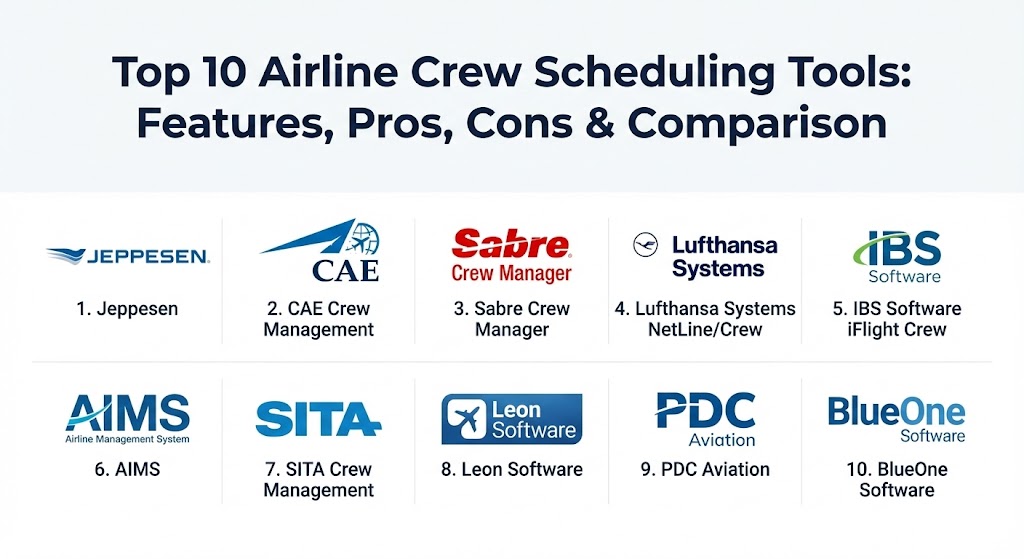
Top 10 Airline Crew Scheduling Tools
1 — Jeppesen Crew Management (Boeing)
Jeppesen, a subsidiary of Boeing, offers what many consider the industry gold standard for crew optimization. Its suite is built on high-performance mathematical algorithms that help airlines maximize productivity while respecting crew quality-of-life and regulatory constraints.
- Key features:
- World-class pairing and rostering optimization engines.
- Predictive analytics for crew fatigue and disruption risk.
- Real-time crew tracking with automated FTL legality checks.
- Flexible bidding systems including preferential and seniority-based models.
- Integrated disruption recovery tools to minimize delay impact.
- Mobile-enabled portal for crew schedules and check-ins.
- Pros:
- Unmatched depth of features and a proven track record at major global network carriers.
- Exceptionally strong in modeling complex union contracts and international regulations.
- Cons:
- High implementation cost and complexity often require specialized consultancy.
- The interface can feel overwhelming for smaller regional operators.
- Security & compliance: SOC 2, ISO 27001, GDPR compliant, and FIPS-validated encryption.
- Support & community: Extensive 24/7 global support network, Boeing’s industry-leading documentation, and a massive community of enterprise users.
2 — CAE Crew Management
Following its acquisition of Sabre’s AirCentre suite, CAE has emerged as a powerhouse in crew operations. It provides a modular, end-to-end platform that scales from small regional airlines to the world’s largest fleets.
- Key features:
- Unified view of crew scheduling, training, and operational requests.
- AI-powered pairing optimizer that balances cost with crew satisfaction.
- Configurable rules engine for local and international civil aviation authorities.
- Real-time messaging and roster change notifications.
- Self-service duty swaps and trading modules for crew members.
- Integrated training management linked to active flight duties.
- Pros:
- Excellent integration with CAE’s training and simulation ecosystem.
- Highly modular design allows airlines to purchase only the features they need.
- Cons:
- Transitioning from legacy Sabre systems can involve technical hurdles.
- The sheer breadth of the platform can lead to a steep learning curve for admins.
- Security & compliance: ISO 27001, GDPR, and SSO integration support.
- Support & community: Robust professional services and a dedicated customer success portal for enterprise clients.
3 — Sabre Crew Manager
While CAE now manages much of the AirCentre portfolio, the Sabre-branded legacy tools remain pillars of the industry. These solutions focus on providing decision support that helps airlines stay resilient in the face of weather or mechanical delays.
- Key features:
- Real-time dashboard integrating flight data with crew schedules.
- Automated disruption recovery that generates legal reassignment options.
- Complex pay and per-diem calculation engine.
- Mobile access for crew to check schedules and sign on for duty.
- Advanced “what-if” scenario modeling for operational planning.
- Integrated leave and vacation management.
- Pros:
- Superior visibility into the operational impact of crew changes.
- Strong history of reliability in managing high-volume, high-frequency flight schedules.
- Cons:
- Some modules can feel like a “legacy” experience compared to newer cloud-native apps.
- Ongoing support may eventually transition fully to CAE infrastructure.
- Security & compliance: PCI DSS, GDPR, and SOC 1/2 compliance.
- Support & community: Historically strong user community and extensive technical knowledge bases.
4 — Lufthansa Systems NetLine/Crew
Part of the comprehensive NetLine suite, this tool is designed for dynamic duty management. It emphasizes the “Interaction” aspect, ensuring that the bridge between crew controllers and flight staff is seamless.
- Key features:
- Interactive Duty Plan (IADP) smartphone app for crews.
- Geofenced check-in and real-time duty notifications.
- Rule Management Solution that allows users to configure custom business rules.
- Open Time Management for volunteering and picking up extra shifts.
- High-performance pairing and roster optimization solvers.
- Integrated fatigue risk management (FRM) assessments.
- Pros:
- Very strong emphasis on crew empowerment and job satisfaction.
- Clean, modern interface that reduces training time for new schedulers.
- Cons:
- Best utilized as part of the full NetLine ecosystem; standalone integration can be tricky.
- Optimization engines may require significant tuning for specific airline models.
- Security & compliance: ISO 27001, GDPR, and support for multi-factor authentication.
- Support & community: Strong European-based support with global availability and regular user group meetings.
5 — IBS Software iFlight Crew
iFlight Crew is a cloud-native platform designed to unify fleet and crew management. It uses an “open architecture” to allow for unparalleled performance and scalability in the modern SaaS environment.
- Key features:
- Single digital platform for both fleet and crew operations.
- Real-time situational awareness dashboards for controllers.
- Highly configurable leave and training management modules.
- Mobile-first “Crew Portal” with bidding and shift-swapping.
- AI and ML-driven solvers for roster maintenance and tracking.
- Integrated logistics management (hotels and transport) for crews.
- Pros:
- 15-30% reported reductions in planned and unplanned crew costs.
- Extremely modern, mobile-centric architecture that is easy to update.
- Cons:
- As a newer-generation platform, it may require a significant change-management effort.
- Connectivity-dependent; requires a robust internet infrastructure for best results.
- Security & compliance: SOC 2, ISO 27001, and GDPR compliant.
- Support & community: Comprehensive “Value Diagnostic” framework to help airlines measure ROI.
6 — AIMS Airline Management System
AIMS is an all-in-one aviation software that is particularly popular with mid-size airlines, charters, and business aviation. It integrates crewing, operations, and commercial planning into a single source of truth.
- Key features:
- Fully integrated crewing, operations control, and flight planning.
- Automated FTL legality checking for various international authorities.
- Crew bidding (Preferential and Roster Bidding) modules.
- Integrated document management and crew qualifications tracking.
- Low-cost entry point for airlines transitioning from spreadsheets.
- Offline mode for crew to view schedules without an active connection.
- Pros:
- Excellent value for money; often more cost-effective than “Big Three” suites.
- Very flexible; can be customized for unique regional or charter needs.
- Cons:
- The user interface is functional but can feel dated compared to newer SaaS apps.
- Advanced optimization solvers might not be as powerful as Jeppesen’s.
- Security & compliance: GDPR, standard encryption, and role-based access controls.
- Support & community: Highly praised customer service and a loyal user base of over 200 airlines.
7 — SITA Crew Management
SITA is a global leader in air transport communications, and its crew management tools focus on the “connected” nature of aviation. Its suite, often part of the Horizon or N-Ops & Crew (N-OC) offerings, is designed for rapid disruption recovery.
- Key features:
- Real-time integration with SITA’s global flight tracking network.
- Automated crew notification systems via multiple channels (SMS, App, Email).
- Integrated crew travel and accommodation management.
- Powerful disruption management that handles both aircraft and crew recovery.
- Compliance monitoring for FAA, EASA, and domestic civil aviation rules.
- Biometric check-in integration capabilities.
- Pros:
- Unrivaled connectivity and data sharing across the global aviation network.
- Strong cloud-native deployment options for faster implementation.
- Cons:
- Can be expensive for smaller operators who don’t need SITA’s full network.
- The modularity can sometimes lead to a fragmented user experience across different apps.
- Security & compliance: ISO 27001, GDPR, and FedRAMP (for specific government contracts).
- Support & community: Global 24/7 support with local offices in almost every major country.
8 — Leon Software
Leon is the standout choice for the business aviation and private charter segment. It focuses on being an all-in-one digital command center that is as easy to use as a consumer-grade app.
- Key features:
- Real-time scheduling, flight tracking, and crew duty monitoring.
- Automated EASA/FAA FTL compliance alerts.
- Integrated sales and quoting tools for charter operators.
- Mobile app for crew check-ins, document uploads, and roster viewing.
- Maintenance coordination linked to crew and flight availability.
- Robust API for integrating with third-party trip support services.
- Pros:
- Exceptionally modern, clean, and intuitive user interface.
- Fast implementation; airlines can be up and running in a matter of weeks.
- Cons:
- Not designed for large-scale, 500+ aircraft commercial carriers.
- Optimization engines are simpler than those found in high-end enterprise tools.
- Security & compliance: ISO 27001 & ISO 27018 certified, GDPR compliant, and SSAE 16 support.
- Support & community: Great documentation and a highly active support team focused on business aviation.
9 — PDC Aviation Crew Management
PDC offers an integrated suite (PDC AirlineSuite) that focuses on operational simplicity and cost-effectiveness. It is particularly well-suited for regional carriers and hybrid business models.
- Key features:
- Integrated scheduling, operations control, and crew management.
- Rule-based pairing creation and roster construction.
- Graphic-rich “Short Term Operational Control” board.
- Automated distribution of schedule changes to internal/external agencies.
- Simulation mode for testing the cost of schedule adjustments.
- Crew tracking and historical record keeping.
- Pros:
- Strongest graphical displays in the mid-market segment.
- Excellent value for regional airlines needing an integrated suite.
- Cons:
- Community and third-party integration ecosystem are smaller than giants like Sabre.
- May lack some of the “bleeding-edge” AI features seen in newer SaaS tools.
- Security & compliance: GDPR compliant and standard industry encryption.
- Support & community: High customer satisfaction scores and a focus on personalized on-site implementation.
10 — BlueOne Software
BlueOne is a SaaS-based aircraft and crew management solution that prioritizes transparency and integrated workflows. It targets growing airlines that need a scalable foundation without a massive upfront IT investment.
- Key features:
- End-to-end “Core” solution with modular add-ons for specific needs.
- Real-time communication portal for all stakeholders.
- Integrated data and analytics dashboard for performance metrics.
- Automated crew rostering and tracking with built-in FTL rules.
- Cloud infrastructure with included data backup and disaster recovery.
- Flexible SLA options for enterprise support.
- Pros:
- Attractive pricing model with an unlimited number of users/crew in some plans.
- Very low IT burden; perfect for airlines looking to move fully to the cloud.
- Cons:
- Less brand recognition in the legacy aviation market.
- May not have the extreme depth of union-rule libraries found in Jeppesen.
- Security & compliance: GDPR compliant, encrypted data centers, and ISO-standard security.
- Support & community: 24/7 technical support and included product updates/upgrades.
Comparison Table
| Tool Name | Best For | Platform(s) Supported | Standout Feature | Rating (Gartner/TrueReview) |
| Jeppesen | Global Tier-1 Carriers | Web, Mobile, On-prem | Top-tier Optimization Engines | 4.7 / 5 |
| CAE Crew Mgmt | Modular Integration | SaaS, Mobile, Web | Unified Training & Ops View | 4.5 / 5 |
| Sabre Crew Mgr | Disruption Recovery | Windows, Web, SaaS | “What-if” Scenario Modeling | 4.4 / 5 |
| Lufthansa Systems | Crew Empowerment | Cloud, Mobile, Web | Interactive Rule Management | 4.6 / 5 |
| IBS iFlight | Cloud-Native Scaling | SaaS, Mobile, API | Open-Architecture Solvers | 4.5 / 5 |
| AIMS | Mid-size & Charters | Web, Mobile, On-prem | Integrated Ops & Planning | 4.6 / 5 |
| SITA Crew Mgmt | Network Connectivity | SaaS, Mobile, Cloud | Global Network Integration | 4.3 / 5 |
| Leon Software | Business Aviation | SaaS, Mobile, Web | Modern/Intuitive Interface | 4.8 / 5 |
| PDC Aviation | Regional Carriers | SaaS, Web, On-prem | Graphic Ops Visualization | 4.2 / 5 |
| BlueOne | Growing SaaS Airlines | SaaS, Mobile, Cloud | Unlimited User Licensing | 4.4 / 5 |
Evaluation & Scoring of Airline Crew Scheduling Tools
To provide a fair assessment, we used a weighted scoring rubric that reflects the priorities of modern aviation departments.
| Category | Weight | Evaluation Criteria |
| Core Features | 25% | FTL compliance, pairing/roster optimization, and disruption recovery. |
| Ease of Use | 15% | UI/UX modernism, mobile accessibility, and scheduler dashboard clarity. |
| Integrations | 15% | Compatibility with Flight Planning, MRO, and Payroll systems. |
| Security & Compliance | 10% | Data encryption, SSO, and audit logs for regulatory inspections. |
| Performance | 10% | Solver speed, system uptime, and real-time synchronization. |
| Support | 10% | 24/7 availability, industry-specific expertise, and onboarding quality. |
| Price / Value | 15% | ROI through cost savings vs. total cost of ownership. |
Which Airline Crew Scheduling Tool Is Right for You?
Selecting the right tool depends largely on the complexity of your operation and your long-term IT strategy.
Regional vs. Major Network Carrier
If you operate a global fleet with multiple hubs and complex union contracts, you need the massive mathematical power of Jeppesen or CAE. Regional airlines with less complex rosters will find AIMS or PDC Aviation much easier to manage day-to-day.
Business Aviation & Charter
For non-scheduled operations, flexibility is more important than massive optimization. Leon Software is widely considered the best in this niche because it combines crew management with sales and quoting in a way that commercial-airline tools do not.
Budget-Conscious vs. Premium Solutions
Airlines on a tight budget should look for “all-in-one” suites like AIMS which provide scheduling alongside flight planning. Premium, best-of-breed solutions like Lufthansa Systems or IBS Software offer higher ROI through superior optimization but require a larger initial investment.
Integration and Scalability Needs
If your airline is undergoing a digital transformation, a cloud-native platform like IBS iFlight or SITA is essential. These tools offer the APIs needed to connect with modern EFB (Electronic Flight Bag) and maintenance software, creating a unified data ecosystem.
Frequently Asked Questions (FAQs)
1. What is FTL compliance in crew scheduling?
Flight Time Limitation (FTL) refers to the mandatory rest and duty time regulations set by authorities like the FAA or EASA. Crew scheduling tools automatically track these rules to ensure no pilot or cabin crew is illegally assigned.
2. Can these tools handle “Disruption Management”?
Yes. Modern tools can detect when a flight delay will cause a crew to exceed their legal duty hours and will automatically suggest the most cost-effective and legal replacement crew members.
3. Do these tools support pilot union contracts?
Most enterprise-grade tools (like Jeppesen and Sabre) allow airlines to input “Custom Rules” that reflect specific union agreements, such as seniority bidding or minimum layover times.
4. Is it better to have a standalone crew tool or an integrated suite?
An integrated suite (like AIMS) reduces data entry errors between departments. However, a standalone “best-of-breed” crew tool (like Jeppesen) usually offers much more powerful optimization algorithms.
5. How long does implementation typically take?
For a small charter operator using Leon, it can take 2-4 weeks. For a major airline implementing Jeppesen or CAE, the process can take 6 months to 2 years including data migration and training.
6. Do crew members have their own app?
Yes, almost all modern scheduling tools include a mobile app where crew can view their rosters, bid for flights, check-in for duty, and communicate with schedulers in real-time.
7. How does AI help in crew scheduling?
AI and Machine Learning are used to predict which crew members are at the highest risk of fatigue and to run millions of simulations to find the “cheapest” yet most “crew-friendly” rosters.
8. Can these tools manage crew hotels and transport?
Many premium tools (like IBS iFlight and CAE) have integrated logistics modules that automatically book hotel rooms and ground transport whenever a crew roster is published or changed.
9. What is “Preferential Bidding”?
This is a system where crew members input their personal preferences (e.g., “weekends off” or “morning flights”), and the software’s optimizer tries to grant as many requests as possible while maintaining legality.
10. Do these tools help with crew payroll?
Yes. They track actual hours flown versus scheduled hours and automatically calculate complex pay structures, including per-diems, overtime, and night differentials, for export to payroll.
Conclusion
Choosing an airline crew scheduling tool is one of the most consequential decisions an operations manager will make. The “best” tool isn’t necessarily the one with the most features; it’s the one that aligns with your airline’s specific route structure, labor agreements, and regulatory environment. While giants like Jeppesen and CAE offer unrivaled optimization for the majors, modern cloud-native solutions like IBS iFlight and niche leaders like Leon Software are redefining what efficiency looks like for the rest of the industry. Prioritize tools that empower your crew and provide the real-time data needed to stay resilient in an increasingly unpredictable sky.