Introduction
Air Quality Monitoring Software is a category of cloud-based or on-premise platforms designed to collect, analyze, and visualize data from environmental sensors. These tools track a wide array of parameters, including Particulate Matter (PM2.5, PM10), Carbon Dioxide (CO2), Volatile Organic Compounds (VOCs), and nitrogen oxides (NOx). By centralizing this data, the software provides real-time alerts, historical trend analysis, and automated regulatory reporting.
The importance of these platforms cannot be overstated. In 2026, air monitoring is no longer about static snapshots; it is about dynamic, predictive modeling. Real-world use cases include optimizing HVAC systems to reduce energy costs by 30%, identifying hyperlocal pollution hotspots in urban areas for traffic rerouting, and providing “fenceline” monitoring for industrial plants to mitigate legal liability. When evaluating tools, users should look for automated calibration (to correct sensor drift), open APIs for building integration, and AI-powered forecasting to anticipate pollution spikes before they occur.
Best for: Environmental Health and Safety (EHS) managers, urban planners, facility directors in commercial real estate, and industrial compliance officers. It is ideal for organizations managing high-density environments or those operating under strict ESG (Environmental, Social, and Governance) mandates.
Not ideal for: Private homeowners with a single plug-in sensor or small retail shops where a basic hardware-only display is sufficient. Companies without any physical sensor infrastructure or those only requiring general regional weather data may find enterprise AQM software over-engineered.
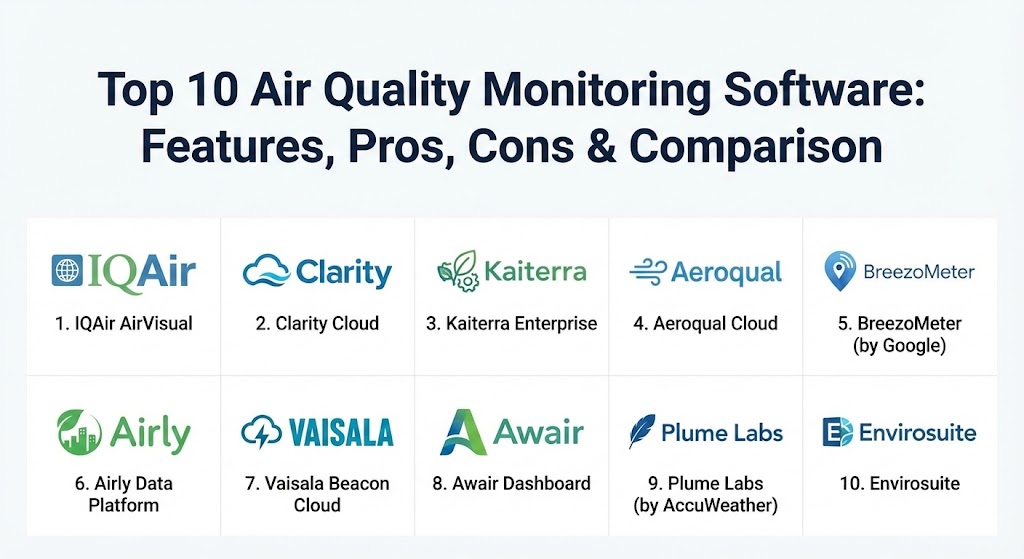
Top 10 Air Quality Monitoring Software Tools
1 — IQAir AirVisual
IQAir AirVisual is perhaps the most globally recognized platform in the industry, offering a comprehensive ecosystem that aggregates data from thousands of public monitoring stations alongside proprietary indoor and outdoor sensors.
- Key features:
- Global, real-time Air Quality Index (AQI) tracking for over 10,000 locations.
- Integration of both low-cost community sensors and high-end enterprise units.
- AI-driven 7-day air quality and weather forecasting.
- Interactive public-facing web widgets for community engagement.
- Mobile app integration with push-notification health alerts.
- Advanced analytics for identifying pollution sources (indoor vs. outdoor).
- Pros:
- Unmatched data reach, making it excellent for companies with a global footprint.
- Highly intuitive, user-friendly interface that requires zero technical training.
- Cons:
- Enterprise-grade features are locked behind a significant subscription tier.
- Heavy reliance on the IQAir hardware ecosystem for full data fidelity.
- Security & compliance: GDPR compliant; SOC 2 Type II (Varies by tier).
- Support & community: Massive global community; extensive self-service documentation and responsive enterprise support.
2 — Clarity Cloud
Clarity Cloud is designed for “Sensing-as-a-Service,” focusing on scalable, low-maintenance air quality monitoring for cities, campuses, and large-scale industrial sites.
- Key features:
- Remote, automated sensor calibration using co-location logic.
- Fleet management dashboard for monitoring sensor health in real-time.
- High-frequency data sampling (up to 1-minute intervals).
- Geospatial heatmaps to visualize pollutant movement over time.
- API-first architecture for seamless “Smart City” platform integration.
- Automated alerts based on custom threshold breaches.
- Pros:
- Eliminates the need for expensive manual field calibrations.
- Built for massive scale, handling thousands of nodes without lag.
- Cons:
- Interface is more “technical,” which may intimidate casual business users.
- Primarily focused on outdoor and city-scale monitoring rather than indoor comfort.
- Security & compliance: ISO 27001; SSO (Single Sign-On) support; encrypted data transit.
- Support & community: Proactive customer success teams and detailed onboarding programs.
3 — Kaiterra Enterprise
Kaiterra focuses heavily on the commercial real estate sector, specializing in high-performance Indoor Air Quality (IAQ) monitoring to meet building certifications like WELL, LEED, and RESET.
- Key features:
- “Smart building” HVAC integration to automate ventilation based on CO2.
- Real-time dashboard optimized for large-scale office floorplans.
- Automated reporting for building certification compliance.
- Multi-parameter tracking including PM, VOCs, CO2, and Formaldehyde.
- Advanced trend analysis to pinpoint specific times of indoor air degradation.
- Public-facing displays to build tenant trust in air safety.
- Pros:
- Leading-edge accuracy for indoor environments.
- Simplifies the complex process of obtaining green building certifications.
- Cons:
- Limited outdoor monitoring capabilities compared to rivals.
- Premium pricing targeted at the commercial real estate market.
- Security & compliance: SOC 2; GDPR; CCPA; supports major enterprise SSO protocols.
- Support & community: High-touch support for building engineers; technical webinars and RESET-certified training.
4 — Aeroqual Cloud
Aeroqual is the choice for industrial and regulatory users who require “near-reference” data—information that is defensible in legal or regulatory contexts.
- Key features:
- Automated daily report generation optimized for environmental regulation.
- Defensible data storage with tamper-proof audit logs.
- Integrated meteorological data (wind speed/direction) for pollution “fingerprinting.”
- Remote instrument diagnostics to minimize site visits.
- Support for “Fenceline” monitoring in Oil & Gas and mining.
- Mobile-ready alerts for site managers during exceedance events.
- Pros:
- Provides the highest level of data integrity for industrial compliance.
- Extremely rugged and reliable in harsh outdoor environments.
- Cons:
- Higher total cost of ownership (TCO) due to specialized hardware/software combo.
- Interface is data-dense and requires some environmental science knowledge.
- Security & compliance: HIPAA (where relevant); ISO 9001; robust audit trails.
- Support & community: Global network of field engineers; academic-level documentation.
5 — BreezoMeter (by Google)
Acquired by Google, BreezoMeter is an API-first software platform that focuses on street-level air quality intelligence, utilizing sophisticated modeling rather than just hardware sensors.
- Key features:
- Street-level air quality data with hyper-local 5-meter resolution.
- Global tracking of wildfires, pollen levels, and traffic pollution.
- Health-based recommendations tailored to sensitive groups (asthma, etc.).
- Historical data analysis for up to 5 years.
- Seamless integration into websites, apps, and car navigation systems.
- Predictive modeling using AI and satellite data.
- Pros:
- Best-in-class spatial resolution (street-by-street mapping).
- No physical hardware required for basic modeling/reporting.
- Cons:
- Lack of “on-site” physical verification can be a drawback for industrial compliance.
- Primarily an API service; lacks a robust “stand-alone” enterprise dashboard for hardware management.
- Security & compliance: Leverages Google Cloud security infrastructure; GDPR; SOC 2.
- Support & community: Extensive developer documentation; enterprise-level technical support via Google.
6 — Airly Data Platform
Airly focuses on making pollution data visible and actionable for local governments and communities, using AI to provide highly accurate 24-hour forecasts.
- Key features:
- AI-powered 24-hour pollution forecasting for PM2.5 and NO2.
- Community impact tools including public maps and automatic factsheets.
- “Community Engagement Tracker” to measure how residents interact with data.
- Solar-powered sensor management for remote rural deployments.
- Mobile app with “Clean Air” routing for pedestrians and cyclists.
- Pros:
- Exceptional focus on community transparency and public relations.
- One of the most cost-effective enterprise platforms for small municipalities.
- Cons:
- Features are heavily skewed toward outdoor urban monitoring.
- Less emphasis on “Indoor Air Quality” metrics like CO2.
- Security & compliance: MCERTS certified (hardware-dependent); GDPR compliant.
- Support & community: Active blog, webinars, and direct email support for public authorities.
7 — Vaisala Beacon Cloud
Vaisala is a titan in weather and environmental measurement. Their Beacon Cloud software is a professional platform that combines air quality data with high-precision meteorological science.
- Key features:
- Professional-grade integration of weather and air quality sensors.
- Visual data mapping for large geographical networks.
- High-integrity data validation and quality control algorithms.
- Calibration-as-a-service through the cloud platform.
- Multi-pollutant tracking for city-wide and industrial applications.
- Pros:
- Scientific-grade accuracy that is trusted by national governments.
- Seamlessly combines AQM with weather data for better root-cause analysis.
- Cons:
- High barrier to entry in terms of cost.
- A complex ecosystem that may be overkill for simple indoor office monitoring.
- Security & compliance: ISO 27001; SOC 2; Highly secure data centers for government use.
- Support & community: World-class support with a global network of specialized field engineers.
8 — Awair Dashboard
Awair has carved out a niche in the small-to-medium enterprise (SME) and education space, offering an approachable, design-focused dashboard for indoor environments.
- Key features:
- “Awair Score” to provide an instant, glanceable health status of a room.
- Specific “Modes” for productivity, allergy management, or sleep.
- Integration with smart building tools like Alexa, Google Home, and IFTTT.
- Multi-device management for large office floorplans and school districts.
- Detailed trend logs for CO2, VOCs, humidity, and temperature.
- Pros:
- The most user-friendly dashboard for non-technical office staff.
- Very fast to deploy—up and running in minutes.
- Cons:
- Lacks the deep industrial compliance reporting of Aeroqual or Vaisala.
- Limited outdoor integration capabilities.
- Security & compliance: AES-256 encryption; SOC 2 compliance (In progress/Varies).
- Support & community: Strong consumer-facing support; helpful video tutorials for classroom teachers.
9 — Plume Labs (by AccuWeather)
Plume Labs focuses on personal and mobile exposure, making it the ideal software for organizations that want to monitor the health of outdoor workers or field teams.
- Key features:
- Personalized “Pollution Maps” based on the specific movement of users.
- Real-time exposure alerts on mobile devices and wearables.
- Simplified “Plume Index” for immediate health risk assessment.
- Crowdsourced air quality maps created by fleet users.
- Integrated routing to avoid high-pollution areas in real-time.
- Pros:
- Only platform focusing effectively on “mobile” air quality.
- Strong gamification and user engagement features to encourage safety.
- Cons:
- Not suitable for static building compliance or industrial fenceline monitoring.
- Relies heavily on GPS accuracy and user participation.
- Security & compliance: Standard data privacy protections (GDPR); anonymized telemetry.
- Support & community: Strong presence on social media; quick response times for mobile app issues.
10 — Envirosuite
Envirosuite is a sophisticated environmental intelligence platform used by airports, mines, and heavy industrial facilities for real-time and predictive modeling.
- Key features:
- Predictive modeling that simulates how weather will disperse future emissions.
- Real-time community sentiment tracking integrated with air data.
- Automated “Incident Management” workflows for pollution events.
- Stakeholder communication portals for radical transparency.
- Compliance dashboards designed for heavy industrial regulation.
- Pros:
- The most powerful “predictive” engine for large-scale industrial sites.
- Unique ability to correlate pollution spikes with specific community complaints.
- Cons:
- Extremely high complexity; requires dedicated environmental managers.
- Pricing is strictly in the high-enterprise bracket.
- Security & compliance: ISO 27001; SOC 2 Type II; HIPAA/GDPR where applicable.
- Support & community: Premium technical account managers; high-level consulting services.
Comparison Table
| Tool Name | Best For | Platform(s) Supported | Standout Feature | Rating (Gartner/TrueReview) |
| IQAir AirVisual | Global Monitoring | Web, iOS, Android | Global Data Aggregation | 4.7 / 5 |
| Clarity Cloud | Smart Cities | Web, Cloud | Remote Auto-Calibration | 4.6 / 5 |
| Kaiterra | Commercial Offices | Web, SaaS | HVAC/RESET Integration | 4.5 / 5 |
| Aeroqual Cloud | Industrial Compliance | Web, SaaS | Defensible Data Logs | 4.8 / 5 |
| BreezoMeter | Developers / API | API-First | 5m Street Resolution | 4.7 / 5 |
| Airly | Local Gov / Planning | Web, iOS, Android | AI-Powered Forecasting | 4.6 / 5 |
| Vaisala Beacon | Scientific Research | Web, Cloud | Weather + AQM Fusion | 4.7 / 5 |
| Awair Dashboard | Schools / SMEs | Web, iOS, Android | “Awair Score” Simplicity | 4.4 / 5 |
| Plume Labs | Mobile Field Teams | iOS, Android | Personal Exposure Maps | 4.3 / 5 |
| Envirosuite | Airports / Mining | Web, Enterprise | Predictive Emission Modeling | 4.6 / 5 |
Evaluation & Scoring of Air Quality Monitoring Software
The following rubric is used to weigh the effectiveness of an enterprise-grade AQM software solution.
| Criteria | Weight | Evaluation Notes |
| Core Features | 25% | Real-time analytics, automated alerts, and multi-sensor support. |
| Ease of Use | 15% | Dashboard clarity and the speed of onboarding for new users. |
| Integrations | 15% | Ability to “talk” to HVAC systems, APIs, and weather data. |
| Security & Compliance | 10% | Data encryption, audit trails, and industry certifications. |
| Performance | 10% | Data latency, high-frequency sampling, and platform uptime. |
| Support | 10% | Documentation quality and accessibility of field engineers. |
| Price / Value | 15% | ROI through energy savings or mitigated legal risks. |
Which Air Quality Monitoring Tool Is Right for You?
Selecting the right software depends on whether you are looking for operational efficiency, regulatory compliance, or public engagement.
- Solo Users vs. SMBs: Small offices and retail shops should prioritize ease of use. Awair Dashboard or IQAir AirVisual offer high-quality insights without requiring a background in environmental science.
- Commercial Real Estate (Mid-Market): If your goal is building certification (LEED/WELL) and tenant safety, Kaiterra is the industry standard for indoor integration.
- Smart Cities & Governments: Transparency and scale are key here. Clarity Cloud and Airly are designed for city-scale deployments with automated management.
- Industrial & High-Risk Facilities: For mining, oil & gas, or airports, data must be defensible. Aeroqual and Envirosuite offer the ruggedness and predictive power needed to handle high-stakes environmental management.
- Budget vs. Premium: BreezoMeter provides an excellent low-cost entry via API modeling if physical sensors aren’t in the budget, while Vaisala represents the premium, scientific end of the spectrum.
Frequently Asked Questions (FAQs)
1. What is the difference between AQI and pollutant concentrations?AQI (Air Quality Index) is a simplified number (usually 0–500) that summarizes the risk of several pollutants into one score. Pollutant concentrations (e.g., 25μg/m3 of PM2.5) are the raw measurements used to calculate that score.
2. Can I use these tools without buying hardware? Platforms like BreezoMeter (by Google) and IQAir provide modeling and public data that do not require you to own sensors. However, for building-specific or site-specific compliance, you will need on-site hardware.
3. How often does the software need to be calibrated?Software like Clarity Cloud uses “remote calibration” that updates automatically. Traditional industrial systems might require physical calibration every 6–12 months, which the software helps schedule.
4. What is a “RESET” or “WELL” certification? These are global standards for healthy buildings. Software like Kaiterra is specifically built to track the continuous data required to maintain these high-value certifications.
5. How do these tools help save energy? By monitoring CO2 and occupancy, the software can tell your HVAC system to “ramp down” when air is fresh or a room is empty, potentially reducing energy bills by up to 35%.
6. Is the data secure? Enterprise tools like Vaisala and Aeroqual use end-to-end encryption and are SOC 2 compliant, ensuring that your facility’s environmental data isn’t leaked to competitors or the public.
7. Can I monitor for specific gases like Ozone or Formaldehyde? Yes, but this is sensor-dependent. Most professional platforms (Aeroqual, Kaiterra) support a wide range of specialized sensor heads for VOCs, O3, and NO2.
8. What is “Hyper-local” air quality? Hyper-local refers to data at the neighborhood or street level (as small as 5 meters), rather than “Regional” data which might come from a single government station miles away.
9. Do these tools provide wildfire alerts? Yes. Most modern platforms now integrate satellite data to provide real-time alerts for wildfire smoke plumes and their predicted paths.
10. Why is PM2.5 the most commonly monitored pollutant?PM2.5 (particulate matter smaller than 2.5 micrometers) can enter the bloodstream and is linked to the most significant health issues, making it the primary metric for safety.
Conclusion
The choice of Air Quality Monitoring software is no longer just an “IT decision”—it is a health, safety, and financial decision. The most effective tools today are those that don’t just tell you the air is bad, but predict when it will be bad and automatically trigger systems to fix it. Whether you are aiming for a green building certification or managing a city’s traffic flow, the “best” tool is the one that aligns with your specific regulatory and operational goals.