Introduction
AI Dubbing Tools are software applications that leverage artificial intelligence—specifically deep learning, neural text-to-speech (TTS), and machine translation—to replace the original audio track of a video with a translated version in a different language. Unlike traditional “robotic” voiceovers, modern AI dubbing preserves the tone, emotion, and sometimes even the unique vocal characteristics of the original speaker.
The importance of these tools lies in their efficiency and scale. They allow a single YouTube creator to reach a global audience or a multinational corporation to deploy training videos to 50 countries simultaneously. Key real-world use cases include e-learning localization, marketing campaign adaptation, news broadcasting, and documentary filmmaking. When evaluating AI dubbing tools, users should look for three pillars: Voice Naturalness (emotional range), Lip-Sync Accuracy (visual alignment), and Language Diversity (the number of supported dialects and accents).
Best for: Content creators (YouTubers, TikTokers), EdTech companies, global marketing agencies, and corporate HR departments. It is ideal for anyone needing to scale video content across multiple languages quickly and cost-effectively without sacrificing professional quality.
Not ideal for: High-budget Hollywood feature films where nuanced, artistic performance requires human actors, or extremely short-form content where simple subtitles would be more cost-effective. It may also not be suitable for live, unscripted broadcasts where real-time latency is still a technical hurdle for perfect lip-syncing.
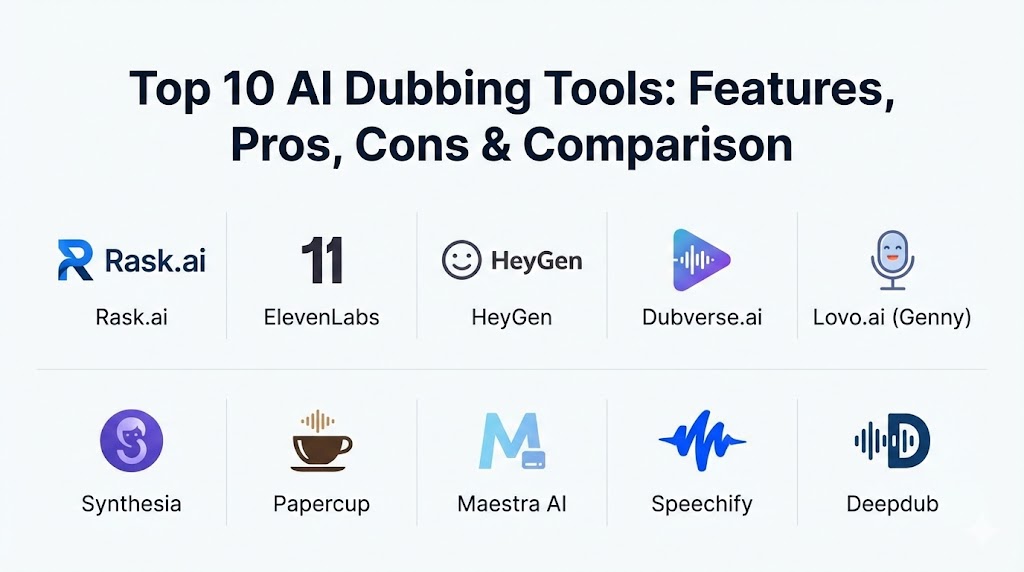
Top 10 AI Dubbing Tools
1 — Rask.ai
Rask.ai is widely considered a leader in the “all-in-one” AI dubbing space. It is designed specifically for creators who want a frictionless experience, offering tools that handle everything from transcription and translation to the final voiceover and lip-syncing.
- Key features:
- Support for over 130 languages for translation.
- Voice Cloning technology that mimics the original speaker’s voice.
- Automated lip-syncing that adjusts the visual movement of the mouth.
- Multi-speaker detection for complex scenes with several actors.
- Integrated “Shorts” generator to repurpose dubbed content for social media.
- High-speed rendering optimized for long-form video content.
- Pros:
- Exceptionally easy-to-use interface that requires no technical background.
- High accuracy in voice cloning, maintaining the “identity” of the creator.
- Cons:
- Subscription costs can be high for casual users or hobbyists.
- Lip-syncing performance can vary depending on the angle of the speaker’s face.
- Security & compliance: GDPR compliant, SOC 2 Type II certified, and utilizes end-to-end encryption for uploaded media.
- Support & community: Extensive documentation library, 24/7 chat support for premium tiers, and an active community of video creators.
2 — ElevenLabs
ElevenLabs is the gold standard for high-fidelity synthetic voices. While it started as a text-to-speech platform, its dedicated dubbing feature leverages its world-class neural models to provide the most emotive AI voices on the market.
- Key features:
- Advanced Speech-to-Speech (STS) translation for better emotional mapping.
- Automatic background noise removal to isolate voices before dubbing.
- Instant voice cloning with as little as 60 seconds of audio data.
- Emotional range sliders to adjust the “stability” and “clarity” of the voice.
- Support for 29+ core languages with high regional accent accuracy.
- API access for developers looking to automate dubbing workflows.
- Pros:
- Unmatched voice quality that is often indistinguishable from human speech.
- Extremely fast processing speeds even for high-bitrate audio.
- Cons:
- Lacks built-in visual lip-syncing; focuses primarily on the audio side.
- Free tier has very limited credits for video processing.
- Security & compliance: SSO available for enterprise, GDPR compliant, and rigorous data privacy policies for voice data.
- Support & community: Robust API documentation, dedicated enterprise account managers, and a massive Discord community for prompt sharing.
3 — HeyGen
HeyGen has gained viral fame for its “Video Translate” feature. While it is primarily an avatar-generation platform, its AI dubbing and lip-syncing capabilities are some of the most visually impressive in the industry.
- Key features:
- Seamless visual lip-syncing that re-renders the lower half of the face.
- One-click translation for YouTube and social media links.
- Multi-speaker support with distinct voice profiles for each person.
- Ability to upload custom “voice seeds” for brand-specific tones.
- Cloud-based editor for fine-tuning translated scripts before rendering.
- Integration with Canva and Zapier for streamlined content workflows.
- Pros:
- The visual lip-syncing is arguably the best in the consumer market.
- Very intuitive for marketing teams who need social-media-ready content.
- Cons:
- Processing times can be long during peak hours.
- Requires high-quality source video (clear face shots) for the best results.
- Security & compliance: SOC 2 compliant, ISO 27001, and supports SSO and audit logs for enterprise users.
- Support & community: Comprehensive video tutorials, live onboarding sessions, and an active Facebook group.
4 — Dubverse.ai
Dubverse.ai is a cloud-based video dubbing platform that focuses on making localization affordable and accessible. It uses a “Lego-style” building block approach to video editing and translation.
- Key features:
- “Self-stack” technology that allows users to choose different AI voices for each speaker.
- Built-in subtitle generator that syncs perfectly with the dubbed audio.
- Support for 30+ global languages and 150+ distinct AI voices.
- Collaborative workspace for teams to review and edit translations.
- Real-time script editing with a side-by-side translation view.
- Sharing links for external client approval without downloading files.
- Pros:
- Highly cost-effective compared to specialized enterprise tools.
- Very fast turnaround for simple talking-head videos.
- Cons:
- AI voices can occasionally sound a bit “flatter” than ElevenLabs.
- Limited advanced features for complex cinematic sound design.
- Security & compliance: Standard data encryption, GDPR compliance, and secure payment processing.
- Support & community: Detailed help center, email support, and a growing YouTube channel with tips.
5 — Lovo.ai (Genny)
Lovo.ai, through its Genny platform, provides a professional-grade suite for voiceovers and dubbing. It is designed for production houses that need granular control over the final sound.
- Key features:
- 500+ AI voices across 100+ languages with various “emotions” (angry, happy, sad).
- Integrated video editor with timeline-based audio syncing.
- Producer mode for fine-tuning pronunciation and emphasis on specific words.
- AI Art Generator to create thumbnails or supporting visuals.
- Support for third-party audio uploads to mix AI and human voices.
- Commercial rights included in most paid tiers.
- Pros:
- Excellent for producers who want to “direct” the AI voice’s performance.
- Huge variety of voices, including many suitable for character acting and gaming.
- Cons:
- The UI can be intimidating for casual users due to the number of controls.
- Higher tiers are required for full HD video exports and high-quality voices.
- Security & compliance: SOC 2 Type II, SSO integration, and secure AWS hosting.
- Support & community: Enterprise-level SLA options, live chat, and an extensive blog on voice technology.
6 — Synthesia
Synthesia is famous for its AI avatars, but its dubbing engine is a core part of its corporate training appeal. It is designed for businesses that want to create and localize videos without ever picking up a camera.
- Key features:
- Create a video in one language and “translate” it into 120+ others instantly.
- AI avatars that “perform” the dubbed audio with perfect lip-sync.
- Screen recording integration for software tutorials.
- Custom AI Avatars (of your own employees) for localized training.
- Brand kits to ensure colors and logos stay consistent across languages.
- Automated script translation powered by advanced LLMs.
- Pros:
- Perfect for corporate training where consistency is more important than “cinema” quality.
- Removes the need for a physical camera, making localization effortless.
- Cons:
- Voices can sometimes feel a bit “corporate” and lack extreme emotional depth.
- Not suitable for dubbing existing real-world movies or documentaries.
- Security & compliance: SOC 2, GDPR compliant, content moderation filters, and SSO for teams.
- Support & community: Synthesia Academy for certifications, dedicated success managers, and global user meetups.
7 — Papercup
Papercup takes a “Human-in-the-loop” approach. While it uses AI for the bulk of the work, it offers a managed service where human editors verify the translation and tone to ensure 100% accuracy.
- Key features:
- High-quality neural voices that mimic the original speaker’s tone.
- Expert human review layer for translation and emotional accuracy.
- End-to-end service suitable for media companies and broadcasters.
- Support for high-volume content libraries (catalogs).
- Specialized models for different genres (news, entertainment, corporate).
- Detailed analytics on localized video performance.
- Pros:
- Highest accuracy in the market due to the human verification layer.
- Ideal for brands that cannot risk a “lost in translation” moment.
- Cons:
- significantly more expensive than “pure” AI tools.
- Longer turnaround times due to the human editing component.
- Security & compliance: Enterprise-grade security, HIPAA compliant options, and rigorous data protection.
- Support & community: White-glove service with dedicated project managers.
8 — Maestra AI
Maestra AI is a versatile tool that focuses on transcription, captioning, and dubbing. It is a favorite for educators and organizations that need a unified platform for accessibility.
- Key features:
- Automatically generates dubbed audio tracks for 80+ languages.
- Interactive script editor that allows for manual correction of AI translation.
- “Voiceover” mode that keeps the original audio low in the background (common in news).
- Team collaboration features with permission-based access.
- Integration with major video platforms like YouTube and Vimeo.
- Cloud-based storage for all localized asset versions.
- Pros:
- Excellent for creating accessible content (Dubbing + Subtitles) in one go.
- Very straightforward pricing and simple user experience.
- Cons:
- Lip-syncing features are not as advanced as HeyGen or Rask.
- Voice quality is good but slightly behind ElevenLabs in emotional range.
- Security & compliance: GDPR compliant, SSL encryption, and secure cloud backups.
- Support & community: Knowledge base, email support, and a very helpful onboarding walkthrough.
9 — Speechify
Speechify, primarily known as a text-to-speech app for reading, has expanded into the AI video dubbing market. It leverages its massive library of natural-sounding voices to localize content.
- Key features:
- One-click video dubbing for over 100+ languages.
- Features “celebrity” AI voices (limited availability) for unique branding.
- Mobile app support for managing projects on the go.
- High-speed transcription engine for rapid script generation.
- Direct integration with web browsers for dubbing online videos.
- Seamless voice cloning that captures the “essence” of the speaker.
- Pros:
- Very fast processing and a very modern, clean UI.
- Cross-platform support (Web, iOS, Android).
- Cons:
- The dubbing-specific features are still maturing compared to Rask.
- Pricing can be opaque for the video-specific enterprise features.
- Security & compliance: Varies / Standard encryption and privacy policies.
- Support & community: Massive user base, 24/7 support for premium users, and extensive video guides.
10 — Deepdub
Deepdub is the “heavyweight” of the AI dubbing world, focusing on the entertainment industry, gaming, and feature-length content. They aim to provide “theatrical quality” AI localization.
- Key features:
- Deepdub GO platform for professional content creators and small studios.
- Emotional preservation technology that keeps the “acting” in the voice.
- Support for surround sound (5.1/7.1) audio mixing in AI dubs.
- Cultural adaptation engine that suggests idiom changes for local audiences.
- Specialized models for character voices in video games.
- Collaborative workflow for directors and sound engineers.
- Pros:
- The best choice for long-form, cinematic content.
- Handles complex sound environments (music + effects + voice) exceptionally well.
- Cons:
- Overkill for simple marketing or training videos.
- Can be expensive and requires a more professional understanding of audio.
- Security & compliance: ISO 27001, SOC 2, and high-level studios security protocols.
- Support & community: Professional service teams and high-level technical support for studios.
Comparison Table
| Tool Name | Best For | Platform(s) Supported | Standout Feature | Rating (Gartner/TrueReview) |
| Rask.ai | All-in-one Creators | Web / Mobile | 130+ Language Support | 4.8 / 5 |
| ElevenLabs | Voice Quality | Web / API | Neural Speech-to-Speech | 4.9 / 5 |
| HeyGen | Visual Lip-Sync | Web / SaaS | Realistic Face Re-rendering | 4.7 / 5 |
| Dubverse.ai | Budget Conscious | Web | Multi-Speaker “Lego” Stack | 4.4 / 5 |
| Lovo.ai | Audio Producers | Web / SaaS | Granular Emotional Control | 4.5 / 5 |
| Synthesia | Training/Corporate | Web | Avatar + Dubbing Combo | 4.7 / 5 |
| Papercup | High Accuracy | Managed Service | Human-in-the-loop Review | 4.6 / 5 |
| Maestra AI | Accessibility/Education | Web | Integrated Subtitle/Dubbing | 4.3 / 5 |
| Speechify | Mobile/Rapid Dubs | Web / iOS / Android | Cross-device Ecosystem | 4.2 / 5 |
| Deepdub | Movies & Gaming | Web / Enterprise | Theatrical Quality Audio | 4.8 / 5 |
Evaluation & Scoring of AI Dubbing Tools
To determine the true value of an AI dubbing tool, we use a weighted scoring rubric that considers the needs of the modern content producer.
| Category | Weight | Evaluation Criteria |
| Core Features | 25% | Quality of voice cloning, translation accuracy, and lip-syncing capabilities. |
| Ease of Use | 15% | Intuitive interface, minimal setup time, and helpfulness of the onboarding. |
| Integrations | 15% | Ability to connect with YouTube, Canva, Zapier, or existing API workflows. |
| Security & Compliance | 10% | GDPR/SOC 2 status and the safety of voice and video data. |
| Performance | 10% | Rendering speeds, uptime, and handling of long-form (60min+) video. |
| Support & Community | 10% | Availability of human help, documentation, and a helpful user forum. |
| Price / Value | 15% | Total cost of ownership relative to the features and “time saved.” |
Which AI Dubbing Tool Is Right for You?
Selecting the right tool depends on your specific balance of speed, cost, and visual quality.
- Solo Creators & Small YouTubers: If your goal is to grow your channel in 10 languages, Rask.ai or HeyGen are your best bets. They handle the complex visual lip-syncing that keeps viewers engaged.
- Small to Medium Businesses (SMBs): For localized marketing ads or product demos, Dubverse.ai offers a great balance of price and performance, allowing you to scale without a massive budget.
- Corporate & EdTech: If you are building a library of 1,000 training videos, Synthesia or Maestra AI are ideal. They prioritize workflow efficiency and accessibility over “cinematic” flair.
- Enterprise & Media Houses: For documentaries or premium streaming content, Deepdub or Papercup are the only real choices. They offer the security, emotional depth, and accuracy checks required for professional broadcasting.
- Developers & Tech Firms: If you want to build your own localization app or automate a massive pipeline, ElevenLabs provides the most powerful API and the best raw audio quality.
Frequently Asked Questions (FAQs)
1. Is AI dubbing actually better than human voice acting?
For speed and cost, yes. For artistic nuance and high-end cinematic performance, human actors are still superior. However, in 2026, AI is close enough that for 90% of business and web content, viewers cannot tell the difference.
2. Does AI dubbing include lip-syncing?
Not always. Tools like HeyGen and Rask.ai offer visual lip-syncing (re-animating the mouth), while others like ElevenLabs focus purely on the audio. Always check if the tool provides “Visual Lip-Sync” if that is important to you.
3. How much does AI dubbing cost?
Most tools use a “credit-based” system. You might pay $30 to $100 per month for a certain number of video minutes. Enterprise plans for high-volume users like Deepdub are usually custom-quoted.
4. Can these tools clone my own voice?
Yes, most top-tier tools (Rask, ElevenLabs, HeyGen) feature “Voice Cloning.” You simply upload a few minutes of your own speech, and the AI can then speak any language in your unique voice.
5. How accurate is the translation?
Most tools use advanced models (like GPT-4 or specialized neural translation) which are about 95% accurate. However, for technical or medical content, you should always have a native speaker review the script.
6. Can I dub a video with multiple speakers?
Yes, but you need a tool that supports “Multi-speaker detection” (like Rask.ai or Lovo.ai). This allows the AI to assign a unique cloned voice to each person in the video.
7. How long does it take to dub a 10-minute video?
With pure AI tools, it usually takes between 5 and 15 minutes to process, translate, and render the final video. Managed services with human review (like Papercup) can take 24-48 hours.
8. Are there copyright issues with AI dubbing?
Generally, if you own the original video, you own the dubbed version. However, cloning a celebrity’s voice without permission is a major legal risk. Most reputable tools have filters to prevent this.
9. What file formats are supported?
Almost all tools support .MP4, .MOV, and .AVI for video, and .MP3 or .WAV for audio. Some also allow you to import directly from a YouTube or Google Drive link.
10. Is my data safe with AI dubbing tools?
Top-tier tools are GDPR and SOC 2 compliant. However, always check the privacy policy to ensure they aren’t using your uploaded voice data to “train” their public models without your consent.
Conclusion
The “best” AI dubbing tool is the one that aligns with your specific production goals. If you need visual perfection, HeyGen is unmatched. If you need raw emotional audio quality, ElevenLabs is the industry leader. For a complete, automated content pipeline, Rask.ai remains the top all-around choice. As AI continues to evolve, the barrier between cultures will only continue to shrink, making it easier than ever to share your message with the entire world, regardless of the language they speak.