Introduction
Age verification tools are specialized software-as-a-service (SaaS) or API-driven solutions that confirm a user’s age before they can access restricted products or services. These tools have evolved beyond manual ID checks to include AI-driven facial age estimation, biometric liveness detection, and global database pings. By automating the verification process, companies can prevent underage access to harmful content, tobacco, alcohol, and gambling, thereby avoiding catastrophic fines and legal liability.
Key evaluation criteria for these tools include accuracy (low false acceptance/rejection rates), speed (processing in under 10 seconds), and privacy preservation (minimizing the collection of Personally Identifiable Information). Real-world use cases span from liquor delivery apps and online casinos to “kid-safe” social networks and high-ticket marketplaces.
Best for: Online gaming and gambling platforms, e-commerce retailers selling age-restricted goods (vape, alcohol, CBD), social media companies, and regulated financial services. It is essential for compliance officers and IT managers in high-growth companies looking to scale globally.
Not ideal for: B2B platforms with closed ecosystems, internal-only corporate tools, or informational websites that do not collect user data or sell age-restricted products. For these, a simple self-certification disclaimer is usually sufficient.
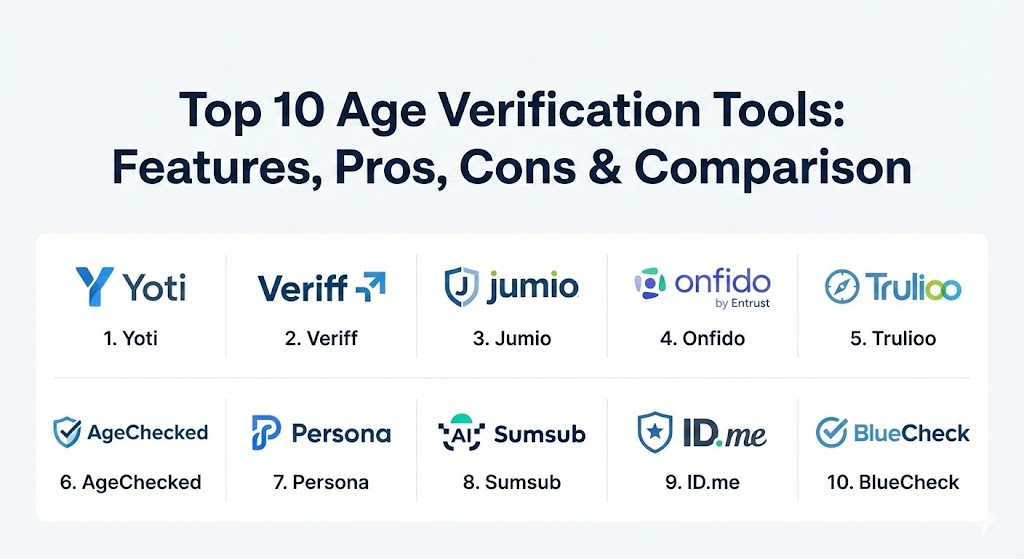
Top 10 Age Verification Tools
1 — Yoti
Yoti is a global leader in privacy-centric digital identity. Their standout feature is “Facial Age Estimation,” which uses AI to determine a user’s age without requiring them to share their name or upload a physical document.
- Key features:
- AI-powered facial age estimation (privacy-first).
- Reusable Digital Identity Wallet for one-click verification.
- Document-based verification (passports, IDs) for 200+ countries.
- Integrated liveness detection to prevent spoofing.
- Anonymized results (e.g., “User is 18+”).
- Retail and online hardware-software integration.
- Pros:
- Offers the lowest friction for users who value privacy.
- Highly accurate estimation (often +/- 1.5 years margin).
- Cons:
- Requires a document backup if the AI estimation is near the threshold.
- Integration can be more complex than basic API-only tools.
- Security & compliance: SOC 2 Type II, ISO 27001, HIPAA, and GDPR. KJM-certified in Germany.
- Support & community: Enterprise-grade support with detailed developer docs and a robust GitHub repository.
2 — Veriff
Veriff is known for its “AI-guided” verification flow, which uses real-time feedback to help users take perfect photos of their IDs and faces, resulting in industry-leading conversion rates.
- Key features:
- Real-time ID and selfie verification with instant feedback.
- Support for over 12,000 document types globally.
- Video-based “liveness” to combat deepfakes and masks.
- Automated fraud detection engine with risk labeling.
- Dynamic workflow builder for custom compliance rules.
- Pros:
- Exceptional first-time pass rates due to the guided capture flow.
- Decisions are often delivered in under 6 seconds.
- Cons:
- Pricing is on the higher end for premium features.
- Can be resource-heavy for older mobile devices.
- Security & compliance: GDPR, SOC 2 Type II, and ISO 27001 compliant.
- Support & community: Dedicated account managers for enterprise and a highly responsive technical support team.
3 — Jumio
Jumio is the “gold standard” for large-scale regulated enterprises. It offers a multi-layered approach that combines automated AI checks with human oversight for maximum assurance.
- Key features:
- Biometric face matching and passive liveness detection.
- Automatic decline for users under the legal threshold.
- Sanctions and PEP (Politically Exposed Persons) screening.
- Biometric re-authentication for returning users.
- In-person integration for physical retail locations.
- Pros:
- Unrivaled security and reliability for high-risk industries.
- Extensive global database for cross-referencing identity data.
- Cons:
- User friction is slightly higher due to the thoroughness of checks.
- Licensing and per-check costs are tailored for larger budgets.
- Security & compliance: PCI DSS, HIPAA, SOC 2, and GDPR.
- Support & community: Extensive training materials, webinars, and global 24/7 enterprise support.
4 — Onfido (by Entrust)
Onfido, now part of Entrust, leverages the “Atlas” AI forger-detection engine to provide high-accuracy age and identity verification for fintech and SaaS companies.
- Key features:
- Atlas AI engine trained on millions of forged documents.
- Smart capture SDK for seamless mobile integration.
- Video and photo liveness checks.
- Fully automated verification workflow.
- Deep integration with the broader Entrust identity ecosystem.
- Pros:
- Strongest “anti-spoofing” technology in the market.
- Excellent for organizations that need more than just age (full KYC).
- Cons:
- Slower decision times compared to Veriff (can take 30–60 seconds).
- Some users report challenges with document edge cases.
- Security & compliance: ISO 27001, GDPR, and SOC 2.
- Support & community: Solid enterprise-level support; documentation is technical and thorough.
5 — Trulioo
Trulioo provides the largest identity “marketplace” in the world, connecting to 400+ data sources (credit bureaus, utility bills, voter logs) to verify age without the user ever needing to upload an ID.
- Key features:
- Non-document age verification via authoritative databases.
- Global coverage for 5 billion people in 195 countries.
- No-code “Workflow Studio” for drag-and-drop verification rules.
- Mobile and Web SDKs for easy deployment.
- Real-time risk and fraud scoring.
- Pros:
- The lowest possible friction for users (no selfie or document needed).
- Best for global scalability across diverse markets.
- Cons:
- Accuracy is dependent on the availability of third-party data.
- May not meet the “high-assurance” requirements of some gambling regulators.
- Security & compliance: GDPR, HIPAA, SOC 2, and numerous local certifications.
- Support & community: Excellent partner-focused support and extensive regulatory guidance.
6 — AgeChecked
AgeChecked is a specialized gateway focused specifically on the UK and EU e-commerce and gambling markets, offering a “single solution” for diverse age-restricted industries.
- Key features:
- Jurisdiction-specific compliance for the UK and EU.
- Age tokenization (verify once, use across multiple sites).
- Minimal data retention to reduce merchant liability.
- Support for multiple methods (credit card, database, mobile network).
- Ready-made plugins for Shopify, WooCommerce, and Magento.
- Pros:
- Highly specialized for e-commerce and retail niches.
- Compliant with the UK’s stringent PAS 1296 standard.
- Cons:
- Limited coverage outside of Western Europe.
- User interface is less modern than the “AI-first” giants.
- Security & compliance: GDPR, UK Data Protection Act, and PAS 1296.
- Support & community: Strong focus on localized compliance advice for European merchants.
7 — Persona
Persona is a modern, flexible identity infrastructure platform that allows teams to build highly customized verification “experiences” based on user risk.
- Key features:
- Dynamic, risk-based friction levels (easier for low-risk users).
- Fully customizable web and mobile SDKs.
- Automated decisioning with manual review fallbacks.
- Integrated case management for auditing.
- Sophisticated re-verification triggers.
- Pros:
- Unmatched flexibility in UI/UX design.
- Very developer-friendly with high-quality APIs.
- Cons:
- Advanced configuration requires significant engineering time.
- Pricing can be complex and scale quickly with usage.
- Security & compliance: SOC 2, GDPR, HIPAA, and CCPA compliant.
- Support & community: Excellent documentation and a growing community of SaaS developers.
8 — Sumsub
Sumsub is an all-in-one verification platform that combines age checks with full KYC, KYB, and AML (Anti-Money Laundering) monitoring in a single dashboard.
- Key features:
- AI facial age estimation.
- 3D Liveness and deepfake detection.
- Automated document verification for 2,500+ ID types.
- Custom “Waterfall” logic (if Method A fails, try Method B).
- Legal and compliance support for worldwide regulations.
- Pros:
- Great “one-stop shop” for organizations with multiple compliance needs.
- Predictable, tiered pricing that is friendly to mid-market firms.
- Cons:
- The dashboard can feel overwhelming due to the sheer volume of features.
- Document extraction can occasionally miss niche IDs.
- Security & compliance: GDPR, ISO 27001, and SOC 2.
- Support & community: Comprehensive “Sumsub Academy” for training and proactive support managers.
9 — ID.me
ID.me is a digital identity wallet platform used by millions of users in the US. Once a user verifies their age with ID.me, they can access any participating site with a single login.
- Key features:
- Federated identity (one identity for many sites).
- High-assurance identity proofing for government agencies.
- Multi-factor authentication (MFA).
- Social proof and affinity verification (e.g., veteran or student status).
- “Next-day” human-assisted verification for edge cases.
- Pros:
- Massive pre-verified user base in the US (high conversion).
- Reduces the need for the user to repeatedly share sensitive documents.
- Cons:
- Narrower international reach compared to Veriff or Jumio.
- Users must be willing to create an ID.me account.
- Security & compliance: FedRAMP High, NIST 800-63-3, SOC 2, and HIPAA.
- Support & community: High-tier enterprise support; large US-based user support team.
10 — BlueCheck
BlueCheck is a streamlined age verification tool designed for high-conversion e-commerce environments where minimizing “cart abandonment” is the top priority.
- Key features:
- Quick name/DOB database verification behind the scenes.
- Minimal user interaction for honest customers.
- Machine learning-based fraud prevention.
- Age token reuse across sessions.
- Simple API and plugin-based deployment.
- Pros:
- One of the most cost-effective solutions for SMBs.
- Focused entirely on the checkout flow conversion rate.
- Cons:
- Lacks the deep biometric features of the top-tier enterprise tools.
- Primarily focused on the North American market.
- Security & compliance: GDPR and CCPA compliant; encrypted data handling.
- Support & community: Responsive customer support and simple setup guides.
Comparison Table
| Tool Name | Best For | Platform(s) Supported | Standout Feature | Rating (G2 / Gartner) |
| Yoti | Privacy-First | Web, iOS, Android | Facial Age Estimation | 4.6 / 5 |
| Veriff | High-Growth Tech | Web, iOS, Android | AI-Guided Capture | 4.7 / 5 |
| Jumio | Large Enterprises | Web, Mobile, POS | Hybrid AI + Human Review | 4.4 / 5 |
| Onfido | Fintech & Security | Web, API, Mobile | Atlas AI Forgery Detection | 4.5 / 5 |
| Trulioo | Global Scale | Web, API | 400+ Data Sources | 4.3 / 5 |
| AgeChecked | UK/EU E-commerce | Web, Plugins | PAS 1296 Compliance | N/A |
| Persona | Custom UX | Web, iOS, Android | Risk-Based Workflows | 4.8 / 5 |
| Sumsub | All-in-One Compliance | Web, Mobile | Automated Waterfall Logic | 4.6 / 5 |
| ID.me | US Consumer Login | Web, Mobile Wallet | Federated Identity Wallet | 4.5 / 5 |
| BlueCheck | SMB E-commerce | Web, API | Low-Friction DB Checks | 4.4 / 5 |
Evaluation & Scoring of Age Verification Tools
To determine which tool offers the best ROI, we evaluate them against a weighted scoring rubric based on current industry standards.
| Category | Weight | Evaluation Criteria |
| Core Features | 25% | Facial estimation, document OCR, database checks, and liveness detection. |
| Ease of Use | 15% | Friction level for the end-user and the intuitive nature of the admin dashboard. |
| Integrations | 15% | Availability of SDKs, REST APIs, and plugins for Shopify/WooCommerce. |
| Security & Compliance | 10% | Certifications like SOC 2, ISO 27001, and regional KJM/PAS 1296 approval. |
| Performance | 10% | Average response time for a verification decision (under 10s is ideal). |
| Support & Community | 10% | Quality of technical documentation and availability of 24/7 support. |
| Price / Value | 15% | Cost per check versus the security and conversion gains provided. |
Which Age Verification Tool Is Right for You?
Selecting an age verification tool is a balance between Conversion (Revenue) and Compliance (Risk).
- Solo Sellers & Boutique SMBs: If you sell specialized age-restricted goods on Shopify, BlueCheck or AgeChecked offer the best price-to-performance ratio and easy setup.
- Mid-Market Growth Companies: If you are scaling a social app or a gaming platform, Veriff and Persona provide the best user experience and developer flexibility to keep sign-up drop-off low.
- Global Enterprises & Regulated Firms: If you operate in highly regulated “high-risk” sectors like sports betting or fintech, Jumio, Onfido, or Trulioo offer the global coverage and military-grade security needed to satisfy auditors.
- Privacy-Conscious Platforms: If your brand identity is built on user privacy (e.g., a “safe” messaging app), Yoti’s facial estimation is the clear winner as it doesn’t require “naming” the user.
- US-Focused Retailers: If your audience is primarily in the United States, ID.me is a powerful choice because millions of users already have their identities “ready to go” in their wallets.
Frequently Asked Questions (FAQs)
1. Is facial age estimation the same as facial recognition?
No. Facial estimation (like Yoti’s) analyzes facial features (wrinkles, skin texture) to estimate an age range but does not identify who the person is. Facial recognition specifically matches a face to a known identity.
2. Does age verification slow down the checkout process?
Modern tools are designed to be nearly invisible. Database checks happen in milliseconds, while AI photo checks now average 6–10 seconds. The “friction” is minimal compared to the risk of legal fines.
3. What happens if a user’s ID is expired?
Most high-tier tools (Veriff, Jumio) can be configured to either accept or decline expired IDs based on your specific industry’s regulatory requirements and risk tolerance.
4. Are these tools GDPR compliant?
Yes. Leading providers use “privacy by design,” meaning they encrypt data in transit and at rest, and often provide options for “instant deletion” of PII once the age has been verified.
5. Can minors bypass these systems with a VPN?
A VPN only changes a user’s location. Modern age verification requires an ID upload or a biometric scan, which a VPN cannot fake. Liveness detection also stops users from holding up a printed photo of an adult.
6. How accurate is AI-based age estimation?
In 2026, AI estimation is highly accurate, often within a margin of 1.5 to 2 years. Most platforms set a “buffer” (e.g., requiring ID if the AI thinks the user is between 18 and 21) to ensure safety.
7. Do I need to store copies of user IDs?
Generally, no. Most MFT and Age Verification tools provide a “Yes/No” token. You store the confirmation, while the vendor handles the risky task of managing the document data (or deletes it immediately).
8. What is “Liveness Detection”?
It is a security check that ensures the person is physically present. It usually requires the user to blink, turn their head, or follow a light on the screen to prove they aren’t using a photo or a “deepfake” video.
9. Can I use these tools for alcohol delivery?
Yes. Many delivery apps integrate mobile SDKs so the driver can verify the customer’s ID on their phone at the doorstep before handing over the restricted items.
10. Why is a “Waterfall” model important?
A waterfall model (offered by Sumsub and Trulioo) allows you to try a low-friction check (like a database ping) first. If that fails, it “falls down” to a higher-friction check (like an ID upload) rather than just rejecting the user.
Conclusion
The “best” age verification tool isn’t the one with the most features; it’s the one that fits your specific regulatory environment without killing your conversion rates. As we move further into 2026, the technology is shifting toward “Zero Knowledge” proofs and AI estimation—methods that prove a user is old enough without ever needing to know who they are. When choosing your partner, prioritize a balance of accuracy, speed, and privacy.