Introduction
Modern software delivery demands more than just technical proficiency with tools; it requires strategic leadership and operational excellence. This guide introduces the Certified DevOps Manager (CDM) program, a comprehensive certification designed for professionals aiming to lead DevOps transformations. We have designed this resource for engineering leads, aspiring managers, and senior architects who need to bridge the gap between technical execution and business value. Furthermore, this guide clarifies the roadmap for career progression, ensuring that you can make informed decisions about your professional development. By focusing on leadership and organizational culture, we help you navigate the complexities of modern platform engineering.
What is the Certified DevOps Manager (CDM)?
The Certified DevOps Manager (CDM) represents a standard for excellence in technical leadership within the cloud-native ecosystem. This certification exists to validate a professional’s ability to oversee complex delivery pipelines while managing diverse engineering teams. Consequently, the curriculum emphasizes real-world, production-focused learning rather than abstract theory. It aligns perfectly with modern engineering workflows by teaching participants how to implement enterprise-grade practices across various departments. Specifically, the CDM focuses on the governance, ROI, and cultural shifts required to sustain a high-performing DevOps environment.
Who Should Pursue Certified DevOps Manager (CDM)?
Engineering managers and technical leads who oversee software delivery cycles will find immense value in this program. In addition, senior Site Reliability Engineers (SREs) and Cloud Architects transitioning into leadership roles should consider this certification to broaden their management scope. The program also benefits security and data professionals who want to understand the broader management context of DevSecOps and DataOps. Whether you are working in a startup or a global enterprise in India or abroad, the CDM provides a universal language for leadership. Beginners with strong leadership potential can also use this as a blueprint for their long-term career goals.
Why Certified DevOps Manager (CDM) is Valuable in 2026 and Beyond
The demand for skilled managers who understand both the “Dev” and the “Ops” side of the business continues to grow as enterprise adoption of cloud-native technologies accelerates. Organizations now prioritize longevity and stability in their systems, which requires leaders who can manage tool sprawl and technical debt effectively. This certification helps professionals stay relevant despite rapid changes in the tool landscape by focusing on foundational management principles. Moreover, the return on time investment is significant, as it prepares you for high-level decision-making roles. Ultimately, the CDM ensures your career remains resilient against automation and shifting industry trends.
Certified DevOps Manager (CDM) Certification Overview
The program is delivered via the official Certified DevOps Manager (CDM) course and hosted on DevOpsSchool. This certification uses a multi-level assessment approach to ensure that candidates possess both theoretical knowledge and practical application skills. The ownership of the program lies with industry experts who update the content regularly to reflect current enterprise practices. In practical terms, the structure includes comprehensive training modules, hands-on labs, and a final evaluation that tests management scenarios. Consequently, this rigorous approach ensures that the CDM credential carries weight in the competitive job market.
Certified DevOps Manager (CDM) Certification Tracks & Levels
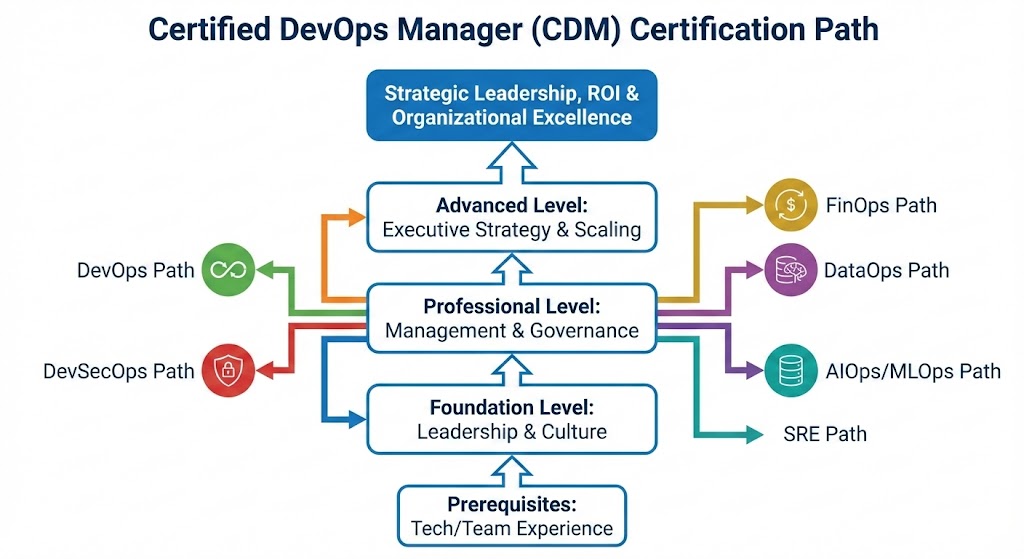
The CDM program offers a structured progression through Foundation, Professional, and Advanced levels. The Foundation level introduces the core concepts of DevOps leadership and team dynamics. Moving forward, the Professional level focuses on the practical implementation of metrics, governance, and toolchain orchestration. Finally, the Advanced level covers strategic planning, budgeting, and driving large-scale organizational change. These levels align with typical career progression from a team lead to a director of engineering. By following these specialization tracks, you can tailor your learning to focus on specific areas like SRE leadership or FinOps management.
Complete Certified DevOps Manager (CDM) Certification Table
| Track | Level | Who it’s for | Prerequisites | Skills Covered | Recommended Order | Official Link |
| Leadership | Foundation | Team Leads | Basic DevOps Knowledge | Culture, Metrics, Agile | First | Official Link |
| Management | Professional | Dept. Managers | 3+ Years Experience | Toolchain Governance, ROI | Second | Official Link |
| Executive | Advanced | Directors/CTOs | 5+ Years Experience | Strategic Scaling, FinOps | Third | Official Link |
Detailed Guide for Each Certified DevOps Manager (CDM) Certification
Certified DevOps Manager (CDM) – Foundation
What it is This certification validates your understanding of the core pillars of DevOps from a management perspective. It ensures you can speak the language of both developers and operations staff effectively.
Who should take it Aspiring managers and senior engineers should take this to build a solid foundation in leadership. It is ideal for those moving from individual contributor roles to supervisory positions.
Skills you’ll gain
- Mastery of DevOps cultural principles and team structures.
- Understanding of the software development lifecycle (SDLC) management.
- Ability to define and track basic performance metrics like DORA.
- Knowledge of incident management and communication protocols.
Real-world projects you should be able to do
- Design a communication plan for a cross-functional DevOps team.
- Set up a basic performance dashboard for a small engineering squad.
- Conduct a post-incident review that leads to actionable improvements.
Preparation plan
- 7–14 days: Review official course materials and familiarize yourself with DevOps terminology.
- 30 days: Deep dive into case studies regarding team culture and conflict resolution.
- 60 days: Participate in community forums and mock leadership scenarios provided in the training.
Common mistakes
- Focusing too much on specific tools instead of the management process.
- Underestimating the importance of cultural change in a DevOps environment.
Best next certification after this
- Same-track option: CDM Professional Level.
- Cross-track option: Certified SRE Professional.
- Leadership option: Certified Agile Leader.
Certified DevOps Manager (CDM) – Professional
What it is This level focuses on the operational aspects of managing a DevOps department. It validates your ability to optimize toolchains and ensure security is integrated into the delivery process.
Who should take it Current managers and senior leads who have mastered the basics and now need to scale their operations. It is designed for those responsible for multiple teams or complex projects.
Skills you’ll gain
- Advanced orchestration of CI/CD pipelines at an enterprise scale.
- Implementation of DevSecOps practices within the management framework.
- Managing technical debt and prioritizing architectural improvements.
- Budgeting for cloud resources and software licenses.
Real-world projects you should be able to do
- Implement a standardized toolchain across three or more engineering teams.
- Develop a compliance and security auditing process for automated deployments.
- Create a multi-year roadmap for migrating legacy systems to microservices.
Preparation plan
- 7–14 days: Study advanced governance models and cloud-native management tools.
- 30 days: Practice designing complex delivery workflows in a simulated environment.
- 60 days: Analyze real-world enterprise failure stories to learn risk mitigation strategies.
Common mistakes
- Ignoring the financial impact of cloud-native tool choices.
- Failing to align DevOps goals with broader business objectives.
Best next certification after this
- Same-track option: CDM Advanced Level.
- Cross-track option: Certified DevSecOps Manager.
- Leadership option: PMP or Prince2.
Certified DevOps Manager (CDM) – Advanced
What it is The Advanced CDM level is the pinnacle of the program, focusing on strategic leadership and global delivery. It validates your capability to lead digital transformations at the executive level.
Who should take it Directors, VPs of Engineering, and CTOs who are driving large-scale organizational changes. This is for leaders who need to justify DevOps investments to the board.
Skills you’ll gain
- Strategic planning for global engineering organizations.
- Driving organizational change management and cultural evolution.
- Advanced FinOps and resource optimization strategies.
- Mastery of AIOps and MLOps management frameworks.
Real-world projects you should be able to do
- Lead a global transformation initiative that reduces time-to-market by 40%.
- Architect a FinOps strategy that saves the organization 20% in annual cloud costs.
- Establish a center of excellence (CoE) for DevOps within a large enterprise.
Preparation plan
- 7–14 days: Focus on executive communication and business alignment strategies.
- 30 days: Review advanced financial modeling and cloud economics.
- 60 days: Execute a mock transformation project based on a complex business case.
Common mistakes
- Becoming disconnected from the technical reality of the engineering teams.
- Overcomplicating the management structure, leading to bureaucratic friction.
Best next certification after this
- Same-track option: Continued Professional Development (CPD) in niche tech.
- Cross-track option: Certified FinOps Professional.
- Leadership option: MBA or Executive Leadership Program.
Choose Your Learning Path
DevOps Path
Professionals on the DevOps path should focus on the CDM Foundation and Professional levels to master delivery pipelines. Specifically, you should concentrate on how to integrate automated testing and deployment into the management lifecycle. This path ensures that you can lead teams in high-velocity environments where speed is critical. Furthermore, it prepares you to handle the technical challenges of containerization and orchestration from a supervisory lens. Ultimately, this path turns a technical expert into a delivery strategist.
DevSecOps Path
The DevSecOps path emphasizes the “Shift Left” mentality by integrating security into the CDM framework. You will learn how to manage security audits and compliance without slowing down the development process. Additionally, this path covers the management of automated security tools and vulnerability remediation workflows. Managers on this path are highly valued for their ability to protect the organization while maintaining agility. Consequently, this leads to roles such as Security Delivery Manager or Head of DevSecOps.
SRE Path
The Site Reliability Engineering (SRE) path focuses on stability and availability within the CDM curriculum. You will prioritize learning about Service Level Objectives (SLOs) and error budgets as management tools. Moreover, this path teaches you how to manage on-call rotations and incident response teams effectively. By combining CDM principles with SRE practices, you ensure that your management style supports high system reliability. This path is ideal for those aiming for VP of Infrastructure or Reliability Engineering Lead roles.
AIOps / MLOps Path
The AIOps and MLOps path is designed for managers overseeing data-driven automation and machine learning pipelines. You will learn how to apply CDM governance to the unique challenges of model deployment and data drift. Additionally, this track explores the use of artificial intelligence to improve operational monitoring and decision-making. Managers who master this path can lead cutting-edge teams that utilize automation to solve complex infrastructure problems. This ensures your skills remain at the forefront of technological innovation.
DataOps Path
Managers on the DataOps path focus on the flow of data across the organization using DevOps principles. You will learn how to manage data pipelines with the same rigor and automation as software delivery. Furthermore, this path emphasizes data quality, governance, and the collaboration between data scientists and operations teams. By applying CDM leadership to data projects, you reduce the cycle time for data analytics and insights. This path is perfect for those aspiring to become Data Engineering Managers.
FinOps Path
The FinOps path integrates financial accountability into the Certified DevOps Manager (CDM) framework. You will focus on cloud cost optimization, budgeting, and the financial transparency of engineering projects. Moreover, this path teaches you how to communicate the business value of technical infrastructure to finance and executive teams. Professionals on this path bridge the gap between engineering spend and company revenue. Consequently, you become a vital asset for any organization looking to scale its cloud operations efficiently.
Role → Recommended Certified DevOps Manager (CDM) Certifications
| Role | Recommended Certifications |
| DevOps Engineer | CDM Foundation, CDM Professional |
| SRE | CDM Foundation, SRE Professional |
| Platform Engineer | CDM Professional, CDM Advanced |
| Cloud Engineer | CDM Foundation, Cloud Management |
| Security Engineer | CDM Foundation, DevSecOps Professional |
| Data Engineer | CDM Foundation, DataOps Specialist |
| FinOps Practitioner | CDM Professional, FinOps Certified |
| Engineering Manager | CDM Professional, CDM Advanced |
Next Certifications to Take After Certified DevOps Manager (CDM)
Same Track Progression
Deep specialization within the DevOps management track involves moving from Foundation to the Advanced level. This progression ensures that you build a comprehensive skill set that covers every aspect of the management lifecycle. Specifically, you can focus on obtaining specialized badges in areas like “DevOps Governance” or “Enterprise Scaling.” Furthermore, staying on this track establishes you as a subject matter expert in DevOps leadership. Ultimately, this leads to senior executive positions within the technology sector.
Cross-Track Expansion
Skill broadening involves taking certifications in related fields such as SRE or DevSecOps to complement your CDM status. This cross-track expansion makes you a more versatile leader who can manage diverse technical teams. For example, a CDM with a background in security can better manage a DevSecOps transition. Moreover, understanding different methodologies like SRE allows you to implement a more balanced operational strategy. Consequently, you become a “T-shaped” leader with both depth and breadth of knowledge.
Leadership & Management Track
The transition to broader organizational leadership often requires certifications like PMP, MBA, or specialized executive coaching. These programs complement the technical management skills gained in the CDM by focusing on corporate strategy and finance. Additionally, these certifications prepare you for roles that go beyond the engineering department, such as Chief Operating Officer (COO). By combining CDM with traditional management credentials, you position yourself as a leader who understands both technology and business. This dual expertise is highly sought after in the modern enterprise.
Training & Certification Support Providers for Certified DevOps Manager (CDM)
DevOpsSchool DevOpsSchool provides a robust platform for candidates pursuing the CDM certification with expert-led sessions and practical labs. They focus on delivering high-quality content that aligns with real-world enterprise requirements and industry standards. Moreover, their mentorship program ensures that you receive the guidance needed to excel in your leadership journey.
Cotocus Cotocus specializes in corporate training and professional development for engineering teams and their managers globally. They offer tailored CDM preparation programs that focus on the specific needs of large organizations and complex infrastructures. Additionally, their training methodology emphasizes hands-on experience and case-study-based learning for better retention.
Scmgalaxy Scmgalaxy is a leading community-driven platform that provides extensive resources and tutorials for DevOps professionals worldwide. They support CDM candidates by offering a wealth of articles, videos, and documentation to supplement the official curriculum. Furthermore, their active forums allow learners to interact with peers and industry experts for collaborative problem-solving.
BestDevOps BestDevOps focuses on career coaching and skill development for those aiming for top-tier roles in the DevOps ecosystem. They provide comprehensive CDM training that includes resume building and interview preparation for leadership positions. Consequently, they help professionals not just get certified, but also land their dream roles in the industry.
devsecopsschool.com This provider focuses specifically on the intersection of security and DevOps, making it a great resource for CDM candidates. They offer specialized modules that teach you how to integrate security governance into your management framework. In addition, their certifications ensure that you are prepared to handle the security challenges of modern delivery.
sreschool.com Sreschool.com offers dedicated training for those who want to balance management with high system reliability and uptime. Their CDM-related content focuses on the operational excellence and reliability aspects of technical leadership. Moreover, they provide practical insights into managing on-call teams and reducing operational toil effectively.
aiopsschool.com As AI continues to change the landscape of IT operations, aiopsschool.com provides the necessary training for the next generation of managers. They offer insights into how CDM professionals can leverage machine learning to automate complex management tasks. Consequently, their curriculum is essential for leaders who want to stay ahead of the automation curve.
dataopsschool.com Dataopsschool.com addresses the management of data pipelines using DevOps principles, which is a key area for modern CDM leads. They provide specialized training on how to manage data quality and collaboration across the entire data lifecycle. Additionally, their resources help you apply CDM governance to big data and analytics projects.
finopsschool.com Finopsschool.com is the go-to resource for managers who need to master the financial aspects of cloud-native engineering. They provide detailed training on cloud cost management and ROI optimization within the CDM framework. Furthermore, their courses help you align your engineering budget with the strategic goals of your organization.
Frequently Asked Questions (General)
- How difficult is it to obtain the Certified DevOps Manager (CDM) certification? The difficulty level is moderate to high, as it requires a balanced understanding of both technical tools and leadership strategies. Candidates must demonstrate that they can manage teams, budgets, and complex delivery pipelines effectively. While the technical concepts are accessible to senior engineers, the management scenarios require a shift in mindset. Consequently, those with prior experience in leading teams will find the process more intuitive. However, the certification is designed to be rigorous enough to ensure that only qualified professionals can earn the credential.
- How much time should I dedicate to preparing for the CDM exam? Preparation time varies based on your existing experience, but most professionals should plan for 30 to 60 days of study. If you are already in a leadership role, you might focus more on the theoretical frameworks and governance models. Conversely, those transitioning from technical roles may need extra time to understand management principles and organizational culture. Specifically, dedicating 5–10 hours per week to reviewing materials and completing labs is recommended. Consistent effort over a two-month period usually results in a deep understanding and a successful outcome.
- What are the prerequisites for the Certified DevOps Manager (CDM) program? While there are no strict mandatory prerequisites for the Foundation level, having 2–3 years of experience in an engineering environment is highly beneficial. For the Professional and Advanced levels, several years of experience in a leadership or senior technical role are typically expected. Understanding basic DevOps tools like Git, Jenkins, and Docker is necessary to grasp the management context. Additionally, a basic knowledge of Agile methodologies will help you understand the cultural aspects of the program. Ultimately, the CDM is designed for those ready to move into management.
- What is the return on investment (ROI) for this certification? The ROI for the CDM is significant, often leading to salary increases and access to higher-level management positions. Organizations value leaders who can reduce time-to-market while maintaining high quality and low costs. By earning this certification, you prove your ability to drive these business outcomes through technical leadership. Moreover, the skills you gain in FinOps and governance can save your organization thousands in cloud costs. This makes you an indispensable asset, providing long-term career stability and growth opportunities in the global job market.
- Is the CDM certification recognized globally, or is it specific to India? The Certified DevOps Manager (CDM) program is recognized globally and follows international standards for DevOps and management practices. While it has a strong presence in the Indian market through providers like DevOpsSchool, its principles are applicable to any enterprise worldwide. Global companies in the US, Europe, and Asia value the structured approach to management that the CDM provides. Consequently, having this credential on your resume will help you stand out to international recruiters and hiring managers. It serves as a universal benchmark for DevOps leadership excellence.
- Can I take the CDM exam online, or do I need to visit a center? The program offers flexible learning and assessment options, including online proctored exams that you can take from home. This convenience allows busy professionals to balance their certification goals with their full-time jobs. Furthermore, the online platform provides access to all the necessary study materials and lab environments required for preparation. Some training providers may also offer in-person workshops or bootcamps if you prefer a traditional classroom setting. Regardless of the format, the evaluation remains standardized and rigorous to ensure the integrity of the certification.
- How does the CDM compare to other management certifications like PMP? While PMP focuses on general project management across all industries, the CDM is specifically tailored for the software delivery and cloud-native ecosystem. It covers technical governance, CI/CD orchestration, and DevOps culture, which are often missing from general management programs. Consequently, for those in the tech industry, the CDM offers more practical and relevant skills. However, combining both certifications can be very powerful, as it merges technical depth with broad management expertise. Ultimately, the CDM is the better choice for those staying within engineering leadership.
- What kind of jobs can I get after becoming a Certified DevOps Manager? Earning your CDM opens doors to roles such as DevOps Manager, Engineering Lead, Site Reliability Manager, and Director of Platform Engineering. You will also be qualified for positions like Head of Cloud Operations or Infrastructure Manager. In addition, the skills you gain in strategic planning and budgeting make you a candidate for executive-level roles like VP of Engineering. These roles are among the highest-paid positions in the technology sector today. Consequently, the CDM acts as a catalyst for significant career advancement and leadership opportunities.
- Does the certification expire, and how do I renew it? Most professional certifications require periodic renewal or proof of continuous learning to remain active. The CDM program typically encourages candidates to stay updated with the latest industry trends through continuing professional development (CPD) credits. You might need to participate in advanced workshops or attend industry conferences to maintain your status. This ensures that your knowledge remains fresh and that you are aware of the latest tools and methodologies. Regularly updating your certification demonstrates your commitment to being a lifelong learner and a modern leader.
- Are there any mock tests or practice exams available for the CDM? Yes, most training providers, including DevOpsSchool and Scmgalaxy, offer mock tests and practice scenarios to help you prepare. These exams simulate the actual test environment and cover the types of questions and case studies you will encounter. Taking these practice tests helps you identify your strengths and weaknesses before the final evaluation. Moreover, they build your confidence by familiarizing you with the exam format and time constraints. Utilizing these resources is a key part of a successful preparation strategy for any candidate.
- Can I move directly to the Advanced level if I have 10 years of experience? While your experience is valuable, it is generally recommended to start with the Professional level or review the Foundation materials to ensure alignment with the CDM framework. The program uses specific terminology and governance models that might differ from your current practices. Consequently, starting at a lower level or taking a bridge course ensures you have no gaps in your understanding. However, for highly experienced candidates, the progression through the levels can be accelerated. This ensures that you still gain the full benefit of the structured learning path.
- Is there any community support for CDM candidates? There is a vibrant community of CDM candidates and alumni available through forums, LinkedIn groups, and platforms like Scmgalaxy. Joining these communities allows you to ask questions, share experiences, and network with other professionals in the field. Furthermore, many training providers offer alumni networks that provide ongoing support and job placement assistance. Engaging with the community can provide practical insights that go beyond the textbook. Ultimately, being part of this network helps you stay connected to the latest leadership trends and career opportunities.
FAQs on Certified DevOps Manager (CDM)
- What is the primary focus of the CDM curriculum compared to a DevOps Engineer certification? The primary focus of the CDM is on leadership, governance, and organizational strategy rather than just technical tool proficiency. While a DevOps Engineer certification teaches you how to build a pipeline, the CDM teaches you how to manage the team building it. This includes budgeting, hiring, culture-building, and aligning technical goals with business objectives. Specifically, it addresses the “why” and “how much” rather than just the “how.” Consequently, it prepares you for a role where you are responsible for the overall success and ROI of the DevOps initiative.
- How does the CDM program address the challenge of “DevOps Silos”? The CDM program addresses silos by teaching managers how to foster a culture of shared responsibility and cross-functional collaboration. It provides frameworks for breaking down departmental barriers between development, operations, and security. Specifically, you will learn how to implement shared metrics and communication channels that align all teams toward a common goal. Moreover, the curriculum covers management strategies for creating “platform teams” that provide self-service tools to developers. By focusing on these organizational structures, the CDM helps you build a more integrated and efficient engineering department.
- Does the CDM cover financial management and cloud budgeting? Yes, financial management is a core component of the Certified DevOps Manager (CDM) curriculum, especially at the Professional and Advanced levels. You will learn about cloud cost optimization (FinOps), license management, and how to calculate the return on investment for DevOps tools. This is crucial for managers who must justify their budgets to senior leadership. Specifically, the program teaches you how to track engineering spend against business features and outcomes. Consequently, you gain the skills necessary to run a cost-effective department while delivering high-quality software at scale.
- What role does incident management play in the CDM certification? Incident management is treated as a critical leadership skill within the CDM framework, focusing on communication and post-mortem analysis. You will learn how to lead a team through a high-pressure outage and how to manage stakeholder expectations during an incident. The program emphasizes “blameless culture” and the importance of learning from failures to improve system resilience. Specifically, it covers the management of on-call rotations and the implementation of automated alerting systems. By mastering these skills, you ensure that your team can maintain high availability while minimizing burnout.
- How does the CDM certification help with managing technical debt? The CDM provides managers with frameworks for identifying, measuring, and prioritizing technical debt within the software delivery lifecycle. It teaches you how to balance the need for new features with the necessity of architectural improvements and bug fixes. Specifically, you will learn how to communicate the risks of technical debt to non-technical stakeholders in a language they understand. Moreover, the program covers the implementation of automated code quality checks and technical audits. This ensures that your management strategy promotes long-term system health over short-term gains.
- Can the CDM help me transition from a non-DevOps management role into tech leadership? Yes, the CDM is an excellent bridge for managers from other sectors who want to transition into the fast-growing world of tech leadership. It provides a structured introduction to the unique challenges of software delivery and cloud-native culture. While you will need to learn the basic technical context, the CDM focuses on the management skills that are transferable. Specifically, it teaches you how to lead high-performing technical teams using modern methodologies. Consequently, this certification provides the credibility needed to lead a DevOps department even if your background is in a different field.
- How is the CDM certification kept up to date with the latest tool releases? The CDM program is governed by a board of industry experts who regularly review and update the curriculum to reflect current trends. This ensures that the management strategies you learn are applicable to the latest versions of popular tools like Kubernetes and Terraform. Furthermore, the program focuses on “tool-agnostic” principles that remain relevant even as specific technologies change. Specifically, it emphasizes the underlying patterns and practices that define successful DevOps at scale. Consequently, your CDM credential remains valuable and relevant in the ever-evolving landscape of modern engineering.
- What kind of leadership styles does the CDM program advocate? The CDM program advocates for a “Servant Leadership” and “Transformational Leadership” style, which are essential for the DevOps philosophy. You will learn how to empower your team by removing obstacles and providing them with the tools they need to succeed. This approach contrasts with traditional command-and-control management, which can hinder the agility of a DevOps environment. Specifically, the curriculum covers how to motivate engineers through autonomy, mastery, and purpose. By adopting these modern leadership styles, you can create a high-trust culture that drives innovation and employee retention.
Final Thoughts: Is Certified DevOps Manager (CDM) Worth It?
If you are looking to advance your career into the upper echelons of engineering leadership, the CDM is a worthwhile investment. It offers a structured path to move beyond the keyboard and start influencing organizational strategy and culture. The certification provides a formal validation of your management skills, which is increasingly important in a market saturated with technical specialists. Moreover, the focus on ROI and governance prepares you for the realities of enterprise-level decision-making. Specifically, the program helps you bridge the gap between complex engineering tasks and the business value they provide. Ultimately, the CDM is for the professional who wants to lead the future of software delivery with confidence and clarity.