Introduction
Imagine attempting to build a high-performance race car but only checking the brakes after the race has already started. This scenario describes the precarious state of many modern software pipelines before they adopt a security-first mindset. Consequently, the DevSecOps Certified Professional (DSOCP) serves as the definitive blueprint for engineers who want to build safety into the chassis from day one. This guide specifically caters to professionals who recognize that deployment speed is useless if the system remains vulnerable to a single point of failure.
What is the DevSecOps Certified Professional (DSOCP)?
The DevSecOps Certified Professional (DSOCP) represents a rigorous validation of an engineer’s ability to integrate security practices into a high-velocity DevOps pipeline. Instead of focusing solely on theoretical security models, this program emphasizes practical, production-focused learning. It exists to ensure that engineers can handle real-world challenges such as automated vulnerability scanning, secret management, and compliance as code. Moreover, the curriculum aligns with modern enterprise practices where security is no longer a final hurdle but a continuous process. Specifically, it focuses on the tools and workflows that allow security to scale alongside containerized applications and microservices.
Who Should Pursue DevSecOps Certified Professional (DSOCP)?
Software engineers and systems administrators who want to transition into specialized security roles will find this certification immensely beneficial. Additionally, Site Reliability Engineers (SREs) and Cloud Architects can use this program to deepen their understanding of infrastructure security and policy enforcement. Managers who oversee technical teams also benefit from the DSOCP as it provides them with the vocabulary and framework needed to lead security-first initiatives. This certification holds significant relevance for the global market, particularly in India’s growing tech hubs, where companies are rapidly adopting cloud-native architectures. Ultimately, anyone involved in the software delivery lifecycle who wishes to stay ahead of evolving threats should consider this path.
Why DevSecOps Certified Professional (DSOCP) is Valuable in the Future and Beyond
The demand for specialized security talent continues to outpace the supply, making the DSOCP a highly durable asset for any professional. As enterprises adopt more complex multi-cloud environments, the need for automated security governance becomes a top priority. Consequently, obtaining this certification ensures that you remain relevant even as specific tools change, because it teaches the underlying principles of the “Shift Left” philosophy. Furthermore, the return on time investment is substantial, as certified professionals often command higher salaries and occupy more strategic roles within their organizations. By mastering these skills, you provide long-term value to employers who are increasingly focused on preventing costly security breaches through proactive engineering.
DevSecOps Certified Professional (DSOCP) Certification Overview
The program is delivered via the official course page and hosted on DevOpsSchool. This certification utilizes a hands-on assessment approach that evaluates your ability to configure and secure actual CI/CD pipelines. Rather than relying on simple multiple-choice questions, the structure emphasizes practical competency and problem-solving in a lab environment. Ownership of the certification rests with a platform dedicated to high-standard DevOps education, ensuring that the curriculum stays updated with industry trends. Furthermore, the modular structure allows participants to grasp fundamental concepts before moving into advanced security orchestration and automation techniques.
DevSecOps Certified Professional (DSOCP) Certification Tracks & Levels
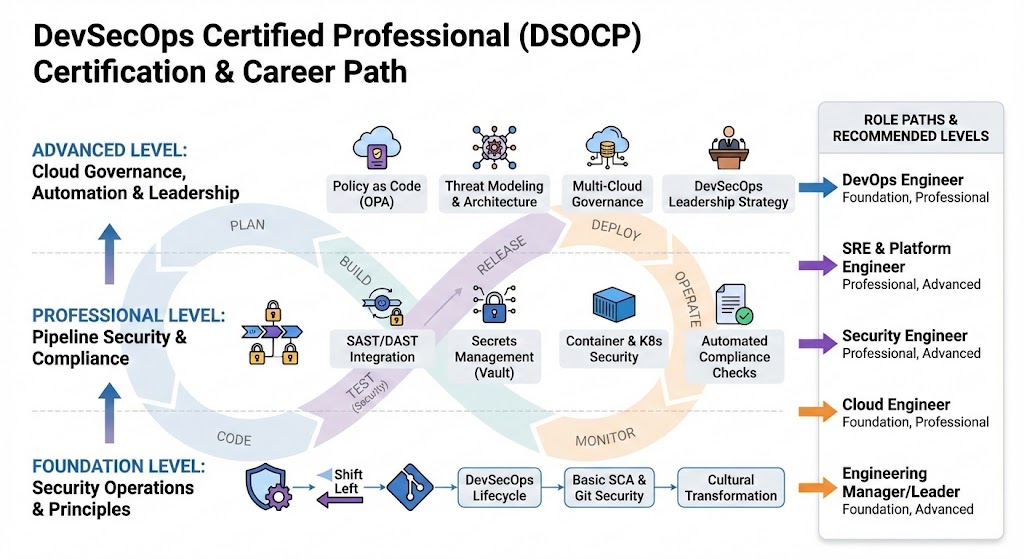
The DSOCP journey is structured across foundation, professional, and advanced levels to cater to different career stages. Beginners start at the foundation level, where they learn the core vocabulary and basic integration points of security in DevOps. Subsequently, the professional level dives deep into specific toolchains and automated testing methodologies. The advanced level focuses on architectural security, compliance frameworks, and leadership in DevSecOps transformations. These tracks allow professionals to specialize in areas like FinOps-aligned security or SRE-focused resilience, ensuring a clear path for career progression.
Complete DevSecOps Certified Professional (DSOCP) Certification Table
| Track | Level | Who it’s for | Prerequisites | Skills Covered | Recommended Order |
| Security Operations | Foundation | Aspiring Security Engineers | Basic Linux & Git | Shift Left, Basic SCA | 1st |
| Pipeline Security | Professional | DevOps & SREs | CI/CD knowledge | DAST, SAST, Secrets | 2nd |
| Cloud Governance | Advanced | Architects & Leads | Cloud Experience | Policy as Code, OPA | 3rd |
| Compliance | Professional | Audit & Risk Managers | IT Governance | Automated Auditing | Optional |
| Automation | Advanced | Platform Engineers | Scripting/Python | Custom Security Tooling | 4th |
Detailed Guide for Each DevSecOps Certified Professional (DSOCP) Certification
DevSecOps Certified Professional (DSOCP) – Foundation
What it is This certification validates a candidate’s understanding of basic DevSecOps principles and the “Shift Left” mindset. It confirms that the professional can identify where security fits into the standard DevOps lifecycle.
Who should take it Junior developers, entry-level systems administrators, and recent graduates should pursue this level. It serves as an ideal starting point for those new to the intersection of security and automation.
Skills you’ll gain
- Understanding the DevSecOps lifecycle.
- Identifying common security vulnerabilities.
- Basic usage of Software Composition Analysis (SCA) tools.
- Integrating simple security checks in Git.
Real-world projects you should be able to do
- Configure a basic Git hook for credential scanning.
- Perform a baseline vulnerability scan on a web application.
- Generate a report identifying outdated dependencies in a project.
Preparation plan
- 7–14 days: Focus on understanding the terminology and the cultural shifts required for DevSecOps.
- 30 days: Explore basic tools like SonarQube and learn how to interpret their results.
- 60 days: Build a simple pipeline that includes at least one automated security check.
Common mistakes
- Ignoring the cultural aspect of DevSecOps in favor of only learning tools.
- Failing to understand the Shared Responsibility Model in the cloud.
Best next certification after this
- Same-track option: DSOCP Professional.
- Cross-track option: Docker Certified Associate.
- Leadership option: Certified DevOps Leader.
DevSecOps Certified Professional (DSOCP) – Professional
What it is The Professional level validates the ability to implement and manage complex security toolchains within automated pipelines. It proves that you can move beyond theory and execute technical security integrations at scale.
Who should take it Experienced DevOps engineers and security analysts who are responsible for maintaining CI/CD pipelines should take this. It targets those who work daily with automation tools and container environments.
Skills you’ll gain
- Implementing SAST and DAST in Jenkins or GitLab.
- Managing secrets using tools like HashiCorp Vault.
- Securing container images and Kubernetes clusters.
- Automating compliance checks within the deployment process.
Real-world projects you should be able to do
- Set up a production-grade Vault instance for dynamic secret injection.
- Build a secure CI/CD pipeline that blocks builds based on high-severity vulnerabilities.
- Implement runtime security monitoring for a Kubernetes-based application.
Preparation plan
- 7–14 days: Deep dive into specific tool configurations (e.g., Jenkins security plugins).
- 30 days: Practice hands-on labs involving container security and image signing.
- 60 days: Complete an end-to-end security automation project covering SCA, SAST, and DAST.
Common mistakes
- Overwhelming the development team with too many “false positive” security alerts.
- Neglecting the security of the CI/CD platform itself.
Best next certification after this
- Same-track option: DSOCP Advanced.
- Cross-track option: Certified Kubernetes Security Specialist (CKS).
- Leadership option: Engineering Manager Certification.
DevSecOps Certified Professional (DSOCP) – Advanced
What it is This level focuses on the strategic implementation of security as code and enterprise-wide governance. It validates the ability to design secure architectures and enforce policies automatically across multiple teams.
Who should take it Principal engineers, security architects, and technical leads should pursue this. It is designed for individuals who make high-level decisions about security tooling and organizational standards.
Skills you’ll gain
- Designing “Policy as Code” using Open Policy Agent (OPA).
- Implementing advanced threat modeling for microservices.
- Governing security across multi-cloud and hybrid environments.
- Leading cultural transformations toward a security-first engineering approach.
Real-world projects you should be able to do
- Develop a custom OPA policy to prevent insecure Kubernetes deployments.
- Architect a cross-account secret management strategy for AWS or Azure.
- Design a security dashboard that aggregates data from multiple automated tools.
Preparation plan
- 7–14 days: Study advanced compliance frameworks like SOC2 or HIPAA in a technical context.
- 30 days: Master Rego language for writing policies and implement them in a lab environment.
- 60 days: Create a comprehensive security governance strategy for a hypothetical enterprise.
Common mistakes
- Focusing too much on governance and losing sight of developer experience.
- Failing to iterate on security policies, leading to outdated or restrictive rules.
Best next certification after this
- Same-track option: Specialized Cloud Security (AWS/Azure/GCP).
- Cross-track option: Site Reliability Engineering (SRE) Foundation.
- Leadership option: Chief Information Security Officer (CISO) training paths.
Choose Your Learning Path
DevOps Path
If you are already a DevOps engineer, your focus should be on integrating security into the existing pipelines you manage. You should start by understanding how Static Application Security Testing (SAST) fits into the build stage. Furthermore, mastering secret management is crucial to ensure that your automation scripts do not expose sensitive credentials. Consequently, this path leads to a more robust and resilient delivery process.
DevSecOps Path
This is the most direct application of the DSOCP certification, where you act as the bridge between security and engineering teams. You will spend your time tuning security tools to reduce noise and provide actionable feedback to developers. Additionally, you will work on automating the remediation of common vulnerabilities. As a result, you become a key player in ensuring that the organization remains compliant and secure by default.
SRE Path
Site Reliability Engineers should view DevSecOps through the lens of system availability and integrity. Security breaches are essentially reliability failures; therefore, SREs must monitor for anomalous behavior that could indicate a security incident. You will likely focus on runtime security and observability tools to protect production environments. This path ensures that your systems are not only up and running but also operating within secure boundaries.
AIOps / MLOps Path
In the world of Machine Learning, security involves protecting data pipelines and model integrity. You should apply DevSecOps principles to ensure that your training data remains untampered and that model deployments are secure. Furthermore, you will need to manage the unique secrets associated with large-scale data processing. Consequently, this path specializes in securing the lifecycle of AI-driven applications.
DataOps Path
DataOps professionals focus on the secure flow of information across the enterprise. By following a DevSecOps approach, you can automate the encryption of data at rest and in transit within your data pipelines. Additionally, you will implement access controls that scale with your data infrastructure. As a result, you help the organization maintain data privacy and meet regulatory requirements effortlessly.
FinOps Path
FinOps and security often intersect when it comes to resource management and unauthorized usage. By integrating security checks, you can prevent “crypto-jacking” and other attacks that drive up cloud costs unexpectedly. Furthermore, automated policies can ensure that only authorized, cost-effective resources are deployed. Consequently, this path helps you maintain a secure environment that is also financially optimized.
Role → Recommended DevSecOps Certified Professional (DSOCP) Certifications
| Role | Recommended Certifications |
| DevOps Engineer | DSOCP Foundation, DSOCP Professional |
| SRE | DSOCP Professional, DSOCP Advanced |
| Platform Engineer | DSOCP Professional, DSOCP Advanced |
| Cloud Engineer | DSOCP Foundation, DSOCP Professional |
| Security Engineer | DSOCP Professional, DSOCP Advanced |
| Data Engineer | DSOCP Foundation, DataOps Specialist |
| FinOps Practitioner | DSOCP Foundation, FinOps Certified |
| Engineering Manager | DSOCP Foundation, DevOps Leader |
Next Certifications to Take After DevSecOps Certified Professional (DSOCP)
Same Track Progression
Once you complete the DSOCP, you should look toward deep specialization in specific security domains. This might include becoming an expert in container security or focusing exclusively on cloud-native application protection platforms (CNAPP). Furthermore, staying updated with the latest vulnerabilities and exploit techniques will keep your skills sharp. Consequently, you will remain a top-tier expert in the ever-changing field of DevSecOps.
Cross-Track Expansion
Broadening your skills into areas like Site Reliability Engineering or Platform Engineering can make you a more versatile professional. Understanding how security impacts system performance and developer workflows allows you to design better solutions. Additionally, learning about FinOps can help you understand the cost implications of security tooling. As a result, you become a well-rounded engineer capable of handling diverse technical challenges.
Leadership & Management Track
For those looking to move into management, the DSOCP provides a strong technical foundation to lead security-focused teams. You can transition into roles like Security Lead or Engineering Manager by combining your technical expertise with leadership training. Furthermore, understanding the strategic value of DevSecOps allows you to advocate for better security practices at the executive level. Consequently, you will be well-positioned to drive organizational change.
Training & Certification Support Providers for DevSecOps Certified Professional (DSOCP)
DevOpsSchool This provider offers extensive hands-on labs and real-world scenarios designed to prepare you for the DSOCP exam. Their instructors are industry veterans who provide practical insights into modern toolchains. Additionally, they offer flexible learning options to suit working professionals.
Cotocus Cotocus focuses on delivering high-quality corporate training and individual coaching for advanced technical certifications. They emphasize the practical application of security tools within enterprise environments. Furthermore, their curriculum is regularly updated to reflect the latest industry shifts.
Scmgalaxy Scmgalaxy is a well-known community and training hub that provides a wealth of resources for DevOps and security enthusiasts. They offer specialized bootcamps that dive deep into CI/CD security and automation. Consequently, it is a great place to find peer support and expert guidance.
BestDevOps This platform provides curated learning paths and study materials specifically tailored for the DSOCP certification. They focus on simplifying complex concepts through clear documentation and practical exercises. In addition, they offer mock exams to help you gauge your readiness.
devsecopsschool.com As a dedicated resource for security automation, this site offers deep dives into specific security tools and methodologies. They provide a community-driven approach to learning where professionals can share best practices. Moreover, their content is highly focused on the “Security as Code” philosophy.+2
sreschool.com This provider bridges the gap between reliability and security, making it ideal for SREs pursuing the DSOCP. Their training emphasizes the operational aspects of security monitoring and incident response. Furthermore, they offer insights into building resilient systems that can withstand attacks.
aiopsschool.com AIOpsSchool provides unique perspectives on how artificial intelligence can be used to enhance security operations. Their training covers the use of machine learning for anomaly detection and automated threat hunting. Consequently, it is a valuable resource for engineers working on cutting-edge AI platforms.
dataopsschool.com This platform focuses on the intersection of data management and security automation. They provide guidance on securing data pipelines and ensuring compliance throughout the data lifecycle. Additionally, their courses cover the tools needed to implement robust data governance.
finopsschool.com FinOpsSchool helps professionals understand the financial impact of security decisions and cloud usage. Their training explores how to balance security requirements with cost optimization strategies. As a result, you learn how to build secure systems that are also budget-friendly.
Frequently Asked Questions (General)
- How difficult is it to achieve the DSOCP certification? The difficulty level is moderate to high because it requires a solid understanding of both DevOps and security principles. You must demonstrate hands-on proficiency in configuring security tools within a pipeline. Furthermore, the practical nature of the assessment means you cannot rely on rote memorization. Consequently, thorough preparation and practical experience are essential for success.
- What is the typical time commitment for preparation? Most professionals spend between 30 and 60 days preparing for the DSOCP, depending on their existing experience. This includes time for watching lectures, reading documentation, and completing hands-on labs. Additionally, you should allocate time for building your own sample projects to reinforce the concepts. Consequently, a consistent study schedule is the best way to ensure readiness.
- Are there any mandatory prerequisites for the DSOCP exam? While there are no strict formal prerequisites, a basic understanding of Linux, Git, and CI/CD concepts is highly recommended. Having some experience with cloud platforms like AWS or Azure will also be beneficial. Furthermore, familiarity with at least one programming or scripting language can help with the automation aspects. Consequently, beginners should start with foundation-level materials.
- What is the return on investment (ROI) for this certification? The ROI is significant as DevSecOps is one of the highest-paying specializations in the current tech market. Certified professionals often see immediate career advancement and access to more senior roles. Moreover, the skills gained help you protect your organization from costly breaches, increasing your internal value. Consequently, it is a worthwhile investment for long-term career growth.
- In what order should I take the different levels? It is generally recommended to follow the logical progression from Foundation to Professional and then Advanced. This ensures that you build a strong base before tackling complex automation and governance topics. However, experienced engineers may choose to jump directly to the Professional level if they have significant prior knowledge. Consequently, your path should align with your current skill level.
- Does the DSOCP certification expire? Like many technical credentials, the DSOCP usually requires renewal every two to three years to ensure your skills stay current. This is important because the security landscape and tooling evolve very rapidly. Furthermore, renewal often involves proving continued learning or passing an updated assessment. Consequently, staying active in the community is vital for maintaining your certified status.
- How does DSOCP compare to other security certifications like CISSP? The DSOCP is much more focused on the engineering and automation aspects of security compared to the broader, management-focused CISSP. While CISSP covers high-level governance, DSOCP dives into the actual implementation of security within a CI/CD pipeline. Furthermore, DSOCP is more relevant for hands-on DevOps and SRE roles. Consequently, it is a more practical choice for engineers.
- Can I pass the DSOCP without prior DevOps experience? It is possible but will require a much steeper learning curve, especially regarding automation and pipeline concepts. You would need to spend extra time mastering tools like Jenkins, Docker, and Kubernetes before focusing on their security. Additionally, the hands-on labs will be more challenging without a baseline in DevOps. Consequently, gaining some general DevOps knowledge first is advised.
- What tools are covered in the DSOCP curriculum? The curriculum covers a wide range of industry-standard tools including SonarQube, Vault, Trivy, OWASP ZAP, and various cloud-native security services. You will learn how to integrate these tools into a unified workflow for continuous security. Furthermore, you will explore policy-as-code tools like Open Policy Agent. Consequently, you gain a very versatile and practical toolset.
- Is the exam proctored online or at a center? The exam is typically offered as a proctored online assessment, allowing you to take it from the comfort of your home or office. You will need a stable internet connection and a computer that meets the technical requirements for the lab environment. Additionally, you may need to provide identification and follow specific security protocols. Consequently, online testing offers great flexibility.
- Are there any study groups or communities for DSOCP? Yes, there are several active online communities on platforms like Slack, Discord, and LinkedIn where candidates share tips and resources. Engaging with these groups can provide valuable insights and help you stay motivated during your preparation. Furthermore, many training providers host their own private forums for students. Consequently, you do not have to study in isolation.
- What kind of jobs can I get after becoming a DSOCP? You will be qualified for roles such as DevSecOps Engineer, Security Automation Engineer, Cloud Security Architect, and Lead DevOps Engineer. Many companies specifically look for this certification when hiring for platform engineering teams. Moreover, it opens doors to consultancy and specialized security auditing roles. Consequently, the career opportunities are diverse and rewarding.
FAQs on DevSecOps Certified Professional (DSOCP)
- Is the DSOCP certification recognized globally by major tech companies? The certification is highly respected across the industry as it focuses on practical skills that are directly applicable to enterprise environments. Many global organizations recognize the value of engineers who can bridge the gap between development and security. Consequently, it is a strong addition to any international resume.
- Does the course include hands-on lab environments for practice? The program provides extensive access to cloud-based labs where you can practice tool configurations in real-time. These labs simulate production scenarios, allowing you to build and secure pipelines without risking any actual data. Furthermore, these environments are essential for passing the practical portions of the exam.
- How often is the DSOCP curriculum updated to reflect new threats? The curriculum is reviewed and updated regularly to include emerging security trends and the latest tool versions. This ensures that you are learning about current threats and the most effective ways to mitigate them. Consequently, the knowledge you gain remains relevant in a fast-moving technical landscape.
- Can I take the DSOCP exam multiple times if I do not pass? Most training providers allow for retakes, although there may be a waiting period or an additional fee involved. It is important to review your exam results to identify areas where you need more practice. Furthermore, utilizing mock exams can help reduce the need for multiple attempts.
- What is the passing score for the DSOCP certification exam? The passing score usually ranges between 70% and 80%, depending on the specific version of the assessment. The exam evaluates both theoretical knowledge and practical execution in the lab environment. Consequently, you must perform well in both areas to earn the certification and prove your competency.
- Is there a focus on specific cloud providers like AWS or Azure? While the principles are cloud-agnostic, the course often uses popular providers like AWS for practical demonstrations. You will learn how to apply security concepts to any major cloud environment or on-premises setup. Furthermore, the focus remains on the tools and workflows that work across different platforms.
- Are the instructors for the DSOCP course industry professionals? The instructors are typically senior engineers and consultants with years of experience in the DevOps and security fields. They bring real-world examples and “war stories” to the classroom, which helps put the technical concepts into context. Consequently, you gain practical insights that go beyond standard documentation.
- Will this certification help me move into a leadership role? Absolutely, as the DSOCP demonstrates a high level of technical mastery and a strategic understanding of the software lifecycle. It provides the credibility needed to lead security initiatives and mentor other engineers. Furthermore, the “Advanced” level specifically addresses the governance and leadership skills required for senior positions.
Final Thoughts: Is DevSecOps Certified Professional (DSOCP) Worth It?
When you look at the trajectory of the software industry, it is clear that security is no longer an optional add-on. Engineering teams are increasingly responsible for the entire lifecycle of their applications, and this includes protecting them from threats. The DevSecOps Certified Professional (DSOCP) provides a structured, practical way to gain these essential skills. It moves you away from the “gatekeeper” mentality of traditional security and moves you toward a “facilitator” role where you empower teams to move fast and stay safe.