Introduction
Modern software delivery requires more than just knowing a few tools; it demands a cohesive strategy that integrates development, operations, and security. The Master in DevOps Engineering (MDE) serves as a comprehensive framework designed to transform traditional IT professionals into elite platform engineers. This guide targets engineers and managers who aim to master the complexities of cloud-native ecosystems and automated pipelines. By reading this analysis, you will understand how this program bridges the gap between basic automation and enterprise-grade site reliability. Furthermore, this roadmap assists technical leaders in identifying the specific competencies required to scale their engineering teams effectively.
What is the Master in DevOps Engineering (MDE)?
The Master in DevOps Engineering (MDE) represents a rigorous professional standard that focuses on the entire software delivery lifecycle rather than isolated scripts. It exists to provide a structured approach to mastering infrastructure as code, continuous integration, and high-availability architecture. Instead of focusing solely on theoretical concepts, the program emphasizes production-ready skills that align with current enterprise needs. It validates an engineer’s ability to design systems that are not only automated but also resilient, scalable, and secure. Consequently, professionals who complete this journey gain a deep understanding of how modern engineering workflows function at scale.
Who Should Pursue Master in DevOps Engineering (MDE)?
This program specifically benefits software engineers, SREs, and cloud architects who want to formalize their expertise and advance to senior roles. Additionally, security professionals and data engineers find immense value in learning the operational side of delivery to better integrate their specialized domains. Beginners with a strong foundation in Linux and networking can use this as a definitive career launchpad, while experienced managers utilize it to stay technically grounded. In the context of the global market, particularly within India’s massive tech hubs, this certification provides a distinct competitive advantage. It ensures that professionals from various backgrounds speak a common language of efficiency and reliability.
Why Master in DevOps Engineering (MDE) is Valuable in 2026 and Beyond
As organizations move toward platform engineering and internal developer platforms, the demand for high-level DevOps expertise continues to grow exponentially. The Master in DevOps Engineering (MDE) ensures longevity in a career because it teaches fundamental principles that remain constant even as specific tools evolve. Professionals who hold this credential demonstrate a commitment to excellence that results in a significant return on their time and career investment. Because enterprises are increasingly adopting multi-cloud and AI-driven operations, staying relevant requires a deep mastery of underlying automation patterns. Ultimately, this certification acts as a shield against technical obsolescence by fostering a mindset of continuous improvement.
Master in DevOps Engineering (MDE) Certification Overview
The program is delivered via the official Master in DevOps Engineering (MDE) course and is hosted on the DevOpsSchool website. It features a tiered structure that allows candidates to progress through various levels of technical depth and complexity. The assessment approach focuses on practical application, ensuring that the holder can actually perform the tasks required in a real-world environment. Ownership of the curriculum remains with industry experts who update the content regularly to reflect the latest shifts in the cloud-native landscape. This structured approach provides a clear path for anyone looking to transition from a generalist role to a specialized DevOps authority.
Master in DevOps Engineering (MDE) Certification Tracks & Levels
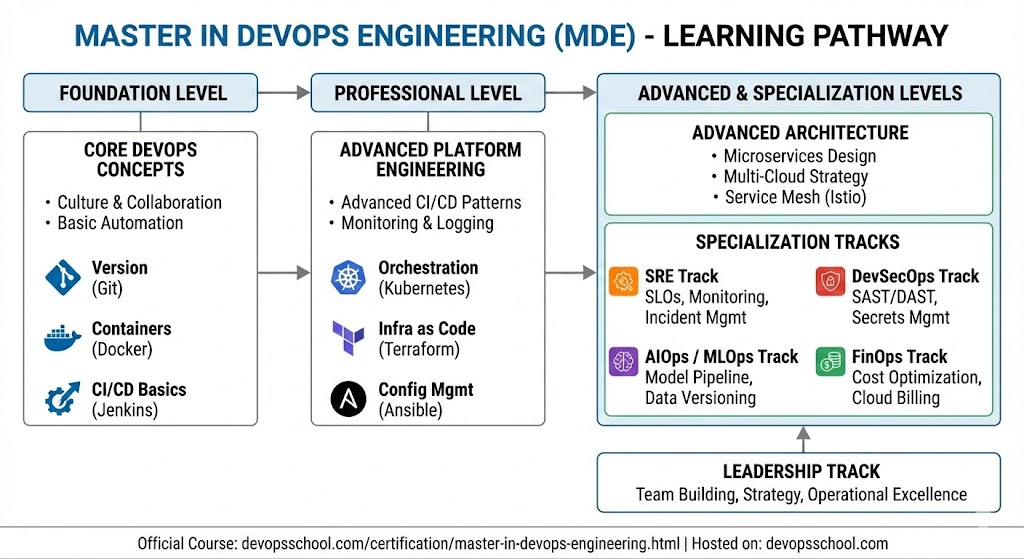
The certification is organized into foundation, professional, and advanced levels to cater to different stages of a professional’s career. The foundation level focuses on core automation and culture, while the professional level dives deep into orchestration and advanced CI/CD patterns. Advanced levels and specialization tracks allow engineers to focus on specific domains such as SRE, FinOps, or DevSecOps depending on their career goals. These tracks ensure that the learning path aligns perfectly with industry roles, making the progression logical and rewarding. By following these levels, a professional can systematically build a portfolio of skills that matches the expectations of top-tier technology firms.
Complete Master in DevOps Engineering (MDE) Certification Table
| Track | Level | Who it’s for | Prerequisites | Skills Covered | Recommended Order |
| Core DevOps | Foundation | Aspiring DevOps Engineers | Basic Linux & Networking | Git, Docker, Jenkins Basics | 1 |
| Engineering | Professional | Experienced SysAdmins/Devs | Foundation Level | Kubernetes, Terraform, Ansible | 2 |
| Architecture | Advanced | Senior Engineers/Architects | Professional Level | Multi-cloud, Microservices, Mesh | 3 |
| Reliability | SRE Track | SREs and Ops Leads | Professional Level | Monitoring, SLIs/SLOs, Incident Mgmt | 4 |
| Security | DevSecOps | Security Engineers | Core DevOps Knowledge | SAST/DAST, Vault, Compliance | 4 |
| Financial | FinOps | Cloud Financial Managers | Cloud Basics | Cost Optimization, Billing, Tagging | 5 |
Detailed Guide for Each Master in DevOps Engineering (MDE) Certification
Master in DevOps Engineering (MDE) – Foundation Level
What it is This certification validates the fundamental understanding of DevOps culture and the basic toolchain required for modern software delivery. It serves as the baseline for all subsequent advanced tracks.
Who should take it Junior engineers, system administrators, and recent graduates should take this to establish a strong technical footing. It is also ideal for stakeholders who need to understand the DevOps lifecycle.
Skills you’ll gain
- Mastery of Version Control using Git
- Basic Containerization with Docker
- Continuous Integration workflows with Jenkins
- Understanding of Agile and DevOps culture
Real-world projects you should be able to do
- Create a multi-branch pipeline for a web application
- Containerize a legacy application and run it locally
- Automate basic environment setup using shell scripts
Preparation plan
- 7–14 days: Focus on Git commands and basic CI/CD concepts.
- 30 days: Complete hands-on labs for Docker and Jenkins.
- 60 days: Build a full end-to-end basic pipeline and take practice exams.
Common mistakes
- Ignoring the cultural aspects of DevOps in favor of only learning tools.
- Skipping Linux command-line basics which are essential for debugging.
Best next certification after this
- Same-track option: MDE Professional Level
- Cross-track option: MDE DevSecOps Foundation
- Leadership option: DevOps Foundation for Managers
Master in DevOps Engineering (MDE) – Professional Level
What it is The Professional Level validates an engineer’s ability to manage complex, distributed systems using orchestration and infrastructure as code. It focuses on production-grade deployments and automation.
Who should take it Intermediate DevOps engineers and Cloud Engineers who have at least one year of experience in the field should pursue this. It is designed for those who handle day-to-day production environments.
Skills you’ll gain
- Advanced Kubernetes cluster management
- Infrastructure as Code (IaC) with Terraform
- Configuration Management using Ansible
- Advanced CI/CD patterns and blue-green deployments
Real-world projects you should be able to do
- Deploy a highly available Kubernetes cluster on a public cloud
- Manage multi-tier infrastructure using Terraform modules
- Automate the configuration of 100+ servers using Ansible playbooks
Preparation plan
- 7–14 days: Master Kubernetes objects and YAML configurations.
- 30 days: Build and destroy cloud environments using Terraform.
- 60 days: Integrate all tools into a unified, automated deployment framework.
Common mistakes
- Failing to understand how state files work in Terraform.
- Neglecting security best practices when writing CI/CD scripts.
Best next certification after this
- Same-track option: MDE Advanced Level
- Cross-track option: MDE SRE Professional
- Leadership option: Technical Lead Certification
Choose Your Learning Path
DevOps Path
The DevOps path focuses on the core cycle of continuous integration and continuous delivery. You start by mastering version control and move toward complex orchestration with Kubernetes. This path is ideal for those who enjoy building the “highways” that allow code to travel from a developer’s laptop to production safely. Furthermore, it emphasizes the removal of silos between teams to ensure a smooth flow of value.
DevSecOps Path
In the DevSecOps path, you integrate security checks into every stage of the pipeline rather than treating security as an afterthought. You will learn how to automate vulnerability scanning, manage secrets securely, and ensure compliance as code. This path attracts professionals who are passionate about protecting data and infrastructure without slowing down the development process. It is currently one of the highest-paying specializations in the industry.
SRE Path
The Site Reliability Engineering (SRE) path applies software engineering principles to operations problems. You will focus on maintaining system availability, managing latency, and handling incident response through automation. This path teaches you how to balance the need for new features with the requirement for system stability using Error Budgets. It is the perfect choice for engineers who love troubleshooting and optimizing large-scale systems.
AIOps / MLOps Path
This path addresses the unique challenges of deploying and managing machine learning models in production. You will learn how to automate the training pipeline, manage data versioning, and monitor model performance over time. As AI becomes a staple in enterprise software, professionals who can bridge the gap between data science and operations will be in high demand. It combines traditional DevOps practices with specialized data workflows.
DataOps Path
DataOps focuses on the automated, policy-based management of data to improve quality and reduce cycle time. You will learn how to build resilient data pipelines and ensure that data is available to those who need it across the organization. This path is essential for companies that rely on real-time analytics and big data for decision-making. It ensures that data delivery is as reliable as software delivery.
FinOps Path
The FinOps path brings financial accountability to the variable spend model of the cloud. You will learn how to analyze cloud bills, allocate costs to specific products, and optimize resource usage to save money. This path bridges the gap between engineering, finance, and business leadership. It is increasingly vital as organizations look to prove the ROI of their cloud migrations.
Role → Recommended Master in DevOps Engineering (MDE) Certifications
| Role | Recommended Certifications |
| DevOps Engineer | MDE Foundation, MDE Professional, MDE DevSecOps |
| SRE | MDE Professional, MDE SRE Advanced |
| Platform Engineer | MDE Professional, MDE Advanced Architecture |
| Cloud Engineer | MDE Professional, MDE FinOps Practitioner |
| Security Engineer | MDE Foundation, MDE DevSecOps Professional |
| Data Engineer | MDE Foundation, MDE DataOps Specialization |
| FinOps Practitioner | MDE FinOps, MDE Foundation |
| Engineering Manager | MDE Foundation, MDE Leadership Track |
Next Certifications to Take After Master in DevOps Engineering (MDE)
Same Track Progression
Once you complete the advanced levels of the Master in DevOps Engineering (MDE), you should pursue deep technical specializations in specific tools like OpenShift or Istio. Deepening your knowledge in a single area makes you the “go-to” expert for complex architectural challenges. Moreover, staying within the same track allows you to refine your expertise until you reach a principal engineer level.
Cross-Track Expansion
If you have mastered core DevOps, expanding into DevSecOps or FinOps provides a more holistic view of the business. Broadening your skills ensures that you can contribute to various parts of the organization, making you more versatile. This transition is beneficial because it allows you to understand the pressures and requirements of adjacent teams.
Leadership & Management Track
For those looking to move away from hands-on coding, transitioning into a leadership track is a natural progression. You can focus on certifications that emphasize team building, strategic planning, and operational excellence. This path allows you to use your technical background to guide entire departments toward better engineering practices.
Training & Certification Support Providers for Master in DevOps Engineering (MDE)
DevOpsSchool This provider offers extensive hands-on labs and live instructor-led sessions for all MDE levels. They focus on real-world scenarios and provide excellent post-training support to help candidates pass their exams. Their curriculum is highly practical and updated frequently.
Cotocus Cotocus specializes in corporate training and provides customized paths for teams looking to adopt DevOps at scale. They emphasize the integration of tools within enterprise environments. Their trainers often come with significant industry experience.
Scmgalaxy Scmgalaxy provides a wealth of community resources, blogs, and tutorials that supplement the official MDE curriculum. They are an excellent source for troubleshooting specific technical hurdles encountered during the learning process. The site is a hub for SCM and DevOps professionals.
BestDevOps This platform focuses on curated learning paths and provides high-quality video content for self-paced learners. They offer a variety of mock exams that closely mirror the actual certification environment. It is a great resource for independent study.
devsecopsschool.com This site is the primary resource for the DevSecOps specialization within the MDE framework. They provide specific deep dives into security automation tools and compliance frameworks. Their content is essential for security-focused engineers.
sreschool.com Dedicated to the SRE track, this provider offers specialized training on observability, reliability, and incident management. They focus on the Google-born principles of SRE. It is the best place to learn about managing “toil” and uptime.
aiopsschool.com Aiopsschool.com provides the necessary training for engineers looking to enter the MLOps and AIOps space. They cover the intersection of artificial intelligence and traditional operations. Their courses include practical labs on model deployment.
dataopsschool.com This provider focuses on the data lifecycle and how to apply DevOps principles to data engineering. They offer insights into managing complex data pipelines at scale. It is ideal for data professionals moving toward automation.
finopsschool.com Finopsschool.com is the go-to resource for the financial side of cloud operations. They provide training on cost optimization and cloud governance. Their courses help engineers understand the business impact of their architectural choices.
Frequently Asked Questions (General)
- How difficult is the MDE certification? The difficulty depends on your current experience level, but the program is designed to be challenging yet achievable. The foundation level focuses on core concepts, making it accessible to most, while the professional and advanced levels require significant hands-on practice. Because the exams focus on practical application rather than rote memorization, you must spend time building projects. Most candidates find that a consistent study routine and laboratory work are the keys to success. Consequently, the certification carries high respect in the industry because it proves actual technical capability.
- What are the prerequisites for the MDE program? While there are no strict legal prerequisites for the starting level, having a basic understanding of Linux and networking is highly recommended. For the professional and advanced tracks, you typically need to have completed the previous level or demonstrate equivalent industry experience. Familiarity with at least one programming or scripting language, such as Python or Bash, will significantly aid your progress. The program is structured to build your skills from the ground up, so a willingness to learn is the most important requirement.
- What is the typical ROI for this certification? Professionals often report significant salary increases and better job opportunities after earning the MDE credential. In the current market, DevOps expertise is in high demand, and certified engineers often command a premium over their non-certified peers. Beyond the financial aspect, the ROI includes improved efficiency in your daily tasks and the ability to lead high-impact projects. Many companies also offer reimbursement for the certification costs, making the personal investment minimal. Ultimately, it accelerates your career progression toward senior and lead roles.
- How long does it take to complete the Master in DevOps Engineering? The timeline varies based on the level of certification and your prior knowledge. On average, a dedicated student can complete the foundation level in about 4 to 8 weeks. The professional level usually takes another 3 to 4 months of intensive study and lab work. For those pursuing the full “Master” status across all tracks, it can take 6 to 12 months of consistent effort. However, because the learning is modular, you can gain value and recognition after completing each individual level.
- Is the exam based on multiple-choice questions or practical labs? The Master in DevOps Engineering (MDE) assessment primarily uses a performance-based approach, which includes practical labs and scenario-based challenges. While some theoretical questions exist to verify fundamental knowledge, the core of the evaluation tests your ability to solve real problems. You might be asked to fix a broken pipeline, configure a Kubernetes cluster, or write an automation script during the exam. This ensures that the certification remains a credible indicator of hands-on skill. This practical focus is what differentiates it from many other entry-level certifications.
- Can I take the certification exam online? Yes, the certification is designed to be accessible globally through an online proctored environment. You will need a stable internet connection, a webcam, and a quiet space to complete the assessment. The proctoring process ensures the integrity of the exam while providing you with the convenience of testing from home or your office. Clear instructions are provided before the exam to help you set up your environment correctly. This flexibility makes it easier for working professionals to fit the certification into their busy schedules.
- How does MDE compare to AWS or Azure DevOps certifications? While cloud-provider certifications focus heavily on their specific proprietary tools, the MDE program is largely tool-agnostic and focused on the broader ecosystem. It teaches you how to use industry-standard tools like Jenkins, Terraform, and Kubernetes across any cloud or on-premise environment. This makes your skills more portable and prevents you from being “locked in” to a single vendor. Many engineers choose to earn both types of certifications to demonstrate both broad platform knowledge and specific cloud expertise. MDE provides the foundational engineering principles that make you a better overall architect.
- Is the MDE certification recognized globally? The Master in DevOps Engineering (MDE) is recognized by leading technology companies and enterprises around the world, including in India, the US, and Europe. It follows international standards for DevOps practices and is taught by instructors with global industry experience. Because the curriculum aligns with the requirements of major tech hubs, the credential is valid regardless of where you choose to work. Recruiters often look for this specific certification when hiring for roles that require a deep understanding of automation and reliability. It serves as a universal benchmark for DevOps excellence.
- What kind of support is available during the learning process? Students have access to a variety of support mechanisms, including community forums, live Q&A sessions, and dedicated Slack channels. Many training providers also offer 24/7 lab support to help you if you get stuck on a technical exercise. Additionally, the extensive documentation and blog posts provided by the community offer answers to common questions. This ecosystem of support ensures that you are never alone during your certification journey. Having access to mentors and peers significantly increases the likelihood of successfully completing the program.
- Do I need to renew the certification? To ensure that your skills remain current in a fast-moving field, the certification usually requires renewal or continuing education every two to three years. You can often maintain your status by passing the latest version of the exam or by earning a higher-level specialization. This requirement encourages lifelong learning and ensures that the MDE designation remains a sign of up-to-date expertise. Most professionals find the renewal process helpful for staying aware of new tools and methodologies. It keeps the community of certified professionals at the forefront of the industry.
- Are there any group discounts for corporate teams? Many training providers for the MDE program offer corporate packages and group discounts for organizations looking to upskill their entire engineering department. These programs often include customized training schedules and private lab environments tailored to the company’s specific tech stack. Investing in team certification ensures that everyone follows the same best practices and speaks the same technical language. This leads to better collaboration and faster delivery times for the business. Interested managers should reach out to the providers for bespoke pricing.
- Can I skip the Foundation level if I have experience? While it is possible to jump directly to higher levels in some cases, it is generally recommended to at least review the Foundation material to ensure there are no gaps in your knowledge. The MDE program is designed to be cumulative, and advanced topics often build on specific techniques taught in the earlier stages. Some providers may offer a “fast-track” or assessment test to allow experienced engineers to prove their baseline knowledge. However, even seasoned pros often find valuable “nuggets” of information in the foundation course that they might have missed during their self-taught careers.
FAQs on Master in DevOps Engineering (MDE)
- What specific tools are covered in the MDE curriculum? The curriculum covers a comprehensive suite of industry-standard tools including Git for version control, Docker for containerization, and Kubernetes for orchestration. Additionally, you will master Jenkins for CI/CD, Terraform for Infrastructure as Code, and Ansible for configuration management. Monitoring tools like Prometheus and Grafana are also included to ensure you can manage system health. The program focuses on how these tools integrate to form a seamless, automated pipeline. By the end, you will have a versatile toolkit applicable to almost any modern tech stack.
- Does the MDE program cover cloud-specific services? Yes, while the program is tool-agnostic at its core, it includes practical modules on deploying these tools to major cloud providers like AWS, Azure, and GCP. You will learn how to use cloud-native services in conjunction with open-source tools to build hybrid or multi-cloud architectures. This ensures that you can handle real-world scenarios where companies utilize specific cloud features alongside their own automation. Understanding the nuances of cloud environments is a key part of becoming a true Master in DevOps Engineering. This balanced approach makes the certification highly practical.
- How does the MDE program handle security? Security is not treated as a separate module but is integrated throughout the entire MDE curriculum as part of the DevSecOps mindset. You will learn how to automate security scanning within your CI/CD pipelines and how to manage sensitive data using tools like HashiCorp Vault. The program emphasizes “shifting left,” which means catching security vulnerabilities as early as possible in the development process. By learning these practices, you become an engineer who builds systems that are secure by design. This holistic view of security is essential for modern enterprise deployments.
- Is there a focus on legacy system migration in the MDE? The program includes strategies for “containerizing” legacy applications and migrating them to modern microservices architectures. You will learn how to build “strangler patterns” and other migration techniques to move away from monolithic systems without causing downtime. This is a critical skill because most enterprises are not “greenfield” and require help modernizing existing infrastructure. The MDE program provides the practical steps needed to bridge the gap between old and new technologies. This makes you invaluable to large organizations undergoing digital transformation.
- Does the MDE certification help with SRE roles? The SRE track within the MDE program is specifically designed to teach the principles of site reliability, such as SLIs, SLOs, and Error Budgets. You will learn how to automate operational tasks to reduce “toil” and how to perform effective post-mortems after incidents. These skills are exactly what companies look for when hiring Site Reliability Engineers. By combining the automation skills of DevOps with the reliability focus of SRE, the MDE program creates a well-rounded professional. It is one of the most direct paths into a high-level SRE career.
- Are the labs provided as part of the course? Most authorized training providers include access to cloud-based lab environments where you can practice the exercises without incurring your own cloud costs. These labs are pre-configured with the necessary tools and datasets to allow you to focus on learning rather than environment setup. Having a “sandbox” to experiment in is crucial for mastering complex technologies like Kubernetes. The labs often mirror real-world production setups to give you a taste of actual engineering challenges. This hands-on experience is a core part of the MDE value proposition.
- How is the MDE program updated for new technologies? The curriculum is reviewed quarterly by a board of industry experts who monitor the landscape for significant shifts in technology or methodology. When a new tool becomes an industry standard or a new practice emerges, it is integrated into the course material. This ensures that the Master in DevOps Engineering (MDE) designation always reflects the current “state of the art.” For example, modules on AIOps and platform engineering were added as those fields matured. This commitment to staying current protects the long-term value of your certification.
- What is the pass mark for the MDE exams? The pass mark generally hovers around 70% to 75%, depending on the specific level and the complexity of the practical tasks assigned. However, the focus is not just on reaching a number but on demonstrating competence in the core domains. If you fail an attempt, most providers offer a detailed breakdown of your performance so you can focus your studies on the areas where you struggled. Some packages even include a free retake to reduce the pressure on the candidate. Preparation and hands-on practice are the best ways to ensure you exceed the pass mark comfortably.
Final Thoughts: Is Master in DevOps Engineering (MDE) Worth It?
If you are looking for a shortcut or a “magic pill” for your career, no certification will provide that. However, if you are a serious professional committed to mastering the craft of software delivery, the Master in DevOps Engineering (MDE) is an exceptional investment. It provides the structure, the community, and the technical depth required to move from being a “tool user” to a “system architect.” The value lies not just in the digital badge but in the confidence you gain by solving complex, production-grade problems in a controlled environment.
In a world where technology changes every week, having a solid foundation in DevOps principles is your best defense against irrelevance. Companies are no longer looking for people who can just “write scripts”; they need engineers who can build resilient, automated platforms that drive business value. The MDE program prepares you exactly for that role. For those willing to put in the effort, the rewards in terms of career growth, salary, and job satisfaction are well worth the journey.
This blog outlines a clear DevOps roadmap, helping learners build practical skills step by step toward real-world engineering roles.