Introduction
Professional engineers recognize that mastering the DevOps Certified Professional (DCP) creates a significant advantage in today’s competitive job market. This guide specifically helps software engineers, SREs, and technical leads understand the practical benefits of this certification. Moreover, it defines the role of the DCP within the broader contexts of cloud-native systems and platform engineering architectures. By breaking down the certification’s impact, the guide enables you to navigate your career path with greater precision. Therefore, you will find the information necessary to make informed choices about your technical and professional future.
What is the DevOps Certified Professional (DCP)?
The DevOps Certified Professional (DCP) represents a rigorous validation of an engineer’s ability to implement and manage automated delivery pipelines. Unlike purely theoretical programs, this certification emphasizes production-focused learning and hands-on technical proficiency. It exists to bridge the gap between knowing a tool and understanding how to orchestrate an entire ecosystem. Furthermore, the program aligns with contemporary engineering workflows, ensuring that candidates can handle enterprise-grade infrastructure challenges. Organizations value this certification because it guarantees that a professional understands the nuances of stability, scalability, and speed in modern software deployment.
Who Should Pursue DevOps Certified Professional (DCP)?
A wide range of technical professionals finds significant value in pursuing the DevOps Certified Professional (DCP). Systems engineers, software developers, and Site Reliability Engineers (SREs) benefit most from the structured curriculum. Additionally, cloud architects and security professionals use this certification to broaden their understanding of integrated automation. Beginners find a clear path to entry, while experienced engineers use it to formalize their years of practical knowledge. Managers also pursue this credential to better lead technical teams and understand the underlying mechanics of the DevOps lifecycle. The global relevance of the program makes it particularly attractive for engineers in India and other major tech hubs.
Why DevOps Certified Professional (DCP) is Valuable and Beyond
The demand for streamlined software delivery continues to grow as enterprises migrate more services to the cloud. Consequently, the DevOps Certified Professional (DCP) offers longevity in a market that frequently changes its preferred tools. It focuses on core principles and methodologies that remain relevant regardless of whether a team uses specific proprietary or open-source software. This focus ensures a high return on time and career investment for the individual. Moreover, enterprise adoption of DevOps practices ensures that certified professionals remain highly sought after for leadership and high-impact technical roles. Staying relevant requires constant learning, and this certification provides the necessary foundation for that evolution.
DevOps Certified Professional (DCP) Certification Overview
The DevOps Certified Professional (DCP) program is delivered via the official course page and hosted on DevOpsSchool. The certification offers various levels of assessment, ranging from foundational concepts to expert-level architecture. It employs a practical assessment approach where candidates demonstrate their skills through real-world scenarios rather than simple multiple-choice questions. DevOpsSchool owns and maintains the curriculum, ensuring it reflects the latest industry trends and requirements. This structure provides a transparent and measurable way for professionals to prove their competence to current and future employers.
DevOps Certified Professional (DCP) Certification Tracks & Levels
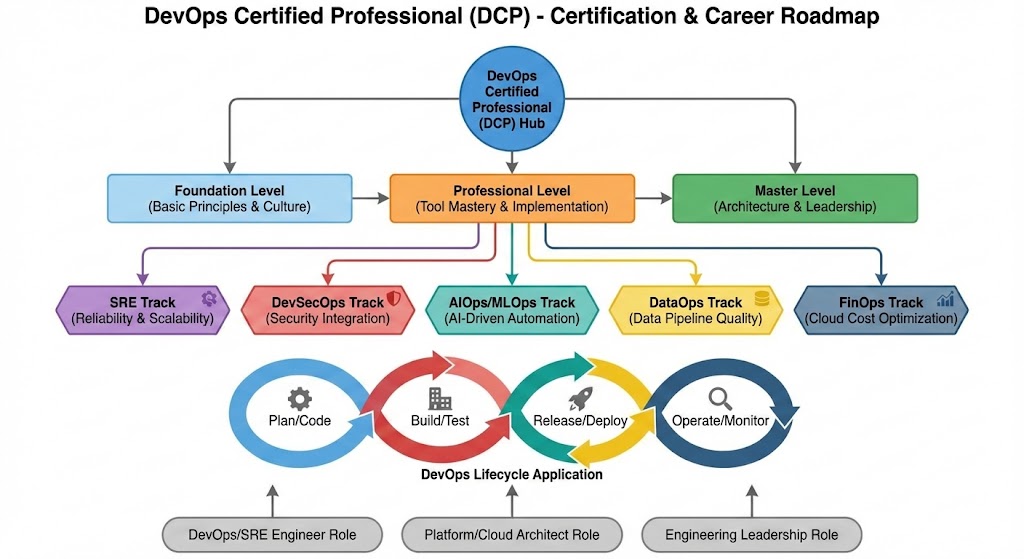
The program categorizes learning into foundation, professional, and advanced levels to suit different career stages. The foundation level introduces core concepts of automation and collaboration for those new to the field. Meanwhile, the professional level dives deep into implementation, covering CI/CD, containerization, and infrastructure as code. Advanced levels focus on architectural design and organizational transformation for senior leaders. Furthermore, the program offers specialized tracks such as SRE, FinOps, and DevSecOps to allow for niche expertise. These levels align perfectly with standard career progression, moving from individual contributor roles to specialized and leadership positions.
Complete DevOps Certified Professional (DCP) Certification Table
| Track | Level | Who it’s for | Prerequisites | Skills Covered | Recommended Order |
| Core DevOps | Foundation | Aspiring DevOps Engineers | Basic IT knowledge | Linux, Git, Virtualization | 1 |
| Core DevOps | Professional | Active Engineers | 1-2 years experience | Docker, K8s, Jenkins, Ansible | 2 |
| SRE Track | Professional | Systems/SREs | Cloud fundamentals | Monitoring, SLIs/SLOs, Logging | 2 |
| Security | Advanced | Security Engineers | DevOps Professional | Vault, SonarQube, Compliance | 3 |
| Architecture | Master | Senior Architects | Advanced experience | Multi-cloud, Microservices | 4 |
Detailed Guide for Each DevOps Certified Professional (DCP) Certification
DevOps Certified Professional (DCP) – Foundation Level
What it is This certification validates a candidate’s understanding of basic DevOps principles and the culture of collaboration. It serves as the initial step for those transitioning from traditional IT or development roles.
Who should take it Aspiring DevOps engineers, fresh graduates, and project managers should take this level. It suits anyone needing a high-level overview of how modern software teams operate.
Skills you’ll gain
- Understanding of SDLC and Agile integration.
- Proficiency in basic Linux command-line operations.
- Knowledge of version control systems using Git.
- Familiarity with virtualization and container concepts.
Real-world projects you should be able to do
- Set up a local development environment using Vagrant or Docker.
- Manage source code repositories with branching strategies.
- Document a basic CI/CD pipeline workflow.
Preparation plan
- 7-14 days: Focus on terminology, culture, and basic Git commands.
- 30 days: Practice setting up Linux environments and small automation scripts.
- 60 days: In-depth study of various DevOps tools and their roles in the lifecycle.
Common mistakes
- Ignoring the cultural aspects of DevOps in favor of only learning tools.
- Underestimating the importance of Linux command-line proficiency.
Best next certification after this
- Same-track option: DevOps Certified Professional (DCP) – Professional Level.
- Cross-track option: Cloud Practitioner Certification.
- Leadership option: Agile Scrum Master.
DevOps Certified Professional (DCP) – Professional Level
What it is This level confirms the ability to build and maintain production-ready automated pipelines. It focuses on the technical “how-to” of implementing DevOps tools at scale.
Who should take it Active software engineers and system administrators with some experience should take this. It targets those responsible for the day-to-day operations of deployment systems.
Skills you’ll gain
- Mastery of Jenkins for CI/CD pipeline construction.
- Advanced container orchestration using Kubernetes.
- Configuration management using Ansible or Terraform.
- Implementation of automated testing within the pipeline.
Real-world projects you should be able to do
- Build a fully automated “Commit to Deploy” pipeline.
- Deploy a microservices application on a Kubernetes cluster.
- Automate infrastructure provisioning using Infrastructure as Code (IaC).
Preparation plan
- 7-14 days: Intensive lab sessions focusing on one tool, like Docker.
- 30 days: Building integrated pipelines involving multiple tools.
- 60 days: Troubleshooting complex deployment scenarios and optimizing performance.
Common mistakes
- Focusing too much on a single tool rather than the integration between tools.
- Failing to practice real-world troubleshooting scenarios.
Best next certification after this
- Same-track option: DevOps Certified Professional (DCP) – Master Level.
- Cross-track option: DevSecOps Professional.
- Leadership option: DevOps Team Lead.
Choose Your Learning Path
DevOps Path
The DevOps path focuses on the core pillars of automation, integration, and delivery. Engineers start with the Foundation level to grasp the mindset before moving to the Professional level for tool mastery. Consequently, they learn to eliminate silos between development and operations teams. This path eventually leads to architect-level roles where professionals design global-scale delivery systems. It remains the most popular choice for those wanting a well-rounded engineering career.
DevSecOps Path
This path integrates security directly into the automated pipeline rather than treating it as an afterthought. Professionals learn to automate security scanning, vulnerability management, and compliance checks. By choosing this path, engineers ensure that speed does not compromise the safety of the application. Furthermore, it prepares candidates for specialized roles in highly regulated industries like finance and healthcare. It is an essential track for those who value proactive risk management.
SRE Path
The Site Reliability Engineering (SRE) path focuses on the operational stability and scalability of services. Candidates learn to use software engineering principles to solve operations problems, such as managing latency and availability. They study concepts like error budgets and Service Level Objectives (SLOs) to balance innovation with reliability. This path is ideal for those who enjoy deep-dive troubleshooting and complex systems architecture. Moreover, it aligns with how major tech companies manage their massive infrastructures.
AIOps / MLOps Path
This specialized track combines DevOps practices with Machine Learning and Artificial Intelligence. Professionals learn to automate the deployment of ML models and manage the lifecycle of data-driven applications. They focus on model versioning, data lineage, and automated retraining pipelines. As AI becomes more prevalent, this path offers a high-growth opportunity for forward-thinking engineers. Additionally, it addresses the unique challenges of non-deterministic software deployments.
DataOps Path
The DataOps path applies DevOps principles to data management and analytics pipelines. It emphasizes the quality, speed, and reliability of data delivery across the organization. Engineers learn to automate data integration, transformation, and validation processes. Consequently, this path enables organizations to make faster, data-driven decisions without manual bottlenecks. It is perfectly suited for professionals working in data engineering or big data environments.
FinOps Path
The FinOps path focuses on the financial management and optimization of cloud spending. Candidates learn to bring accountability to cloud costs through automation and real-time monitoring. They work on tagging strategies, cost allocation, and rightsizing infrastructure to ensure maximum value. By following this path, professionals bridge the gap between engineering, finance, and business teams. It is a critical role for any organization looking to scale its cloud presence efficiently.
Role → Recommended DevOps Certified Professional (DCP) Certifications
| Role | Recommended Certifications |
| DevOps Engineer | DCP Foundation, DCP Professional |
| SRE | DCP Professional, SRE Specialized Track |
| Platform Engineer | DCP Professional, DCP Master Level |
| Cloud Engineer | DCP Foundation, Cloud-Specific Professional |
| Security Engineer | DCP Foundation, DevSecOps Specialized Track |
| Data Engineer | DCP Foundation, DataOps Specialized Track |
| FinOps Practitioner | DCP Foundation, FinOps Specialized Track |
| Engineering Manager | DCP Foundation, DevOps Leadership Track |
Next Certifications to Take After DevOps Certified Professional (DCP)
Same Track Progression
After completing the initial levels, professionals should seek the Master level of the DevOps Certified Professional (DCP). This certification focuses on high-level strategy, organizational change, and complex multi-cloud architectures. It validates your ability to not just run a team, but to design the entire engineering culture of a company. Deepening your knowledge in your current track ensures you remain a subject matter expert.
Cross-Track Expansion
If you have mastered core DevOps, consider expanding into DevSecOps or SRE tracks to broaden your utility. Learning how to integrate security or manage extreme reliability makes you a more versatile asset to any organization. Furthermore, broadening your skills allows you to transition into different departments or handle more diverse project requirements. Versatility is often the key to moving into senior staff or principal engineering roles.
Leadership & Management Track
For those looking to move away from hands-on keyboard work, leadership certifications are the logical next step. These programs focus on team dynamics, budgeting, and strategic alignment with business goals. They help you transition from solving technical problems to solving people and process problems. Consequently, you can lead larger departments and influence the long-term direction of the company’s technology stack.
Training & Certification Support Providers for DevOps Certified Professional (DCP)
DevOpsSchool
DevOpsSchool serves as the primary hub for the DevOps Certified Professional (DCP) curriculum and official assessments. They provide comprehensive study materials, instructor-led training, and a robust platform for hands-on labs. Most professionals start their journey here due to the direct alignment with the certification standards. Their trainers often have decades of industry experience, providing practical insights.
Cotocus
Cotocus offers specialized training and consulting services that complement the DCP certification tracks. They focus on deep technical implementation and helping organizations adopt DevOps practices through mentored learning. Their approach is highly practical, often involving real-world project scenarios. This makes them a great choice for engineers who want additional hands-on coaching.
Scmgalaxy
Scmgalaxy functions as a massive community and resource hub for DevOps professionals seeking DCP status. They provide a wealth of free tutorials, blogs, and forums where candidates can discuss exam topics. Many engineers use this site to stay updated on the latest tool releases and industry news. It is an invaluable resource for self-paced learners and community-driven support.
BestDevOps
BestDevOps focuses on delivering high-quality, bootcamp-style training for the DCP program. They emphasize rapid skill acquisition and career readiness for those looking to switch roles quickly. Their curriculum is streamlined to cover the most impactful tools and methodologies required for the exam. This provider is ideal for professionals on a tight schedule who need focused preparation.
devsecopsschool.com
This provider specializes specifically in the security aspects of the DevOps Certified Professional (DCP) universe. They offer deep dives into automated security testing, container security, and compliance-as-code. Engineers looking to specialize in the DevSecOps track find their focused content highly beneficial. They bridge the gap between traditional security and modern automated delivery.
sreschool.com
Sreschool.com provides dedicated training for the SRE specialization within the DCP framework. Their courses cover site reliability principles, incident management, and performance monitoring in great detail. Professionals who want to master the art of keeping massive systems online use this site as their primary guide. They offer labs that simulate production outages and recovery scenarios.
aiopsschool.com
Aiopsschool.com caters to the emerging field of AI and Machine Learning within the DevOps lifecycle. They provide training for the AIOps and MLOps tracks of the DCP program, focusing on data science automation. This provider helps engineers understand how to manage non-deterministic models in a deterministic pipeline. It is a cutting-edge resource for those looking at the future of automation.
dataopsschool.com
Dataopsschool.com focuses on the intersection of data engineering and DevOps principles. They provide the necessary training for the DataOps track, emphasizing data quality and pipeline reliability. Their courses help professionals automate the flow of data from source to insight. It is the go-to provider for data professionals wanting to adopt modern automation practices.
finopsschool.com
Finopsschool.com specializes in the financial management track of the DevOps Certified Professional (DCP) program. They teach engineers how to monitor cloud costs and optimize infrastructure for financial efficiency. Their training is essential for organizations struggling with runaway cloud bills and lack of cost visibility. They provide the tools and frameworks needed to make cost-conscious engineering decisions.
Frequently Asked Questions (General)
- How difficult is the DevOps Certified Professional (DCP) exam for a beginner? The difficulty depends largely on your background in Linux and basic programming. For a complete beginner, the Foundation level is approachable but requires dedicated study of at least 30 to 60 days. The Professional level, however, is significantly more challenging and requires hands-on experience with tools like Docker and Jenkins. You must understand how these tools interact in a real environment rather than just memorizing definitions. Success requires a balance of theoretical knowledge and practical application, which most beginners find manageable with consistent lab practice.
- How much time should I dedicate to preparing for the DCP certification? Preparation time varies based on your existing experience and the level of certification you are pursuing. For the Foundation level, 40 to 60 hours of study is usually sufficient for most candidates. For the Professional level, you should plan for 100 to 150 hours, including significant time spent in hands-on labs. Advanced levels may require months of preparation and real-world project experience to master. Consistency is more important than cramming, so aim for 10 to 15 hours of study per week.
- Are there any specific prerequisites for taking the Professional level DCP? While there are no mandatory legal prerequisites, we strongly recommend having at least one year of experience in a technical role. Familiarity with the Linux command line, basic networking, and at least one programming language like Python or Bash is crucial. If you lack this experience, starting with the Foundation level provides the necessary context. The Professional exam assumes you already understand the “why” of DevOps and focuses heavily on the “how.” Skipping the basics often leads to difficulty in the practical assessment sections.
- What is the return on investment (ROI) for getting DCP certified? The ROI for the DevOps Certified Professional (DCP) is typically seen in higher salary offers and faster career progression. Certified professionals often report salary increases of 20% to 50% depending on their location and previous experience. Furthermore, the certification opens doors to senior engineering and architectural roles that were previously inaccessible. Many organizations prioritize certified candidates because it reduces the risk of hiring someone without verified technical skills. Beyond the financial aspect, the structured learning path saves you hundreds of hours of unorganized self-study.
- In what order should I take the various DCP tracks? You should always start with the Core DevOps Foundation to build a solid base of understanding. From there, move to the Core DevOps Professional level for tool mastery. Once you have the core down, choose a specialization like SRE or DevSecOps based on your career interests. Finally, aim for the Master level or leadership tracks once you have several years of experience. This sequence ensures you have a logical progression of skills that build upon each other.
- How long does the DCP certification remain valid? Most technical certifications in the DevOps space, including the DCP, remain valid for two to three years. This timeframe ensures that your skills remain current in an industry that evolves very rapidly. You can renew your certification by taking an updated exam or by earning continuing education credits through advanced tracks. Maintaining an active certification shows employers that you are committed to continuous learning and staying updated with modern trends. It prevents your knowledge from becoming obsolete as new tools and methodologies emerge.
- Does the DCP certification focus on a specific cloud provider like AWS or Azure? The DevOps Certified Professional (DCP) is designed to be cloud-agnostic, focusing on tools and principles that work across any platform. While you may use a specific cloud provider during your labs, the concepts apply to AWS, Azure, Google Cloud, and even on-premises environments. This approach makes you a more flexible engineer who is not tied to a single vendor’s ecosystem. Most enterprises use multi-cloud strategies, so having a vendor-neutral certification is often more valuable than a narrow, cloud-specific one.
- Can I pass the DCP exam using only free online resources? While free resources like Scmgalaxy are incredibly helpful, they are often not enough to cover the entire curriculum required for the DCP. Official training from providers like DevOpsSchool ensures you cover every topic that will appear on the exam. Furthermore, official courses provide access to structured lab environments that are difficult to replicate on your own. Using a combination of free resources for general knowledge and official training for exam-specific preparation is the most effective strategy for success.
- What kind of jobs can I get after becoming a DevOps Certified Professional (DCP)? The certification qualifies you for roles such as DevOps Engineer, Site Reliability Engineer, Platform Engineer, and Build/Release Engineer. With the specialized tracks, you can also move into roles like DevSecOps Engineer or Cloud Cost Optimizer. Engineering Managers and Technical Leads also use the DCP to prove their technical oversight capabilities. The job market for these roles is global, with high demand in tech hubs across India, North America, and Europe. Every company building software now needs the skills validated by this program.
- Is the DCP certification recognized by major tech companies? Yes, the DevOps Certified Professional (DCP) is recognized and respected by many mid-sized to large enterprises globally. Hiring managers value the practical, assessment-based nature of the program over simple multiple-choice certifications. Many companies list the DCP or equivalent certifications as a “preferred qualification” in their job descriptions. It serves as a reliable filter for recruiters who need to verify the technical competence of applicants quickly. The program’s alignment with industry-standard tools makes its graduates immediately productive in enterprise environments.
- How does the DCP compare to other certifications like AWS DevOps Engineer or CKA? The DCP is broader than the AWS DevOps Engineer certification, which focuses heavily on proprietary Amazon tools. Compared to the Certified Kubernetes Administrator (CKA), the DCP covers the entire CI/CD lifecycle rather than just container orchestration. Think of the DCP as a comprehensive program that covers the “full stack” of DevOps, whereas others are niche specializations. Many engineers choose to get the DCP first for a broad foundation and then add niche certifications later. This combination provides both breadth and depth in your professional profile.
- What happens if I fail the DCP exam on my first attempt? Most providers offer a retake policy that allows you to attempt the exam again after a short waiting period. Use the feedback from your first attempt to identify weak areas in your knowledge or practical skills. Usually, you will need to wait at least 14 days before a second attempt to ensure you have enough time to restudy. Some training packages even include a “pass guarantee” or a free retake voucher. Failing is often just a part of the learning process, especially for the more difficult professional levels.
FAQs on DevOps Certified Professional (DCP)
- What specific tools are covered in the DCP Professional level? The Professional level covers a wide range of industry-standard tools including Git for version control and Jenkins for automation. You will also learn Docker for containerization and Kubernetes for managing those containers at scale. Configuration management tools like Ansible and Infrastructure as Code tools like Terraform are also central to the curriculum. Furthermore, you will gain experience with monitoring tools like Prometheus and Grafana. The goal is to provide a complete toolkit that allows you to manage an application from code to production.
- Does the DCP include training on soft skills and culture? Yes, the Foundation level specifically addresses the cultural shifts required for successful DevOps adoption. It covers communication strategies, breaking down departmental silos, and the philosophy of “failing fast” and learning. Many technical projects fail not because of the tools, but because of human and process issues. The DCP ensures that you understand how to navigate these organizational challenges effectively. This makes you a more effective leader and collaborator within your engineering team. Understanding culture is just as important as understanding code.
- How are the practical lab assessments structured in the DCP? The practical assessments usually involve a live environment where you must complete specific tasks within a time limit. For example, you might be asked to fix a broken Jenkins pipeline or deploy a specific application to a Kubernetes cluster. These labs test your ability to troubleshoot and implement solutions under pressure, reflecting real-world engineering work. You are graded on the final outcome and sometimes the efficiency of your solution. This hands-on approach ensures that anyone who passes is truly capable of doing the work in a real job.
- Is there a community for DCP certified professionals? Yes, there is a large and active community of DCP professionals who connect through forums, LinkedIn groups, and local meetups. Providers like Scmgalaxy offer platforms where you can share experiences, ask for career advice, and find job opportunities. Networking with other certified professionals can lead to mentorship and collaborative projects. Many engineers find that the community aspect is just as valuable as the certification itself. It provides a support system that helps you stay motivated and informed throughout your career.
- Can I take the DCP exam online from my home? Most DCP exams are available through online proctoring services, allowing you to take them from the comfort of your home. You will need a reliable internet connection, a webcam, and a quiet space free from distractions. The proctor will monitor your session to ensure the integrity of the exam. This flexibility makes the certification accessible to professionals all over the world, regardless of their proximity to a physical testing center. Always check the specific technical requirements of the hosting platform before your scheduled exam time.
- How does the DCP handle the shift toward Platform Engineering? The DCP curriculum has evolved to include Platform Engineering concepts, focusing on internal developer platforms (IDPs). It teaches you how to build self-service capabilities so that developers can manage their own infrastructure within safe guardrails. This shift reduces the bottleneck on the operations team and increases the speed of the entire organization. By learning these concepts, you position yourself at the forefront of the modern DevOps movement. Platform Engineering is the logical evolution of DevOps at scale, and the DCP reflects this reality.
- Are there any group discounts for corporate teams taking the DCP? Most training providers, including DevOpsSchool, offer significant discounts for corporate groups and teams. Many companies use the DCP as a standard training benchmark for their entire engineering department to ensure everyone speaks the same technical language. Group training often includes customized labs that focus on the specific tools and clouds used by your company. This is an excellent way for organizations to upskill their workforce quickly and efficiently. Managers should contact the providers directly to discuss volume licensing and customized training schedules.
- What is the passing score for the DCP Professional exam? The passing score typically falls between 70% and 80%, depending on the specific level and version of the exam. Since the exam includes practical assessments, the scoring is based on completing specific technical objectives. You receive credit for correctly configured components and successfully deployed services. Partial credit may be given for some tasks, but the core requirements must be met to pass. This high bar ensures that the certification maintains its value and reputation in the industry. It proves you have a deep and functional understanding of the material.
Final Thoughts: Is DevOps Certified Professional (DCP) Worth It?
From a mentor’s perspective, the value of the DevOps Certified Professional (DCP) lies in its structured approach to a very chaotic field. The tech industry moves so fast that it is easy to become a “tool collector” without ever understanding the underlying systems. This certification forces you to step back and look at the entire lifecycle, from the first line of code to the final production monitor. It provides a common language and a proven framework that you can take to any company, anywhere in the world.
If you are looking for a magic bullet that will instantly make you a senior engineer, no certification can provide that. However, if you want a roadmap that guides your learning and a credential that proves your dedication, the DCP is an excellent investment. It provides the “proof of work” that hiring managers look for in a crowded market. Ultimately, your career is built on the problems you can solve, and this program gives you the tools to solve the most important ones.
This blog focuses on real-world DevOps skills, helping professionals move beyond theory and confidently manage complex, production-ready systems.