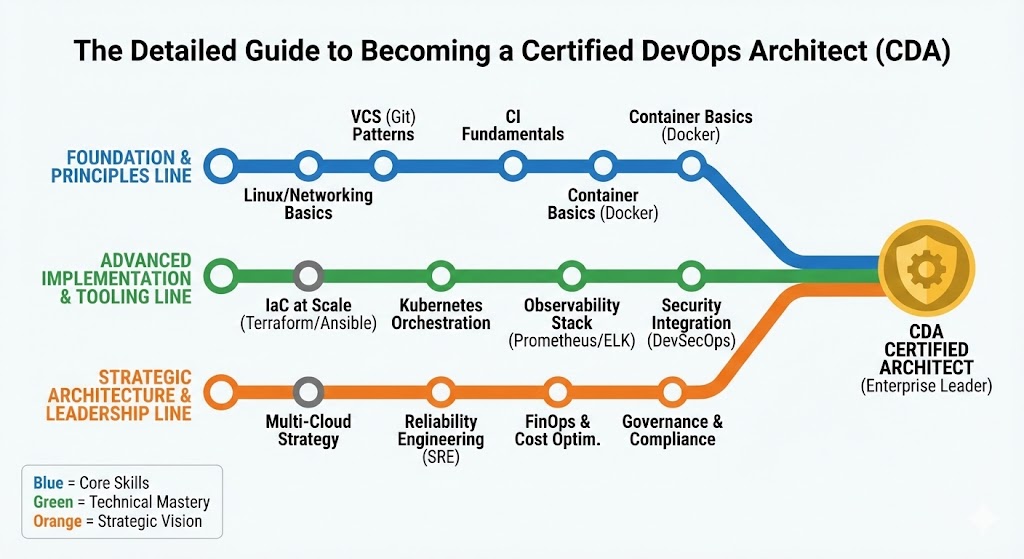
Introduction
Industry veterans understand that scaling a DevOps culture requires more than just installing the latest tools. It demands a sophisticated architectural vision that aligns technical execution with business strategy. Consequently, the Certified DevOps Architect (CDA) serves as a critical credential for engineers who aspire to lead this transformation. This guide empowers you to navigate the complexities of modern software delivery, from microservices orchestration to global infrastructure governance. Furthermore, it helps you make informed career decisions by highlighting how architectural mastery directly impacts organizational success. By following this roadmap, you transition from a tool operator to a strategic designer of resilient, automated ecosystems.
What is the Certified DevOps Architect (CDA)?
The Certified DevOps Architect (CDA) represents a professional standard for individuals who design and govern high-performance software delivery systems. It prioritizes the creation of production-ready environments that emphasize stability, security, and scalability above all else. Unlike foundational certifications, the CDA focuses on the “why” and “how” of complex system integration. Moreover, it aligns perfectly with modern enterprise workflows by treating infrastructure and security as code. This certification ensures that you possess the skills to lead technical teams through the challenges of cloud-native development and platform engineering.
Who Should Pursue Certified DevOps Architect (CDA)?
Senior software engineers, Site Reliability Engineers (SREs), and Cloud Architects stand to gain the most from this certification. It specifically targets professionals who manage production environments and want to move into strategic leadership roles. Additionally, engineering managers who lead technical teams find immense value in the program as it sharpens their ability to evaluate technical blueprints. Whether you work in a global tech giant or a fast-paced startup, this credential proves your readiness for high-stakes architectural responsibilities. Consequently, any professional seeking to influence the direction of their organization’s technology stack should pursue the CDA.
Why Certified DevOps Architect (CDA) is Valuable
The technology landscape shifts rapidly, yet sound architectural principles remain constant. Achieving the CDA ensures your skills remain relevant even as specific tools evolve or disappear. Organizations actively seek architects who can lower operational costs while simultaneously increasing deployment frequency. Furthermore, this certification offers a high return on investment by positioning you for senior-level roles that command respect and high compensation. It also provides a structured way to validate your expertise in managing enterprise-scale digital transformations. By earning this credential, you demonstrate a commitment to engineering excellence that resonates with global employers.
Certified DevOps Architect (CDA) Certification Overview
DevOpsSchool delivers this comprehensive program through the Certified DevOps Architect (CDA) curriculum and hosts it on the DevOpsSchool website. The program utilizes a rigorous, scenario-based assessment model to verify your practical skills in real-world environments. It structures the learning journey into logical phases, ensuring you master foundational concepts before tackling enterprise-scale design. Moreover, industry experts curate the content to reflect the most current practices in automation and resilience. This approach guarantees that every certified professional maintains a high standard of technical and strategic proficiency.
Certified DevOps Architect (CDA) Certification Tracks & Levels
The CDA program offers three primary tiers: Foundation, Professional, and Advanced. Each level mirrors a specific stage in an engineer’s professional progression, moving from basic pipeline design to organizational governance. You can also specialize in tracks like DevSecOps, SRE, or FinOps to align the certification with your specific role. This structure allows you to build a personalized learning path that supports your daily responsibilities and long-term career goals. Consequently, the program ensures you gain deep expertise in your chosen niche while maintaining a broad architectural perspective.
Complete Certified DevOps Architect (CDA) Certification Table
| Track | Level | Who it’s for | Prerequisites | Skills Covered | Recommended Order | Official Link |
| Core Architecture | Foundation | Emerging Architects | 2+ Years Experience | CI/CD, GitOps, Docker | First | Link |
| System Design | Professional | Senior Engineers | CDA Foundation | K8s, Microservices | Second | Link |
| Enterprise Strategy | Advanced | Tech Directors | CDA Professional | Governance, FinOps | Third | Link |
Detailed Guide for Each Certified DevOps Architect (CDA) Certification
Certified DevOps Architect (CDA) – Foundation
What it is This introductory level confirms your grasp of core DevOps theories and your ability to contribute to automated workflows. It sets the stage for architectural thinking by breaking down the silos between development and operations teams.
Who should take it Junior developers and system administrators who want to build a career in architecture should start here. It also serves as an excellent refresher for QA engineers who interact with delivery pipelines daily.
Skills you’ll gain
- Build automated pipelines using modern CI tools.
- Manage containerized applications with Docker.
- Implement version control strategies for large teams.
- Understand the basics of Infrastructure as Code.
Real-world projects you should be able to do
- Construct a Jenkins pipeline that automates unit testing.
- Containerize a legacy application for cloud deployment.
- Provision local development environments using Terraform.
Preparation plan
- 7–14 days: Study the DevOps lifecycle and fundamental tool definitions.
- 30 days: Execute basic labs focusing on Git and containerization.
- 60 days: Explore Linux system administration and networking basics.
Common mistakes
- Learning tools in isolation without understanding the broader workflow.
- Skipping the cultural principles that drive DevOps success.
Best next certification after this
- Same-track: CDA Professional
- Cross-track: Certified SRE Practitioner
- Leadership: DevOps Team Lead
Certified DevOps Architect (CDA) – Professional
What it is The Professional tier validates your ability to manage complex, multi-service environments in production. It shifts the focus toward orchestration, high availability, and self-healing system design.
Who should take it Experienced engineers who currently manage production workloads find this level most appropriate. It requires prior knowledge of cloud environments and container orchestration.
Skills you’ll gain
- Orchestrate containers at scale using Kubernetes.
- Design canary and blue-green deployment strategies.
- Monitor system health with advanced observability tools.
- Automate configuration management across hundreds of nodes.
Real-world projects you should be able to do
- Build a resilient Kubernetes cluster on a public cloud provider.
- Configure a centralized logging stack using ELK.
- Implement an automated rollback mechanism for failed releases.
Preparation plan
- 7–14 days: Deep dive into Kubernetes networking and storage.
- 30 days: Practice building end-to-end pipelines with security gates.
- 60 days: Conduct failure simulations to test system resilience.
Common mistakes
- Over-engineering solutions for simple architectural problems.
- Ignoring the monitoring and alerting aspects of the delivery loop.
Best next certification after this
- Same-track: CDA Advanced
- Cross-track: DevSecOps Expert
- Leadership: Engineering Manager
Certified DevOps Architect (CDA) – Advanced
What it is This elite certification proves you can lead massive digital transformations at the enterprise level. You learn to manage the intersection of business goals, technical excellence, and financial responsibility.
Who should take it Principal architects and CTOs who determine the long-term technology roadmap for their companies should pursue this. It requires years of experience managing diverse teams and technologies.
Skills you’ll gain
- Create multi-cloud strategies to avoid vendor lock-in.
- Enforce security and compliance as code across an organization.
- Optimize cloud spending through advanced FinOps principles.
- Lead the migration of complex monoliths to modern microservices.
Real-world projects you should be able to do
- Develop a disaster recovery strategy for global operations.
- Design a governance framework for enterprise-wide cloud use.
- Execute a large-scale migration plan for legacy financial systems.
Preparation plan
- 7–14 days: Focus on regulatory compliance and cloud governance.
- 30 days: Master the financial aspects of cloud resource management.
- 60 days: Analyze case studies of successful enterprise-scale transformations.
Common mistakes
- Neglecting the financial impact of architectural decisions.
- Failing to communicate technical changes to non-technical stakeholders.
Best next certification after this
- Same-track: Executive Leadership Programs
- Cross-track: MLOps Architect
- Leadership: IT Director
Choose Your Learning Path
DevOps Path
Engineers follow this route to master the entire delivery lifecycle from code development to production deployment. You learn to automate every manual hurdle, creating a seamless flow for developers. This path turns you into a versatile generalist who understands the pulse of the engineering organization. Consequently, you gain the ability to troubleshoot issues across the entire stack.
DevSecOps Path
This track prioritizes security as a core component of the delivery pipeline rather than an afterthought. You gain the skills to automate vulnerability scanning and manage identity across distributed systems. Specifically, you learn to implement security checks early in the development process. This specialization remains vital for architects working in highly regulated industries.
SRE Path
The SRE path focuses on the reliability and performance of systems after they reach production. You use software engineering techniques to solve traditional operations problems like uptime and latency. Moreover, this path teaches you how to manage error budgets and implement robust observability. It suits those who enjoy the challenge of keeping massive systems running smoothly under pressure.
AIOps / MLOps Path
Architects on this path bridge the gap between data science and traditional DevOps by automating machine learning workflows. You learn to manage model versioning, data drift, and the deployment of AI at scale. As AI becomes a standard feature of modern software, these skills become increasingly valuable. Consequently, this path future-proofs your architectural expertise.
DataOps Path
DataOps applies architectural rigor to data management, ensuring quality and speed in data delivery. You build resilient pipelines that handle massive volumes of information with high reliability. Furthermore, this path suits data engineers who want to bring automation and testing to their data workflows. It prevents data silos and ensures consistent information across the organization.
FinOps Path
The FinOps path tackles the challenge of cloud cost management within the engineering process. You learn to design systems that maximize performance while minimizing unnecessary expenses. This specialization allows you to prove the business value of your architectural designs. It is a critical skill set for architects working with large-scale cloud budgets in enterprise environments.
Role → Recommended Certified DevOps Architect (CDA) Certifications
| Role | Recommended Certifications |
| DevOps Engineer | CDA Foundation & CDA Professional |
| SRE | CDA Professional & SRE Practitioner |
| Platform Engineer | CDA Advanced & Kubernetes Master |
| Cloud Engineer | CDA Professional & Cloud Provider Expert |
| Security Engineer | CDA Foundation & DevSecOps Specialist |
| Data Engineer | CDA Professional & DataOps Master |
| FinOps Practitioner | CDA Advanced & FinOps Specialist |
| Engineering Manager | CDA Foundation & Leadership Track |
Next Certifications to Take After Certified DevOps Architect (CDA)
Same Track Progression
Deepen your expertise by pursuing advanced certifications from specific cloud providers like AWS or Google Cloud. These complement your architectural knowledge with deep, provider-specific implementation skills. Furthermore, you might explore niche certifications for advanced networking or service mesh technologies. Continuous deep learning ensures you remain the top authority in your specific field.
Cross-Track Expansion
Expand your versatility by moving into AIOps or FinOps after you master the CDA. This “T-shaped” skill set allows you to lead multi-disciplinary teams and tackle more complex business challenges. Moreover, broadening your knowledge base makes you an ideal candidate for high-level consulting or principal roles. It prevents your career from stagnating in a single technical domain.
Leadership & Management Track
Transition into leadership by combining your technical CDA background with management training. Look for certifications in project management or executive leadership to round out your professional profile. Your architectural expertise gives you the credibility to lead engineers, while management skills help you navigate organizational politics. This path often leads to roles like VP of Engineering or CTO.
Training & Certification Support Providers for Certified DevOps Architect (CDA)
DevOpsSchool
DevOpsSchool offers a complete training environment with expert instructors and extensive lab access. They update their content constantly to ensure you learn the latest architectural trends. Moreover, their program provides a solid foundation for anyone serious about passing the CDA.
Cotocus
Cotocus specializes in training for enterprise-level DevOps challenges. They provide deep insights into how large companies manage their infrastructure at scale. Furthermore, their trainers bring years of real-world experience into the classroom to help you solve actual production issues.
Scmgalaxy
Scmgalaxy provides a wealth of community resources, tutorials, and technical blogs for CDA candidates. They foster a learning environment where professionals share practical tips and solutions. Their approach remains highly practical and community-focused for all skill levels.
BestDevOps
BestDevOps focuses on efficient and direct certification preparation for working professionals. They offer concentrated boot camps that help you master the CDA curriculum quickly. Specifically, their materials target the most critical aspects of the architectural exam for maximum success.
devsecopsschool.com
This provider focuses exclusively on the security aspects of the DevOps lifecycle. They help you integrate advanced security measures directly into your CDA architectural designs. Their training is essential for anyone on the DevSecOps path who wants to master automated compliance.
sreschool.com
Sreschool.com teaches the principles of site reliability and high availability. They provide the practical skills needed to manage production systems according to global SRE standards. Their labs simulate high-stress incident response scenarios to prepare you for any situation.
aiopsschool.com
Aiopsschool.com helps you navigate the intersection of artificial intelligence and operations. They provide the training necessary to implement AI-driven monitoring and automation within your architecture. This provider helps you stay ahead of the curve in the evolving tech landscape.
dataopsschool.com
Dataopsschool.com focuses on the automation of data pipelines and large-scale data architecture. They show you how to apply CDA principles to complex data environments effectively. This training remains vital for architects in modern, data-driven organizations.
finopsschool.com
Finopsschool.com provides the tools and knowledge to manage cloud costs effectively. They help architects understand the financial impact of their technical designs. Their training bridges the gap between engineering and finance departments for better resource allocation.
Frequently Asked Questions (General)
- How do I begin the Certified DevOps Architect (CDA) journey? You start by reviewing the official curriculum and assessing your current skill level against the foundation requirements. Most candidates begin with the foundation level to ensure they have no gaps in their basic knowledge. From there, you should select a training provider that fits your learning style, whether you prefer live sessions or self-paced labs. Consistent practice and community engagement will help you progress through the levels efficiently. Moreover, focusing on practical implementation during your study will yield the best results for the actual certification exam.
- Does this certification require coding skills? Yes, a successful architect must understand the code that powers automation and infrastructure. While you do not need to be a full-stack developer, you must be comfortable with scripting languages like Python or Bash. You also need to understand YAML for configuration and Infrastructure as Code. Coding skills allow you to build the very systems you design, making you a much more effective leader. Furthermore, understanding code helps you communicate better with development teams during the design phase of a project.
- How does the CDA help with salary growth? Certified architects typically command much higher salaries because they bring strategic value to a company. Organizations pay a premium for professionals who can reduce downtime and optimize expensive cloud resources. The CDA validates your ability to handle high-stakes technical decisions, which directly translates to better compensation packages. Moreover, it acts as a powerful lever during salary negotiations and promotion cycles by providing objective proof of your expertise. Consequently, many professionals see a significant salary jump shortly after achieving their advanced certification levels.
- Is the exam based more on theory or practice? The exam strikes a careful balance but leans heavily toward practical application and scenario-based problem-solving. You must understand the “why” behind architectural choices, but you also need the “how” to implement them. Many questions present real-world scenarios where you must choose the best design for a specific set of constraints. This ensures that certified professionals can actually perform the job in a live production environment. Consequently, candidates who spend significant time in hands-on labs tend to perform better than those who only study theory.
- How often should I recertify for the CDA? Most professionals recertify every two to three years to stay current with the fast-moving tech landscape. Recertification usually involves passing an updated exam or completing a set of advanced training modules. This process ensures that your skills remain relevant as new tools and methodologies emerge in the industry. Furthermore, it proves to employers that you remain committed to continuous professional growth and technical excellence. Recertification protects the integrity of the credential and ensures that every Certified DevOps Architect maintains modern standards.
- Can I study for the CDA while working full-time? Absolutely, the program remains designed specifically for working professionals who need flexible learning options. Most training providers offer weekend or evening sessions to accommodate busy schedules. If you dedicate a few hours each week to study and hands-on labs, you can successfully earn your certification without leaving your job. Furthermore, the practical nature of the course often allows you to apply what you learn directly to your current role. This immediate application reinforces your learning and provides instant value to your employer.
- What is the global recognition of the CDA? The CDA holds significant value across the globe, from North America and Europe to the major tech hubs in Asia. Multinational corporations recognize it as a benchmark for architectural excellence in the DevOps field. Because the principles of sound architecture remain universal, your CDA credential stays respected regardless of where you choose to work. Furthermore, it provides a global passport for your engineering career, making it easier to secure roles in international environments. Employers worldwide trust the CDA to identify top-tier architectural talent.
- How do the labs work in this program? The labs typically use cloud-based environments where you build and test real architectural designs. You use tools like Kubernetes, Terraform, and Jenkins to complete specific architectural tasks. These labs simulate real-world challenges, such as recovering from a system crash or scaling an application during a traffic spike. Furthermore, they provide the safe “sandbox” environment you need to master complex technical skills without risking production systems. Successful completion of these labs ensures you can handle the pressure of managing actual enterprise infrastructure.
- Does the CDA cover multi-cloud strategies? Yes, the curriculum places a strong emphasis on multi-cloud and hybrid-cloud designs for modern enterprises. You learn how to leverage the strengths of different providers while maintaining a cohesive management layer. This knowledge remains essential for organizations that want to avoid vendor lock-in and increase system resilience. Furthermore, you will gain the skills to architect solutions that span across AWS, Azure, and on-premises data centers seamlessly. Mastering multi-cloud architecture makes you an invaluable asset to any large-scale organization today.
- What is the role of an architect versus an engineer? The architect focuses on the “what” and “why” of the entire ecosystem, while the engineer often focuses on the “how” of specific tasks. An architect designs the blueprints, sets the standards, and ensures that all components work together seamlessly. Conversely, the engineer executes those designs and maintains the day-to-day operations of the pipeline. The CDA prepares you to bridge these two worlds, providing the vision and technical depth required for leadership. Furthermore, understanding both roles allows you to build more practical and effective systems.
- How does the CDA help professionals in India specifically? In India, the tech industry shifts rapidly toward high-end product engineering and global service delivery. Having a CDA credential sets you apart in a competitive job market where basic DevOps skills are common. It proves to employers that you possess the architectural depth required for complex global projects. Furthermore, many top-tier Indian IT firms and product startups prioritize certified architects for their senior leadership roles. Consequently, the CDA acts as a significant catalyst for career progression within the vibrant Indian technology sector.
- Is there any prerequisite for the Advanced level? The Advanced level generally requires you to have completed the Professional certification or demonstrate equivalent high-level industry experience. You need a deep understanding of core DevOps and SRE principles before you can master enterprise-wide strategy. This ensures that advanced candidates possess the technical foundation necessary to lead large-scale organizational shifts. Furthermore, starting from the foundation level provides a cohesive learning experience that builds upon itself. This structured approach maintains the prestige and integrity of the highest level of certification in the market.
FAQs on Certified DevOps Architect (CDA)
- How does the CDA improve system reliability? The CDA teaches you to design for failure by implementing redundancy and automated recovery mechanisms. You learn to use advanced observability tools to catch issues before they affect your users. By applying these architectural patterns, you significantly reduce the mean time to recovery (MTTR) for your applications. Furthermore, reliability becomes a built-in feature of your system rather than an afterthought. Consequently, your engineering team experiences less stress during deployments, and your customers enjoy a much more stable and consistent experience with your products.
- What makes the CDA curriculum unique compared to other certifications? The CDA focuses specifically on the “Architect” persona, which many other training programs often ignore. It does not just teach you how to use a tool; it teaches you how to design a cluster that supports hundreds of teams at an enterprise scale. The curriculum emphasizes the strategic trade-offs of different technical decisions, such as cost versus performance. Furthermore, it incorporates modern concepts like FinOps and MLOps directly into the architectural framework. This focus on high-level design and organizational impact makes the CDA a unique credential.
- Can an architect still remain “hands-on” with the code? The best architects remain hands-on by building prototypes and key components of the automated infrastructure. The CDA encourages this “lead by example” approach, ensuring you never lose touch with the practical realities of engineering. While you spend more time on design and strategy, you still maintain the skills to troubleshoot complex production issues. Furthermore, staying hands-on ensures that your architectural designs remain practical and grounded in reality for your engineering team. This balance between strategy and execution makes you a much more effective and respected leader.
- How does the CDA handle legacy system migrations? The CDA provides a structured framework for moving legacy monolithic systems to modern cloud-native architectures. You learn various strategies like “lift and shift,” “replatforming,” and “refactoring” to ensure a successful transition. The curriculum teaches you how to manage the risks associated with moving old databases and complex codebases into a DevOps environment. Furthermore, you gain the skills to design a migration path that minimizes downtime and ensures a smooth transition. Consequently, you can lead your organization through a digital transformation without disrupting core business operations.
- What is the significance of Infrastructure as Code in the CDA? Infrastructure as Code (IaC) serves as the backbone of the CDA philosophy. You learn to treat your servers, networks, and databases with the same rigor as your application code. This means using version control, automated testing, and continuous integration for your infrastructure changes. Furthermore, IaC allows you to recreate entire environments in minutes, ensuring consistency across your production fleet. It prevents “configuration drift” and makes your architecture much more resilient to human error. Mastering IaC remains a fundamental requirement for any modern architect.
- How does the CDA support career transitions for senior professionals? The CDA provides the technical and strategic “vocabulary” you need to move into higher-level management or consulting roles. It gives you the confidence to lead complex technical discussions with senior stakeholders and engineers alike. Furthermore, many professionals use the CDA to transition from traditional system administration or development into high-paying architect roles. The certification acts as a formal validation of your ability to handle the responsibilities of a senior technical leader. Consequently, it provides a clear pathway for career growth for those who feel stuck in execution-focused roles.
- Does the program cover FinOps in detail? Yes, the program integrates FinOps to help you understand the financial side of cloud architecture. You learn how to track spending, identify waste, and design systems that are cost-effective by default. This skill remains critical for architects who manage large-scale cloud deployments where costs can quickly spiral out of control. Furthermore, being able to demonstrate cost-savings makes you a hero in the eyes of the finance department. Mastering FinOps allows you to prove the direct business value of your architectural designs to your organization’s leadership.
- What kind of support can I expect after I earn my certification? Once you earn your CDA, you join an elite community of certified architects who share knowledge and job opportunities. Many training providers offer ongoing support through exclusive forums and alumni networks. You gain access to updated materials and webinars that keep your skills sharp as the industry continues to evolve. Furthermore, this community provides a valuable sounding board for your own architectural challenges. This ongoing support ensures that your certification remains a valuable asset throughout your entire career, providing long-term professional and personal growth.
Final Thoughts: Is Certified DevOps Architect (CDA) Worth It?
If you aim to move beyond the role of a tool operator and become a true technical visionary, the Certified DevOps Architect (CDA) remains an essential milestone. It transforms your approach from managing individual tasks to managing entire technical ecosystems. The program demands significant effort and dedication, but it rewards you with unparalleled career growth and technical authority. For those ready to leave silos behind and build the future of resilient, automated systems, the CDA offers the perfect path forward. Consequently, investing in this certification today ensures you lead the engineering world of tomorrow.
Great detailed guide for anyone planning a career in DevOps architecture. The roadmap, certification levels, and career tips are explained very clearly and make learning easier for beginners and professionals alike.