Introduction
Security Analytics Platforms are centralized solutions that ingest, normalize, and analyze massive volumes of security data from across an enterprise’s entire digital footprint. Unlike legacy SIEM (Security Information and Event Management) systems that relied heavily on rigid, manually written correlation rules, modern security analytics tools leverage User and Entity Behavior Analytics (UEBA) and Artificial Intelligence (AI) to identify anomalies that don’t fit a known signature. They provide the necessary context to transform a “suspicious” alert into a high-confidence incident notification.
The importance of these tools cannot be overstated. With the rise of AI-powered malware and sophisticated state-sponsored “low and slow” attacks, organizations need the ability to correlate events across disparate silos—such as linking a suspicious login on a SaaS app to a strange file download on a local workstation. Key evaluation criteria include the platform’s ingestion speed, the depth of its pre-built detection content, its automated response capabilities (SOAR), and its ability to maintain high performance without skyrocketing costs as data volumes grow.
Best for: Security operations teams, threat hunters, and compliance officers in mid-to-large enterprises, government agencies, and managed security service providers (MSSPs). It is particularly vital for organizations with hybrid or multi-cloud architectures that need a unified visibility layer.
Not ideal for: Very small businesses with simple, localized IT setups or companies with no dedicated security personnel. In these cases, a managed service (MDR) or basic built-in cloud security tools may be more appropriate and less overwhelming.
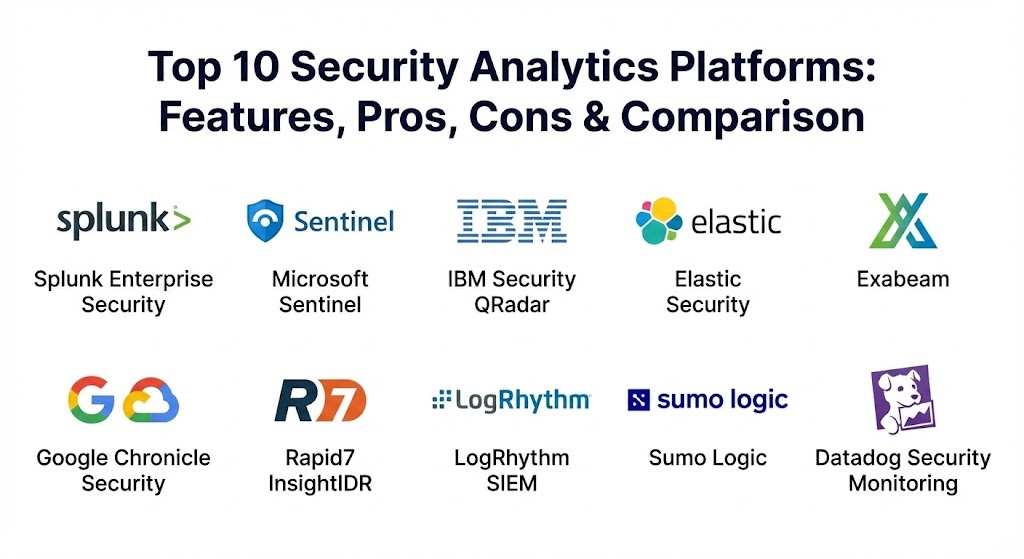
Top 10 Security Analytics Platforms
1 — Splunk Enterprise Security
Splunk is widely regarded as the heavyweight champion of the data-to-everything world. Its Enterprise Security (ES) platform is a premium analytics-driven SIEM that turns machine data into “answers.” It is designed for large-scale environments that require deep customization and massive data ingestion.
- Key features:
- Comprehensive security posture dashboards and real-time monitoring.
- Incident Review workflows with integrated “notable event” tracking.
- Asset and Identity correlation for better contextual awareness.
- Advanced threat intelligence integration from multiple sources.
- Behavioral analytics to detect “unknown unknowns.”
- Deep integration with Splunk SOAR for automated remediation.
- Pros:
- The most flexible query language (SPL) in the industry, allowing for incredibly specific searches.
- An enormous ecosystem of apps and add-ons that support almost every hardware/software vendor.
- Cons:
- Known for a high “Total Cost of Ownership” (TCO) due to volume-based or workload-based pricing.
- Requires specialized training or dedicated “Splunk Admins” to run effectively at scale.
- Security & compliance: SOC 2 Type II, ISO 27001, HIPAA, GDPR, and PCI DSS. Supports SSO and end-to-end encryption.
- Support & community: World-class support with a massive user community (Splunk Answers) and extensive certification programs.
2 — Microsoft Sentinel
Microsoft Sentinel is a cloud-native SIEM and SOAR platform that has seen meteoric growth due to its seamless integration with the Microsoft 365 and Azure ecosystems. It leverages the power of the Azure cloud to provide near-infinite scale.
- Key features:
- One-click data ingestion from Microsoft 365, Azure, and Teams.
- Built-in AI and machine learning models trained on trillions of signals.
- Advanced “Hunting” queries using the Kusto Query Language (KQL).
- Integration with Microsoft Defender for XDR-level visibility.
- Automated playbooks via Azure Logic Apps.
- Community-driven detection rules from GitHub.
- Pros:
- Significantly reduces the complexity of managing physical servers or storage for security logs.
- Offers substantial cost savings (often free ingestion) for certain Microsoft 365 data types.
- Cons:
- Can feel like “Azure lock-in” for organizations that are heavily multi-cloud.
- Some advanced behavioral features require a high level of expertise in KQL.
- Security & compliance: FedRAMP High, HIPAA, GDPR, SOC 2, and more than 100 global compliance certificates.
- Support & community: Backed by Microsoft’s global support; vibrant GitHub community for sharing detections.
3 — IBM Security QRadar
IBM QRadar is a stable, mature, and highly integrated security analytics platform favored by enterprises that prioritize consistency and “out-of-the-box” correlation rules.
- Key features:
- Integrated log management, network flow analysis, and vulnerability management.
- QRadar Advisor with Watson (AI) for accelerated incident investigation.
- “Offense” based alerting that groups related events into a single investigation.
- Sophisticated user behavioral analytics (UBA) module.
- Massive library of “Device Support Modules” (DSMs).
- Hybrid cloud deployment options (SaaS or On-Prem).
- Pros:
- Excellent at “noise reduction”—grouping thousands of logs into a single actionable “offense.”
- The AI assistant (Watson) is genuinely helpful for providing external threat context.
- Cons:
- The user interface can feel dated compared to newer, cloud-native rivals.
- Upgrading on-premises instances can be a complex and time-consuming project.
- Security & compliance: FIPS 140-2, Common Criteria, SOC 2, HIPAA, and ISO 27001.
- Support & community: Strong enterprise support and a well-established global partner network.
4 — Elastic Security
Built on the “ELK Stack” (Elasticsearch, Logstash, Kibana), Elastic Security is a favorite for teams that want speed, openness, and the ability to search massive datasets in sub-second time.
- Key features:
- Limitless data ingestion and sub-second search speeds.
- Integrated EDR (Endpoint Detection and Response) agents.
- Hundreds of pre-built detection rules mapped to the MITRE ATT&CK framework.
- Behavioral anomaly detection using built-in machine learning.
- Timeline view for interactive investigation of security events.
- Open-source core with a transparent development roadmap.
- Pros:
- Unrivaled performance for searching through historical data over long timeframes.
- Very cost-effective for organizations that are willing to manage their own infrastructure.
- Cons:
- The learning curve for “Lucene” or “ESQL” queries can be steep.
- Managing a large self-hosted cluster requires significant DevOps expertise.
- Security & compliance: SOC 2, HIPAA, GDPR, and FedRAMP (for Elastic Cloud).
- Support & community: Massive open-source community and excellent documentation for self-learners.
5 — Exabeam (New-Scale SIEM)
Exabeam is a leader in the UEBA space, recently reinventing itself as a “New-Scale SIEM.” It is designed for SOC teams that struggle with “alert fatigue” and need to automate the incident investigation process.
- Key features:
- “Smart Timelines” that automatically stitch together a user’s cross-session activity.
- Advanced behavioral baselining for every user and device on the network.
- Outcome-based security approach with built-in compliance workflows.
- Automated threat hunting with an intuitive search interface.
- Cloud-native architecture with petabyte-scale search performance.
- High-fidelity alerting based on risk scoring rather than simple triggers.
- Pros:
- The automated timelines significantly reduce the time analysts spend “connecting the dots.”
- Exceptional at identifying insider threats and compromised credentials.
- Cons:
- Heavily dependent on the quality of log data ingested to build accurate baselines.
- Can be pricier than more “basic” log management solutions.
- Security & compliance: SOC 2 Type II, GDPR, HIPAA, and ISO 27001.
- Support & community: Focuses on “Customer Success” with dedicated onboarding and a strong online training portal.
6 — Google Chronicle Security
Chronicle is Google’s attempt to bring “Google-speed” search to security data. It is a hyperscale platform that allows organizations to store and search massive amounts of data with fixed-cost pricing models.
- Key features:
- Search months of data in milliseconds using a familiar Google-like interface.
- “Universal Data Model” (UDM) that normalizes data from all vendors automatically.
- Massive data retention (typically 1 year by default).
- Integrated threat intelligence from Google’s Mandiant and VirusTotal.
- Curated detections that are managed and updated by Google engineers.
- Seamless integration with Google Cloud Platform (GCP).
- Pros:
- Solves the “data hoarding” problem with predictable, per-employee pricing rather than per-GB.
- The speed of search is widely considered the fastest in the current market.
- Cons:
- Still lacks some of the deep, granular customization options found in Splunk.
- The “black box” nature of some curated detections can be frustrating for advanced hunters.
- Security & compliance: SOC 2, ISO 27001, HIPAA, and GDPR. Data is stored in encrypted, isolated silos.
- Support & community: Rapidly growing; benefits from Google’s massive engineering and support resources.
7 — Rapid7 InsightIDR
InsightIDR is a SaaS-based SIEM designed for mid-to-large enterprises that need a comprehensive security platform without the overhead of a complex deployment. It focuses on high-fidelity alerts and “Time to Value.”
- Key features:
- Integrated UEBA, EDR, and Deception technology (honeypots).
- Centralized log management and search.
- Pre-built detection library curated by Rapid7’s MDR and research teams.
- Intuitive “visual” investigation interface.
- Native integration with InsightConnect (SOAR).
- Cloud-first architecture with easy-to-deploy data collectors.
- Pros:
- Incredibly fast to deploy—often providing value within the first 48 hours.
- The built-in “Deception” (honeypots) is a unique and highly effective way to catch intruders.
- Cons:
- Less flexible for highly specialized custom data sources compared to Splunk or Elastic.
- Advanced reporting can be somewhat limited for very complex compliance audits.
- Security & compliance: SOC 2 Type II, ISO 27001, GDPR, and HIPAA compliant.
- Support & community: Strong community (Rapid7 Discuss) and highly rated customer support.
8 — LogRhythm SIEM
LogRhythm is an analyst-centric platform that emphasizes the “TLM” (Threat Lifecycle Management) framework. It is designed to empower the human analyst with a streamlined workflow.
- Key features:
- Precision Search using an easy-to-understand filter interface.
- Sophisticated AI Engine for real-time correlation and behavioral analysis.
- Unified console that combines SIEM, Log Management, and Case Management.
- “SmartResponse” automation for immediate threat containment.
- Integrated Network Detection and Response (NDR) capabilities.
- Compliance-focused automation for PCI, HIPAA, and GDPR.
- Pros:
- The workflow is very logical, leading analysts through detection to remediation in one path.
- Excellent for organizations that are heavy on compliance reporting requirements.
- Cons:
- The transition from their legacy platform to the new “Axon” platform is still ongoing for some users.
- Requires a fair amount of tuning to minimize false positives initially.
- Security & compliance: FIPS 140-2, SOC 2, HIPAA, and ISO 27001.
- Support & community: Dedicated LogRhythm University for training and a very loyal long-term user base.
9 — Sumo Logic
Sumo Logic is a true cloud-native observability and security platform. It treats security as a “data problem” and uses high-speed log analytics to provide a unified view of DevOps and SecOps.
- Key features:
- Multi-cloud and hybrid cloud visibility for AWS, Azure, and GCP.
- “Cloud SIEM” module that uses “Insights” to cluster related signals.
- LogReduce and LogCompare for identifying patterns in massive datasets.
- Native Kubernetes and container security monitoring.
- Global intelligence feeds that benchmark your security against others.
- Integrated SOAR platform for automated workflows.
- Pros:
- True multi-tenant SaaS; no hardware or software to maintain, ever.
- Excellent for modern, cloud-native companies that use microservices and serverless.
- Cons:
- Can be complex to manage “data tiers” to control costs for high-volume logs.
- Primarily focused on logs; network flow analysis is less robust than QRadar or LogRhythm.
- Security & compliance: PCI DSS, HIPAA, SOC 2 Type II, ISO 27001, and FedRAMP Moderate.
- Support & community: Robust online training; good technical documentation; active Slack community.
10 — Datadog Security Monitoring
Datadog, originally an observability tool for developers, has expanded aggressively into security. It is the best choice for organizations where the “Dev” and “Sec” teams share the same dashboard.
- Key features:
- Real-time threat detection across applications, infrastructure, and logs.
- Cloud Security Posture Management (CSPM) and Workload Security.
- Application Security Management (ASM) for monitoring web attacks.
- OOTB (Out of the Box) detection rules for standard cloud attacks.
- Seamless integration with Datadog’s APM and infrastructure monitoring.
- Correlation between performance spikes and security incidents.
- Pros:
- Ideal for “shifting left”—allowing developers to see security issues alongside performance logs.
- Very easy to turn on if you are already using Datadog for monitoring.
- Cons:
- Not as “deep” as a dedicated SIEM for legacy on-premises networking hardware.
- Cost can escalate quickly if monitoring thousands of containers or cloud functions.
- Security & compliance: SOC 2, HIPAA, GDPR, and ISO 27001.
- Support & community: Modern, responsive support and a massive community of DevOps and SRE professionals.
Comparison Table
| Tool Name | Best For | Platform(s) Supported | Standout Feature | Rating (Gartner Peer Insights) |
| Splunk ES | Large Scale / Customization | Hybrid, Cloud, On-Prem | SPL Query Language | 4.6 / 5 |
| Microsoft Sentinel | Microsoft Ecosystem | Azure-Native | M365 Integration | 4.7 / 5 |
| IBM QRadar | Noise Reduction | Hybrid, On-Prem | “Offense” Clustering | 4.5 / 5 |
| Elastic Security | Speed / Openness | Multi-Cloud, On-Prem | Sub-Second Search | 4.6 / 5 |
| Exabeam | Insider Threats / UEBA | Cloud-Native | Smart Timelines | 4.5 / 5 |
| Google Chronicle | Hyperscale / Search | Google Cloud | Fixed-Cost Analytics | 4.4 / 5 |
| Rapid7 InsightIDR | Fast Deployment | SaaS-Based | Deception (Honeypots) | 4.5 / 5 |
| LogRhythm | Analyst Workflow | Hybrid, On-Prem | Threat Lifecycle Mgmt | 4.4 / 5 |
| Sumo Logic | Multi-Cloud Observability | SaaS-Native | LogReduce / Pattern ID | 4.3 / 5 |
| Datadog Security | DevSecOps / Cloud | Cloud-Native | Monitoring + Security | 4.5 / 5 |
Evaluation & Scoring of Security Analytics Platforms
Selecting a security analytics platform is not just about features; it’s about how well the tool integrates with your specific human and technical workflows. The following scoring rubric reflects the priorities of modern SOC managers.
| Category | Weight | Evaluation Criteria |
| Core Features | 25% | UEBA capability, MITRE ATT&CK mapping, SOAR integration, and threat intel depth. |
| Ease of Use | 15% | Dashboard clarity, incident investigation workflow, and search language intuitiveness. |
| Integrations | 15% | Breadth of supported cloud providers, EDR tools, and legacy on-prem hardware. |
| Security & Compliance | 10% | Encryption standards, SOC 2/HIPAA certifications, and robust audit trails. |
| Performance | 10% | Search speed on historical data and real-time alert latency. |
| Support & Community | 10% | Quality of documentation, certification programs, and user forums. |
| Price / Value | 15% | Predictability of costs as data volume grows (TCO). |
Which Security Analytics Platform Is Right for You?
The “best” platform depends almost entirely on your current technical debt, your team’s expertise, and your cloud strategy.
- Solo Users & Small Teams: You generally should not buy a standalone platform. Instead, use the native security dashboards of your cloud provider (Azure Security Center or AWS Security Hub) or look for a managed MDR service.
- The “Microsoft Shop”: If your organization is 80%+ on Azure and M365, Microsoft Sentinel is the obvious choice. The ease of ingestion and the cost savings on O365 logs are too significant to ignore.
- The High-End Global Enterprise: If you have a dedicated SOC team of 20+ people and need absolute control over every data point, Splunk Enterprise Security remains the most powerful (albeit expensive) option.
- The Modern Cloud-Native Startup: If you are running on Kubernetes, Serverless, and multiple clouds, Sumo Logic or Datadog provide the observability-focused security that matches your dev cycle.
- Budget-Conscious Hunters: If you need petabyte-scale search but have a capped budget, Google Chronicle (with its per-employee pricing) or Elastic Security (with a self-managed model) offer the best value.
- High Insider Threat Risk: If your primary concern is IP theft or compromised employee accounts, Exabeam’s behavioral timelines will save your analysts hundreds of hours of manual work.
Frequently Asked Questions (FAQs)
1. What is the difference between SIEM and Security Analytics? SIEM is a traditional category focused on log collection and compliance. Security Analytics is a more modern evolution that uses AI, ML, and UEBA to proactively hunt for threats rather than just reacting to log correlations.
2. Why are these platforms so expensive? You are paying for three things: the massive compute power required to search petabytes of data, the continuous research of the vendor’s threat labs, and the long-term storage of your logs.
3. Do I need an EDR if I have a Security Analytics Platform? Yes. An EDR (like CrowdStrike or SentinelOne) acts as the “sensor” on the ground (endpoints). The Analytics Platform acts as the “command center” that correlates those endpoint signals with network, cloud, and identity logs.
4. How long does it take to implement a platform like Splunk or Sentinel? Cloud-native platforms like Sentinel or Rapid7 can be “running” in days. However, tuning the rules to eliminate false positives and integrating all your data sources typically takes 3 to 6 months.
5. What is UEBA and why does it matter? User and Entity Behavior Analytics (UEBA) tracks what is “normal” for a user. If an accountant suddenly logs in at 3 AM from a new country and accesses a database they’ve never touched, UEBA flags it as a high-risk anomaly.
6. Can these tools help with compliance audits (PCI, HIPAA)? Yes, most have pre-built compliance dashboards. However, the tool alone doesn’t make you compliant; it only provides the evidence and audit logs to prove you are following your security policies.
7. Is my data safe if I use a cloud-based security platform? Generally, yes. These vendors are under more scrutiny than almost any other software class. They use isolated data silos, high-end encryption, and are subject to regular third-party audits.
8. What is a “SOAR” and do I need it? SOAR (Security Orchestration, Automation, and Response) allows you to automate tasks—like automatically blocking an IP address in your firewall when a high-risk alert is triggered. Most top analytics platforms now include SOAR.
9. Why is “Data Normalization” so important? Every vendor writes logs differently. Data normalization (like Google’s UDM) translates those different “languages” into a single standard so you can compare an AWS log to a Cisco firewall log easily.
10. What is “Alert Fatigue”? Alert fatigue happens when a platform triggers too many low-quality alerts, causing human analysts to ignore them—eventually leading to a real breach being missed. Choosing a platform with high-fidelity analytics is the only cure.
Conclusion
Choosing a Security Analytics Platform in 2026 is a decision that will define your organization’s resilience for the next decade. There is no longer a “one size fits all” winner. If you value speed and cloud-native scale, Google Chronicle and Microsoft Sentinel are leading the charge. If you need deep, investigative power and customizability, Splunk and Elastic are the tools of choice. Ultimately, the best platform is the one that empowers your human analysts to act faster, think deeper, and sleep better at night.