Introduction
A security data lake is a centralized, large-scale repository designed to store, process, and analyze massive volumes of security-related data in its original format. Unlike traditional SIEMs that often require data to be parsed and “normalized” before it is saved—frequently resulting in high costs and data loss—a data lake allows organizations to ingest data first and apply structure only when it is queried (schema-on-read). This approach leverages high-performance cloud storage and distributed computing to enable multi-year data retention and complex analytics that were previously cost-prohibitive.
The importance of a security data lake lies in its ability to support advanced threat hunting, long-term forensic investigations, and the training of custom machine learning models. Key real-world use cases include identifying low-and-slow lateral movement spanning months, meeting multi-year regulatory compliance requirements, and consolidating data from fragmented multi-cloud environments. When evaluating these tools, users should prioritize ingestion throughput, support for the Open Cybersecurity Schema Framework (OCSF), cost-effectiveness of cold storage, and the maturity of the query interface (e.g., SQL or natural language search).
Best for: Large enterprises with massive log volumes (over 1TB/day), security engineering teams focused on threat hunting, organizations in highly regulated sectors like finance or defense, and companies moving toward a “Data Mesh” or “Lakehouse” architecture.
Not ideal for: Small businesses with minimal log output or organizations that prefer a “black box” managed security service where they do not wish to manage or query their own data infrastructure.
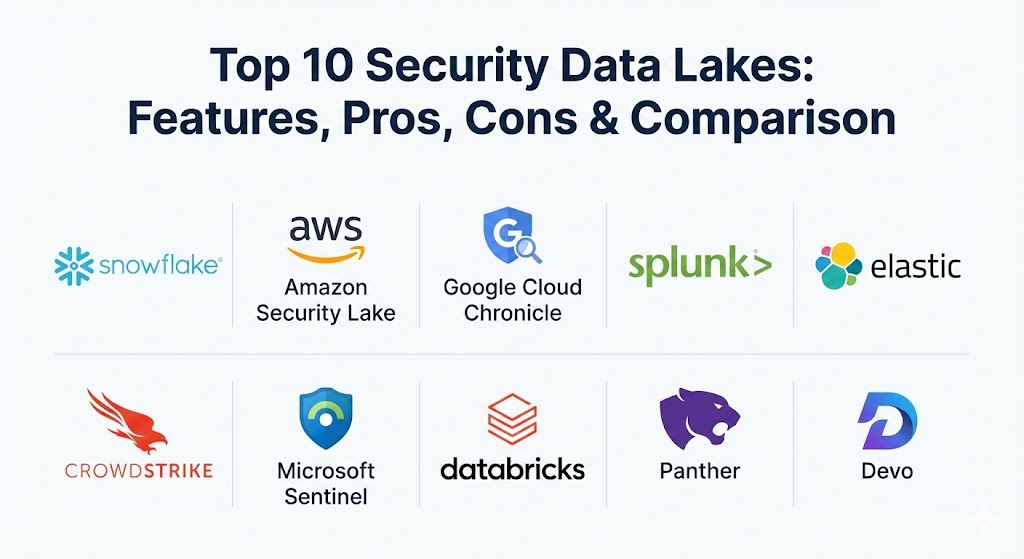
Top 10 Security Data Lakes Tools
1 — Snowflake Cybersecurity Data Cloud
Snowflake has redefined the security market by treating security as a data problem. Its Cybersecurity Data Cloud allows organizations to consolidate all security logs alongside business data, enabling a holistic view of enterprise risk.
- Key features:
- Massive scalability with decoupled storage and compute.
- Support for “Connected SIEM” models, where third-party apps query data directly in Snowflake.
- Native support for structured, semi-structured, and unstructured data.
- “Snowpark” for running custom Python or Java code for advanced threat detection.
- Data sharing capabilities that allow seamless log ingestion from SaaS vendors.
- Integration with major security platforms for automated incident response.
- Pros:
- Eliminates data silos by allowing security and business data to live in the same warehouse.
- Pay-as-you-go pricing for compute ensures you only pay for the queries you run.
- Cons:
- Can become expensive if many high-frequency, complex queries are running simultaneously.
- Requires a certain level of SQL or data engineering expertise to maximize ROI.
- Security & compliance: SOC 1 & 2 Type II, PCI DSS, HIPAA, FedRAMP, GDPR, and ISO 27001. Features end-to-end encryption and robust RBAC.
- Support & community: Extensive documentation; dedicated “Snowflake for Security” user groups and a massive global partner ecosystem.
2 — Amazon Security Lake
Amazon Security Lake is a purpose-built service that automatically centralizes security data from AWS, on-premises, and third-party sources into a purpose-built data lake stored in your own S3 buckets.
- Key features:
- Native integration with AWS CloudTrail, VPC Flow Logs, and Route 53.
- Built on the OCSF (Open Cybersecurity Schema Framework) standard.
- Automatically manages data lifecycle and tiering to lower-cost storage.
- Cross-account and cross-region data aggregation for global visibility.
- Direct integration with Amazon Athena and Amazon OpenSearch for querying.
- Supports dozens of third-party security vendors for “out-of-the-box” ingestion.
- Pros:
- Simplifies the complex task of normalizing logs from dozens of different vendors.
- You own the data in your own S3 bucket, preventing vendor lock-in.
- Cons:
- Primarily focused on the AWS ecosystem; managing non-AWS data requires more manual effort.
- Costs can be difficult to predict due to the combination of S3 storage and Athena query fees.
- Security & compliance: HIPAA, GDPR, PCI DSS, and SOC 1/2/3. Leverages AWS IAM for granular access control.
- Support & community: Backed by AWS Enterprise Support; extensive documentation and a large community of AWS-certified professionals.
3 — Google Cloud Security Operations (Chronicle)
Part of the Google Cloud security suite, Chronicle is a planet-scale security data lake that leverages Google’s core infrastructure to provide lightning-fast search capabilities across years of data.
- Key features:
- Instant search across petabytes of data with sub-second response times.
- Integrated threat intelligence from Google Mandiant and VirusTotal.
- Automated “curated detections” that run against historical data.
- Support for OCSF and Unified Data Model (UDM) for normalization.
- Entity-linkage that maps users to their IP addresses and devices automatically.
- “Security Command Center” integration for a unified Google Cloud view.
- Pros:
- Unique “fixed-price” models based on employee count rather than data volume (in some tiers).
- Extraordinary performance for forensic investigations spanning long timeframes.
- Cons:
- The proprietary query language (YARA-L) has a learning curve for those used to SQL.
- Configuration of data parsers can be technical and time-consuming.
- Security & compliance: ISO 27001, SOC 2, HIPAA, GDPR, and FedRAMP. Data is encrypted at rest and in transit.
- Support & community: Enterprise-grade support; active Google Cloud Security community and specialized Mandiant incident response services.
4 — Splunk (with Federated Search & Data Lake)
While traditionally a SIEM, Splunk has evolved into a hybrid data lake architecture. By using Federated Search, Splunk can query data stored in low-cost S3 buckets or Snowflake without moving it.
- Key features:
- Federated Search across Splunk indexes and external S3/Data Lakes.
- Data Manager for simplified cloud ingestion and routing.
- Edge Processor for filtering and masking data before it hits the lake.
- Search Processing Language (SPL2) for powerful, flexible querying.
- Integrated SOAR (Security Orchestration, Automation, and Response) capabilities.
- Massive library of apps for nearly every security vendor.
- Pros:
- The most mature and feature-rich query language (SPL) in the industry.
- Allows organizations to keep “hot” data in Splunk and “cold” data in a cheaper lake.
- Cons:
- Traditional indexing costs remain high; managing the federated architecture adds complexity.
- Can be resource-heavy to maintain for on-premises or self-managed deployments.
- Security & compliance: SOC 2 Type II, ISO 27001, PCI DSS, HIPAA, and FedRAMP.
- Support & community: Industry-leading “Splunk Answers” community; extensive certification programs and 24/7 global support.
5 — Elastic Security (Stateless Architecture)
Elastic has transformed its famous ELK stack into a “stateless” security data lake architecture, significantly reducing the cost and complexity of long-term data retention.
- Key features:
- Search AI platform that combines vector search with traditional keyword search.
- “Stateless” architecture that separates indexing from storage.
- Native integration with thousands of data sources via Elastic Agent.
- Built-in SIEM features, including endpoint protection and cloud security.
- Flexible deployment: Elastic Cloud, on-premises, or air-gapped.
- Fully open-schema approach (Elastic Common Schema).
- Pros:
- Highly versatile—can be used for security, observability, and search.
- Excellent community support and a large pool of available talent.
- Cons:
- Scaling large clusters requires significant expertise in shard and index management.
- Licensing can be complex as you move from the free tier to enterprise features.
- Security & compliance: SOC 2, ISO 27001, HIPAA, GDPR, and FedRAMP.
- Support & community: Vibrant open-source community; “Elastic University” and dedicated enterprise support.
6 — CrowdStrike Falcon Next-Gen SIEM (LogScale)
CrowdStrike acquired Humio to build a high-speed, index-free data lake that can ingest and query petabytes of data in real-time with massive compression.
- Key features:
- Index-free architecture that enables sub-second query latency even at scale.
- Up to 80% data compression, significantly reducing storage costs.
- Native integration with the CrowdStrike Falcon agent and platform.
- “Falcon Fusion” for automated workflow orchestration based on data lake alerts.
- Support for live streaming dashboards and real-time alerts.
- Multi-tenant architecture for large, distributed enterprises.
- Pros:
- The speed of ingestion and querying is among the fastest in the market.
- Deep integration with Falcon endpoint data provides instant context for investigations.
- Cons:
- Best suited for CrowdStrike customers; non-CrowdStrike data requires more configuration.
- The query language (LQL) is unique and requires training for analysts.
- Security & compliance: SOC 2 Type II, ISO 27001, FedRAMP, and GDPR.
- Support & community: Integrated with the CrowdStrike support portal; extensive technical documentation and proactive threat hunting services.
7 — Microsoft Sentinel (with Log Analytics & ADX)
Microsoft Sentinel acts as the orchestration layer on top of a powerful data lake comprised of Azure Log Analytics and Azure Data Explorer (ADX).
- Key features:
- Native integration with Microsoft 365, Azure, and Entra ID.
- “Basic Logs” tier for ultra-low-cost, long-term data retention.
- Kusto Query Language (KQL) for high-performance data analysis.
- AI-driven threat intelligence and “Copilot for Security” integration.
- Automated data connectors for hundreds of third-party products.
- Integration with Azure Data Explorer for massive-scale hunting.
- Pros:
- If you are a Microsoft-heavy shop, the data ingestion for many MS logs is free.
- KQL is widely considered one of the best languages for high-speed log analysis.
- Cons:
- Cost management in Azure can be complex and requires constant monitoring.
- Limited visibility and performance when managing non-Azure cloud environments.
- Security & compliance: HIPAA, GDPR, SOC 1/2/3, and FedRAMP High.
- Support & community: Deep integration with Microsoft Unified Support; massive global community of KQL experts.
8 — Databricks Cybersecurity Lakehouse
Databricks leverages the “Lakehouse” architecture—combining the performance of a warehouse with the low cost of a lake—to provide a powerful platform for security data science.
- Key features:
- Delta Lake for ACID transactions on big data.
- Native integration with Apache Spark for massive parallel processing.
- Support for MLflow to build, train, and deploy custom security AI models.
- Unified governance via Unity Catalog for all data and AI assets.
- SQL Warehouse for traditional business intelligence on security data.
- Real-time streaming ingestion from Kafka and other sources.
- Pros:
- The best platform for organizations that want to build their own AI-driven detection logic.
- Highly cost-effective for petabyte-scale long-term retention.
- Cons:
- Not a “turnkey” security solution; requires a team of data engineers and scientists.
- Lacks the “out-of-the-box” detection rules found in SIEM-first platforms.
- Security & compliance: SOC 2 Type II, ISO 27001, HIPAA, GDPR, and FedRAMP.
- Support & community: Strong community in the data engineering world; professional services available for security implementations.
9 — Panther
Panther is a cloud-native security data lake that emphasizes “Detection-as-Code.” It allows security teams to use Python to write highly complex, expressive detection logic.
- Key features:
- Python-based detection engine for complex logic and enrichment.
- Serverless architecture that scales automatically with data volume.
- Built on Snowflake or S3 for flexible, scalable storage.
- Real-time alerting and historical search in a unified interface.
- Automated schema management for dozens of common log types.
- Integration with CI/CD pipelines for testing and deploying detections.
- Pros:
- Ideal for “modern” security teams that treat security as a software engineering discipline.
- Very high performance for real-time alerting on cloud logs.
- Cons:
- Requires Python proficiency; not suitable for teams that rely on a visual UI for rules.
- The “as-code” approach can be a cultural shift for traditional SOC teams.
- Security & compliance: SOC 2 Type II, GDPR, and HIPAA compliant.
- Support & community: Highly responsive technical support; active community Slack and detailed documentation.
10 — Devo
Devo is a cloud-native logging and analytics platform that provides a high-performance data lake designed specifically for the speed and scale of modern SOCs.
- Key features:
- “Always-on” data access—no re-hydration or tiering required for old data.
- High-speed ingestion (over 400TB/day) with immediate queryability.
- Integrated “Devo Exchange” for community-shared detections and dashboards.
- Behavior analytics and entity risk scoring.
- Multitenancy support for large global enterprises and MSSPs.
- Devo Flow for visual, low-code automation and enrichment.
- Pros:
- Exceptional query speed even on historical data that is years old.
- The UI is highly responsive and designed specifically for analyst efficiency.
- Cons:
- Smaller ecosystem of third-party integrations compared to Microsoft or Splunk.
- Can be complex to set up custom data parsers for proprietary logs.
- Security & compliance: SOC 2 Type II, ISO 27001, PCI DSS, and HIPAA.
- Support & community: 24/7 global support; growing Devo user community and formal training.
Comparison Table
| Tool Name | Best For | Platform(s) Supported | Standout Feature | Rating (Gartner) |
| Snowflake | Multi-Cloud Data Consolidation | AWS, Azure, GCP | Data Sharing / Connected SIEM | 4.6 / 5 |
| Amazon Security Lake | AWS-Heavy Organizations | AWS (Native) | OCSF Native Standard | 4.4 / 5 |
| Google Chronicle | Massive Scale & Fast Search | Google Cloud / Hybrid | Sub-second Historical Search | 4.5 / 5 |
| Splunk Federated | Hybrid Visibility | On-Prem, Cloud, Hybrid | Federated Search Technology | 4.4 / 5 |
| Elastic Security | Search-Driven Hunting | Multi-Cloud / On-Prem | Stateless Search Architecture | 4.5 / 5 |
| CrowdStrike LogScale | Real-Time Speed | Cloud-Native | Index-Free High Compression | 4.7 / 5 |
| Microsoft Sentinel | Azure / Microsoft Shops | Azure (Native) | KQL Performance / MS Integrations | 4.4 / 5 |
| Databricks | Security Data Science | Multi-Cloud | MLflow / Spark Integration | 4.5 / 5 |
| Panther | Detection-as-Code | Cloud-Native | Python-Based Detection Engine | 4.3 / 5 |
| Devo | SOC Performance | Cloud-Native | High-Speed Ingestion / Flow | 4.5 / 5 |
Evaluation & Scoring of Security Data Lakes
| Category | Weight | Evaluation Criteria |
| Core Features | 25% | Ingestion throughput, OCSF support, long-term retention, and query flexibility. |
| Ease of Use | 15% | UI quality, query language learning curve, and dashboard simplicity. |
| Integrations | 15% | Ecosystem of data connectors (SaaS, Cloud, EDR) and API maturity. |
| Security & Compliance | 10% | Encryption, RBAC, SSO, and regulatory certifications (FedRAMP/HIPAA). |
| Performance | 10% | Query response time on petabytes of data and data freshness. |
| Support & Community | 10% | Documentation, training, and active user forums. |
| Price / Value | 15% | Cost-effectiveness of cold storage and transparency of compute pricing. |
Which Security Data Lake Tool Is Right for You?
The decision to implement a security data lake is often driven by the “tipping point” where your traditional SIEM bill becomes unmanageable.
- Solo Users vs. SMBs: For smaller teams, a dedicated security data lake is usually overkill. You are better off using the native logging of your primary cloud provider (e.g., AWS CloudWatch or Azure Monitor).
- Mid-Market Companies: If you are heavily invested in a specific platform, stay native. Microsoft Sentinel for Azure shops or Amazon Security Lake for AWS shops offers the best balance of cost and ease.
- Large Enterprises: If you have data scattered across every cloud provider and on-premise data centers, Snowflake or Elastic provide the “neutral territory” needed to centralize everything.
- Engineering-First Teams: If your security team thinks like developers and wants to write Python or build custom ML models, Panther or Databricks will provide the power and flexibility they need.
- Forensic/Hunting Teams: If your primary pain point is waiting minutes or hours for historical queries to return, Google Chronicle or CrowdStrike LogScale will revolutionize your investigation speed.
Frequently Asked Questions (FAQs)
1. Is a security data lake a replacement for a SIEM? Not necessarily. Many organizations use a “Connected SIEM” model where the data lake stores all the raw data, and the SIEM queries that lake for alerting and incident management.
2. What is OCSF and why does it matter? The Open Cybersecurity Schema Framework (OCSF) is a standard for log formatting. Using a lake that supports OCSF means you don’t have to write custom “parsers” for every new tool you buy.
3. How much cheaper is a data lake than a SIEM? Because data lakes use object storage (like S3) and separate compute costs, they are often 50% to 80% cheaper for long-term retention (1 year+) compared to traditional indexed SIEMs.
4. Do I need a data engineer to run a security data lake? For “Lakehouse” solutions like Databricks, yes. However, modern platforms like Google Chronicle and Snowflake are increasingly “SaaS-ified” to be manageable by security analysts.
5. Can I run real-time alerts on a data lake? Yes. Modern data lakes like CrowdStrike LogScale and Panther are designed for real-time ingestion and alerting, bridging the gap between historical lakes and real-time SIEMs.
6. What is “schema-on-read”? It means you store the raw data “as-is” and only define its structure (like “this is a username”) when you actually run a search. This makes ingestion much faster and more flexible.
7. Can I use SQL to query a security data lake? Most leading platforms (Snowflake, Databricks, Panther, Athena) use standard SQL, making them accessible to anyone with basic data analysis skills.
8. What is a “Lakehouse”? A Lakehouse (like Databricks) is a hybrid architecture that provides the structure and performance of a data warehouse with the low-cost storage of a data lake.
9. How do I get data from my on-prem servers to a cloud data lake? Most lakes use “collectors” or “forwarders” (like Splunk Universal Forwarder or Elastic Agent) to securely stream local logs to the cloud.
10. Is my data secure in a cloud data lake? Yes, provided you use enterprise-grade tools. These platforms offer encryption at rest, in transit, and granular access controls (RBAC) to ensure only authorized analysts see sensitive logs.
Conclusion
The shift toward security data lakes in 2026 marks a fundamental change in how we defend the enterprise. We have moved from a “collect what you can afford” mindset to a “collect everything” strategy. Whether you choose the massive scale of Snowflake, the lightning speed of Google Chronicle, or the engineering flexibility of Panther, the best tool is the one that aligns with your technical team’s skills and your long-term data strategy. Ultimately, the goal is not just to store data, but to turn that data into actionable intelligence before the adversary strikes.