Introduction
An API Security Platform is a specialized security solution that focuses on the entire lifecycle of an API—from design and development to production. Unlike traditional security tools that look for known attack signatures, these platforms utilize artificial intelligence (AI) and machine learning (ML) to baseline “normal” behavior. By doing so, they can detect sophisticated “low-and-slow” attacks, business logic abuse (such as Broken Object Level Authorization or BOLA), and data exfiltration attempts that mimic legitimate traffic.
The importance of these platforms has skyrocketed as “Shadow APIs”—undocumented or forgotten endpoints—have become a leading cause of data breaches. Real-world use cases include identifying zombie APIs left over from previous software versions, preventing automated bot attacks from scraping sensitive pricing data, and ensuring that partner integrations aren’t accidentally exposing customer PII (Personally Identifiable Information). When choosing a tool, organizations should look for continuous discovery capabilities, deep behavioral analytics, and seamless integration with existing CI/CD pipelines to ensure security is “shifted left.”
Best for: Security architects, DevSecOps teams, and CISOs in mid-to-large enterprises, particularly those in high-compliance industries like FinTech, HealthTech, and E-commerce. Companies managing large-scale microservices or extensive partner ecosystems will find these tools indispensable.
Not ideal for: Small startups with only one or two simple, well-documented public APIs that are already protected by a robust API gateway. In such cases, the administrative overhead and cost of a dedicated platform may outweigh the immediate security benefits.
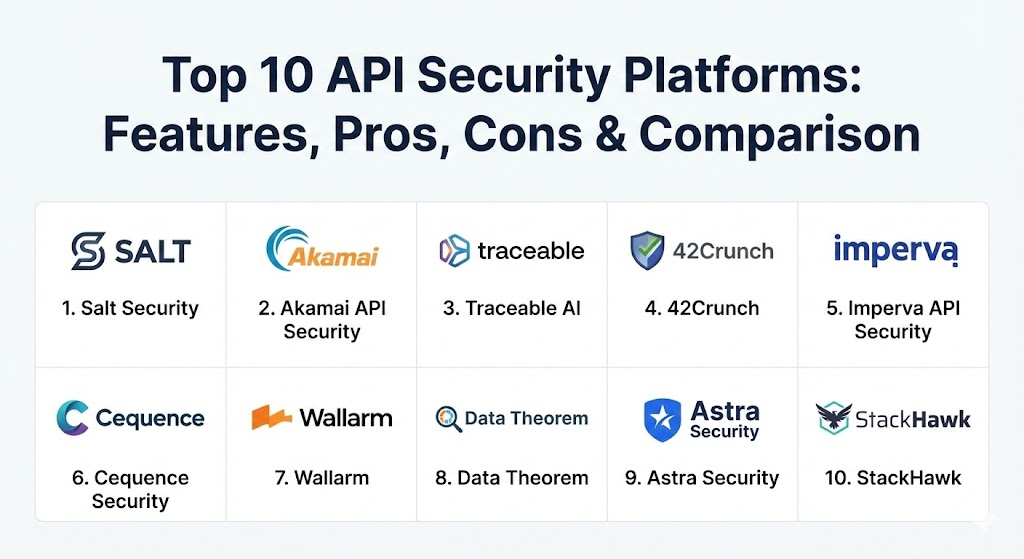
Top 10 API Security Platforms
1 — Salt Security
Salt Security is widely recognized as a pioneer in the API security space. It focuses on using big data and AI to provide deep context into API behavior, making it highly effective at catching logic-based attacks that other tools miss.
- Key features:
- Continuous API discovery of internal, external, shadow, and zombie APIs.
- Salt API Context Engine (ACE) for behavioral baselining.
- Automated threat protection that blocks attackers in real-time.
- Posture management to identify misconfigurations before deployment.
- Detailed forensics and attacker timelines for incident response.
- Integration with major API gateways and WAFs.
- Pros:
- Exceptionally high signal-to-noise ratio; very low false positive rate.
- Out-of-band deployment means no impact on application performance or latency.
- Cons:
- Pricing is geared toward large enterprises and can be steep for smaller firms.
- The user interface is powerful but can be overwhelming for beginners.
- Security & compliance: SOC 2 Type II, GDPR, HIPAA, and ISO 27001 compliant. Supports SSO and end-to-end encryption.
- Support & community: Extensive documentation, dedicated customer success managers for enterprise tiers, and a growing community of security researchers.
2 — Akamai API Security (formerly Noname Security)
Following its acquisition of Noname Security, Akamai has integrated advanced API protection into its global edge network. This tool offers one of the most comprehensive views of the API landscape, from code to production.
- Key features:
- Global edge-native enforcement via Akamai’s massive CDN footprint.
- Multi-source inventory that scans code repos, traffic, and specs.
- Automated API security testing in CI/CD pipelines.
- Behavioral analytics to surface logic abuse and anomalous usage.
- Mature bot mitigation integrated directly into the API defense layer.
- Managed service options for 24/7 monitoring and response.
- Pros:
- Massive scale; ideal for organizations with global traffic.
- Combines WAF, Bot Defense, and API Security into a single vendor relationship.
- Cons:
- Configuration of custom rules across a global network can be time-consuming.
- Primarily benefits organizations already within the Akamai ecosystem.
- Security & compliance: FedRAMP, SOC 2, PCI DSS, and HIPAA compliant. Global data residency options.
- Support & community: 24/7 global support with deep technical expertise; extensive training via Akamai University.
3 — Traceable AI
Traceable AI focuses on “data-aware” security. It is designed to track how sensitive data moves through an application’s microservices, making it a favorite for compliance-heavy organizations.
- Key features:
- End-to-end distributed tracing from edge to database.
- Automated sensitive data discovery and classification.
- API lineage mapping to visualize complex service dependencies.
- Posture management that compares live traffic to OpenAPI specs (drift detection).
- Integrated security testing for developers (DAST for APIs).
- Support for Generative AI and LLM API security.
- Pros:
- Best-in-class visibility for complex, distributed microservices architectures.
- Strong focus on preventing data exfiltration and “Broken Function Level Authorization.”
- Cons:
- Requires more complex instrumentation (agents/sidecars) for full tracing benefits.
- High volume of data tracing can lead to significant storage costs.
- Security & compliance: SOC 2, HIPAA, and GDPR. Strong emphasis on data privacy and masking.
- Support & community: Active blog and webinar series; very responsive technical support team.
4 — 42Crunch
42Crunch takes a unique, “API-first” approach by focusing on the security of the API contract. It is designed to empower developers to write secure code from the very beginning of the lifecycle.
- Key features:
- Automated security audits of OpenAPI (Swagger) definitions.
- Developer-friendly plugins for VS Code and IntelliJ.
- Micro-API Firewall that enforces the API contract at runtime.
- Continuous scanning of API endpoints for vulnerabilities.
- Centralized policy management for consistent governance.
- Detailed scoring of API definitions with remediation guidance.
- Pros:
- The best tool for “shifting left” and catching design flaws early.
- Lightweight firewall can be deployed as a sidecar in Kubernetes.
- Cons:
- Less focus on behavioral “runtime” attacks compared to Salt or Traceable.
- Requires developers to be diligent about maintaining accurate API specs.
- Security & compliance: ISO 27001, SOC 2, and support for major security frameworks.
- Support & community: Excellent developer documentation and a strong presence in the OpenAPI community.
5 — Imperva API Security
Imperva, a leader in the WAF market, provides an API security solution that leverages its global threat intelligence network. It is particularly strong at blocking high-volume automated attacks.
- Key features:
- Automated discovery of all public-facing and internal endpoints.
- Integration with Imperva’s global WAF for edge-level blocking.
- Advanced bot protection to prevent scraping and account takeover.
- Continuous monitoring for OWASP API Top 10 threats.
- Sensitive data tracking to ensure compliance with privacy laws.
- Unified dashboard for web and API security events.
- Pros:
- Excellent DDoS and bot mitigation capabilities.
- Global threat intelligence provides immediate protection against emerging threats.
- Cons:
- Can be complex to manage if using both on-prem and cloud products.
- Some advanced features require manual tuning to avoid false positives.
- Security & compliance: PCI DSS, HIPAA, GDPR, and SOC 2 compliant.
- Support & community: Large global support team and a mature user community through the Imperva Customer Hub.
6 — Cequence Security
Cequence Security focuses on “Unified API Protection” (UAP). It is highly regarded for its ability to discover and protect APIs without requiring any changes to application code or the network.
- Key features:
- Passive discovery that works by analyzing traffic from gateways or load balancers.
- API Spyder for discovering shadow APIs across the public internet.
- ML-based analysis to detect sophisticated “low-and-slow” attacks.
- Real-time mitigation including blocking, rate-limiting, and deception.
- Out-of-the-box support for mobile and web API traffic.
- Integration with nearly all major API gateways (Apigee, MuleSoft, Kong).
- Pros:
- Zero-friction deployment; no agents or sidecars required.
- Deception techniques (honey-tokening) effectively confuse and slow down attackers.
- Cons:
- Lacks some of the “deep-code” insights found in developer-centric tools.
- Reporting can be less granular for specific microservices-to-microservices traffic.
- Security & compliance: SOC 2 Type II, ISO 27001, and HIPAA compliant.
- Support & community: High customer retention rates and a very proactive customer success team.
7 — Wallarm
Wallarm is an AI-powered platform that combines API security and WAF capabilities into a single, unified node. It is built specifically for modern, cloud-native environments like Kubernetes.
- Key features:
- Integrated platform for API discovery, vulnerability testing, and runtime protection.
- Patented AI/ML for automated attack detection without manual tuning.
- Deep request parsing for various data formats (gRPC, GraphQL, WebSocket).
- Active threat verification to confirm if an attack would actually be successful.
- Native Kubernetes integration (Ingress controller or sidecar).
- Support for “East-West” (internal) traffic monitoring.
- Pros:
- Exceptional performance and scalability in Kubernetes environments.
- Automated tuning significantly reduces the burden on security teams.
- Cons:
- The learning curve for the initial setup in complex multi-cloud environments can be high.
- Primarily a cloud-native tool; less ideal for legacy, monolithic on-prem apps.
- Security & compliance: SOC 2, GDPR, and PCI DSS.
- Support & community: Responsive technical support and detailed GitHub documentation for open-source components.
8 — Data Theorem
Data Theorem specializes in “Full Stack” security, extending its reach from the API layer down into the mobile and web applications that consume them.
- Key features:
- Automated inventory of all APIs, including third-party and cloud-native services.
- Continuous scanning of mobile apps to identify insecure API usage.
- “Analyzer Engine” that simulates hacker behavior to find vulnerabilities.
- Support for Serverless, Kubernetes, and traditional cloud environments.
- Integration with Slack and Jira for automated developer alerts.
- Compliance mapping for standards like OWASP and CIS.
- Pros:
- Excellent for organizations with a heavy reliance on mobile applications.
- Provides a truly “hacker’s eye view” of the entire application stack.
- Cons:
- Less focused on real-time blocking/mitigation compared to WAF-based tools.
- The broad scope can make it harder to focus purely on API logic issues.
- Security & compliance: SOC 2, HIPAA, and GDPR compliant.
- Support & community: Strong focus on educational content and helping teams build “Secure-by-Design” apps.
9 — Astra Security
Astra Security is a modern, developer-friendly platform that combines automated vulnerability scanning with high-quality manual pentesting.
- Key features:
- Continuous API discovery that maps undocumented endpoints in minutes.
- Comprehensive scanner covering 8,000+ tests including BOLA and IDOR.
- Developer-first dashboard with video POCs for fixing vulnerabilities.
- Integrated CI/CD scanning to prevent insecure code from shipping.
- Expert-led manual pentesting available as an add-on service.
- Compliance dashboards for SOC 2, ISO 27001, and HIPAA.
- Pros:
- Highly intuitive UI; one of the easiest tools to get started with.
- The combination of automated scanning and manual expertise is unique and powerful.
- Cons:
- Lacks the real-time behavioral “blocking” found in enterprise runtime tools.
- Not designed for managing petabyte-scale API traffic volumes.
- Security & compliance: ISO 27001 and SOC 2 compliant.
- Support & community: Praised for its human-led support and quick remediation guidance.
10 — StackHawk
StackHawk is a “Shift-Left” DAST (Dynamic Application Security Testing) tool that was built from the ground up to test APIs directly in the developer’s local environment or CI/CD pipeline.
- Key features:
- Purpose-built to test REST, GraphQL, gRPC, and SOAP APIs.
- Tight integration with GitHub Actions, GitLab CI, and Jenkins.
- Ability to test “behind the login” using various authentication methods.
- Detailed remediation advice provided directly to the developer.
- “HawkScan” engine that is fast enough to run on every code commit.
- Comparison of results over time to prevent vulnerability regressions.
- Pros:
- The most developer-centric tool on the list; fits perfectly into DevOps workflows.
- Exceptionally fast scanning speeds compared to traditional DAST tools.
- Cons:
- Only catches vulnerabilities in the testing phase; no production runtime protection.
- Requires a running instance of the API to perform its tests.
- Security & compliance: SOC 2 compliant; focuses on ensuring code meets compliance standards.
- Support & community: Growing community of “Hawk” users and excellent video tutorials and webinars.
Comparison Table
| Tool Name | Best For | Platform(s) Supported | Standout Feature | Rating (Gartner Peer Insights) |
| Salt Security | Behavioral Protection | Cloud, On-prem, Hybrid | Big Data Context Engine | 4.7 / 5 |
| Akamai API Sec | Global Enterprises | Akamai Edge, Cloud | Edge-Native Enforcement | 4.6 / 5 |
| Traceable AI | Microservices Visibility | Kubernetes, Cloud | End-to-End Tracing | 4.6 / 5 |
| 42Crunch | Developer Governance | IDE, CI/CD, K8s | API Contract Hardening | 4.5 / 5 |
| Imperva API Sec | Bot & DDoS Defense | Cloud, Edge, On-prem | Global Threat Intel | 4.5 / 5 |
| Cequence Sec | Frictionless Discovery | Gateways, SaaS | API Deception (Honey-tokens) | 4.7 / 5 |
| Wallarm | Kubernetes Security | K8s, Cloud-native | Automated AI Attack Verification | 4.8 / 5 |
| Data Theorem | Full Stack / Mobile | Mobile, Cloud, Serverless | Mobile-to-API Analysis | 4.4 / 5 |
| Astra Security | SMBs / Pentesting | SaaS, Cloud | Automated Scan + Manual Pentest | 4.8 / 5 |
| StackHawk | DevSecOps / CI/CD | GitHub, GitLab, Docker | Developer-First DAST | 4.6 / 5 |
Evaluation & Scoring of API Security Platforms
When scoring these platforms, we weigh features that directly address the “blind spots” of traditional security tools.
| Category | Weight | Evaluation Criteria |
| Core Features | 25% | Discovery of shadow APIs, BOLA/logic abuse detection, and bot mitigation. |
| Ease of Use | 15% | Intuitive dashboards, low false-positive rates, and simple onboarding. |
| Integrations | 15% | Native support for API gateways (Apigee, Kong), CI/CD, and SIEM/SOAR. |
| Security & Compliance | 10% | Support for GDPR, HIPAA, and built-in audit/reporting capabilities. |
| Performance | 10% | Latency impact (especially for inline tools) and scalability of the analysis engine. |
| Support & Community | 10% | Documentation quality, expert support availability, and community resources. |
| Price / Value | 15% | Flexibility of licensing and total cost of ownership (TCO). |
Which API Security Platform Is Right for You?
Selecting the right tool depends on your primary “pain point” and the maturity of your security program.
- Solo Developers & Small Teams: Focus on “Shift-Left” tools that help you write better code. 42Crunch (for design) and StackHawk (for testing) are perfect because they catch issues before they reach the internet.
- Mid-Market Companies: If you have a small security team and need a “set it and forget it” solution for production, Astra Security or Cequence Security offer a great balance of ease and protection.
- Enterprise / Multi-Cloud Giants: You likely need deep behavioral context and global enforcement. Salt Security or Akamai API Security are the best choices for managing millions of daily requests across diverse environments.
- Kubernetes & DevOps Focused: If your infrastructure is built on containers, Wallarm and Traceable AI provide the deep, service-level visibility that traditional “perimeter” tools cannot reach.
- Compliance-First Organizations: If your main goal is protecting sensitive data (PII/PHI), prioritize Traceable AI or Imperva for their advanced data classification and exfiltration prevention features.
Frequently Asked Questions (FAQs)
1. Is an API Gateway enough for security? No. Gateways handle authentication and rate-limiting, but they are generally blind to business logic attacks (like BOLA) where a user uses a valid token to access someone else’s data.
2. What are “Shadow APIs”? Shadow APIs are undocumented or forgotten endpoints that exist in production without the security team’s knowledge. They are high-risk because they often lack proper security controls.
3. How do these tools discover APIs? Most platforms use traffic mirroring or log analysis from your API gateways, load balancers, or cloud providers to automatically map out every endpoint that is receiving traffic.
4. Will a security platform slow down my API? Out-of-band solutions (like Salt or Cequence) have zero impact on latency because they analyze a copy of the traffic. Inline tools (like Wallarm) are designed to be extremely lightweight, often adding less than 1-2ms.
5. Can these tools prevent ransomware? While not a primary anti-ransomware tool, they can prevent the data exfiltration and credential theft that often precede a ransomware attack by identifying suspicious “scraping” or bulk data requests.
6. Do I need to change my code to use these platforms? Most modern platforms are “agentless” and require no code changes. Some (like Traceable) offer deeper insights if you use a lightweight agent or sidecar, but it is rarely mandatory.
7. What is “Broken Object Level Authorization” (BOLA)? BOLA is the #1 threat on the OWASP API Top 10. It occurs when an API allows a user to access or modify data they don’t own by simply changing an ID in the URL or request body.
8. Can these tools protect internal (East-West) APIs? Yes. Modern platforms like Wallarm and Traceable are designed to monitor traffic inside your network (between microservices), not just traffic coming from the internet.
9. How do these platforms use AI? They use AI to build a behavioral model of your APIs. By learning what “normal” looks like, the system can flag anomalies—like a user suddenly requesting 10,000 records when they usually request 5.
10. Are there free versions of these tools? Many vendors offer free tiers (like StackHawk or 42Crunch’s IDE plugins) or open-source components (like OPA or Wallarm’s testing tools) to help teams get started.
Conclusion
The “Wild West” era of unprotected APIs is rapidly coming to an end. As attackers pivot from traditional web vulnerabilities to exploiting API logic, organizations must evolve their defenses. Whether you choose the massive scale of Akamai, the deep behavioral insights of Salt Security, or the developer-first approach of StackHawk, the most critical step is acknowledging that APIs require their own specialized security stack. The “best” platform is the one that integrates seamlessly with your team’s workflow and provides the visibility needed to turn your “Shadow APIs” into a governed, secure asset.
API security is shifting from basic gateway protection to AI-driven behavioral analysis that catches sophisticated logic abuse like BOLA. The contrast between Salt Security’s big data context and 42Crunch’s “shift-left” contract hardening shows how specialized the market has become. This guide is a solid resource for anyone trying to eliminate “Shadow APIs” and secure complex microservices without slowing down deployment.
The comparison of API security platforms is clear and easy to understand. It’s very useful for developers and security teams looking to choose the right API protection solution.