Introduction
A Dependency Vulnerability Scanner is a specialized security tool that inspects an application’s manifest files (like package.json, pom.xml, or requirements.txt) to identify every third-party library in use. It then cross-references these libraries against extensive databases of known security flaws, such as the National Vulnerability Database (NVD) or the GitHub Advisory Database. By identifying Common Vulnerabilities and Exposures (CVEs), these tools allow teams to fix security holes before they reach production.
The importance of these tools cannot be overstated. High-profile incidents like the Log4Shell vulnerability proved that a single flaw in a widely used utility can jeopardize global infrastructure. Key real-world use cases include automating security gates in CI/CD pipelines, performing license compliance audits to avoid legal risks, and maintaining a Software Bill of Materials (SBOM) for regulatory requirements. When evaluating these tools, users should prioritize accuracy (low false positives), the speed of the scanning engine, the depth of the vulnerability database, and the ability to provide automated “fix” suggestions.
Best for: DevOps engineers, security architects, and software development teams in organizations of all sizes. It is particularly critical for enterprises in regulated sectors like finance, healthcare, and government, where supply chain security is a legal mandate.
Not ideal for: Organizations that do not build custom software or those that rely exclusively on closed-source, proprietary third-party binaries where manifest files are not available. In such cases, Binary Analysis or DAST (Dynamic Application Security Testing) may be more appropriate alternatives.
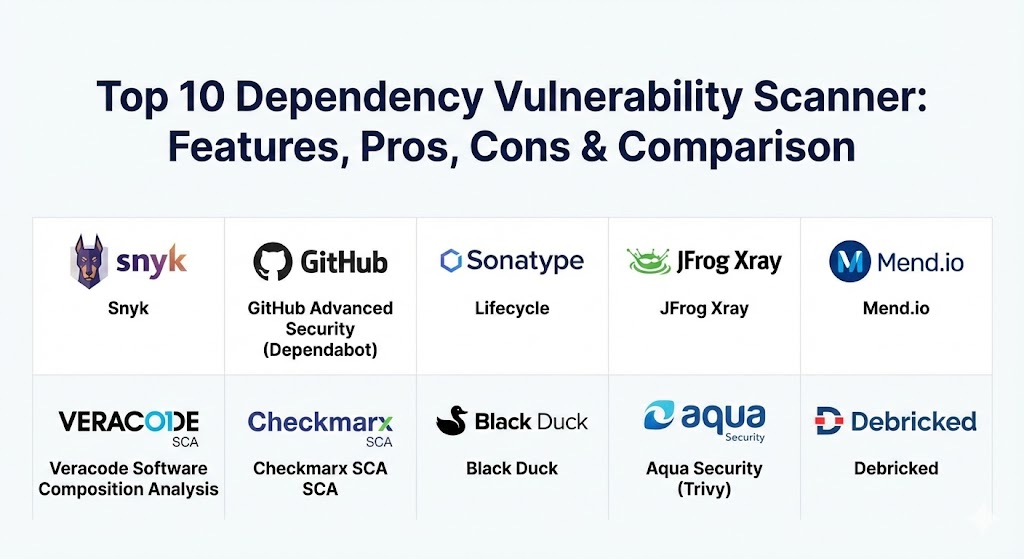
Top 10 Dependency Vulnerability Scanner Tools
1 — Snyk
Snyk is widely considered the pioneer of the “developer-first” security movement. It focuses on integrating seamlessly into the developer’s existing environment—IDEs, Git repositories, and CI/CD pipelines—to catch vulnerabilities at the point of creation rather than the point of deployment.
- Key features:
- Developer-friendly CLI and IDE plugins for real-time feedback.
- Automated “fix” pull requests that upgrade libraries to the nearest secure version.
- Reachability analysis to determine if a vulnerable function is actually being called.
- Comprehensive License Compliance management for open-source libraries.
- Native support for container scanning and Infrastructure as Code (IaC).
- Deep integration with GitHub, GitLab, Bitbucket, and Azure DevOps.
- Extensive proprietary vulnerability database curated by Snyk security researchers.
- Pros:
- Exceptional user experience that encourages developer adoption rather than resistance.
- Extremely fast scan times compared to traditional enterprise security suites.
- Cons:
- The pricing model can escalate quickly for large-scale enterprise deployments.
- Advanced features like “Reachability” are often locked behind the highest pricing tiers.
- Security & compliance: SOC 2 Type II, ISO 27001, GDPR compliant. Supports SSO (SAML/OIDC) and provides detailed audit logs.
- Support & community: Industry-leading documentation; massive community support; 24/7 enterprise support availability with dedicated success managers.
2 — GitHub Advanced Security (Dependabot)
Dependabot is natively integrated into the GitHub ecosystem. For organizations already hosting their code on GitHub, it provides a frictionless way to monitor and update vulnerable dependencies without leaving the platform.
- Key features:
- Native integration directly within the GitHub UI and pull request workflow.
- Automatic security alerts sent to repository administrators when CVEs are found.
- Automated security updates that generate PRs to patch vulnerable dependencies.
- Dependency Graph provides a visual overview of all components in a project.
- Integration with GitHub Actions for automated security gating.
- Supports a wide array of ecosystems including npm, Maven, PyPI, and RubyGems.
- Pros:
- Zero-configuration setup for repositories already hosted on GitHub.
- Free for public repositories, making it the gold standard for open-source projects.
- Cons:
- Reporting and centralized management across multiple organizations can be limited.
- Lacks some of the deep “reachability” and “transitive dependency” logic found in standalone tools.
- Security & compliance: SOC 1/2/3, ISO 27001, GDPR, and HIPAA compliant. Native GitHub SSO and permission sets.
- Support & community: Extensive documentation; community support through GitHub Discussions; enterprise support via GitHub Enterprise agreements.
3 — Sonatype Lifecycle
Sonatype Lifecycle (formerly Nexus Lifecycle) is built on the foundation of the Central Repository (Maven Central). It is designed for enterprises that require strict policy enforcement and high-fidelity data regarding their software components.
- Key features:
- “Nexus Intelligence” database with human-curated vulnerability data.
- Precise policy engine that can automatically block builds based on custom criteria.
- Continuous monitoring of production apps for newly discovered vulnerabilities.
- Advanced Software Bill of Materials (SBOM) generation and management.
- Component “Golden Path” recommendations to guide developers toward safe libraries.
- Integration with Artifactory, Nexus Repository, and major CI/CD tools.
- Pros:
- Extremely low false-positive rate due to manual curation of the vulnerability data.
- Best-in-class for defining and enforcing complex corporate security policies.
- Cons:
- The user interface is more “security-pro” oriented and less intuitive for casual developers.
- Implementation and policy tuning can be time-consuming for large organizations.
- Security & compliance: FIPS 140-2, SOC 2, GDPR, and HIPAA. Supports advanced SSO and role-based access control (RBAC).
- Support & community: High-touch enterprise support; extensive training via Sonatype University; strong presence in the Java community.
4 — JFrog Xray
JFrog Xray is a universal software composition analysis tool that integrates deeply with JFrog Artifactory. It is unique in its ability to scan at the binary level, providing visibility into the “final” state of the software.
- Key features:
- Recursive binary scanning that uncovers vulnerabilities hidden deep within layers.
- Impact analysis that shows exactly which production environments are affected by a CVE.
- Deep integration with JFrog Artifactory for “blocking” vulnerable downloads.
- Support for nearly every package type (Docker, npm, Maven, PyPI, Go, etc.).
- Highly customizable “Watchers” and “Policies” for granular security control.
- Integrated IDE plugins and CLI for shift-left security.
- Pros:
- If you already use Artifactory, Xray is the most logical and integrated choice.
- Binary-level scanning provides a level of truth that manifest-scanning can miss.
- Cons:
- Can be complex to configure for teams not already using the JFrog platform.
- Resource-intensive if scanning massive numbers of Docker images and binaries.
- Security & compliance: SOC 2 Type II, GDPR, HIPAA, and ISO 27001 compliant.
- Support & community: 24/7 global support; comprehensive documentation; active user community and annual user conferences.
5 — Mend.io (formerly WhiteSource)
Mend.io focuses on providing a holistic view of application security, specializing in “reachability” analysis to help teams prioritize the vulnerabilities that actually pose a risk to their specific code implementation.
- Key features:
- Mend Prioritize (Reachability Analysis) to identify “effective” vulnerabilities.
- Automated remediation for both security flaws and outdated licenses.
- Support for over 200 programming languages and package managers.
- Seamless integration with all major repository types and build tools.
- Comprehensive reporting for M&A due diligence and compliance audits.
- Unified platform for SCA and SAST (Static Application Security Testing).
- Pros:
- Dramatically reduces “vulnerability fatigue” by filtering out unreachable flaws.
- Excellent at managing complex license compliance scenarios for legal teams.
- Cons:
- The initial scan setup can be more complex than “plug-and-play” tools like Snyk.
- The web dashboard can occasionally feel cluttered due to the volume of data provided.
- Security & compliance: ISO 27001, SOC 2, HIPAA, GDPR, and FedRAMP (in process/available).
- Support & community: Strong enterprise support; detailed webinars and whitepapers; dedicated customer success managers for large accounts.
6 — Veracode Software Composition Analysis
Veracode is a titan in the Application Security Testing (AST) space. Its SCA solution is part of a broader platform that provides a unified view of security across static, dynamic, and software composition analysis.
- Key features:
- SaaS-based platform that requires no local infrastructure to manage.
- Vulnerable Method Selection to pinpoint exactly where the risk exists in the code.
- Unified reporting across SCA, SAST, and DAST for a single risk score.
- Automated library upgrades via the “fix” feature.
- Integration with Jira and other ticket systems for automated developer tasks.
- Peer benchmarking to see how your security posture compares to industry averages.
- Pros:
- Ideal for centralized security teams managing a massive portfolio of applications.
- Provides a highly professional, “executive-ready” reporting suite.
- Cons:
- Can feel “heavy” or slow to developers who prefer lightweight CLI tools.
- Pricing is geared toward enterprise-scale budgets.
- Security & compliance: FedRAMP authorized, SOC 2, ISO 27001, HIPAA, and GDPR compliant.
- Support & community: Expert “Consultation” calls available to help developers interpret results; 24/7 technical support.
7 — Checkmarx SCA
Checkmarx is known for its “Checkmarx One” platform, which aims to provide a “fusion” of security insights. Its SCA tool is designed to identify risks in the supply chain beyond just CVEs, including malicious packages.
- Key features:
- Supply Chain Security feature to detect “typosquatting” and malicious intent.
- “Exploitable Path” technology to visualize if a vulnerability is accessible.
- Integration with Checkmarx SAST for a correlated view of security risks.
- Support for container scanning and serverless function analysis.
- Flexible deployment options including cloud, on-premise, and hybrid.
- Pros:
- Excellent at identifying emerging threats that haven’t yet been assigned a CVE.
- Correlated results with SAST help developers fix the most critical issues first.
- Cons:
- The platform has a high learning curve for new administrators.
- Resource consumption for on-premise installations can be significant.
- Security & compliance: SOC 2, ISO 27001, GDPR, and HIPAA. Extensive SSO and audit capabilities.
- Support & community: Global professional services; dedicated technical account management; extensive training platform.
8 — Black Duck (by Synopsys)
Black Duck is perhaps the most famous name in the SCA world. It is the industry standard for organizations performing mergers and acquisitions (M&A) due to its massive database of open-source components.
- Key features:
- KnowledgeBase database covering over 4 million open-source projects.
- Binary Analysis (BDBA) to identify components in compiled applications.
- Deep license compliance checking with a library of thousands of licenses.
- Automated policy enforcement throughout the SDLC.
- Snippet matching to find open-source code “copied and pasted” into files.
- Integration with Black Duck Alert for real-time notifications via Slack or email.
- Pros:
- Unrivaled database depth; if an open-source library exists, Black Duck knows it.
- The most trusted tool for legal and compliance audits.
- Cons:
- Can produce a high volume of data that requires careful filtering to avoid noise.
- Traditionally seen as more of a “compliance” tool than a “developer productivity” tool.
- Security & compliance: ISO 27001, SOC 2, GDPR, and HIPAA. Supports complex enterprise SSO architectures.
- Support & community: World-class support and consulting services; extensive online documentation and user groups.
9 — Aqua Security (Trivy)
While Aqua is known as a Cloud Native Security platform, its open-source tool, Trivy, has become the darling of the DevOps world for its simplicity, speed, and effectiveness in scanning containers and dependencies.
- Key features:
- Single binary installation with no external dependencies required.
- Scans container images, filesystems, Git repositories, and Kubernetes.
- Extremely fast vulnerability scanning using a decentralized database.
- Support for IaC misconfiguration scanning (Terraform, Dockerfile, CloudFormation).
- Can be used as a library or integrated into CI/CD pipelines (GitHub Actions, GitLab CI).
- Support for SBOM generation in CycloneDX and SPDX formats.
- Pros:
- One of the fastest and easiest tools to get started with in a cloud-native environment.
- Completely free and open-source, with a huge community following.
- Cons:
- Lacks the centralized “management dashboard” and policy engine in the free version.
- Enterprise features require the full Aqua platform (Aqua Enterprise).
- Security & compliance: Varies (Trivy is open-source); Aqua Enterprise is SOC 2, GDPR, and HIPAA compliant.
- Support & community: Massive GitHub community; excellent Slack support for open-source users; 24/7 support for enterprise.
10 — Debricked
Debricked is a modern, AI-driven SCA tool that focuses on high-quality data and actionable insights. It emphasizes the “health” of open-source communities, helping users pick better libraries before they even start coding.
- Key features:
- Open Source Select: A tool to evaluate the health and maintenance of libraries.
- AI-assisted vulnerability remediation and “smart” patch suggestions.
- Support for license compliance and automated legal workflows.
- Extremely modern and intuitive user interface.
- Integration with major Git providers and CI/CD pipelines.
- High-quality vulnerability database with minimal noise.
- Pros:
- The “Open Source Select” feature helps prevent technical debt before it happens.
- Modern UI makes it easy for teams to stay on top of security without feeling overwhelmed.
- Cons:
- Smaller ecosystem and fewer “deep enterprise” features than giants like Black Duck.
- Support for very niche or legacy programming languages may be limited.
- Security & compliance: SOC 2 Type II, GDPR, and SSO support.
- Support & community: Excellent documentation; responsive email/chat support; growing presence in the European tech scene.
Comparison Table
| Tool Name | Best For | Platform(s) Supported | Standout Feature | Rating (Gartner) |
| Snyk | Developer Adoption | SaaS, CLI, IDE | Auto-Fix Pull Requests | 4.7 / 5 |
| GitHub Advanced | Native GitHub Users | GitHub Enterprise | Zero-Config Integration | 4.6 / 5 |
| Sonatype Lifecycle | Policy Enforcement | On-Prem, Cloud | Human-Curated Data | 4.5 / 5 |
| JFrog Xray | Binary/Container Mgmt | On-Prem, Cloud | Recursive Binary Scanning | 4.4 / 5 |
| Mend.io | Priority/Reachability | SaaS, On-Prem | Reachability Analysis | 4.4 / 5 |
| Veracode SCA | Portfolio Risk Mgmt | SaaS | Unified AST Reporting | 4.5 / 5 |
| Checkmarx SCA | Supply Chain Threats | SaaS, On-Prem | Malicious Package Detection | 4.3 / 5 |
| Black Duck | M&A / Compliance | On-Prem, Cloud | Massive KnowledgeBase | 4.4 / 5 |
| Trivy (Aqua) | DevOps / Cloud-Native | CLI, Containers | Speed & Simple Setup | 4.8 / 5 |
| Debricked | AI-Driven Guidance | SaaS | Open Source Health Scores | 4.6 / 5 |
Evaluation & Scoring of Dependency Vulnerability Scanner
To determine which tool offers the best return on investment, we have applied a weighted scoring rubric based on industry trends in 2026.
| Category | Weight | Evaluation Criteria |
| Core Features | 25% | Scanning accuracy, language support, reachability analysis, and SBOM generation. |
| Ease of Use | 15% | Developer experience (DX), CLI quality, IDE integrations, and UI intuitiveness. |
| Integrations | 15% | Ecosystem support (CI/CD, Git, Ticket systems, Registry integrations). |
| Security & Compliance | 10% | Internal security posture, SSO support, and automated license compliance. |
| Performance | 10% | Scan speed, incremental scanning capabilities, and impact on build times. |
| Support & Community | 10% | Quality of documentation, community responsiveness, and enterprise SLAs. |
| Price / Value | 15% | Transparency of pricing and the breadth of features in the “standard” tier. |
Which Dependency Vulnerability Scanner Tool Is Right for You?
Selecting the right tool depends on where your “center of gravity” lies—is it in the developer’s hands, the security office, or the legal department?
- Solo Users & Open Source Projects: If you are working alone or on a public project, GitHub Dependabot or Trivy are the clear winners. They are free, fast, and provide all the security you need without the administrative overhead.
- SMBs & Startups: If you want a tool that “just works” and grows with you, Snyk or Debricked are excellent. They prioritize developer speed and provide modern UIs that don’t require a dedicated security team to manage.
- Mid-Market & Rapid Scale: For companies growing fast and using multiple tools, Mend.io is worth its weight in gold for its reachability analysis, which will prevent your developers from wasting time on vulnerabilities that aren’t actually exploitable.
- Enterprise & Regulated Industries: If you have 500+ developers and a strict compliance mandate, Sonatype Lifecycle or Black Duck are the industry standards. They provide the “hardened” policy controls and massive databases required for high-stakes audits.
- JFrog/Nexus Shops: If your organization is already standardized on Artifactory or Nexus Repository, sticking to JFrog Xray or Sonatype Lifecycle will provide a “single source of truth” for your binaries and dependencies that third-party tools can’t easily match.
Frequently Asked Questions (FAQs)
1. What is the difference between SCA and SAST? SAST (Static Application Security Testing) scans the code you write (e.g., your business logic). SCA (Software Composition Analysis) scans the libraries and dependencies others wrote that you have imported into your project.
2. Are free dependency scanners accurate enough? Yes, tools like Trivy and Dependabot are highly accurate because they pull from the same public databases (NVD, GitHub Advisories) as paid tools. Paid tools add value through proprietary research, “reachability” logic, and better reporting.
3. Will these tools slow down my CI/CD pipeline? If configured incorrectly, yes. However, modern tools like Snyk and Trivy offer “incremental” scanning or “differential” scanning, which only looks at what has changed, keeping build times fast.
4. What is a “transitive dependency”? A transitive dependency is a library that your direct library depends on. If you import Library A, and Library A imports Library B, then Library B is a transitive dependency. Good scanners must check the entire tree.
5. How do I handle a vulnerability that has no “fixed” version yet? This is a common issue. In these cases, your scanner should help you find alternative libraries or suggest “mitigation” steps, such as disabling a specific feature in the library that is vulnerable.
6. Can these scanners detect malicious packages (Supply Chain Attacks)? Standard SCA tools look for accidental bugs (CVEs). However, premium tools like Checkmarx and Snyk are now adding specific features to detect intentional malice, such as typosquatting or data exfiltration code.
7. Why is license compliance included in these tools? Many open-source licenses (like GPL) have “copyleft” requirements that could legally force you to open-source your proprietary code. Scanners identify these licenses so your legal team can approve them.
8. What is an SBOM? A Software Bill of Materials (SBOM) is a comprehensive list of every component in your software. It is increasingly becoming a requirement for selling software to government agencies or large enterprises.
9. Do I need to scan my containers separately? Ideally, yes. Vulnerabilities can exist in the application dependencies and in the OS packages (like glibc) within your Docker image. Tools like Aqua (Trivy) and Snyk excel at both.
10. How often should I scan my dependencies? Scanning should happen at every pull request and every build. Additionally, you should scan your deployed code daily, as new vulnerabilities are discovered in old libraries every single day.
Conclusion
The “best” dependency vulnerability scanner isn’t necessarily the one with the most features; it is the one that your developers will actually use. Security tools that act as “friction” are often bypassed or ignored. Whether you choose the developer-friendly approach of Snyk, the native integration of GitHub, or the enterprise rigor of Sonatype, the goal remains the same: knowing what is in your software and ensuring it is safe. In 2026, with the rise of AI-driven attacks and complex supply chain threats, having an automated, reliable SCA tool is no longer optional—it is the foundation of digital trust.
Dependency scanning now uses automated, real-time detection to catch vulnerable libraries before they reach production. The contrast between Snyk’s developer-first approach and GitHub’s native simplicity highlights the “shift left” security trend. This guide is a solid resource for securing your software supply chain without slowing down the CI/CD pipeline.
The tool comparisons are explained in a very easy and organized way. It’s a great resource for developers who want to improve software dependency security and reduce vulnerabilities.