Introduction
A Payment Fraud Scoring API is a real-time software interface that analyzes hundreds of data points from a transaction—ranging from IP address and device fingerprints to behavioral biometrics—and returns a numerical probability score of fraud. Unlike legacy systems that offer binary “yes/no” decisions based on rigid rules, these APIs leverage machine learning to provide nuanced risk assessments. This allows businesses to automate their decision-making process: approving low-risk orders instantly, flagging medium-risk cases for manual review, and blocking high-risk attempts before they impact the bottom line.
The importance of these tools lies in the delicate balance between security and customer experience. A high “False Positive” rate (blocking legitimate customers) can be more expensive than the fraud itself due to lost lifetime customer value. Key real-world use cases include preventing Account Takeover (ATO), stopping “Card Testing” bots, and identifying “Synthetic Identities.” When evaluating these APIs, users should look for low-latency response times (ideally under 200ms), deep data enrichment capabilities, and the ability to explain the “why” behind a specific risk score.
Best for: High-volume e-commerce retailers, global marketplaces, fintech startups, and payment service providers (PSPs) who need to scale their fraud prevention without hiring an army of manual reviewers.
Not ideal for: Brick-and-mortar businesses with minimal online presence or very small “mom-and-pop” shops where transaction volume is low enough that manual verification of every order is feasible.
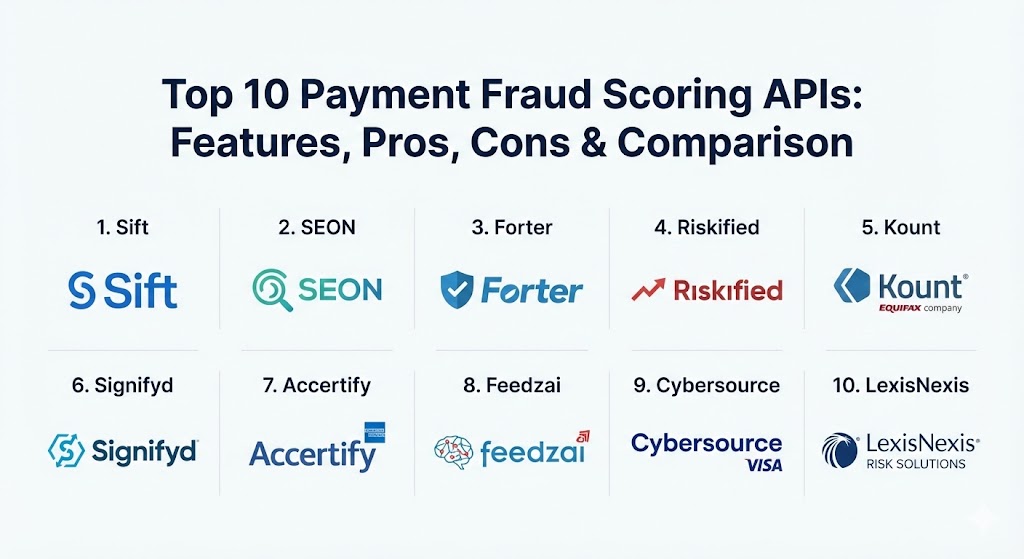
Top 10 Payment Fraud Scoring APIs
1 — Sift
Sift (formerly Sift Science) is a pioneer in the “Digital Trust & Safety” space. It uses a massive global data network to protect some of the world’s largest brands by predicting fraud across the entire user journey.
- Key features:
- Consensus-Based Learning: Leverages data from thousands of other sites to identify a fraudster even if they’ve never visited yours.
- Device Fingerprinting: Identifies the specific hardware profile of a user to bypass spoofed IPs.
- Content Integrity: Specifically flags spam and scam content in addition to payment fraud.
- Account Takeover Protection: Monitors login behavior for anomalies.
- Dynamic Friction: Triggers MFA only for suspicious users.
- Workflow Automation: Intuitive “If/Then” logic to route scores to specific actions.
- Pros:
- Exceptional user interface that makes complex risk signals easy for analysts to digest.
- High accuracy in identifying “Synthetic Identities” early in the onboarding process.
- Cons:
- Pricing can be high for mid-market companies due to minimum volume requirements.
- The AI models can sometimes feel like a “black box” without enough granular explanation.
- Security & compliance: SOC 2 Type II, GDPR, HIPAA, and PCI DSS Level 1 compliant.
- Support & community: Strong documentation and a dedicated “Sift Academy” for user training.
2 — SEON
SEON stands out for its “Data Enrichment” approach. Instead of relying solely on internal data, it uses an email address or phone number to perform real-time social media and digital footprint lookups to verify a person’s existence.
- Key features:
- Social Media Lookup: Checks 50+ platforms (LinkedIn, Facebook, etc.) to verify an identity.
- Email & Phone Intelligence: Analyzes domain age, data breaches, and messenger app activity.
- IP & Proxy Detection: Sophisticated detection of residential proxies and Tor nodes.
- Modular API: Allows you to pick and choose specific modules (Intelligence vs. Scoring).
- Explainable AI: Provides a clear breakdown of every rule that contributed to a score.
- Machine Learning Suggestions: Proposes new rules based on your historical data.
- Pros:
- Transparent, pay-as-you-go pricing model is very accessible for startups.
- Very easy to integrate; developers can have it running in a sandbox environment in minutes.
- Cons:
- Heavy reliance on social media signals can be less effective in regions with lower social media penetration.
- Higher false positive rates if rules are not carefully tuned for your specific industry.
- Security & compliance: GDPR, SOC 2, and PCI DSS compliant.
- Support & community: Excellent technical documentation and a highly active “Fraud Fighters” blog.
3 — Forter
Forter is a fully automated, “Decision-as-a-Service” platform. It is designed for merchants who want to outsource the decision-making entirely, often backed by a chargeback guarantee.
- Key features:
- Identity Graph: Links millions of unique identities across the Forter merchant network.
- Chargeback Guarantee: Forter covers the cost of any fraudulent transaction they approved.
- Abuse Prevention: Detects coupon, promo, and returns abuse.
- Smart Payments: Optimizes authorization rates by communicating directly with issuing banks.
- Trust Platform: Validates users at login, checkout, and returns.
- Pros:
- Removes the need for a manual review team entirely, reducing operational costs.
- Incredible speed; decisions are typically returned in less than 60ms.
- Cons:
- High level of vendor lock-in; you must trust their automated decisions implicitly.
- Less granular control for businesses that want to “tweak” their own risk logic.
- Security & compliance: SOC 2, PCI DSS Level 1, HIPAA, and ISO 27001.
- Support & community: Enterprise-tier support with dedicated account managers and performance reviews.
4 — Riskified
Riskified is a leading competitor to Forter, specializing in high-volume retail. It pioneered the chargeback guarantee model and focuses heavily on maximizing approval rates for legitimate customers.
- Key features:
- Decentralized Machine Learning: Custom models for different industries (Fashion, Electronics, Travel).
- Frictionless Checkout: Minimizes the need for 3D Secure or extra verification steps.
- Dynamic Thresholds: Automatically adjusts risk tolerance based on peak seasons (e.g., Black Friday).
- Policy Protections: Identifies “Friendly Fraud” and reseller abuse.
- Enterprise Portal: Deep insights into why specific transactions were declined.
- Pros:
- Proven to increase approval rates for global merchants by as much as 10–20%.
- Strong “guarantee” model aligns their success directly with your revenue.
- Cons:
- Best suited for very high-volume merchants; not ideal for low-volume B2B.
- The “guarantee” fee can be more expensive than a per-call API fee for high-margin products.
- Security & compliance: ISO 27001, SOC 2, GDPR, and PCI DSS.
- Support & community: Extensive case studies and a massive knowledge base for e-commerce growth.
5 — Kount (An Equifax Company)
Kount combines high-tech digital signals with traditional credit data from Equifax, making it one of the most data-rich platforms in the world for identity verification.
- Key features:
- Identity Trust Global Network: Analyzes billions of signals from 32 billion interactions annually.
- Equifax Integration: Access to offline identity data (credit history, address verification).
- Custom Rule Engine: Powerful “What If” testing to simulate rule changes.
- Case Management: Built-in tools for manual reviewers to dive deep into suspicious orders.
- Omnichannel Support: Covers mobile app, web, and physical POS data.
- Pros:
- Unrivaled ability to verify “Account Opening” and “Loan Application” fraud.
- The “What If” testing feature is essential for large teams managing complex rule sets.
- Cons:
- The legacy interface can feel a bit more complex than modern SaaS alternatives like SEON.
- Integration can be a longer process due to the depth of the Equifax data layers.
- Security & compliance: PCI DSS, GDPR, ISO 27001, and SOC 2.
- Support & community: Extensive training via “Kount University” and formal enterprise support tiers.
6 — Signifyd
Signifyd is another major player in the “Guaranteed Fraud Protection” market. It focuses on the “Commerce Protection” suite, which looks at the entire customer lifecycle from payment to fulfillment.
- Key features:
- Automated Decisioning: High-accuracy approvals and declines in real-time.
- Abuse Manager: Protects against item-not-received (INR) fraud and promo abuse.
- Return Manager: Automates the returns process while checking for fraud.
- Decision Center: A transparent dashboard showing the signals behind every automated choice.
- Pros:
- Excellent for merchants who struggle with “Friendly Fraud” (legitimate customers claiming they never got the item).
- Integration with major platforms like Shopify and BigCommerce is exceptionally smooth.
- Cons:
- Like Riskified, the percentage-based fee on every order can eat into tight margins.
- Some users report that the “guarantee” claims process can be document-heavy.
- Security & compliance: PCI DSS Level 1, SOC 2, and GDPR compliant.
- Support & community: Highly rated customer success team with 24/7 availability.
7 — Accertify (An American Express Company)
Accertify provides an enterprise-grade risk management platform that is widely used in the airline, travel, and hospitality sectors.
- Key features:
- Strategic Analytics: A dedicated team of analysts helps you tune your specific risk models.
- Community Risk Network: Shares specific fraud data across a network of global enterprises.
- Chargeback Management: Highly automated dispute handling tools.
- Device Intelligence: Advanced identification of emulators and rooted devices.
- Pros:
- Industry-specific expertise in travel and ticketing fraud is unmatched.
- Very stable, enterprise-scale infrastructure backed by American Express.
- Cons:
- Can be quite expensive; definitely targeted at the enterprise market.
- The platform is highly sophisticated, requiring a dedicated fraud team to manage.
- Security & compliance: ISO 27001, SOC 2, GDPR, and PCI DSS.
- Support & community: High-level professional services and dedicated analyst support.
8 — Feedzai
Feedzai is a “RiskOps” platform that focuses on the convergence of fraud and anti-money laundering (AML). It is the preferred choice for banks and large-scale payment processors.
- Key features:
- Pulse AI: A human-centric AI that explains exactly why a score was generated.
- Genome: A visual tool to map out connections between accounts to find fraud rings.
- Omnichannel View: Monitors fraud across ATM, mobile, branch, and online channels.
- Unsupervised Learning: Detects “Unknown Unknowns”—new fraud patterns that haven’t been seen before.
- Pros:
- The most advanced tool for identifying complex money laundering schemes.
- High flexibility for multi-jurisdictional compliance needs.
- Cons:
- Overkill for a standard e-commerce shop; built for the financial services industry.
- Implementation typically requires a significant professional services engagement.
- Security & compliance: ISO 27001, SOC 2, GDPR, and HIPAA.
- Support & community: Strong academic focus on AI ethics and high-end enterprise support.
9 — Cybersource (A Visa Solution)
Cybersource is a global payment gateway that includes “Decision Manager,” one of the world’s largest fraud detection engines, powered by Visa’s internal intelligence.
- Key features:
- Visa Intelligence: Analyzes billions of Visa transactions to spot global patterns.
- Rule-Based Engine: Over 260 distinct variables to build custom logic.
- Global Coverage: Unparalleled data on international card-not-present transactions.
- Unified Platform: Combines payment processing and fraud detection in one API.
- Pros:
- Great for merchants who want to consolidate their gateway and fraud tools into one vendor.
- Access to Visa’s proprietary card-issuer data leads to higher authorization rates.
- Cons:
- User interface feels “corporate” and slightly less agile than newer competitors.
- Customizing complex rules can be more labor-intensive than the “drag-and-drop” styles of Sift or GoAnywhere.
- Security & compliance: PCI DSS Level 1, GDPR, and SOC 2.
- Support & community: Massive global support network and extensive developer portal.
10 — LexisNexis Risk Solutions (ThreatMetrix)
ThreatMetrix is a leader in identity-based fraud scoring, utilizing the “Digital Identity Network” to verify the person behind the screen.
- Key features:
- Digital Identity Network: Analyzes 1.4 billion unique online identities.
- TrueID: Combines digital signals with physical document verification (ID scan).
- Behavioral Biometrics: Analyzes how a user types, swipes, and holds their phone.
- Bot Detection: Sophisticated identification of automated scraping and credential stuffing.
- Pros:
- Exceptional at identifying Account Takeovers (ATO) before the hacker can change account details.
- Strong global reach, particularly in EMEA and APAC regions.
- Cons:
- Integration is complex and usually requires a long-term contract.
- Data privacy concerns can arise in some jurisdictions due to the depth of the identity tracking.
- Security & compliance: SOC 2, ISO 27001, PCI DSS, and GDPR.
- Support & community: Professional services and extensive webinars for enterprise risk teams.
Comparison Table
| Tool Name | Best For | Platform(s) Supported | Standout Feature | Rating (Gartner Peer Insights) |
| Sift | Marketplaces / Apps | Web, Mobile, API | Consensus-Based Learning | 4.6 / 5 |
| SEON | Startups / SMBs | SaaS, Chrome, API | Social Media Lookup | 4.8 / 5 |
| Forter | Hands-off Automation | SaaS, API | Chargeback Guarantee | 4.7 / 5 |
| Riskified | High-Volume Retail | SaaS, API | Frictionless Checkout AI | 4.5 / 5 |
| Kount | Identity Verification | On-prem, Cloud, API | Equifax Data Integration | 4.5 / 5 |
| Signifyd | Shopify / E-commerce | SaaS, Shopify, API | Item-Not-Received Protection | 4.6 / 5 |
| Accertify | Travel / Airlines | Enterprise, API | Strategic Analyst Support | 4.3 / 5 |
| Feedzai | Banks / Fintech | Enterprise, API | Genome Link Analysis | 4.7 / 5 |
| Cybersource | All-in-one Gateway | Cloud, API | Visa Global Intelligence | 4.4 / 5 |
| ThreatMetrix | Account Takeover | SaaS, API | Behavioral Biometrics | 4.6 / 5 |
Evaluation & Scoring of Payment Fraud Scoring APIs
When selecting a tool, it is crucial to weigh the various categories based on your business stage. A startup might prioritize “Ease of Use,” while a bank must prioritize “Security & Compliance.”
| Category | Weight | Evaluation Criteria |
| Core Features | 25% | ML-based scoring, rule engine flexibility, and behavioral analysis. |
| Ease of Use | 15% | API documentation quality, dashboard intuitiveness, and sandbox availability. |
| Integrations | 15% | Pre-built connectors for Shopify, Magento, ERPs, and cloud storage. |
| Security | 10% | Data encryption, SSO, and compliance (PCI, GDPR, SOC 2). |
| Performance | 10% | Latency (ms), uptime, and ability to handle high-concurrency peaks. |
| Support | 10% | Availability of manual analysts and community resources. |
| Price / Value | 15% | Transparency of fees and measurable ROI in fraud reduction. |
Which Payment Fraud Scoring API Tool Is Right for You?
The right tool depends on your technical maturity and your specific “fraud pain point.”
- Solo Users & Startups: If you are just starting out, SEON or Stripe Radar (if you use Stripe) are the best choices. They offer low barriers to entry and pay-as-you-go pricing without long-term commitments.
- SMBs on E-commerce Platforms: For Shopify or BigCommerce users, Signifyd or Riskified provide an “autopilot” experience. The chargeback guarantee allows you to focus on marketing rather than worrying about fraud alerts.
- Mid-Market Companies: If you have an in-house fraud analyst but need better data, Sift provides the best dashboard and analytics tools to empower your team.
- Enterprise & Financial Institutions: For those needing a “fortress” approach, Feedzai and LexisNexis ThreatMetrix offer the depth of data and the AML compliance features required by regulators.
- Budget-Conscious: Always look for APIs with a free tier or a low per-request fee like Amazon Fraud Detector or SEON. Avoid “Chargeback Guarantee” models if your product has thin margins, as the percentage-based fees (often 0.5%–1.5%) can be higher than the actual fraud losses.
Frequently Asked Questions (FAQs)
1. What exactly is a “False Positive” in fraud scoring? A false positive occurs when a legitimate customer is incorrectly flagged as a fraudster. This often results in a “declined” transaction, causing the merchant to lose revenue and damaging customer loyalty.
2. Does a fraud scoring API slow down my checkout page? Generally, no. Most top-tier APIs (like Forter or Sift) return results in under 200 milliseconds. If integrated correctly, the scoring happens in the background while the payment gateway processes the card.
3. What is “Device Fingerprinting”? It is a technique that collects information about a user’s device (browser version, OS, screen resolution, battery level, etc.) to create a unique ID. This helps identify fraudsters even if they clear their cookies or use a VPN.
4. How does a chargeback guarantee work? In this model, the fraud tool makes the final “Approve” or “Decline” decision. If they approve a transaction that later turns out to be fraudulent, the tool provider pays the merchant back for the full amount of the loss.
5. Why should I use an API instead of just basic rules? Static rules (e.g., “Block all orders from country X”) are easily bypassed by smart fraudsters. APIs use machine learning to detect subtle patterns—like the speed of typing or the sequence of pages visited—that a human or a static rule would miss.
6. Can these tools detect “Friendly Fraud”? Yes. Modern tools like Riskified and Signifyd analyze a customer’s history across multiple merchants to see if they have a pattern of claiming “item not received” despite evidence to the contrary.
7. Are these tools compliant with GDPR? Yes, most reputable vendors are GDPR compliant. However, since these tools process personal data (email, phone, IP), you must update your privacy policy to inform users that a third-party service is used for fraud prevention.
8. Can I integrate a fraud API with my existing payment gateway? Yes. Most fraud APIs are gateway-agnostic, meaning they work with Stripe, Braintree, Adyen, or any custom-built gateway. Some gateways, like Cybersource, have fraud tools built-in.
9. What is “Synthetic Identity Fraud”? This is where a fraudster creates a “Frankenstein” identity using some real information (like a stolen SSN) combined with fake information (name, address). APIs like Kount are specifically designed to catch these by cross-referencing credit data.
10. Do I need to send all my transaction data to the API? For the highest accuracy, yes. The more data you provide (shipping address, item SKUs, session duration), the more context the AI has to make an accurate prediction.
Conclusion
The “arms race” between merchants and fraudsters is constant, but Payment Fraud Scoring APIs have finally given businesses the upper hand. The key to success is not just finding the tool with the most features, but finding the one that integrates seamlessly into your existing stack and aligns with your risk appetite. Whether you choose the automated safety net of a chargeback guarantee or the granular control of a data-enrichment API, the goal remains the same: ensuring that your customers have a frictionless path to purchase while keeping the “bad actors” at bay.
The distinction between legacy binary decision-making and modern, nuanced fraud scoring is a critical point that this guide explains clearly. It’s fascinating to see how SEON leverages social media lookups to verify identity, providing a layer of digital footprinting that purely transactional data often misses. I also found the mention of Forter’s “Decision-as-a-Service” model to be a standout perspective, as the shift toward full automation with a chargeback guarantee can be a massive operational game-changer for high-volume retailers. The focus on reducing false positives is particularly insightful; it’s a great reminder that the cost of an incorrectly declined legitimate customer can often outweigh the cost of the fraud itself. Seeing specialized tools like Accertify for travel alongside data-heavy giants like Kount shows how much the fraud prevention landscape has matured to meet industry-specific needs. This comparison is a solid asset for any business looking to secure their payment pipeline without introducing unnecessary friction into the customer journey.