Introduction
Buy Now, Pay Later (BNPL) Platforms are short-term financing solutions that allow consumers to split a purchase into several smaller, often interest-free installments. For merchants, these tools function as high-powered conversion engines. By removing the immediate “sticker shock” of a large purchase, BNPL platforms significantly boost average order value (AOV) and reduce cart abandonment.
The importance of these platforms lies in their ability to democratize credit. Unlike traditional credit cards that often require a high credit score and carry revolving interest, BNPL tools typically use “soft” credit checks and offer transparent, fixed repayment schedules. Real-world use cases have expanded far beyond “fast fashion.” In 2026, we see BNPL being used for high-ticket items like home renovations, elective medical procedures through specialized platforms, and even B2B inventory management. When choosing a platform, businesses must evaluate it based on integration effort, merchant transaction fees, approval rates, and the global footprint of the provider.
Best for: E-commerce retailers looking to boost sales, high-ticket service providers (dental, automotive, travel), and brands targeting younger demographics who are averse to traditional debt.
Not ideal for: Ultra-low margin businesses where a 3-6% merchant fee might eliminate profitability, or B2B industries that already operate on net-30/60 billing cycles without the need for third-party financing.
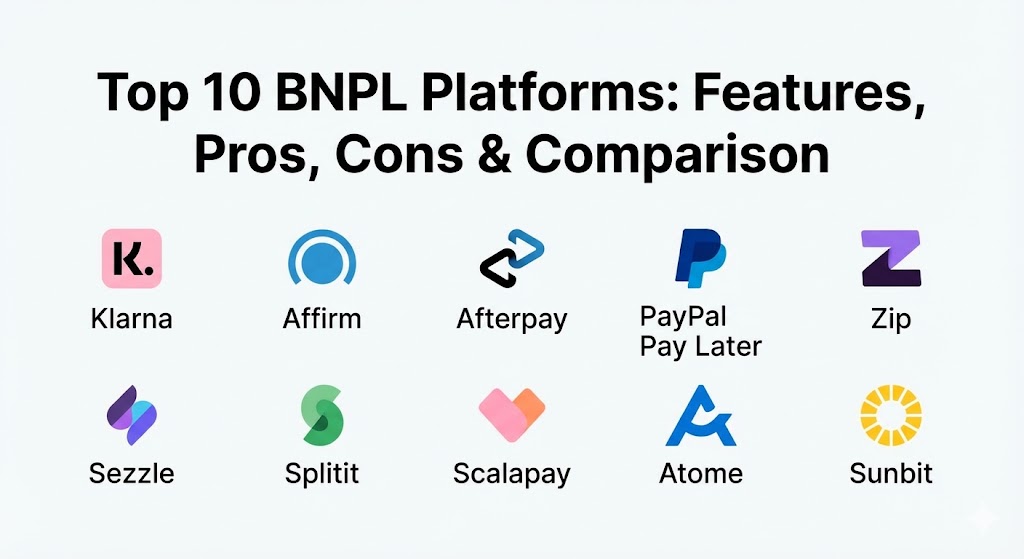
Top 10 BNPL Platforms
1 — Klarna
Klarna has solidified its position as the global leader in the BNPL space. In 2026, it is less of a payment provider and more of a “shopping super-app” that integrates AI-powered personal shopping assistants with flexible payment options.
- Key features:
- Pay in 4: Interest-free installments paid every two weeks.
- Pay in 30: Allows customers to try products and pay only for what they keep after 30 days.
- Long-term Financing: Traditional lending options for large purchases (up to 36 months).
- AI Shopping Assistant: Personalized recommendations based on previous spending.
- Virtual Cards: Allows Klarna to be used at any merchant, even those without native integration.
- Klarna Rewards: A loyalty program that rewards timely repayments.
- Pros:
- Massive global user base (over 150 million) provides immediate “discovery” traffic to merchants.
- One of the highest conversion rate uplifts in the fashion and beauty sectors.
- Cons:
- Merchant fees can be on the higher end of the spectrum (3% to 7%).
- Brand “overtake”—the Klarna brand is so prominent it can sometimes overshadow smaller retailers.
- Security & compliance: SOC 2 Type II, PCI DSS Level 1, GDPR, and ISO 27001 compliant.
- Support & community: Extensive merchant portal with deep analytics; 24/7 global support and a massive “Klarna for Business” community.
2 — Affirm
Affirm is the preferred choice for high-value purchases. Known for its “no late fees ever” policy, it has built a reputation for transparency and consumer-friendly lending, making it a favorite for brands like Peloton and Amazon.
- Key features:
- Transparent Pricing: No late fees, no hidden costs, and no compounding interest.
- Adaptive Checkout: Dynamically offers Pay in 4 or monthly installments based on order value.
- Affirm Card: A physical and virtual card for in-store and online shopping.
- High-Limit Financing: Supports purchases up to $30,000 for qualifying users.
- Direct Amazon Integration: Deeply embedded into the world’s largest marketplace.
- Savings Account: Integrated high-yield savings to encourage financial health.
- Pros:
- Best-in-class for high-ticket items like furniture, electronics, and fitness equipment.
- Extremely high trust rating among consumers due to the “No Late Fees” promise.
- Cons:
- Approval rates for subprime users can be lower than some competitors.
- For interest-bearing loans, APR can reach 30% depending on the user’s credit.
- Security & compliance: PCI DSS, SOC 2, and compliant with the Truth in Lending Act (TILA).
- Support & community: High-quality developer documentation; dedicated account managers for enterprise-tier merchants.
3 — Afterpay (by Block)
Owned by Block (formerly Square), Afterpay focuses on the “Pay in 4” model with a heavy emphasis on community and fashion. It is the go-to platform for Gen Z shoppers who value simplicity and budgeting.
- Key features:
- Pulse Rewards: A loyalty program that unlocks benefits like “no payment upfront.”
- Afterpay Ads: A merchant marketing tool to place products in front of 20M+ active users.
- Square Integration: Native, one-click setup for any business using Square POS.
- Bi-Weekly Split: Simple four-payment structure with no interest.
- In-Store Barcode: Allows users to pay via the app at physical retail counters.
- Spend Control: Proactively limits spending based on repayment history to prevent debt.
- Pros:
- Exceptional mobile app engagement; drives a significant amount of referral traffic.
- Simplest “Pay in 4” experience with very low friction at checkout.
- Cons:
- Late fees apply if a payment is missed (capped, but present).
- Not designed for very large purchases (usually capped around $2,000).
- Security & compliance: PCI DSS Level 1 certified; compliant with Australian and US financial regulations.
- Support & community: Robust community of “Afterpay-ers”; excellent self-service documentation for small businesses.
4 — PayPal Pay Later
Leveraging its massive existing merchant and consumer network, PayPal’s BNPL offering provides a “no-new-account-needed” experience. It is often the easiest tool to implement for businesses already using PayPal.
- Key features:
- Pay in 4: Interest-free bi-weekly payments for smaller purchases.
- Pay Monthly: Larger installments over 6, 12, or 24 months.
- Buyer Protection: The same famous protection that applies to standard PayPal transactions.
- Zero Integration: If you have PayPal Checkout, Pay Later is usually already available.
- Global Reach: Available in most major markets including the US, UK, France, and Germany.
- Auto-Repay: Seamlessly pulls from the user’s linked bank or card.
- Pros:
- Extremely high consumer trust; users don’t have to share data with a “new” company.
- Near-zero technical effort for existing PayPal merchants.
- Cons:
- Lacks the lifestyle/shopping discovery features found in Klarna or Afterpay.
- The merchant dashboard is integrated into the general PayPal portal, which can be cluttered.
- Security & compliance: World-class security; PCI, SOC 2, and global banking licenses.
- Support & community: Massive global support infrastructure; however, getting a human representative can sometimes be slow.
5 — Zip (formerly Quadpay)
Zip distinguishes itself by its flexibility. It allows users to “Zip” any purchase, anywhere, by creating a virtual card. This makes it a versatile tool for both online and offline environments.
- Key features:
- Virtual Card Generation: Allows users to pay in installments at any store that accepts Visa.
- Zip App: A central hub for managing all installments across different retailers.
- In-Store QR Codes: For fast, touchless retail payments.
- Chrome Extension: Brings BNPL to the desktop browser for any website.
- Business Credit: Specialized BNPL options for small business inventory needs.
- Flexible Dates: Allows users to shift payment dates (for a small fee).
- Pros:
- High flexibility for the consumer—not restricted to “partner” stores.
- Strong performance in the electronics and gaming sectors.
- Cons:
- Charges a “convenience fee” (usually $1) per installment for consumers.
- User interface is functional but less “premium” than Klarna.
- Security & compliance: PCI DSS Level 1, SOC 2, and local regulatory compliance in AU/US/NZ.
- Support & community: Good documentation; community is smaller than the big three but loyal.
6 — Sezzle
Sezzle markets itself as the “purpose-driven” BNPL. It is a B Corp that focuses on financial literacy and helping users build their credit scores through a specialized program called Sezzle Up.
- Key features:
- Sezzle Up: Reports on-time payments to credit bureaus to help users build credit.
- Interest-Free Pay-in-4: The standard installment model.
- Reschedule Payments: Allows one free payment reschedule per order.
- Virtual Card: Compatible with Apple Pay and Google Pay.
- Long-Term Financing: Partnerships to offer monthly installments on larger buys.
- Social Impact: Focus on sustainable and ethical brands within their app.
- Pros:
- High appeal to ethical consumers and “credit-builders.”
- One of the few BNPLs that actually helps the user’s long-term credit health.
- Cons:
- Brand recognition is lower than Klarna or PayPal.
- Late fees and “account reactivation” fees can be a deterrent.
- Security & compliance: PCI DSS Level 1; B Corp certified for transparency and ethics.
- Support & community: Excellent “Sezzle University” educational content; proactive merchant support.
7 — Splitit
Splitit is a “white-label” BNPL that works differently. It doesn’t issue new credit; instead, it uses the customer’s existing credit card limit to guarantee installments.
- Key features:
- Credit Card Based: No credit checks and no new applications for the consumer.
- White-Label Checkout: The merchant keeps the customer on their own site (no redirection).
- 0% Interest: Since it’s using the user’s own card, there are no hidden loan fees.
- High Approval: Since the credit is already granted by a bank, approval is almost 100%.
- Global Card Support: Works with Visa, Mastercard, and Amex worldwide.
- No Consumer App Required: Very low friction; the user just chooses “installments” at checkout.
- Pros:
- Perfect for luxury brands that want to maintain a “clean” checkout experience.
- Eliminates the risk of a third-party app “stealing” the customer relationship.
- Cons:
- The user must have a credit card with a high enough limit to cover the full purchase.
- Doesn’t help consumers who don’t already have a traditional credit card.
- Security & compliance: PCI DSS Level 1; works within the existing secure rails of Visa/Mastercard.
- Support & community: Strong B2B support; documentation is geared toward developers.
8 — Scalapay
Scalapay is the leading BNPL provider in Southern Europe (Italy, France, Spain). It is designed for the European lifestyle, focusing heavily on fashion, travel, and high-end retail.
- Key features:
- Pay in 3: The standard model in Europe (vs. the Pay in 4 model in the US).
- Deep European Retail Integration: Partnered with major European department stores.
- “Slow Shopping” Philosophy: Marketing that encourages quality over quantity.
- Direct API Integration: Fast, localized integration for European e-commerce platforms.
- Localized Support: Support teams fluent in major European languages.
- Pros:
- Best-in-class for retailers targeting the Italian or French markets.
- Higher average order values in the “Luxury & Boutique” categories.
- Cons:
- Limited presence in the North American or Asian markets.
- Consumer app is very localized, which might not suit global “nomad” shoppers.
- Security & compliance: Fully compliant with EU’s PSD2 and GDPR regulations.
- Support & community: Highly praised partner success team for European brands.
9 — Atome
Atome is the dominant player in the Asian market (Singapore, Malaysia, Indonesia, Vietnam). It is essential for any brand looking to expand into the rapidly growing Southeast Asian digital economy.
- Key features:
- Pay in 3: Interest-free installments.
- Massive Merchant Network: Over 15,000 online and offline merchants.
- Atome+ Rewards: A comprehensive point-based system for discounts.
- Flash Sales: The app frequently hosts exclusive timed sales for users.
- Omnichannel Focus: Extremely strong in-store “Scan to Pay” presence.
- Localized Payment Methods: Integrates with local e-wallets across Asia.
- Pros:
- Mandatory for brands with a physical or digital presence in SE Asia.
- Very high mobile app engagement and gamified user experience.
- Cons:
- Virtually non-existent in Western markets.
- The “gamified” nature may feel cluttered to users used to minimal Western apps.
- Security & compliance: Compliant with MAS (Singapore) and regional central bank regulations.
- Support & community: Excellent localized support; massive social media community in Asia.
10 — Sunbit
Sunbit is a niche BNPL player that specializes in “essential services.” While other apps focus on shoes and tech, Sunbit focuses on the auto shop, the dentist, and the optician.
- Key features:
- High Approval Rates: Claims to approve 90% of applicants.
- Service-Sector Focus: Built specifically for service-based POS systems.
- Transparent Installments: 3, 6, or 12-month plans.
- Fast Funding: Merchants are paid within one business day.
- Tablet-Based In-Store App: Designed for service advisors to use with customers.
- No Hard Credit Pull: Uses soft checks for the application process.
- Pros:
- Invaluable for service-based businesses with high ticket prices (e.g., $500–$5,000).
- Fills a gap that lifestyle-focused BNPLs like Afterpay miss.
- Cons:
- Not suitable for standard “small item” e-commerce.
- The consumer interface is more utilitarian and less “fun.”
- Security & compliance: PCI DSS, SOC 2, and compliant with healthcare/financial data laws.
- Support & community: Strong training programs for merchant staff to learn how to offer financing.
Comparison Table
| Tool Name | Best For | Platform(s) Supported | Standout Feature | Rating (Gartner / TrueReview) |
| Klarna | Lifestyle & Global Fashion | Web, iOS, Android | AI Shopping Super-App | 4.7 / 5 |
| Affirm | High-Value / Amazon | Web, iOS, Android | No Late Fees Ever | 4.8 / 5 |
| Afterpay | Gen Z / Fashion | Web, iOS, Android, POS | Pulse Rewards Loyalty | 4.6 / 5 |
| PayPal Pay Later | Existing Merchants | Web, Mobile | Trusted Buyer Protection | 4.5 / 5 |
| Zip | Shop Anywhere | Web, Mobile, Virtual Card | “Anywhere” Virtual Card | 4.3 / 5 |
| Sezzle | Credit Building | Web, iOS, Android | Sezzle Up Credit Reporting | 4.5 / 5 |
| Splitit | Luxury White-Label | API / Checkout Embed | Uses Existing Credit Limit | 4.4 / 5 |
| Scalapay | European Retail | Web, iOS, Android | Luxury European Network | 4.6 / 5 |
| Atome | SE Asia Expansion | Web, iOS, Android, POS | Gamified Rewards System | 4.7 / 5 |
| Sunbit | Essential Services | POS Tablet, Mobile | 90% Approval Rate | 4.8 / 5 |
Evaluation & Scoring of BNPL Platforms
| Category | Weight | Evaluation Criteria |
| Core Features | 25% | Variety of installment plans (Pay in 4 vs Long-term), virtual card availability, and consumer apps. |
| Ease of Use | 15% | Consumer checkout friction, merchant dashboard clarity, and mobile app UX. |
| Integrations | 15% | Support for Shopify, Magento, WooCommerce, and physical POS systems. |
| Security & Compliance | 10% | Regulatory adherence (GDPR, SOC 2), data encryption, and fraud prevention logic. |
| Performance | 10% | Approval rates, system uptime during peak shopping (Black Friday), and settlement speed. |
| Support & Community | 10% | Quality of developer docs, merchant success teams, and referral traffic volume. |
| Price / Value | 15% | Merchant transaction fees (MDR) vs. the AOV and conversion boost provided. |
Which BNPL Platform Is Right for You?
The “right” platform is determined by your geography, your ticket size, and your brand’s technical maturity.
- Solo Users & Small Creators: If you are a small creator on a platform like Etsy or Shopify, PayPal Pay Later is almost always the best starting point. It requires zero extra setup and uses the trust associated with the PayPal name.
- SMBs in Fashion/Beauty: Afterpay or Klarna are essential. These aren’t just payment methods; they are marketing channels. Their apps will drive new customers to your store who are specifically looking for “pay-later” options.
- Mid-Market High-Ticket Retailers: If you sell furniture, electronics, or fitness gear (AOV over $1,000), Affirm is the gold standard. Their ability to offer longer-term, transparent financing is superior to the “Pay in 4” models.
- Enterprise Luxury Brands: If you want to maintain your brand’s prestige without showing a “third-party” logo at checkout, Splitit is the winner. It allows for interest-free installments while keeping the UI entirely yours.
- Global Multi-Nationals: You will likely need a multi-provider strategy. Use Klarna for US/UK/EU, Scalapay for a deeper focus in Southern Europe, and Atome for your Asian expansion.
- Service-Based Businesses: For dental clinics, auto repair shops, or opticians, Sunbit is the only logical choice as it is built for the “unexpected expense” rather than the “impulse buy.”
Frequently Asked Questions (FAQs)
1. How do BNPL platforms make money if they don’t charge interest? They primarily make money through “Merchant Discount Rates” (MDR). Merchants pay a percentage of the sale (typically 3–6%) to the platform in exchange for the increased sales volume and conversion rates the tool provides.
2. Does using a BNPL platform affect my credit score? Most BNPL tools use “soft” credit pulls for the Pay-in-4 model, which do not affect your score. However, long-term financing (like Affirm’s 12-month plans) or missing payments can impact your credit.
3. Is BNPL better than a credit card? For consumers, BNPL is often better for specific, one-off purchases because it is interest-free and has a fixed end date. Credit cards are better for general spending and earning travel rewards but carry high revolving interest.
4. Are merchants paid immediately, or do they have to wait for installments? Merchants are paid the full amount (minus the platform fee) upfront, usually within 1–3 business days. The BNPL provider takes on the risk of collecting future payments from the customer.
5. What happens if a customer returns an item? The refund process is handled through the merchant. Once the merchant confirms the return, the BNPL platform automatically cancels future installments and refunds any money already paid.
6. Can I use BNPL in a physical store? Yes. Most major platforms (Klarna, Afterpay, Zip) offer a “virtual card” or a QR code in their mobile app that can be scanned at a traditional POS terminal.
7. Is there a limit to how much a customer can spend? Yes. Limits are dynamic and based on the user’s repayment history, the merchant’s category, and the specific BNPL platform’s risk engine.
8. Are BNPL platforms regulated? In 2026, regulation has increased. Most platforms must now comply with regional lending laws, perform affordability checks, and be transparent about fees, similar to traditional banks.
9. What is a “soft” vs. “hard” credit check? A soft check is a background inquiry that doesn’t show up on your credit report. A hard check occurs when you apply for a formal loan and can slightly lower your credit score temporarily.
10. Why would a merchant pay a 6% fee when credit cards only charge 2.5%? Because BNPL platforms are proven to increase “Average Order Value” by up to 40% and boost conversion rates by 20% or more. The “marketing” value of being listed in the BNPL app often outweighs the higher fee.
Conclusion
In 2026, the question is no longer if you should offer BNPL, but which ones fit your customer profile. The market has bifurcated into “lifestyle apps” like Klarna and Afterpay, and “pure financing” tools like Affirm and Splitit. Choosing the right platform is a strategic decision that affects your customer acquisition costs and your brand’s perception. Ultimately, the best BNPL platform is the one that removes the most friction from your specific customer’s journey, whether they are buying a $50 dress in Milan or a $5,000 transmission in Ohio.
The way this guide highlights the shift of Buy Now, Pay Later from a simple payment method to a full-fledged “shopping super-app” is a great perspective on where the industry is heading in 2026. It’s fascinating to see how specialized players like Sunbit are democratizing credit for essential services like dental work and auto repairs, proving that the BNPL model has much more utility than just retail fashion. I also found the mention of Splitit’s white-label approach particularly insightful; for luxury brands, maintaining the integrity of the checkout experience without redirecting to a third-party app is a massive advantage. Seeing the regional breakdown, from Scalapay in Southern Europe to Atome in Southeast Asia, really underscores that a successful global commerce strategy requires a localized approach to financing. This comparison is a solid asset for any merchant trying to navigate the trade-offs between high merchant fees and the undeniable boost in average order value that these platforms provide.