Introduction
An API Aggregator is a platform that consolidates multiple APIs within a specific category—such as CRM, HRIS, Accounting, or Payments—into one “Unified API.” Instead of writing custom code for Salesforce, HubSpot, and Pipedrive individually, a developer integrates with the aggregator once. The aggregator handles the “mapping” of different data formats into a common model, manages authentication (OAuth), and provides a consistent way to sync data across disparate systems.
The importance of these tools in 2026 cannot be overstated. They significantly reduce “integration debt,” accelerate time-to-market for new features, and ensure that data remains consistent regardless of the source. Real-world use cases include fintech apps aggregating bank data for lending decisions, HR platforms syncing employee records across multiple payroll systems, and marketing tools centralizing customer behavior data from dozens of touchpoints. When evaluating an API aggregator, users should prioritize the breadth of their “connector” library, the frequency of their data syncs, the robustness of their developer sandbox, and their adherence to global privacy standards like GDPR and SOC 2.
Best for: B2B SaaS companies, fintech startups, and enterprise platform teams that need to scale their integration offerings quickly without bloating their engineering headcount. It is ideal for teams moving toward an “API-first” architecture.
Not ideal for: Organizations that only need to connect to one or two specific services with highly bespoke, edge-case requirements that might be “lost in translation” by a unified data model. In these cases, a direct, native integration is often superior.
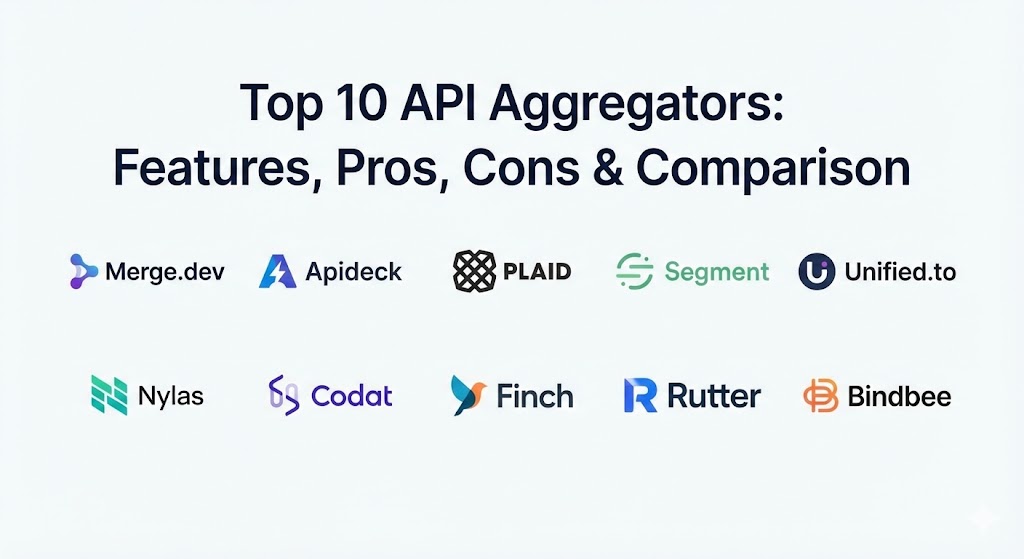
Top 10 API Aggregators
1 — Merge.dev
Merge.dev is widely considered the market leader in the Unified API space, offering specialized categories for HRIS, ATS, Accounting, CRM, and File Storage. It is designed for high-growth SaaS companies that want to launch dozens of integrations in days rather than months.
- Key features:
- 7+ specialized Unified API categories covering 150+ integrations.
- Advanced “Common Models” that normalize data across competing platforms.
- Automated webhooks and real-time data sync capabilities.
- Robust “Linking Flow” UI component for easy customer authentication.
- Comprehensive dashboard for monitoring integration health and logs.
- Automatic handling of API rate limits and versioning updates.
- Pros:
- The most mature and reliable “Common Model” mapping in the industry.
- Excellent developer experience with high-quality SDKs and documentation.
- Cons:
- Premium pricing can be a barrier for very early-stage startups.
- Does not allow “passthrough” requests to original APIs in all tiers.
- Security & compliance: SOC 2 Type II, ISO 27001, HIPAA, and GDPR compliant. Includes end-to-end encryption.
- Support & community: Dedicated customer success managers for enterprise tiers; active Slack community for developers.
2 — Apideck
Apideck offers a “Plug-and-Play” ecosystem for integrations. Beyond just being a Unified API, it provides a “Vault” for secure credential storage and an “Ecosystem” portal where companies can showcase their available integrations to their users.
- Key features:
- Unified APIs for CRM, HRIS, Accounting, and E-commerce.
- “The Vault” – a centralized, encrypted storage for customer API keys.
- Auto-generated “Integration Marketplace” for your website.
- Side-by-side comparison of data mappings across vendors.
- Webhook management and automated retry logic.
- Support for “Proxy” requests to access native vendor features.
- Pros:
- Great for companies that want to build an “App Store” experience for their users.
- Very transparent and flexible pricing model for scaling teams.
- Cons:
- Connector library is vast but sometimes lacks the “depth” of specialized competitors.
- The UI can feel slightly complex due to the breadth of features.
- Security & compliance: SOC 2 Type II, GDPR, and ISO 27001. All data is encrypted at rest and in transit.
- Support & community: High-quality technical support; extensive API reference and tutorials.
3 — Plaid
Plaid is the undisputed heavyweight in the financial data aggregation space. It connects to over 12,000 financial institutions globally, enabling apps to access bank balances, transaction history, and identity verification.
- Key features:
- “Link” UI for secure and seamless bank account connection.
- Transactions API with categorized and cleaned financial data.
- Balance API for real-time verification of funds.
- Identity API to verify account ownership and prevent fraud.
- Support for “Liabilities” (loans) and “Investments” data.
- Assets API for generating comprehensive financial reports for lenders.
- Pros:
- The widest bank coverage in the world; virtually essential for fintech.
- Extremely high security and trust levels with consumers.
- Cons:
- Frequent “connectivity breaks” due to banks changing their security protocols.
- High cost-per-call can become expensive at scale.
- Security & compliance: PCI DSS, SOC 2 Type II, and rigorous bank-level encryption standards.
- Support & community: Massive global community and professional enterprise support.
4 — Segment (by Twilio)
Segment is a “Customer Data Platform” (CDP) that acts as an aggregator for marketing and analytics data. It allows you to collect data from your website or app and “fan it out” to hundreds of other tools simultaneously.
- Key features:
- Unified tracking API for web, mobile, and server-side events.
- “Connections” to hundreds of destinations (Google Analytics, Salesforce, etc.).
- “Personas” for building unified customer profiles across devices.
- Protocols feature for enforcing data quality and schemas.
- Integrated privacy tools for handling “Right to be Forgotten” requests.
- Real-time data streaming and replay capabilities.
- Pros:
- Eliminates the need to install dozens of different “tracking pixels.”
- Superior data governance and quality control tools.
- Cons:
- Expensive for high-volume B2C apps with millions of monthly tracked users.
- Can be overkill for simple one-to-one integrations.
- Security & compliance: ISO 27001, SOC 2, GDPR, and HIPAA (with specific configurations).
- Support & community: Extensive training via “Segment University” and global enterprise support.
5 — Unified.to
Unified.to is a newer, fast-growing player that prides itself on being the most developer-friendly and cost-effective unified API. It covers a broad range of categories and offers a very rapid “time-to-first-call.”
- Key features:
- 20+ Unified API categories (CRM, HRIS, ATS, Ticketing, etc.).
- Real-time sync engine with minimal latency.
- Built-in “Unified Search” across all connected integrations.
- Integrated “Linking Component” that can be customized to your brand.
- Detailed logging and observability for every API request.
- Support for custom objects and fields mapping.
- Pros:
- One of the best “price-to-feature” ratios on the market.
- Very fast onboarding; you can often get an integration live in minutes.
- Cons:
- Smaller community compared to established giants like Merge.
- Less historical “uptime” data compared to legacy players.
- Security & compliance: SOC 2 Type II, GDPR, and HIPAA compliant.
- Support & community: Responsive Discord community and direct engineering support.
6 — Nylas
Nylas is the specialized aggregator for communication data. It provides a single API to connect to all major email, calendar, and contact providers like Gmail, Outlook, and iCloud.
- Key features:
- Unified Email API for reading, sending, and searching emails.
- Unified Calendar API with automated scheduling and availability.
- Unified Contacts API for syncing address books.
- “Neural” API for sentiment analysis and OCR in emails.
- Hosted “OAuth” flow to simplify user authentication.
- Real-time webhooks for incoming messages and event changes.
- Pros:
- The only way to bypass the massive complexity of the Microsoft Graph and Gmail APIs.
- Exceptional performance for high-volume communication apps.
- Cons:
- Strictly focused on communication; you’ll need other tools for CRM or HRIS.
- Parsing email threads can still be complex despite the aggregation.
- Security & compliance: HIPAA, SOC 2 Type II, GDPR, and ISO 27001.
- Support & community: Strong documentation and a dedicated developer relations team.
7 — Codat
Codat is the go-to aggregator for B2B financial data. It connects to the accounting, banking, and commerce systems used by small businesses, making it a favorite for lenders and business insurance providers.
- Key features:
- Connections to QuickBooks, Xero, Sage, NetSuite, and more.
- Unified model for Profit & Loss, Balance Sheets, and Invoices.
- “Link” UI for white-labeled customer onboarding.
- Bidirectional sync (can both read and write data to accounting software).
- Integrated “Lending” module for automated credit risk analysis.
- Support for POS (Point of Sale) and E-commerce data aggregation.
- Pros:
- Deep, high-quality data mapping for the “hard-to-reach” accounting world.
- Significantly reduces the risk of manual data entry errors for SMEs.
- Cons:
- High enterprise pricing; not always suitable for “casual” use cases.
- The accounting-specific terminology can be a hurdle for non-financial devs.
- Security & compliance: SOC 2 Type II, ISO 27001, and GDPR compliant.
- Support & community: High-touch enterprise onboarding and a professional success team.
8 — Finch
Finch is the specialized leader for employment data. It provides a single API for HRIS (Human Resources Information Systems) and Payroll, focusing heavily on the “Read/Write” capabilities needed for benefits administration.
- Key features:
- Access to 200+ HRIS and Payroll systems via a single API.
- Direct integration with payroll systems to update deductions and contributions.
- Unified “Employee” and “Company” data models.
- Automated “Finch Connect” UI for secure user authentication.
- Support for “legacy” payroll systems through secure file-based bridging.
- Real-time webhooks for hiring and termination events.
- Pros:
- The “gold standard” for 401(k), health insurance, and fintech payroll apps.
- Handles the extreme fragmentation of the US payroll market better than anyone.
- Cons:
- Limited coverage outside of the HR/Payroll vertical.
- Some integrations rely on “web scraping” when an official API isn’t available.
- Security & compliance: SOC 2 Type II, HIPAA, and GDPR. Strict PII data protection.
- Support & community: Deep domain expertise in the HR tech space and responsive support.
9 — Rutter
Rutter focuses on the “Commerce” and “Accounting” sectors. It is the primary choice for companies building software for e-commerce merchants who use Shopify, Amazon, and WooCommerce.
- Key features:
- Unified API for E-commerce platforms, Payments, and Accounting.
- Real-time sync of orders, inventory, and product data.
- Global support for international e-commerce platforms.
- “Rutter Link” for high-conversion merchant onboarding.
- Performance-optimized for large-scale data transfers.
- Unified “Payment” model to aggregate data across Stripe and PayPal.
- Pros:
- Excellent for “merchant-facing” apps that need to see store performance.
- Very high uptime and reliability for the e-commerce sector.
- Cons:
- Less focus on general “Business CRM” or “HR” categories.
- The dashboard analytics for admins are good but could be more detailed.
- Security & compliance: SOC 2 Type II, PCI DSS (as a service provider), and GDPR.
- Support & community: Friendly, fast support and a very straightforward setup guide.
10 — Bindbee
Bindbee is a rising star in the unified API market, specifically targeting the HR tech and employee benefits space. It focuses on high-fidelity data syncs and an extremely clean developer experience.
- Key features:
- Unified API for 60+ HRIS, Payroll, and ATS systems.
- Focus on “Normalized” data with high accuracy for benefits providers.
- No-code “Connection Setup” for non-technical users.
- Real-time logs and event visibility for troubleshooting.
- Support for “custom field” mapping and custom object sync.
- Option for on-premise deployment for high-security environments.
- Pros:
- Emerging as a strong, modern alternative to Finch and Merge.
- Very competitive pricing for the level of support provided.
- Cons:
- Library is growing but still smaller than the legacy giants.
- Brand recognition is lower in the global enterprise market.
- Security & compliance: SOC 2, ISO 27001, GDPR, and HIPAA certified.
- Support & community: High-touch support with a focus on winning deals for their clients.
Comparison Table
| Tool Name | Best For | Platform(s) Supported | Standout Feature | Rating (Gartner / TrueReview) |
| Merge.dev | B2B SaaS Growth | Cloud / SaaS | Advanced Common Models | 4.8 / 5 |
| Apideck | Ecosystem Marketplaces | Cloud / SaaS | The Vault (Secret Storage) | 4.6 / 5 |
| Plaid | Consumer Fintech | Global Banking | 12k+ Bank Connections | 4.7 / 5 |
| Segment | Marketing & Analytics | Web, Mobile, Server | Unified Customer Profiles | 4.8 / 5 |
| Unified.to | Fast Multi-Category | Cloud / SaaS | Real-time Unified Search | 4.6 / 5 |
| Nylas | Email & Calendar | Cloud / SaaS | Neural API (AI Insights) | 4.7 / 5 |
| Codat | SME Business Data | Cloud / SaaS | Bidirectional Accounting | 4.5 / 5 |
| Finch | HRIS & Payroll | Cloud / SaaS | Payroll Write Access | 4.6 / 5 |
| Rutter | E-commerce Tech | Cloud / SaaS | Global Commerce Model | 4.5 / 5 |
| Bindbee | HR & Benefits | Cloud / On-Prem | High-Fidelity Data Sync | 4.7 / 5 |
Evaluation & Scoring of API Aggregators
Choosing an aggregator is an “architecture-level” decision. We evaluated these tools based on a weighted rubric to ensure they meet the demands of 2026.
| Category | Weight | Evaluation Criteria |
| Core Features | 25% | Number of connectors, quality of common models, and sync frequency. |
| Ease of Use | 15% | Quality of documentation, SDK availability, and “Link” UI components. |
| Integrations | 15% | Breadth across categories (CRM, HR, Accounting) and deep vertical coverage. |
| Security & Compliance | 10% | SOC 2, HIPAA, GDPR, and encryption standards. |
| Performance | 10% | Latency, rate-limit handling, and “passthrough” request support. |
| Support & Community | 10% | Technical support speed, Slack/Discord presence, and reliability. |
| Price / Value | 15% | Scalability of pricing from “Free/Growth” to “Enterprise.” |
Which API Aggregator Tool Is Right for You?
Selecting the right tool depends on your specific “vertical” and your engineering team’s current velocity.
- Solo Developers & Early Startups: If you need to add “as many integrations as possible” for a broad B2B app, Unified.to or Apideck are your best bets. They are fast to set up and have generous entry-level pricing.
- Financial Services & Lending: If your app depends on bank statements or credit risk, Plaid is non-negotiable for consumer data, and Codat is the gold standard for business accounting data.
- HR Tech & Benefits: If you are building a 401(k) platform or an employee benefits app, Finch and Bindbee offer the deepest payroll-write capabilities that others might lack.
- Marketing & Analytics Platforms: If your goal is to understand customer behavior across multiple touchpoints, Segment is the industry standard for aggregating and normalizing “event” data.
- Enterprise B2B SaaS: For those selling to large companies who demand hundreds of “deep” integrations with Salesforce, Workday, or NetSuite, Merge.dev offers the most robust enterprise-grade infrastructure.
Frequently Asked Questions (FAQs)
1. Is an API aggregator slower than a direct connection? Slightly. Since the aggregator acts as a proxy and must translate data, there is a small amount of latency. However, in 2026, most aggregators use “edge computing” to keep this latency below 50-100ms.
2. What happens if the aggregator goes down? Your integrations will stop working. This is why it is critical to choose aggregators with high-availability guarantees (99.9%+) and robust “webhook retry” mechanisms to prevent data loss.
3. Do my customers have to know I’m using an aggregator? No. Most aggregators offer “white-labeled” authentication flows (like Merge Link or Plaid Link) that can be fully customized with your brand colors and logo.
4. Can I still access “custom fields” through an aggregator? Yes, most top-tier aggregators (like Merge and Bindbee) allow you to map “Custom Objects” and “Custom Fields” from the source system into your unified model.
5. How does an aggregator handle API versioning? This is one of their biggest benefits. When Salesforce or QuickBooks updates their API, the aggregator updates their code on the backend, and your integration continues to work without any changes on your side.
6. Are API aggregators secure? Top providers use “vault” technology where your customers’ API keys are stored in encrypted hardware modules. They also undergo annual SOC 2 and ISO audits to ensure data privacy.
7. Can I switch from one aggregator to another later? It is difficult but possible. Because each aggregator has its own “Unified Data Model,” switching requires re-mapping your data and asking your customers to re-authenticate their connections.
8. Do aggregators work for mobile apps? Yes. Most provide mobile-friendly “Linking” components for iOS and Android, allowing users to connect their accounts securely within your native app.
9. What is “Passthrough” or “Proxy” mode? This is a feature that allows you to bypass the “Unified Model” and send a raw request directly to the provider’s API (e.g., calling a specific, non-standard Salesforce endpoint) while still using the aggregator’s authentication layer.
10. How much does an API aggregator cost? Pricing usually starts at a “Free” tier for developers, moving to “Growth” plans around $500–$1,000/month, and “Enterprise” plans that can reach tens of thousands based on the number of connected customers.
Conclusion
The decision to use an API aggregator is no longer about “if,” but “which one.” In 2026, the speed of integration has become a primary competitive differentiator. By leveraging a unified API, your engineering team can stop fighting with disparate data formats and start focusing on the core unique value of your product. Whether you choose the broad horizontal reach of Merge.dev or the deep financial expertise of Plaid, the “best” tool is the one that allows you to say “Yes” to every customer integration request without breaking your sprint cycle.
The concept of “unified APIs” is becoming a critical solution for the modern developer’s struggle with integration debt, and this guide does a great job of explaining why. It’s particularly interesting to see how market leaders like Merge.dev are moving beyond just providing a pipe between systems to actually handling the heavy lifting of data mapping across complex categories like HRIS and CRM. The point about how these aggregators allow a team to launch dozens of integrations at once without bloating their engineering headcount is a major advantage for any B2B SaaS company looking to scale quickly. I also appreciated the “Not ideal for” section; it’s a refreshing reminder that if you have highly bespoke requirements for a single service, a native integration is still often the most robust path forward. This comparison is a solid asset for any product leader trying to balance the need for broad platform connectivity with the reality of limited development resources.