Introduction
Digital asset compliance tools are specialized software solutions designed to monitor, analyze, and report on blockchain-based transactions. Unlike traditional fiat compliance, which relies on centralized bank ledgers, these tools leverage the transparency of public and private blockchains to provide real-time risk assessment. They utilize advanced heuristics, clustering algorithms, and massive databases of known illicit addresses to identify “red flags” such as ties to darknet markets, sanctioned entities, or money laundering mixers.
The importance of these tools is amplified by the shifting global regulatory landscape, including the FATF (Financial Action Task Force) guidelines and the EU’s MiCA (Markets in Crypto-Assets) regulation. Key real-world use cases include real-time transaction monitoring for exchanges, wallet screening for institutional investors, and forensic investigations for law enforcement. When evaluating these tools, users should look for deep liquidity pool coverage, low false-positive rates, multi-chain support (Layer 1s and Layer 2s), and seamless API integration into existing core banking or trading systems.
Best for: Cryptocurrency exchanges (VASPs), traditional financial institutions entering the crypto space, institutional asset managers, regulatory bodies, and law enforcement agencies requiring forensic capabilities.
Not ideal for: Individual retail investors or very small projects with minimal transaction volume where manual oversight of a few addresses is feasible. It is also not a replacement for legal counsel regarding specific jurisdictional licensing.
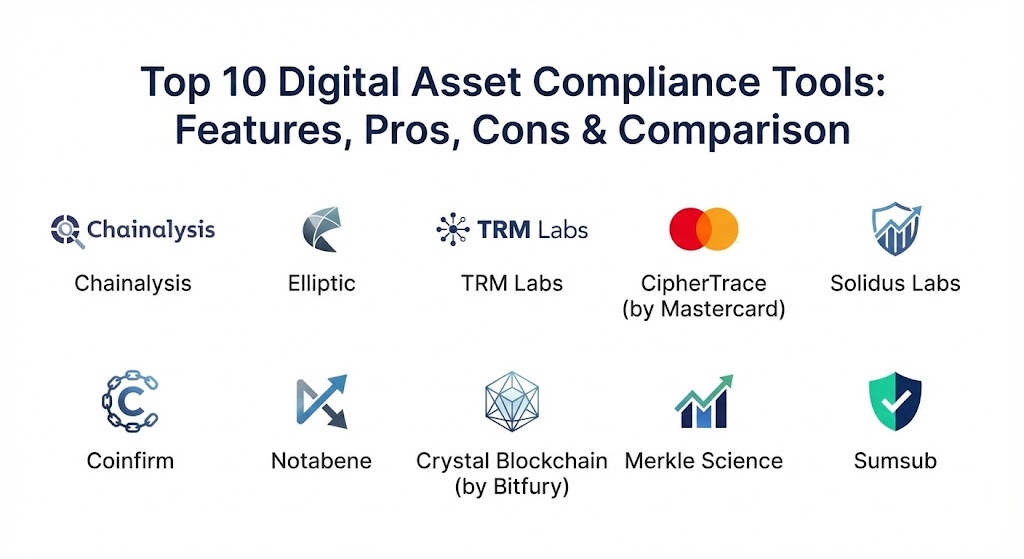
Top 10 Digital Asset Compliance Tools
1 — Chainalysis
Chainalysis is widely regarded as the industry leader in blockchain data and analysis. It is the primary choice for government agencies like the FBI and IRS, as well as the world’s largest financial institutions.
- Key features:
- Reactor: A powerful graph-based tool for manual forensic investigations.
- KYT (Know Your Transaction): Real-time monitoring of all transactions for AML risk.
- Kryptos: Deep insights into the business profiles and risk scores of other crypto services.
- Coverage of over 100 different blockchains and thousands of digital assets.
- Automated alerts for high-risk transfers and sanctioned entity interactions.
- Integrated “Travel Rule” compliance solutions.
- Pros:
- Unmatched database of “tagged” addresses and entities globally.
- Often considered the “standard” by regulators; using it can simplify audit processes.
- Cons:
- Premium pricing makes it one of the most expensive options on the market.
- The interface, while powerful, requires significant training for advanced forensic work.
- Security & compliance: SOC 2 Type II compliant; specifically designed to meet FATF, GDPR, and FinCEN standards.
- Support & community: Offers “Chainalysis Academy” for certification; provides 24/7 dedicated enterprise support.
2 — Elliptic
Elliptic focuses on providing “bank-grade” compliance solutions for crypto businesses and financial institutions. They pride themselves on data accuracy and reducing the “noise” of false positives.
- Key features:
- Lens: A tool for screening wallets at the point of interaction (onboarding/withdrawal).
- Navigator: Real-time transaction monitoring with configurable risk rules.
- Holistic View: A unique feature that tracks assets across different chains simultaneously.
- Support for thousands of assets including DeFi tokens and NFTs.
- Deep research insights into emerging crypto threats and sanctions.
- API-first design for automated enterprise workflows.
- Pros:
- The “Holistic View” is excellent for tracking users who attempt to hide trails by “chain-hopping.”
- Very low false-positive rates compared to some competitors.
- Cons:
- Documentation for custom API integrations can be dense for smaller teams.
- Less focus on the “investigative” side compared to Chainalysis Reactor.
- Security & compliance: ISO 27001 certified; supports global AML/CFT compliance.
- Support & community: High-touch customer success teams; frequent webinars on global regulatory shifts.
3 — TRM Labs
TRM Labs is a younger, high-growth competitor that has gained massive traction by focusing on the “next generation” of crypto: DeFi, Cross-chain, and NFTs.
- Key features:
- Integrated risk management for over 1 million assets across 25+ blockchains.
- Native support for decentralized finance (DeFi) protocol monitoring.
- TRM Forensic: A modern, web-based investigation tool with automated “pathfinding.”
- Real-time sanctions screening (OFAC, UN, EU).
- Automated reporting templates for Suspicious Activity Reports (SARs).
- Entity-based risk scoring that looks beyond individual addresses.
- Pros:
- Best-in-class support for complex cross-chain and DeFi transactions.
- Modern, highly intuitive user interface that reduces investigator fatigue.
- Cons:
- Their “entity” database, while growing fast, is occasionally smaller than the decade-old legacy players.
- Can be overly sensitive in its risk scoring, requiring manual “tuning” of rules.
- Security & compliance: SOC 2 Type II; GDPR and HIPAA compliant data handling.
- Support & community: Fast-growing community; provides “TRM Academy” for investigator training.
4 — CipherTrace (by Mastercard)
Acquired by Mastercard in 2021, CipherTrace provides a bridge between the traditional payments world and the crypto economy. It is particularly strong in “Travel Rule” compliance.
- Key features:
- Traveler: A dedicated tool for FATF Travel Rule compliance (VASP-to-VASP communication).
- Armada: Specifically designed for banks to identify and manage risk from crypto exchanges.
- Support for privacy coins (Monero) through specialized forensic heuristics.
- Over 800 tokens and 2,000+ entities monitored.
- Integrated risk scoring for smart contracts and DeFi protocols.
- Pros:
- Backed by Mastercard’s massive global financial network and security infrastructure.
- Leading-edge research on privacy-enhancing technologies.
- Cons:
- Recent focus has shifted heavily toward the “banking/payments” side of crypto.
- User interface feels slightly more “corporate” and less “agile” than TRM Labs.
- Security & compliance: FIPS 140-2 level security; highly compliant with international banking standards.
- Support & community: Excellent global enterprise support via the Mastercard network.
5 — Solidus Labs
Solidus Labs specializes in “Market Integrity.” While others focus on AML/KYC, Solidus is the leader in identifying market manipulation (wash trading, spoofing, etc.) within crypto exchanges.
- Key features:
- HALO: A unified hub for trade surveillance, transaction monitoring, and onboarding.
- Over 50 different “market abuse” alert types.
- Cross-market surveillance to detect manipulation across multiple venues.
- Automated case management workflow for compliance teams.
- Direct integrations with top trading engines.
- Regulatory reporting dashboards for transparency.
- Pros:
- The undisputed leader for market abuse detection in digital assets.
- Essential for any exchange seeking a Tier-1 license in a strict jurisdiction.
- Cons:
- Less focus on deep “on-chain” forensic tracing of stolen funds.
- Narrower focus on “trading” rather than general “wallet screening.”
- Security & compliance: SOC 2 compliant; designed to meet MiCA and SEC-style surveillance requirements.
- Support & community: Very active in “Crypto Market Integrity” (CMIC) industry groups.
6 — Coinfirm
Coinfirm is a European-based powerhouse that offers a highly modular approach to digital asset compliance, with a strong emphasis on data quality and regulatory “mapping.”
- Key features:
- AML Platform: Over 350 risk evaluation flags for automated monitoring.
- NFT Cop: Specialized tool for assessing the risk and provenance of NFTs.
- Reclaim Crypto: A tool for victims of hacks to report and track stolen funds.
- Coverage for over 1,500 protocols and tokens.
- Visual relationship mapping for address clusters.
- Customizable risk engines to fit specific jurisdictional needs.
- Pros:
- Excellent value for money for European firms needing MiCA/AMLD5 compliance.
- Very strong focus on “provenance” for high-value NFTs and art tokens.
- Cons:
- The visualization tool is less “fluid” than Chainalysis Reactor or TRM Forensic.
- Can sometimes lag behind US-centric competitors in adding new “Layer 2” chains.
- Security & compliance: GDPR compliant; ISO 27001 and ISO 9001 certified.
- Support & community: Strong European presence; excellent technical support for API users.
7 — Notabene
Notabene is the industry’s “Travel Rule” specialist. While it doesn’t do deep blockchain forensics, it is the essential “plumbing” that allows exchanges to talk to each other compliantly.
- Key features:
- SafeTransact: A platform for managing and exchanging Travel Rule data.
- Global VASP Directory to identify who you are sending funds to.
- Automated “beneficiary” information collection and verification.
- Integration with Chainalysis and Elliptic for unified risk/identity views.
- Protocol-agnostic (supports TRP, IVMS101, etc.).
- Pros:
- The easiest way to solve the “Travel Rule” problem without building custom infrastructure.
- Excellent at managing “counterparty risk” for institutional desks.
- Cons:
- Only solves the Travel Rule; you still need a separate tool for transaction monitoring.
- Dependent on the counterparty also having a Travel Rule solution.
- Security & compliance: SOC 2 Type II; focused exclusively on data privacy and security of identity data.
- Support & community: Very helpful documentation and a focus on industry standardization.
8 — Crystal Blockchain
Crystal Blockchain (by Bitfury) is a comprehensive AML platform that offers one of the most cost-effective forensic tools for investigative teams and smaller exchanges.
- Key features:
- Real-time transaction monitoring and risk scoring.
- Advanced case management and visualization for investigators.
- Automated tracking of “Dust Attacks” and other common wallet threats.
- Direct integration with exchanges for automated withdrawals/deposits.
- “Crystal Expert” certification for professional compliance officers.
- Pros:
- Highly competitive pricing makes it the “best bang for your buck” in the forensic space.
- Very fast at indexing new blocks and reflecting risk changes.
- Cons:
- The database of “known entities” is slightly less deep than Chainalysis or Elliptic.
- Smaller team results in fewer “whitepapers” and research insights than the top 3.
- Security & compliance: ISO 27001; GDPR and AMLD6 compliant.
- Support & community: Good documentation and a responsive support team via chat and email.
9 — Merkle Science
Merkle Science takes a “Predictive” approach to compliance. Instead of just looking at past history, they use behavior-based rules to detect potential future risk.
- Key features:
- Compass: A behavior-based transaction monitoring system.
- Tracker: A visualization tool for fund flow analysis.
- Customizable “Rule Engine” that doesn’t rely on static address lists.
- Support for high-speed transaction screening for institutional desks.
- Detailed risk reports for regulatory audits.
- Pros:
- The predictive “behavioral” approach is excellent for catching new, untagged threats.
- Highly customizable; you can set very specific risk tolerances.
- Cons:
- Behavioral rules require more “tuning” by compliance officers to avoid false positives.
- UI for investigations is functional but lacks some “quality of life” features.
- Security & compliance: SOC 2; focuses on international AML/CFT standards.
- Support & community: Strong presence in the APAC and MENA regions.
10 — Sumsub
Sumsub is a unified verification platform that excels at the “Know Your Customer” (KYC) side of the digital asset equation, offering a seamless bridge between identity and crypto transactions.
- Key features:
- Integrated ID verification, liveness checks, and AML screening.
- Crypto Monitoring: Linking user identity directly to their wallet’s on-chain risk.
- Automated Travel Rule data collection during onboarding.
- Support for over 220 countries and territories.
- Legal assistance and compliance consulting as an add-on.
- Pros:
- The best tool for firms that want KYC and Crypto AML in a single dashboard.
- Exceptional user experience for the end-user during the verification process.
- Cons:
- Less specialized in deep blockchain “forensics” compared to Chainalysis.
- Pricing is per-check, which can scale quickly with high user growth.
- Security & compliance: ISO 27001; GDPR, HIPAA, and BMM compliant.
- Support & community: Excellent documentation and a focus on “Compliance-as-a-Service.”
Comparison Table
| Tool Name | Best For | Platform(s) Supported | Standout Feature | Rating (Gartner/TrueReview) |
| Chainalysis | Governments / Large Institutions | Cloud / SaaS | Reactor Visualization | 4.8 / 5 |
| Elliptic | Bank-Grade AML | Cloud / API | Holistic Cross-Chain View | 4.7 / 5 |
| TRM Labs | DeFi / Next-Gen Crypto | SaaS / API | Cross-Chain Pathfinding | 4.7 / 5 |
| CipherTrace | Payments / Banking | SaaS | Monero/Privacy Forensics | 4.4 / 5 |
| Solidus Labs | Market Surveillance | Cloud / API | HALO Integrity Hub | 4.6 / 5 |
| Coinfirm | European / NFT Focus | SaaS / API | Provenance Tracking | 4.3 / 5 |
| Notabene | Travel Rule Compliance | SaaS / API | VASP Identity Network | 4.5 / 5 |
| Crystal Blockchain | Investigative Value | Cloud / On-Prem | Cost-Effective Forensics | 4.4 / 5 |
| Merkle Science | Behavioral Detection | SaaS / API | Predictive Risk Engine | 4.2 / 5 |
| Sumsub | Unified KYC / AML | SaaS / Web | ID-to-Wallet Linking | 4.6 / 5 |
Evaluation & Scoring of Digital Asset Compliance Tools
The following weighted rubric shows how industry leaders typically evaluate these tools during a procurement process.
| Category | Weight | Evaluation Criteria |
| Core Features | 25% | Real-time monitoring, sanctions screening, and forensic tracing depth. |
| Ease of Use | 15% | Dashboard clarity, case management efficiency, and alert customization. |
| Integrations | 15% | API quality, support for various blockchains (L1/L2), and core banking interop. |
| Security & Compliance | 10% | SOC 2/ISO certifications and depth of regulatory reporting templates. |
| Performance | 10% | Transaction processing speed, latency, and false-positive reduction. |
| Support & Community | 10% | Training programs (Academies), response times, and industry thought leadership. |
| Price / Value | 15% | Total cost of ownership relative to risk mitigation and scalability. |
Which Digital Asset Compliance Tool Is Right for You?
The right tool depends on your position in the digital asset ecosystem and your specific regulatory “headaches.”
- Solo Founders & Seed Projects: If you are just starting and need to clear KYC/AML hurdles quickly, Sumsub is the most efficient choice for a “all-in-one” onboarding and monitoring experience.
- Small to Medium Exchanges (VASPs): Crystal Blockchain offers the best balance of professional forensic capabilities and manageable pricing. For the Travel Rule specifically, Notabene is the go-to specialist.
- Institutional Trading Desks: TRM Labs is often preferred for its superior handling of DeFi and cross-chain “hops,” which are common in institutional strategies.
- Banks and Payment Processors: CipherTrace (Mastercard) or Elliptic provide the “bank-grade” documentation and security frameworks that legacy finance departments demand.
- Exchanges seeking Tier-1 Licenses: If you are applying for licenses in New York (BitLicense) or Singapore (MAS), you will likely need Chainalysis for AML and Solidus Labs for market surveillance to satisfy the strict requirements.
Frequently Asked Questions (FAQs)
1. What is the “Travel Rule” in crypto? The Travel Rule requires Virtual Asset Service Providers (VASPs) to share personal information about the originators and beneficiaries of digital asset transfers above a certain threshold (usually $1,000).
2. Can these tools “unmask” an anonymous wallet holder? Directly, no. They don’t know the person’s name on a public blockchain. However, they link the address to “entities” (like an exchange) where the user has likely done KYC, allowing law enforcement to subpoena that information.
3. Do these tools work on private blockchains? Most are focused on public blockchains (Bitcoin, Ethereum, Solana, etc.). For private ledgers (Hyperledger, Corda), specific custom modules are often required, which tools like Elliptic and Chainalysis can provide.
4. How do these tools handle “Mixers” like Tornado Cash? They flag any funds coming from a mixer as “High Risk.” Advanced tools can sometimes “de-mix” or trace through the mixer using heuristic patterns to find the original source of funds.
5. Are these tools compatible with NFTs? Yes. Coinfirm and TRM Labs have specific modules to track NFT provenance and identify if an NFT was purchased with “tainted” funds.
6. Can I use these for my personal wallet security? While designed for enterprises, some (like Chainalysis and Crystal) offer lighter versions. However, retail users are better served by “wallet guard” browser extensions.
7. What is a “False Positive” in crypto compliance? This is when a transaction is flagged as risky (e.g., tied to a hack) when it is actually a legitimate user. Minimizing these is key to operational efficiency.
8. Do I need these tools if my company is decentralized (DeFi)? Increasingly, yes. Regulators are moving toward holding DeFi front-ends and developers accountable for AML, making tools like TRM Labs essential for these projects.
9. How often is the data updated? Top-tier tools update their entity databases in real-time or near-real-time as new hacks occur or new sanctions are announced by bodies like OFAC.
10. What is the difference between Transaction Monitoring and Trade Surveillance? Transaction Monitoring looks for money laundering risk (where the money came from). Trade Surveillance looks for market manipulation risk (how the assets are being traded on an exchange).
Conclusion
Digital asset compliance has moved from a “nice-to-have” checkbox to a core strategic pillar for any serious participant in the crypto economy. While the transparency of the blockchain provides a unique advantage over traditional finance, the complexity of DeFi and cross-chain transactions requires the specialized power of these top 10 tools. When choosing your platform, remember that the goal is not just to “stop” illicit activity, but to build a transparent, compliant bridge that allows digital assets to eventually merge with the global financial system.
It’s fascinating to see how the industry has moved toward “just-in-time” transcoding, and this guide does an excellent job of explaining how that simplifies the delivery pipeline for developers. The distinction between the raw power of FFmpeg and the broadcast-grade orchestration of tools like Telestream Vantage really highlights the different needs of a solo creator versus a global media giant. I also appreciated the mention of Bitmovin’s “split-and-stitch” processing; achieving faster-than-real-time encoding for 4K content is a massive technical hurdle that they’ve managed to turn into a competitive advantage. Seeing the comparison between the free, local power of HandBrake and the infinite scalability of AWS MediaConvert provides a clear roadmap for anyone trying to balance hardware constraints with processing volume. This comparison is a solid asset for anyone trying to navigate the complexities of modern video standards while keeping their storage and bandwidth costs under control.