Introduction
Crypto custody platforms are specialized financial services and software solutions designed to safeguard private keys—the digital passcodes that grant access to blockchain assets. Unlike retail wallets, institutional custody platforms are built to prevent single points of failure. They replace the “one person with a seed phrase” model with sophisticated multi-signature (Multi-sig) or Multi-Party Computation (MPC) frameworks, ensuring that no single employee or bad actor can move funds unilaterally.
The importance of these tools cannot be overstated in 2026. Beyond simple storage, they serve as the gateway to the broader Web3 economy, enabling safe participation in staking, decentralized finance (DeFi), and the tokenization of real-world assets (RWAs). Key real-world use cases include corporate treasury management, the operational backbone of crypto ETFs, and secure settlement for OTC (Over-the-Counter) trading desks. When evaluating a platform, users must prioritize regulatory status (Qualified Custodian), insurance coverage, asset breadth, and the quality of their API for automated treasury workflows.
Best for: Institutional investors, hedge funds, family offices, and corporations holding crypto on their balance sheets. It is also the go-to for fintechs and banks building their own crypto-integrated consumer products.
Not ideal for: Individual retail investors with small holdings who are better served by non-custodial hardware wallets or standard exchange accounts, or for high-frequency “day traders” where the latency of cold storage or multi-party approval might hinder execution speed.
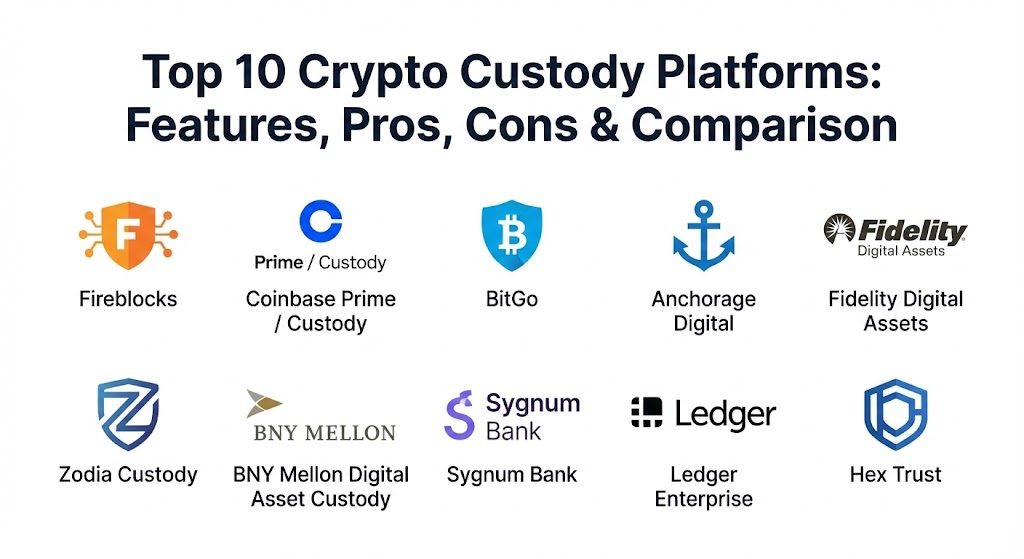
Top 10 Crypto Custody Platforms
1 — Fireblocks
Fireblocks is the de facto standard for institutional digital asset movement. It isn’t just a vault; it’s a high-speed transfer network that uses MPC (Multi-Party Computation) to eliminate the risk of private key theft during storage and transit.
- Key features:
- MPC-CMP technology: Industry-leading multi-party computation for sub-second transaction signing.
- Fireblocks Network: A closed-loop settlement network connecting 1,800+ institutions.
- Policy Engine: Granular, rule-based approval workflows (e.g., “require 3/5 signatures for transfers over $1M”).
- DeFi & Staking Integration: Secure access to permissioned DeFi protocols.
- Non-Custodial Option: Allows institutions to maintain full control of their own key shards.
- Tokenization Suite: Tools for minting and managing stablecoins or RWAs.
- Pros:
- Unrivaled speed and efficiency for active trading and frequent transfers.
- Eliminates “counterparty risk” as Fireblocks never holds the full key.
- Cons:
- Highly technical interface requires dedicated DevOps or security staff.
- Pricing is significantly higher than basic vault services.
- Security & compliance: SOC 2 Type II, ISO 27001, 27017, 27018. Member of the Confidential Computing Consortium.
- Support & community: 24/7 global support with dedicated account managers for large enterprises; extensive developer documentation.
2 — Coinbase Prime / Custody
Coinbase Prime is the institutional arm of the largest U.S. crypto exchange. It is a “one-stop-shop” that combines qualified custody with a world-class prime brokerage, making it the top choice for many Bitcoin ETF issuers.
- Key features:
- Qualified Custodian: Operates as a fiduciary under New York Banking Law.
- Segregated Cold Storage: 100% of assets are kept in offline, air-gapped vaults.
- Staking from Cold Storage: Earn rewards on ETH and SOL without moving funds online.
- Integrated Trading: Execute large-block trades directly from the custody vault.
- Institutional Reporting: Audit-ready monthly statements and real-time cost-basis tracking.
- NFT Custody: Secure storage for high-value digital collectibles.
- Pros:
- The transparency of a U.S. public company (NASDAQ: COIN).
- Massive insurance policy ($320M+) for commercial crime and theft.
- Cons:
- High barrier to entry; account minimums are often prohibitive for smaller firms.
- Centralized model means you must trust Coinbase as a single counterparty.
- Security & compliance: NYDFS-regulated, SOC 1 Type II, SOC 2 Type II.
- Support & community: High-touch coverage for Prime clients; massive library of institutional research.
3 — BitGo
BitGo is a pioneer in the custody space, having invented the first multi-signature wallet. In 2026, it remains a dominant force, especially after receiving its national bank charter and expanding its global footprint.
- Key features:
- Multi-Sig & MPC: Offers both security models depending on client preference.
- Qualified Custody: Federally chartered and regulated in the U.S., Germany, and Singapore.
- Self-Managed or Regulated: Clients can choose to hold their own keys or use BitGo as a trustee.
- Insurance: Up to $250M in coverage for digital assets.
- Go Network: Enables instant settlement between BitGo clients and exchanges.
- Developer APIs: One of the most mature “Wallet-as-a-Service” offerings.
- Pros:
- Exceptional history of reliability—rarely experienced downtime in over a decade.
- Broadest asset support in the industry (700+ tokens).
- Cons:
- The platform can feel “legacy” compared to the sleek interfaces of newer MPC startups.
- Complex fee structure with multiple add-ons for staking and insurance.
- Security & compliance: OCC-chartered bank, SOC 1 & 2 Type II.
- Support & community: Extensive developer portal and a large ecosystem of third-party integrations.
4 — Anchorage Digital
Anchorage Digital is unique as the first crypto-native firm to receive a federal bank charter from the OCC. It is designed for institutions that require “fiduciary-grade” custody with the flexibility of a modern tech stack.
- Key features:
- Federal Charter: Direct oversight from the Office of the Comptroller of the Currency.
- Sub-15 Minute Settlement: High-speed withdrawals from “cold-first” storage.
- Governance Support: Vote on DAO proposals directly from the custody vault.
- Advanced Staking: Institutional-grade validator nodes for all major PoS chains.
- Financing: Integrated lending and borrowing against digital asset collateral.
- Pros:
- The most rigorous regulatory status in the United States.
- Excellent balance between the security of cold storage and the speed of hot wallets.
- Cons:
- Strict onboarding requirements and a heavy focus on the U.S. market.
- Not as “API-first” as Fireblocks for pure developers.
- Security & compliance: OCC National Bank Charter, SOC 1 & 2.
- Support & community: White-glove service with dedicated implementation teams.
5 — Fidelity Digital Assets
Fidelity brings decades of traditional finance (TradFi) pedigree to the crypto space. It is the preferred choice for massive pension funds and insurance companies that want a “brand-name” custodian.
- Key features:
- TradFi Integration: Seamlessly integrates with existing Fidelity wealth management tools.
- Air-Gapped Storage: Multi-layered physical security including 24/7 guarded vaults.
- BTC and ETH Specialization: Deepest expertise in the two largest assets.
- Trade Execution: Access to deep liquidity pools via Fidelity’s proprietary routing.
- Internal Controls: Rigorous separation of duties and multi-person authorization.
- Pros:
- Lowest “default risk” in the industry due to Fidelity’s multi-trillion dollar balance sheet.
- Highly familiar experience for users coming from traditional banking.
- Cons:
- Limited asset support compared to crypto-native rivals (focuses on BTC, ETH, SOL).
- Lacks support for high-frequency DeFi or complex Web3 interactions.
- Security & compliance: OCC National Trust Charter, SOC 1 & 2.
- Support & community: World-class enterprise support; access to Fidelity’s vast institutional network.
6 — Zodia Custody
Zodia is a bank-backed digital asset custodian (Standard Chartered in association with Northern Trust) designed for the requirements of the European and Asian institutional markets.
- Key features:
- Bank-Grade Governance: Compliance and risk frameworks designed by a G-SIB (Global Systemically Important Bank).
- Asset Segregation: Clear legal segregation of client assets on the blockchain.
- Interchange: Off-exchange settlement to mitigate exchange insolvency risk.
- Proof of Reserves: Real-time on-chain transparency for auditors.
- Staking & Yield: Integrated rewards through vetted institutional partners.
- Pros:
- Offers the regulatory peace of mind of a global Tier 1 bank.
- Specifically built for MiCA compliance in the EU.
- Cons:
- Onboarding can be slow due to rigorous “Know Your Business” (KYB) checks.
- Less flexible for “DeFi-heavy” investment strategies.
- Security & compliance: FCA-registered (UK), Central Bank of Ireland, SOC 2.
- Support & community: High-level relationship management for global financial institutions.
7 — BNY Mellon Digital Asset Custody
The world’s largest custodian bank has finally integrated digital assets into its core platform. BNY Mellon provides a unified view of traditional and digital assets in one dashboard.
- Key features:
- Unified Accounting: See your stocks, bonds, and Bitcoin in a single report.
- Legacy Trust: Leverages 240+ years of institutional trust experience.
- Global Settlement: Connectivity to traditional market infrastructure.
- Qualified Custody: Full fiduciary status for institutional fund managers.
- Pros:
- The ultimate choice for “bridging” portfolios between TradFi and Crypto.
- Highest level of institutional trust; “too big to fail” profile.
- Cons:
- Conservative asset rollout; typically slow to support new tokens or L2s.
- Higher fees than many crypto-native tech providers.
- Security & compliance: Globally regulated bank; highest tier SOC and ISO certifications.
- Support & community: Unmatched global infrastructure and dedicated client service teams.
8 — Sygnum Bank
Sygnum is the world’s first digital asset bank, based in Switzerland. It provides a full-service banking experience including custody, brokerage, and lending under a single Swiss license.
- Key features:
- Swiss Regulatory Framework: Assets are held off-balance sheet and protected by Swiss law.
- Multi-Custody Platform: Combines hot, warm, and cold storage tiers.
- Tokenization Engine: Easily create digital representations of assets like art or real estate.
- Fiat Integration: Native support for CHF, EUR, USD, and GBP settlement.
- Pros:
- Perfect for companies that need a bank account and a crypto vault in one.
- Strong “Swiss-Privacy” culture and legal protections.
- Cons:
- Heavy focus on the European/Swiss market; less presence in the US/Asia.
- Interface is professional but less “cutting-edge” than US MPC platforms.
- Security & compliance: FINMA-regulated (Switzerland), CMS-licensed (Singapore).
- Support & community: Boutique banking experience with highly personalized service.
9 — Ledger Enterprise
Building on the success of their retail hardware, Ledger Enterprise offers a high-security platform that combines hardware-based security with powerful management software.
- Key features:
- Hardware Root of Trust: Uses secure elements (chips) to protect keys.
- Governance Rules: Create complex approval flows for different team members.
- Zero-Trust Architecture: Private keys are never exposed to any network.
- White-Labeling: Fintechs can use Ledger’s tech to build their own wallets.
- Pros:
- Best-in-class hardware security—the “Gold Standard” for physical key protection.
- “Security-first” approach that appeals to technical CSOs.
- Cons:
- Managing physical hardware (HSMs) adds an extra layer of operational complexity.
- Slightly higher latency for transfers compared to pure-software MPC.
- Security & compliance: CSPN (ANSSI), SOC 2 Type II.
- Support & community: Dedicated technical account managers and a strong global reseller network.
10 — Hex Trust
Hex Trust is a leading institutional custodian in the Asia-Pacific (APAC) region, providing specialized services for the rapidly growing Web3 and GameFi sectors.
- Key features:
- Hex Safe: Proprietary bank-grade custody platform.
- Deep NFT Support: Advanced custody for gaming assets and digital real estate.
- APAC Regulatory Focus: Fully licensed in Hong Kong, Singapore, and Dubai.
- Connectivity: Integration with dozens of exchanges and DeFi platforms.
- Pros:
- Unmatched expertise and regulatory alignment for the Asian market.
- Most innovative for “non-financial” crypto assets like NFTs and Metaverse land.
- Cons:
- Less brand recognition in North America or Europe.
- The platform is highly specialized for Web3, which might be overkill for simple BTC holders.
- Security & compliance: HK Trust Company, MAS-licensed (Singapore), SOC 2.
- Support & community: High focus on APAC client relations and a localized support team.
Comparison Table
| Tool Name | Best For | Platform(s) Supported | Standout Feature | Rating (Agio/Gartner) |
| Fireblocks | High-Speed Trading | SaaS / API-first | MPC Transfer Network | 4.8 / 5 |
| Coinbase Prime | ETF Issuers / US Corps | Cloud / SaaS | Qualified Cold Storage | 4.7 / 5 |
| BitGo | Developers / WaaS | Multi-cloud / API | Multi-sig Multi-chain | 4.6 / 5 |
| Anchorage | Fiduciary Compliance | Cloud / SaaS | Federal Bank Charter | 4.7 / 5 |
| Fidelity Digital | Pensions / TradFi | On-prem / Cloud | TradFi Pedigree | 4.5 / 5 |
| Zodia Custody | European Institutions | SaaS | Bank-Backed Governance | 4.4 / 5 |
| BNY Mellon | Unified Portfolios | Integrated Banking | Traditional/Crypto Hybrid | 4.3 / 5 |
| Sygnum Bank | Swiss Banking | SaaS / Mobile | Full-service Swiss Bank | 4.6 / 5 |
| Ledger Enterprise | Hardware Security | SaaS / HSM-based | Secure Element Chips | 4.5 / 5 |
| Hex Trust | APAC / Web3 native | SaaS | NFT / GameFi Specialization | 4.4 / 5 |
Evaluation & Scoring of Crypto Custody Platforms
| Category | Weight | Evaluation Criteria |
| Core Features | 25% | Multi-sig/MPC options, staking, DeFi access, and asset coverage. |
| Ease of Use | 15% | Dashboard clarity, mobile access, and workflow speed. |
| Integrations | 15% | API maturity, exchange connectivity, and TradFi reporting. |
| Security & Compliance | 10% | Regulatory status (Qualified Custodian), SOC audits, and insurance. |
| Performance | 10% | Transfer speed, withdrawal windows, and system uptime. |
| Support & Community | 10% | Relationship management, developer forums, and documentation. |
| Price / Value | 15% | Custody fees vs. brokerage and staking commission share. |
Which Crypto Custody Platform Is Right for You?
Selecting a platform in 2026 is about aligning your regulatory requirements with your operational style.
- Solo High-Net-Worth Individuals: You likely don’t need a full institutional platform. A high-quality hardware wallet (like Ledger) or a premium retail custodian (like Gemini) is usually sufficient.
- Startups & Fintechs: If you are building a product that involves crypto, BitGo or Fireblocks are the best “building blocks” due to their robust APIs and “Wallet-as-a-Service” models.
- Hedge Funds & Active Traders: Speed is your primary concern. Fireblocks and Anchorage offer the fastest ways to move funds from storage to an exchange or a DeFi protocol.
- Corporate Treasuries: If you are holding Bitcoin as a reserve asset (like MicroStrategy), Coinbase Prime or Fidelity offer the security, insurance, and auditability that your board of directors and legal team will demand.
- Global/Sovereign Entities: If your operations are regional, prioritize the regulator. Choose Sygnum for Switzerland, Zodia for the UK/EU, or Hex Trust for Asia.
Frequently Asked Questions (FAQs)
1. What is a “Qualified Custodian”? A Qualified Custodian is a regulated entity (like a bank or trust company) that is legally authorized to hold client assets. In many jurisdictions, institutional investors are required by law to use a qualified custodian.
2. Is MPC safer than Multi-sig? Not necessarily; they are different. Multi-sig uses multiple keys on the blockchain. MPC uses a single key that is never fully formed in one place—it’s broken into shards. MPC is generally faster and more flexible for multi-chain support.
3. Does the custodian own my crypto? No. In a “segregated” custody model, you remain the legal owner of the assets. The custodian simply holds the keys on your behalf. Ensure your contract explicitly states that assets are held “off-balance sheet.”
4. How long does a withdrawal take? It varies. “Hot” wallets are instant. “Cold” storage withdrawals can take anywhere from 15 minutes to 48 hours, depending on the human-in-the-loop approval process required.
5. What does the insurance actually cover? Most policies cover internal fraud, theft, and hacks. They typically do not cover market volatility, loss of value, or a company going bankrupt if assets were commingled.
6. Can I earn yield while my crypto is in custody? Yes. Most institutional platforms now offer “Staking from Cold Storage,” allowing you to earn PoS rewards without exposing your keys to the internet.
7. Can a custodian “freeze” my funds? Yes, if they receive a legal order or if your activity triggers AML (Anti-Money Laundering) alerts. This is a trade-off of using a regulated platform versus self-custody.
8. Why are ETFs moving the needle for custody? ETFs like BlackRock’s IBIT require massive, ultra-secure vaults to hold thousands of BTC. This demand has forced custodians to scale their security and insurance to unprecedented levels.
9. What is “Self-Managed” vs “Full Custody”? Self-managed (like Ledger or Fireblocks) means you use their tech but you hold the keys. Full custody (like Coinbase or Fidelity) means they hold the keys for you.
10. Do these platforms support NFTs? Many do. Platforms like Hex Trust and Coinbase have specialized vaults for high-value digital art and gaming assets.
Conclusion
The era of “not your keys, not your coins” has evolved into “regulated keys, institutional coins.” In 2026, choosing a crypto custody platform is no longer just about preventing a hack—it’s about finding a partner that supports your business growth, satisfies your regulators, and integrates into your financial stack. While Fireblocks and Coinbase Prime lead the market today, the rise of bank-backed solutions like Zodia and BNY Mellon proves that crypto is now a permanent pillar of global finance.
Moving away from the “single point of failure” model is the most important takeaway here, especially with the industry’s shift toward MPC and Multi-sig. It’s wild to see the contrast between the high-speed agility of Fireblocks and the heavy regulatory weight of a federally chartered bank like Anchorage. The mention of “off-exchange settlement” through Zodia is a massive win for anyone still nervous about exchange insolvency post-FTX. This breakdown really clarifies that custody isn’t just about a secure vault anymore; it’s about having a functional gateway to staking and DeFi that doesn’t sacrifice security for speed. It’s a great roadmap for anyone trying to figure out if they need a crypto-native tech stack or the traditional backing of a giant like Fidelity.