Introduction
A blockchain platform is a distributed ledger technology (DLT) framework that allows developers to build and host decentralized applications (dApps), manage digital assets, and execute smart contracts. These platforms vary significantly in their architecture—some are “public” and open to anyone (like Ethereum or Solana), while others are “permissioned” and designed specifically for private enterprise use (like Hyperledger Fabric or R3 Corda).
The importance of choosing the right platform cannot be overstated. Selecting a chain that lacks scalability or security can lead to high transaction costs, network outages, or data breaches. Key real-world use cases in 2026 include institutional Decentralized Finance (DeFi), real-world asset (RWA) tokenization, and transparent ESG (Environmental, Social, and Governance) tracking. When evaluating platforms, users must look for transaction throughput (TPS), finality time, gas fee predictability, and the strength of the developer ecosystem.
Best for: Large enterprises looking for supply chain transparency, financial institutions building settlement layers, startups launching Web3 applications, and government agencies implementing digital identity systems.
Not ideal for: Organizations with simple, centralized data needs where a traditional SQL/NoSQL database would be faster and cheaper, or projects that do not benefit from the transparency or immutability of a distributed ledger.
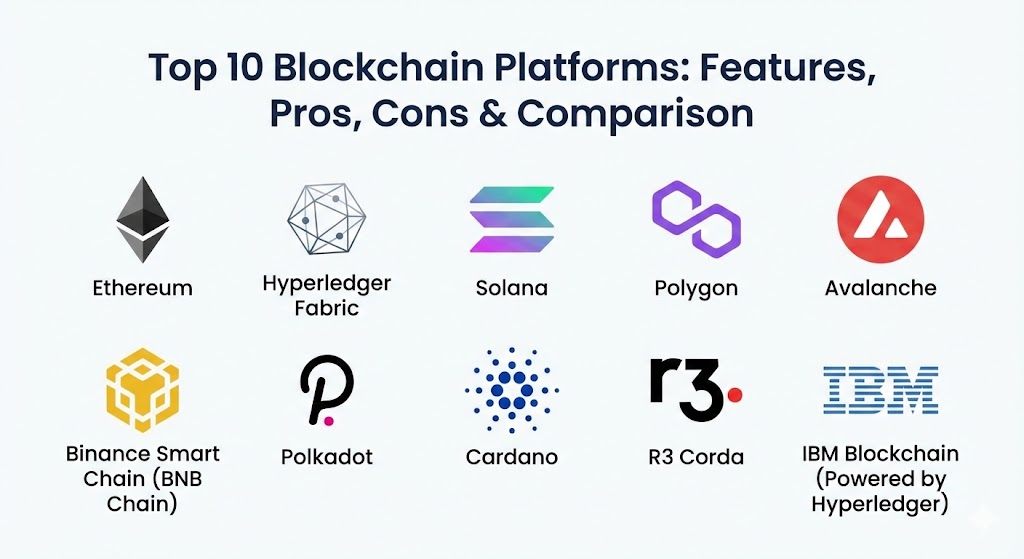
Top 10 Blockchain Platforms
1 — Ethereum
Ethereum remains the industry standard and the most widely adopted smart-contract platform in 2026. Following the success of “The Merge” and subsequent scaling upgrades, it has cemented its position as the primary settlement layer for both global finance and decentralized governance.
- Key features:
- Robust smart contract functionality using the Solidity programming language.
- Industry-leading security through a massive decentralized validator set.
- Extensive Layer-2 (L2) ecosystem (Base, Arbitrum, Optimism) for high-speed scaling.
- Native support for token standards like ERC-20 (fungible) and ERC-721 (NFTs).
- High interoperability with thousands of existing dApps and wallets.
- Transition to Proof-of-Stake (PoS) for energy efficiency.
- Pros:
- Unmatched developer community and documentation.
- The highest “economic security” of any smart contract platform.
- Cons:
- Mainnet (Layer-1) transaction fees can still be volatile and high during peak usage.
- Slower transaction finality compared to high-performance chains like Solana.
- Security & compliance: SOC 2 and GDPR support via specialized providers like Consensys; top-tier cryptographic security; standard for institutional DeFi.
- Support & community: Massive global community; exhaustive documentation; active Ethereum Foundation and enterprise-grade support from vendors like Alchemy and Infura.
2 — Hyperledger Fabric
Hosted by the Linux Foundation, Hyperledger Fabric is the premier permissioned blockchain framework. It is designed from the ground up for enterprise environments where data privacy and authorized access are non-negotiable.
- Key features:
- Modular architecture allowing pluggable consensus and identity services.
- “Private Channels” for restricted data sharing between specific participants.
- Support for smart contracts (Chaincode) written in Go, Java, or JavaScript.
- Permissioned membership requiring users to be authenticated via an MSP.
- High performance and scalability in private network settings.
- No native cryptocurrency, eliminating gas fee volatility.
- Pros:
- Unrivaled for B2B privacy; participants only see data relevant to them.
- Highly flexible for custom business logic and legacy system integration.
- Cons:
- High technical complexity to set up and manage compared to public chains.
- Lacks the open-market liquidity and composability of public blockchains.
- Security & compliance: Built-in ISO and SOC 2 alignment; GDPR compliant by design; enterprise-grade encryption and identity management.
- Support & community: Backed by the Linux Foundation; extensive corporate support from IBM, Oracle, and SAP.
3 — Solana
Solana has emerged as the definitive high-performance public blockchain. In 2026, it is the primary choice for consumer-facing applications that require instant finality and near-zero transaction costs.
- Key features:
- Unique Proof-of-History (PoH) consensus for ultra-high throughput.
- Theoretical capacity of 65,000+ transactions per second (TPS).
- Sub-second block times and 2.5-second finality.
- Low, predictable transaction fees (typically less than $0.01).
- Parallel transaction processing via Sealevel runtime.
- Firedancer client for improved network stability and performance.
- Pros:
- Best-in-class user experience for high-frequency trading and gaming.
- Massive growth in institutional stablecoin usage (e.g., PayPal’s PYUSD).
- Cons:
- Past concerns over network uptime (though largely resolved in 2024–2025).
- Hardware requirements for running a validator node are significantly higher than Ethereum.
- Security & compliance: Cryptographic security; standard public chain compliance; SOC 2 reporting available through infrastructure partners.
- Support & community: Rapidly growing developer ecosystem; strong support from the Solana Foundation; extensive technical documentation.
4 — Polygon
Polygon is a multi-layered scaling solution for Ethereum. It provides a suite of protocols—including its flagship PoS chain and zk-EVM rollups—to help enterprises scale Ethereum-compatible applications at a fraction of the cost.
- Key features:
- Fully compatible with the Ethereum Virtual Machine (EVM).
- Polygon zkEVM for secure, ZK-rollup-based scaling.
- Polygon CDK (Chain Development Kit) for building custom AppChains.
- Extremely low gas fees (often $0.01 to $0.10).
- Large ecosystem of brand partnerships (Disney, Nike, Starbucks).
- High interoperability with Ethereum mainnet.
- Pros:
- The easiest “bridge” for Ethereum developers to scale their projects.
- Strongest track record for mainstream corporate NFT and loyalty programs.
- Cons:
- Faces stiff competition from other L2 solutions like Base and Arbitrum.
- Managing multiple Polygon “sub-chains” can increase architectural complexity.
- Security & compliance: Inherits Ethereum’s security (for ZK-rollups); GDPR-compliant options via specialized private chains.
- Support & community: Very strong tooling (Hardhat/Foundry); dedicated enterprise support team at Polygon Labs.
5 — Avalanche
Avalanche is an open-source platform for launching highly scalable decentralized applications and custom blockchain deployments known as “Subnets.”
- Key features:
- Avalanche Consensus protocol for near-instant finality (under 2 seconds).
- “Subnets” allow enterprises to create their own permissioned or public chains.
- Three-chain architecture: P-Chain (metadata), X-Chain (assets), and C-Chain (smart contracts).
- Full EVM compatibility for the Contract Chain.
- Highly energy-efficient and lightweight validator requirements.
- Native support for asset tokenization and complex financial assets.
- Pros:
- Exceptional for creating custom, compliant blockchains within a larger ecosystem.
- Extremely high throughput and low latency for DeFi applications.
- Cons:
- Subnet adoption is still growing and faces competition from other “AppChain” models.
- Native AVAX token is required for all operations on the primary network.
- Security & compliance: SOC 2 and ISO 27001 compliant options for enterprise subnets; HIPAA-ready architectures possible.
- Support & community: Strong backing from Ava Labs; active developer community and clear documentation for subnet deployment.
6 — Binance Smart Chain (BNB Chain)
BNB Chain is a high-performance blockchain originally developed by Binance. It remains a favorite for startups and gaming projects due to its low fees and deep integration with the world’s largest exchange ecosystem.
- Key features:
- EVM compatibility for seamless migration of Ethereum dApps.
- Proof-of-Staked Authority (PoSA) for fast block times and low costs.
- Integrated with the Binance centralized exchange (CEX) for easy on-ramping.
- BNB Greenfield for decentralized storage and data management.
- Large ecosystem for SocialFi and Web3 gaming.
- Pros:
- One of the most cost-efficient platforms for high-volume transactions.
- Immediate access to a massive global user base through the Binance ecosystem.
- Cons:
- More centralized than Ethereum or Solana due to a smaller validator set.
- Regulatory scrutiny of its parent company can sometimes impact sentiment.
- Security & compliance: Standard blockchain security; specialized compliance tools for AML/KYC through Binance partnerships.
- Support & community: Large, active community; extensive documentation; professional support for ecosystem partners.
7 — Polkadot
Polkadot is a “Layer-0” protocol that connects a web of custom-built blockchains known as “Parachains.” Its focus is on seamless cross-chain interoperability and shared security.
- Key features:
- Relay Chain provides shared security for all connected parachains.
- Parachains can be optimized for specific use cases (privacy, storage, DeFi).
- XCM (Cross-Consensus Messaging) for data and asset transfer between chains.
- On-chain governance and “forkless” upgrades.
- Built using the Substrate framework for rapid blockchain development.
- Pros:
- Eliminates the need for risky third-party bridges between different chains.
- Allows for extreme specialization of individual blockchains.
- Cons:
- The “Parachain Auction” model can be complex and expensive for smaller projects.
- Steeper learning curve for developers due to the complexity of the Substrate framework.
- Security & compliance: Highly secure shared model; GDPR-compliant options via specialized parachains like Kilt.
- Support & community: Very technical and dedicated community; excellent wiki and documentation from Parity Technologies.
8 — Cardano
Cardano is often called the “academic blockchain” because it is built using peer-reviewed research and formal verification methods to ensure high security and reliability.
- Key features:
- Ouroboros Proof-of-Stake consensus mechanism.
- EUTXO (Extended Unspent Transaction Output) model for deterministic fees.
- Multi-asset ledger allowing tokens to be treated as native assets.
- Plutus platform for smart contracts using the Haskell-inspired language.
- Research-driven approach with a focus on sustainability and decentralization.
- Pros:
- Exceptionally high security and reliability for critical infrastructure.
- Strong focus on identity and government projects (e.g., Atala PRISM in Africa).
- Cons:
- Development speed is slower than competitors due to the rigorous peer-review process.
- The Haskell/Plutus programming environment can be difficult for mainstream developers.
- Security & compliance: Formal verification provides high security; alignment with international standards for digital identity.
- Support & community: Loyal, massive global community; strong support from IOHK and the Cardano Foundation.
9 — R3 Corda
R3 Corda is a specialized DLT platform designed specifically for the regulated financial services industry. It focuses on point-to-point data privacy rather than a global broadcast ledger.
- Key features:
- No global ledger; data is only shared with those who “need to know.”
- Designed for legal contract alignment and regulatory compliance.
- High performance and low latency for financial settlements.
- Permissioned network with strong identity frameworks.
- Deep integration with existing enterprise Java-based systems.
- Pros:
- The gold standard for bank-to-bank settlements and insurance claims.
- Avoids the scalability and privacy issues of public blockchains.
- Cons:
- Not suitable for public Web3 or NFT-style consumer applications.
- Very high cost and specialized skill set required for implementation.
- Security & compliance: SOC 2, GDPR, HIPAA, and ISO 27001 compliant; advanced encryption and legally-binding smart contracts.
- Support & community: R3 Consortium provides massive professional support; deep enterprise documentation and global training.
10 — IBM Blockchain (Powered by Hyperledger)
IBM Blockchain is a fully managed “Blockchain-as-a-Service” (BaaS) platform that allows organizations to build, govern, and grow their networks with expert assistance.
- Key features:
- Fully managed environment for Hyperledger Fabric deployments.
- Integrated tools for network governance and participant onboarding.
- Seamless integration with IBM Cloud, Red Hat OpenShift, and on-prem.
- Specialized “Industry Solutions” for food trust, logistics, and healthcare.
- Advanced monitoring and health dashboards for production networks.
- Pros:
- The easiest way for a large corporation to launch a private blockchain.
- Trust and reliability of a legacy tech giant with 24/7 support.
- Cons:
- Proprietary management tools create vendor lock-in to the IBM ecosystem.
- Can be significantly more expensive than self-hosting Hyperledger.
- Security & compliance: Enterprise-level security; SOC 2, HIPAA, and ISO certified; expert compliance audits included.
- Support & community: 24/7 professional support; dedicated account managers; vast corporate training resources.
Comparison Table
| Tool Name | Best For | Platform(s) Supported | Standout Feature | Rating (Gartner) |
| Ethereum | Public dApps & DeFi | Cloud, Web | Largest Ecosystem | 4.4 / 5 |
| Hyperledger Fabric | Private Enterprise | On-prem, Cloud | Private Data Channels | 4.3 / 5 |
| Solana | Consumer Payments | Cloud, Web | 65,000+ TPS Speed | N/A |
| Polygon | Gaming & Scaling | Cloud, Ethereum | Low-cost L2 Scaling | N/A |
| Avalanche | Custom Blockchains | Cloud, Subnets | Custom “Subnets” | N/A |
| BNB Chain | Cost-efficient DeFi | Cloud, Web | Dual-chain Architecture | N/A |
| Polkadot | Interoperability | Cloud, Parachains | Shared Security Model | N/A |
| Cardano | Secure Identity | Cloud, Web | Formal Verification | N/A |
| R3 Corda | Regulated Finance | On-prem, Cloud | Transaction Privacy | N/A |
| IBM Blockchain | Managed Enterprise | IBM Cloud, Hybrid | Managed Services | 4.4 / 5 |
Evaluation & Scoring of Blockchain Platforms
Evaluating a blockchain requires looking beyond “hype” and assessing its technical and operational viability for your specific project.
| Category | Weight | Evaluation Criteria |
| Core Features | 25% | Smart contract depth, consensus efficiency, and Layer-2 options. |
| Ease of Use | 15% | Tooling (SDKs/IDEs), documentation quality, and developer onboarding. |
| Integrations | 15% | Ecosystem of dApps, wallets, bridges, and enterprise partners. |
| Security & Compliance | 10% | Audits, encryption standards, and support for GDPR/HIPAA. |
| Performance | 10% | Real-world TPS, block finality time, and historical network uptime. |
| Support & Community | 10% | Availability of forums, professional services, and core foundation help. |
| Price / Value | 15% | Predictability of gas fees and costs of running/maintaining nodes. |
Which Blockchain Platform Is Right for You?
Selecting a platform depends on your goals, budget, and the level of privacy required.
- Solo Developers & Web3 Startups: Ethereum (via Layer-2s like Polygon or Base) is the standard for building something that “just works” with the existing Web3 world. If your app requires extreme speed (like a fast-paced game), Solana or BNB Chain are better bets.
- Mid-Market & Specialized Projects: Avalanche is perfect if you need to build your own custom, compliant chain (Subnet) while still being connected to a larger network. Polkadot is the go-to if you need different blockchains to talk to each other without using risky bridges.
- Large Enterprises & Regulated Sectors: For private B2B transactions where data privacy is paramount, Hyperledger Fabric or R3 Corda are the only realistic choices. If you want the security of a private chain without the management headache, IBM Blockchain provides the best managed experience.
- Academic & High-Security Needs: If your project involves high-stakes identity or government infrastructure where a single bug is unacceptable, Cardano’s formally verified code provides an extra layer of peace of mind.
Frequently Asked Questions (FAQs)
1. Is blockchain actually more secure than a traditional database? Blockchain is not inherently “more secure” but offers different security properties—primarily immutability and decentralization. While a database can be edited by an admin, a blockchain ensures that once data is written, it cannot be altered without consensus from the network.
2. Do I need to buy cryptocurrency to use these platforms? For public platforms (Ethereum, Solana, etc.), yes—you need the native token (ETH, SOL) to pay “gas fees” for transactions. For permissioned platforms (Hyperledger, Corda), there is usually no native token, and you pay for the infrastructure like any other software.
3. Are public blockchains suitable for enterprises? Yes, but often through Layer-2 or “Private Instance” models. Modern enterprise adoption usually involves public chains for transparency and private chains for sensitive data, often linked together in a hybrid model.
4. What is the difference between Layer-1 and Layer-2? Layer-1 (L1) is the base blockchain (e.g., Ethereum Mainnet). Layer-2 (L2) is a separate network built on top of the L1 that handles transactions much faster and cheaper, then settles the final result back to the L1 for security.
5. Can blockchain handle thousands of users at once? High-performance platforms like Solana and Avalanche can handle thousands of transactions per second. Ethereum achieved this in 2025/2026 through its Layer-2 rollup strategy.
6. Is blockchain environmentally friendly in 2026? Yes. Most major platforms (Ethereum, Solana, Cardano, Polygon) have switched to Proof-of-Stake (PoS), which uses 99.9% less energy than the older Proof-of-Work (PoW) model used by Bitcoin.
7. Can I move my data from one blockchain to another? Directly, no. However, interoperability protocols like Polkadot or bridges on Polygon allow you to “wrap” assets or send messages between different blockchains.
8. What is a “Smart Contract”? A smart contract is self-executing code that automatically performs an action (like releasing a payment) when certain conditions are met, eliminating the need for a human middleman.
9. How does GDPR work with an immutable blockchain? This is a challenge since data can’t be deleted. Enterprises solve this by storing only “hashes” (fingerprints) of data on-chain while keeping the actual personal data off-chain in a database that can be deleted (Off-chain storage).
10. Is blockchain expensive to implement? Public chains have low upfront costs but variable transaction fees. Private chains (Hyperledger/IBM) have high upfront development and maintenance costs but zero transaction fees.
Conclusion
The blockchain landscape in 2026 is no longer a “one-size-fits-all” market. Success depends on aligning your specific project requirements—be it privacy, speed, or ecosystem size—with the architecture of the platform. While Ethereum remains the dominant cultural and economic hub, specialized networks like Solana for speed and Hyperledger for privacy have carved out indispensable niches. The “best” platform is the one that allows you to scale securely while providing the level of decentralization your users demand.