Introduction
Multi-party Computation (MPC) toolkits are specialized software libraries and frameworks that implement cryptographic protocols allowing different entities to collaborate on data without ever revealing the raw data to one another. Essentially, MPC splits data into “shares” that are distributed across multiple servers. These servers perform calculations on the shares and only reconstruct the final result, ensuring that no single server ever sees the complete information.
This technology is no longer a theoretical curiosity. It is now a foundational pillar for secure digital asset custody (MPC wallets), privacy-preserving medical research, and cross-bank fraud detection. When evaluating MPC toolkits, users should look for protocol versatility (support for both “honest majority” and “dishonest majority” models), performance efficiency in high-latency environments, and the quality of the “compiler”—the component that translates high-level code into complex cryptographic circuits.
Best for: Cryptography engineers, privacy-first software developers, and data scientists in regulated sectors like BFSI (Banking, Financial Services, and Insurance), healthcare, and blockchain infrastructure. It is ideal for large-scale data collaborations where trust between parties is limited.
Not ideal for: Simple applications that only require data encryption at rest or in transit, or small-scale projects where a Trusted Execution Environment (TEE) like Intel SGX would be a more performant and less complex alternative.
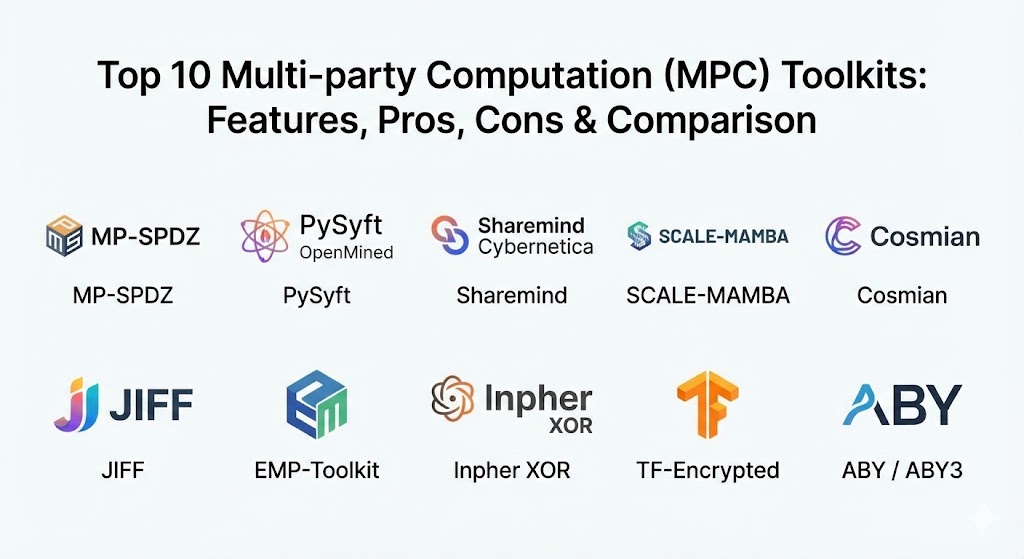
Top 10 Multi-party Computation (MPC) Toolkits
1 — MP-SPDZ
Often described as the “Swiss Army Knife” of the MPC world, MP-SPDZ is a versatile research-oriented framework that supports a massive variety of cryptographic protocols. It is the gold standard for benchmarking different MPC methods in a single environment.
- Key features:
- Supports over 40 different protocol variants (SPDZ, MASCOT, Overdrive, etc.).
- Compiles high-level Python-like programs into MPC circuits.
- Supports both arithmetic and boolean computation.
- Highly optimized for machine learning training and inference.
- Flexible security models, including “malicious” and “semi-honest” settings.
- Capable of handling both honest and dishonest majorities.
- Pros:
- Unmatched flexibility for researchers testing multiple cryptographic backends.
- Excellent performance for complex mathematical operations.
- Cons:
- Steep learning curve for non-cryptographers.
- Documentation is dense and geared toward academic users.
- Security & compliance: Supports malicious security (active adversaries); compliance varies based on implementation.
- Support & community: Extremely active GitHub community; widely cited in peer-reviewed academic literature.
2 — PySyft (by OpenMined)
PySyft is a leading library for “Remote Data Science” that decouples data from model training. It is designed to make privacy-preserving machine learning accessible to Python developers who aren’t necessarily cryptography experts.
- Key features:
- Native integration with PyTorch and NumPy workflows.
- Combines MPC with Differential Privacy and Federated Learning.
- “Data Room” abstraction for managing data access permissions.
- High-level API that abstracts away the underlying cryptography.
- Supports secure data aggregation for multi-owner datasets.
- Integrated audit logs for all data requests.
- Pros:
- The best “developer experience” (DX) in the privacy-tech space.
- Massive, mission-driven community focused on “Social Good” AI.
- Cons:
- Performance overhead is higher than C++ based toolkits.
- Some advanced MPC protocols are still in the experimental phase.
- Security & compliance: Designed for GDPR/HIPAA-compliant data science; includes granular audit logs.
- Support & community: Vibrant Discord community, extensive video tutorials, and active OpenMined courses.
3 — Sharemind (by Cybernetica)
Sharemind is one of the most mature commercial MPC platforms in existence. Developed in Estonia, it focuses on high-performance data analytics and has been used in actual government and financial deployments.
- Key features:
- Specialized language (SecreC) for writing secure algorithms.
- Optimized for processing large-scale databases and “big data.”
- Hardware-accelerated components for increased throughput.
- Built-in tools for secure data collection and cleaning.
- Support for high-availability production clusters.
- Pros:
- Proven track record in real-world, large-scale deployments.
- Highly professional tooling and enterprise-grade documentation.
- Cons:
- Closed-core components; the full enterprise suite is a commercial product.
- Learning the SecreC language adds an extra step for developers.
- Security & compliance: ISO 27001, SOC 2, and GDPR compliant; focused on “Privacy-by-Design.”
- Support & community: Professional enterprise support with SLA options; strong academic foundation.
4 — SCALE-MAMBA
SCALE-MAMBA is a high-assurance MPC framework from KU Leuven. It is designed specifically for “actively secure” (malicious) computation, making it ideal for environments where you cannot trust any of the participants.
- Key features:
- Strict focus on malicious security with an honest majority or dishonest majority.
- MAMBA compiler translates Python-like code into byte-code for the SCALE engine.
- Optimized for modular arithmetic and finite field operations.
- Comprehensive preprocessing phase for faster “online” computation.
- Support for secret-shared integers and fixed-point numbers.
- Pros:
- One of the most robust systems for resisting active hacking attempts during computation.
- Highly respected in the cryptographic community for its theoretical soundness.
- Cons:
- Configuration is complex and requires deep hardware/network knowledge.
- Not as “friendly” for quick prototyping as PySyft.
- Security & compliance: Military-grade security; meets FIPS 140-2 requirements in specific configurations.
- Support & community: Maintained by top-tier academic researchers; documentation is technically rigorous.
5 — Cosmian
Cosmian is a modern, enterprise-focused PETs platform that integrates MPC into standard business workflows. It is built for speed and ease of integration with existing Java and Rust ecosystems.
- Key features:
- Seamless integration with Spark and SQL-based environments.
- Dynamic masking and searchable encryption alongside MPC.
- Developer-friendly SDKs for Java, Python, and Rust.
- Web-based interface for managing cryptographic keys and policies.
- Performance-optimized for real-time risk scoring and fraud detection.
- Pros:
- Excellent for “Real-world IT” where legacy systems must talk to MPC layers.
- Modern, clean documentation and fast onboarding for corporate teams.
- Cons:
- Commercial licensing required for many enterprise features.
- Newer than some of the academic stalwarts like MP-SPDZ.
- Security & compliance: SOC 2, GDPR, and HIPAA compliant; provides full auditability of all computations.
- Support & community: Professional 24/7 support for enterprise clients; active technical blog.
6 — JIFF (JavaScript Interactive Framework for Fingertips)
JIFF is a unique, web-centric MPC framework that allows secure computation to happen directly in a user’s web browser. It is perfect for decentralized web apps (dApps) and user-to-user collaboration.
- Key features:
- 100% JavaScript implementation; runs in any modern browser or Node.js.
- Client-server or peer-to-peer (P2P) computation models.
- Dynamic party management (users can join or leave during computation).
- Extensible via a plugin architecture (e.g., for Bignum support).
- Lightweight enough for mobile web applications.
- Pros:
- Lowest barrier to entry for web developers.
- No specialized server hardware required; users provide the “compute.”
- Cons:
- JavaScript performance is significantly slower than C++ alternatives for heavy math.
- Network latency in browser-based P2P can be a bottleneck.
- Security & compliance: Varies / N/A; depends on the web application’s overall security architecture.
- Support & community: Maintained by Boston University researchers; active GitHub and academic wiki.
7 — EMP-Toolkit
EMP (Efficient Multi-Party) Toolkit is a C++ based framework designed for performance junkies. It is highly modular and provides some of the fastest implementations of Garbled Circuits and Oblivious Transfer (OT).
- Key features:
- Specialized libraries for 2-party (2PC) and multi-party (MPC) computation.
- Optimized for low-latency network environments.
- Support for both semi-honest and malicious adversary models.
- High-level abstractions for common boolean and arithmetic circuits.
- Extensively used as a foundation for other high-performance libraries.
- Pros:
- Blazing fast execution times compared to higher-level frameworks.
- Modular design allows developers to use only the primitives they need.
- Cons:
- Requires strong C++ proficiency and a solid grasp of cryptography.
- Minimal GUI or “dashboard” elements; it is purely a developer’s toolkit.
- Security & compliance: Technically rigorous security proofs; compliance is implementer-defined.
- Support & community: Widely used in the research community; supported via GitHub and academic collaboration.
8 — Inpher XOR
Inpher’s XOR platform is a commercial-first solution designed to make “Secret Computing” accessible to the non-cryptographer. It features a graphical interface that allows data analysts to run MPC queries without writing code.
- Key features:
- Graphical IDE for designing secure data workflows.
- Seamless integration with existing BI tools (Tableau, PowerBI).
- Automated protocol selection based on security and performance needs.
- Secure connectors for AWS S3, Azure Blob, and Snowflake.
- High-performance engine capable of processing millions of rows.
- Pros:
- The most “accessible” tool for data analysts and business users.
- Enterprise-ready deployment with full security and monitoring suites.
- Cons:
- Proprietary software with a high price point for small businesses.
- “Black box” nature might be a turn-off for hard-core crypto researchers.
- Security & compliance: SOC 2 Type II, HIPAA, and GDPR compliant.
- Support & community: Top-tier professional support, dedicated success managers, and training programs.
9 — TF-Encrypted
TF-Encrypted is a specialized library for the AI community. It allows researchers to run TensorFlow models on encrypted data, leveraging MPC to ensure that neither the model nor the data is exposed.
- Key features:
- Familiar TensorFlow-style API for defining models.
- Supports secure training and secure inference (prediction).
- Integrated with Keras for high-level model building.
- Pluggable MPC backends (e.g., Pond protocol).
- Specifically optimized for deep learning operations like convolutions.
- Pros:
- Essential for “AI-as-a-Service” providers who need to prove privacy.
- Allows the use of standard AI talent without retraining them on cryptography.
- Cons:
- Restricted to the TensorFlow ecosystem; no native PyTorch support.
- Deep learning on MPC is computationally expensive and slow for massive models.
- Security & compliance: Supports various encryption standards; designed for GDPR-compliant AI.
- Support & community: Active GitHub community; helpful documentation for data scientists.
10 — ABY / ABY3
ABY (Arithmetic, Boolean, Yao) is a foundational framework for mixed-protocol computation. It allows developers to switch between different cryptographic modes to find the optimal balance of speed and security.
- Key features:
- Efficient conversion between Arithmetic, Boolean, and Yao’s Garbled Circuits.
- Optimized for 2-party (ABY) and 3-party (ABY3) scenarios.
- Highly cited for its performance benchmarks in secure ML.
- Minimal communication overhead for protocol switching.
- Open-source C++ implementation.
- Pros:
- Extremely efficient for applications that need both fast math and fast logic.
- The “gold standard” for academic benchmarking of mixed-protocol MPC.
- Cons:
- Development has slowed on the original ABY in favor of newer derivatives.
- Low-level API makes it difficult for beginners to use.
- Security & compliance: Supports Semi-honest security models (honest-but-curious).
- Support & community: Strong academic community; primarily supported through university research labs and GitHub.
Comparison Table
| Tool Name | Best For | Platform(s) Supported | Standout Feature | Rating (Gartner/Research) |
| MP-SPDZ | Cryptography Research | Linux / Pythonish | 40+ Protocol Support | 4.8 / 5 |
| PySyft | AI & Data Science | Python / Cross-platform | Remote Data Abstraction | 4.7 / 5 |
| Sharemind | Gov & Finance | Linux / SecreC | Mature Production Record | 4.5 / 5 |
| SCALE-MAMBA | High-Stakes Security | Linux / C++ | Malicious Security Focus | 4.4 / 5 |
| Cosmian | Enterprise Integration | Java / Rust / SaaS | Modern Developer DX | 4.6 / 5 |
| JIFF | Browser-based Apps | JavaScript / Web | Browser-native execution | 4.3 / 5 |
| EMP-Toolkit | Performance Benchmarking | C++ / Linux | Optimized OT & GC | 4.5 / 5 |
| Inpher XOR | Data Analysts | Graphical UI / SaaS | No-code MPC interface | 4.6 / 5 |
| TF-Encrypted | TensorFlow Projects | Python / TensorFlow | Encrypted ML Inference | 4.3 / 5 |
| ABY / ABY3 | Mixed-Protocol Research | C++ / Linux | Efficient Protocol Switching | 4.2 / 5 |
Evaluation & Scoring of Multi-party Computation (MPC) Toolkits
The following table evaluates the toolkits based on their readiness for industrial and research use in 2026.
| Category | Weight | Evaluation Criteria |
| Core Features | 25% | Protocol variety, support for malicious security, and “MPC-aware” compilers. |
| Ease of Use | 15% | Quality of the API, availability of high-level languages (Python/JS), and GUI. |
| Integrations | 15% | Compatibility with Spark, TensorFlow, PyTorch, and cloud data warehouses. |
| Security & Compliance | 10% | Verified security proofs, SOC 2/GDPR alignment, and audit trails. |
| Performance | 10% | Execution speed, communication efficiency, and network latency resilience. |
| Support & Community | 10% | Documentation quality, GitHub activity, and professional support availability. |
| Price / Value | 15% | Cost of entry vs. the level of security and convenience provided. |
Which Multi-party Computation (MPC) Toolkit Is Right for You?
The decision-making process for an MPC toolkit is inherently a trade-off between security depth and developer speed.
- Solo Researchers & Academics: Your first stop should be MP-SPDZ. Its ability to toggle between dozens of protocols makes it indispensable for writing papers and benchmarking.
- Small Developers & Startups: If you are building a web-based app or dApp, JIFF is the path of least resistance. For data science startups, PySyft is the industry standard.
- Mid-Market Enterprise Teams: If you need to solve a specific problem like “Secure Fraud Detection” quickly, Cosmian or Inpher XOR are the best choices because they offer professional support and easy integration with existing Java/SQL stacks.
- High-Security Financial & Gov Agencies: You require malicious security and a proven track record. Sharemind and SCALE-MAMBA are the most hardened options available.
- AI & Machine Learning Specialists: Choose based on your library of choice. TensorFlow users should go with TF-Encrypted, while PyTorch users should stick with PySyft.
Frequently Asked Questions (FAQs)
1. Is MPC faster than regular computing? No, MPC is significantly slower (often 100x to 1,000,000x slower) because of the massive network communication overhead and cryptographic processing. It is used for privacy, not for speed.
2. Can I use MPC to process billions of rows of data? Technically yes, but it requires massive infrastructure. Most real-world MPC is currently used for smaller, high-value datasets or simple aggregate statistics (like sums, averages, or intersections).
3. What is “Semi-honest” vs “Malicious” security? “Semi-honest” (honest-but-curious) assumes parties follow the rules but try to learn secrets from the traffic. “Malicious” security assumes parties may cheat or send fake data to break the system.
4. Do I need specialized hardware like SGX for MPC? No. One of the main benefits of MPC is that it is purely math-based and can run on standard CPUs. However, some tools like Sharemind can use hardware acceleration to boost performance.
5. How is MPC different from Fully Homomorphic Encryption (FHE)? FHE allows one party to compute on encrypted data alone. MPC requires multiple parties to talk to each other to complete the computation. MPC is generally faster but requires more network traffic.
6. Can MPC protect against “garbage in, garbage out”? MPC ensures the privacy of the input, but it doesn’t naturally ensure the accuracy of the data. However, “actively secure” MPC can prove that a party followed the protocol correctly.
7. Is MPC legal under GDPR? Yes, MPC is widely considered a form of “Privacy-by-Design.” It helps organizations comply with data minimization and protection requirements by ensuring raw personal data is never shared.
8. What is “Private Set Intersection” (PSI)? PSI is a common use of MPC where two parties want to find the common items in their lists (like matching customer databases) without revealing the items that aren’t in common.
9. Can MPC be used for secure voting? Yes, voting is one of the classic use cases. MPC allows a system to count votes while ensuring no one knows who voted for whom, and it can be verified mathematically.
10. What is a “threshold” in MPC? A threshold (e.g., “2 out of 3”) means that you need a certain number of the participating servers to be honest for the system to remain secure.
Conclusion
Multi-party Computation has transitioned from a cryptographic dream to a practical enterprise tool. In 2026, the choice of a toolkit is no longer just about which math you prefer, but how that math fits into your production pipeline. Whether you are using the academic flexibility of MP-SPDZ, the AI-focus of PySyft, or the enterprise polish of Inpher XOR, the goal remains the same: unlocking the value of data without compromising the privacy of the individual. As the technology matures, expect these tools to become even more integrated into the standard “DevSecOps” stack.