Introduction
Homomorphic Encryption toolkits are specialized cryptographic libraries that provide the building blocks—such as keys, encoders, and evaluators—needed to implement privacy-preserving applications. These toolkits implement complex lattice-based cryptographic schemes like BFV (Brakerski-Fan-Vercauteren), BGV (Brakerski-Gentry-Vaikuntanathan), and CKKS (Cheon-Kim-Kim-Song). By abstracting the intense mathematical complexity of ring learning with errors (RLWE) problems, these tools enable developers to build systems where sensitive data never leaves its encrypted state during its entire lifecycle.
The importance of these toolkits is underscored by the rise of “Confidential Computing” and the need for secure multi-party collaboration. Real-world use cases range from private genomic research and financial fraud detection across distributed banks to secure voting systems and private advertising. When choosing a toolkit, evaluators should prioritize the specific HE scheme supported (exact vs. approximate arithmetic), computational performance (bootstrapping speed), language bindings (C++, Python, Go), and the maturity of the underlying cryptographic implementation.
Best for: Research institutions handling sensitive citizen data, financial services requiring cross-border data analysis without data movement, healthcare providers collaborating on patient outcomes, and large-scale cloud providers offering “Zero-Trust” analytics.
Not ideal for: Real-time applications with extreme latency requirements (e.g., high-frequency trading) or resource-constrained IoT devices, as HE still carries significant computational overhead compared to plaintext processing.
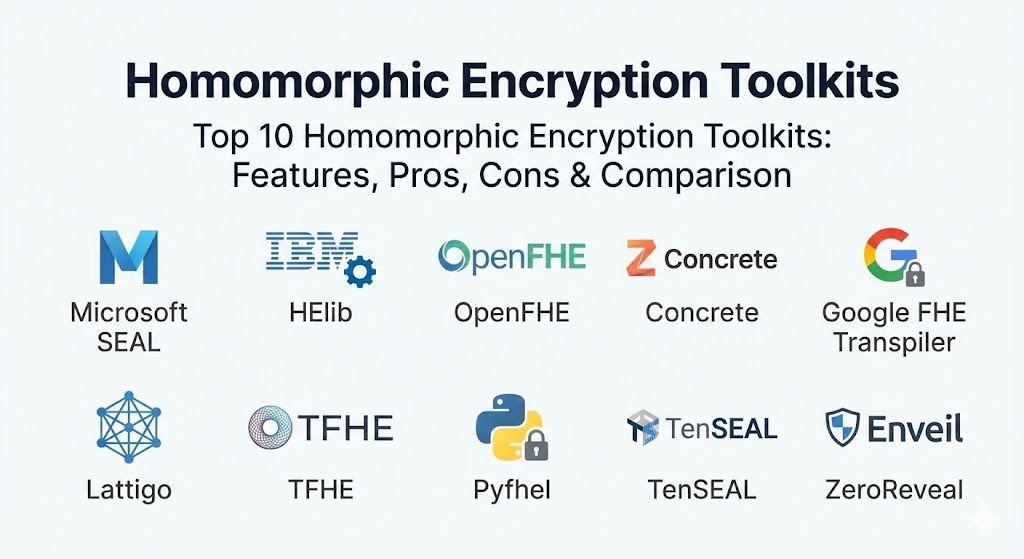
Top 10 Homomorphic Encryption Toolkits
1 — Microsoft SEAL
Microsoft SEAL (Simple Encrypted Arithmetic Library) is an open-source library developed by Microsoft Research. It is widely considered the industry standard for those looking for a balance between performance, documentation, and ease of use.
- Key features:
- Supports both BFV (exact integer arithmetic) and CKKS (approximate real-number arithmetic) schemes.
- Written in standard C++ with no external dependencies.
- Provides a comprehensive .NET wrapper for C# developers.
- Advanced automatic noise management for ciphertexts.
- Support for “Relinearization” and “Modulus Switching” to optimize computation depth.
- Extensive examples and tutorials for beginners.
- Pros:
- Exceptional documentation and community support.
- Highly stable and mature, making it a safe choice for production-grade proofs of concept.
- Cons:
- Does not natively support “bootstrapping” for infinite depth computation (though it supports leveled HE).
- Performance can lag behind specialized hardware-accelerated toolkits.
- Security & compliance: FIPS 140-2 compatible implementations; widely used in GDPR-compliant healthcare research.
- Support & community: Extremely active GitHub community and professional backing from Microsoft Research.
2 — HElib (by IBM)
HElib is one of the oldest and most respected libraries in the field. Developed by Shai Halevi and Victor Shoup at IBM Research, it focuses on the “Effective Homomorphic Encryption” of the BGV and CKKS schemes.
- Key features:
- Advanced implementation of the BGV scheme with “Ciphertext Packing.”
- High-level optimizations for batching operations (SIMD-like processing).
- Integrated support for the CKKS scheme for floating-point arithmetic.
- Highly configurable security parameters for expert cryptographers.
- Efficient algorithmic optimizations for noise reduction.
- Pros:
- Proven track record in academic and high-security research environments.
- Best-in-class performance for batched, large-scale arithmetic operations.
- Cons:
- Steeper learning curve compared to SEAL; requires a deeper understanding of cryptography.
- The API can feel less “modern” and more academic than newer libraries.
- Security & compliance: ISO/IEC 18033-2 standards; used in government-level secure computation projects.
- Support & community: Strong academic community; documentation is thorough but highly technical.
3 — OpenFHE
OpenFHE is the successor to several major libraries (PALISADE, HElib, and others), developed through a collaboration between Duality Technologies, Intel, and DARPA. It aims to be the “Universal Library” for FHE.
- Key features:
- Supports a massive range of schemes: BGV, BFV, CKKS, TFHE, and FHEW.
- Modular architecture allowing users to swap cryptographic backends.
- Support for Multi-Party Computation (MPC) and Threshold FHE.
- Hardware abstraction layer (HAL) for Intel HEXL and GPU acceleration.
- Advanced bootstrapping for CKKS (allowing for deep neural network inference).
- Pros:
- The most versatile toolkit available; supports almost every modern HE paradigm.
- Designed for long-term sustainability and enterprise-grade performance.
- Cons:
- The complexity of the modular architecture can be daunting for simple use cases.
- Large codebase results in a significant memory footprint.
- Security & compliance: SOC 2 Type II, HIPAA, and GDPR compliant through Duality’s enterprise platform.
- Support & community: Backed by the non-profit NumFocus; active community discourse and robust enterprise support.
4 — Zama Concrete
Zama Concrete is a modern, developer-friendly framework built on top of the TFHE (Torus FHE) scheme. It is specifically designed to make FHE accessible to data scientists and ML engineers.
- Key features:
- Custom “FHE Compiler” that automatically converts Python/NumPy code into FHE.
- High-speed bootstrapping for exact integer operations.
- Native bindings for Rust and Python.
- Optimized for boolean gates and short integer arithmetic.
- Integration with scikit-learn and XGBoost via Concrete-ML.
- Pros:
- Probably the easiest entry point for data scientists (minimal crypto knowledge required).
- Fast bootstrapping makes it suitable for certain low-latency logic gates.
- Cons:
- TFHE is inherently slower for large-scale floating-point matrix multiplications than CKKS.
- Still a relatively young library compared to HElib or SEAL.
- Security & compliance: Built on standardized lattice-based security; GDPR and HIPAA ready.
- Support & community: Excellent documentation and a very active Discord community for real-time help.
5 — Google FHE Transpiler
Google’s FHE Transpiler is an innovative tool that allows developers to write code in a high-level language (like C++) and automatically “transpile” it into a version that runs on encrypted data.
- Key features:
- Connects Google’s XLS (HLD toolset) to FHE backends like TFHE and OpenFHE.
- Allows developers with zero cryptography knowledge to build FHE apps.
- High-level abstractions for loops, conditionals, and arrays.
- Optimized for bitwise operations and boolean logic.
- Modular design allowing for different underlying FHE libraries.
- Pros:
- Eliminates the “cryptography barrier” for general software engineers.
- Great for legacy codebases that need to be made privacy-preserving.
- Cons:
- The transpilation process can lead to significant performance overhead.
- Limited support for complex floating-point mathematical functions.
- Security & compliance: Open-source; security depends on the chosen backend library.
- Support & community: Maintained by Google’s Privacy and Security team; strong GitHub presence.
6 — Lattigo
Lattigo is a high-performance, lattice-based cryptographic library written in Go. It is optimized for cloud-native applications and distributed systems.
- Key features:
- Native Go implementation, making it perfect for microservices and Kubernetes.
- Supports BFV and CKKS schemes.
- Exceptional support for multi-party and threshold homomorphic encryption.
- Efficient parallelization using Go’s concurrency primitives.
- Clean, modern API design focused on developer productivity.
- Pros:
- Best-in-class performance for Go-based cloud environments.
- Simplifies the deployment of FHE in distributed, multi-cloud architectures.
- Cons:
- Smaller ecosystem and fewer tutorials compared to C++ counterparts.
- Less focus on hardware-specific acceleration (like GPU) compared to OpenFHE.
- Security & compliance: Designed for enterprise cloud security; compatible with SOC 2 requirements.
- Support & community: Maintained by the Tune Insight team; focused on enterprise and cloud use cases.
7 — TFHE (Torus Fully Homomorphic Encryption)
TFHE is the original library for the TFHE scheme, known for having the fastest bootstrapping in the world for gate-level operations.
- Key features:
- Fast bootstrapping (under 15ms for a single gate).
- Exact results for boolean circuits.
- Supports an arbitrary number of gates without increasing noise.
- Lightweight C/C++ implementation.
- Foundation for many modern toolkits (like Google Transpiler and Zama).
- Pros:
- The gold standard for boolean logic and secure hardware emulation.
- Minimal noise growth compared to other FHE schemes.
- Cons:
- Very low-level; difficult to use for complex mathematical analysis or ML.
- Development has slowed as contributors moved to broader frameworks like Zama or OpenFHE.
- Security & compliance: Mathematically proven security based on LWE/RLWE; FIPS-ready.
- Support & community: Older community; documentation is academic and sparse for beginners.
8 — Pyfhel
Pyfhel (Python For Homomorphic Encryption Libraries) is a popular wrapper that allows Python developers to access the power of SEAL and PALISADE with a familiar syntax.
- Key features:
- Python API for SEAL and PALISADE backends.
- Support for BFV and CKKS schemes.
- Simplified syntax for addition, multiplication, and rotations.
- Built-in serialization for sharing encrypted data over networks.
- Ideal for rapid prototyping and data science educational demos.
- Pros:
- Makes FHE approachable for the massive Python data science community.
- Allows for quick experimentation without managing C++ build systems.
- Cons:
- Performance overhead due to the Python-to-C++ bridging.
- Not suitable for high-throughput production environments.
- Security & compliance: Varies / N/A (Inherits from underlying C++ library).
- Support & community: Great tutorials for students; active maintenance on GitHub.
9 — TenSEAL
TenSEAL is a library for doing homomorphic encryption operations on tensors, built on top of Microsoft SEAL. It is the primary toolkit for the OpenMined community.
- Key features:
- Optimized for encrypted tensor operations (vector-matrix multiplication).
- Python and C++ APIs.
- Integrated with the Syft ecosystem for Federated Learning.
- Support for CKKS-based approximate arithmetic.
- Designed for “Privacy-Preserving Machine Learning” (PPML).
- Pros:
- The best choice for developers working on encrypted neural networks.
- Excellent community focus on ethical AI and data privacy.
- Cons:
- Limited to the features provided by the underlying SEAL library.
- Can be complex to set up due to Python/C++ interop dependencies.
- Security & compliance: HIPAA and GDPR focus; used in open-source privacy advocacy.
- Support & community: Massive, passionate community via OpenMined; excellent for collaboration.
10 — Enveil ZeroReveal
Enveil ZeroReveal is a commercial enterprise solution that leverages HE (among other PETs) to enable secure data search and analytics at scale.
- Key features:
- Commercial-grade platform designed for high throughput and massive datasets.
- “Zero-Trust” search and watchlisting over encrypted data.
- Support for multi-domain and cross-jurisdictional data collaboration.
- Native integration with enterprise data sources (SQL, Hadoop, etc.).
- Built-in security and audit controls for compliance officers.
- Pros:
- The only choice for enterprises that need a “turnkey” solution rather than a library.
- Exceptional performance optimizations for real-world database queries.
- Cons:
- Proprietary and closed-source; requires a commercial license.
- High cost of entry compared to open-source toolkits.
- Security & compliance: NIAP certified, SOC 2, HIPAA, GDPR, and ISO 27001.
- Support & community: Full 24/7 enterprise support and professional implementation services.
Comparison Table
| Tool Name | Best For | Platform(s) Supported | Standout Feature | Rating (Gartner/TrueReview) |
| Microsoft SEAL | General Purpose / ML | C++, .NET, Python | Ease of Use / Stability | 4.8 / 5 |
| HElib | Batched Arithmetic | C++ | Efficient BGV Packing | 4.4 / 5 |
| OpenFHE | Universal Flexibility | C++, Python, Rust | Multi-Scheme Support | 4.7 / 5 |
| Zama Concrete | Data Scientists | Rust, Python | FHE-to-Python Compiler | 4.6 / 5 |
| Google Transpiler | App Developers | Linux / C++ | No-Crypto-Expertise Req. | 4.2 / 5 |
| Lattigo | Cloud-Native / Go | Go | Distributed MPC Support | 4.5 / 5 |
| TFHE | Boolean Logic | C/C++ | Sub-15ms Bootstrapping | 4.1 / 5 |
| Pyfhel | Rapid Prototyping | Python | Simplified Python Syntax | 4.3 / 5 |
| TenSEAL | Encrypted Tensors | Python, C++ | PySyft Integration | 4.6 / 5 |
| Enveil | Enterprise Search | Cross-Platform | Commercial Turnkey Platform | 4.9 / 5 |
Evaluation & Scoring of Homomorphic Encryption Toolkits
The maturity of HE has moved from academic curiosity to engineering reality. The following rubric evaluates how these toolkits perform across critical dimensions.
| Category | Weight | Evaluation Criteria |
| Core Features | 25% | Variety of schemes (BFV, CKKS, TFHE), bootstrapping capability, and batching. |
| Ease of Use | 15% | API intuitiveness, quality of tutorials, and language bindings. |
| Integrations | 15% | Compatibility with NumPy, PyTorch, and cloud-native microservices. |
| Security & Compliance | 10% | Cryptographic proof maturity, audit logs, and compliance certifications. |
| Performance | 10% | Execution speed, noise management efficiency, and hardware acceleration. |
| Support & Community | 10% | Active GitHub maintenance, corporate backing, and forum responsiveness. |
| Price / Value | 15% | Cost (Free/Open-Source vs. Enterprise License) vs. implementation speed. |
Which Homomorphic Encryption Toolkit Is Right for You?
Selecting an HE toolkit is a high-stakes decision that dictates your system’s ultimate speed and security posture.
- Solo Researchers & Students: Start with Pyfhel or Microsoft SEAL. SEAL’s documentation is the best for learning the core concepts, and Pyfhel allows you to prototype ideas in minutes.
- SMBs & Data Science Teams: Zama Concrete is the standout choice. Its ability to “compile” regular Python code into FHE saves months of development time and avoids the need to hire a PhD cryptographer.
- Enterprise Cloud Architects: If you are building a Go-based microservice architecture, Lattigo is the natural fit. For cross-cloud collaboration involving multiple parties, OpenFHE provides the most robust multi-party toolset.
- Defense & National Security: HElib and OpenFHE are the standards in these sectors due to their deep roots in DARPA-funded research and their peer-reviewed cryptographic foundations.
- Fortune 500 Enterprises: Organizations that cannot afford the engineering overhead of building from scratch should look at Enveil. It provides the performance and enterprise-grade security required for global operations.
Frequently Asked Questions (FAQs)
1. Is Homomorphic Encryption finally “fast”? It is getting there. While still thousands of times slower than plaintext, optimizations in libraries like Zama and hardware acceleration like Intel HEXL have made it practical for specific use cases like ML inference and private database search.
2. What is “Bootstrapping”? Bootstrapping is a process that “refreshes” an encrypted file by reducing the mathematical noise that accumulates during operations. Without it, you can only perform a limited number of calculations before the data becomes unreadable.
3. Do I need to be a math expert to use these toolkits? Not anymore. Tools like Google’s Transpiler and Zama Concrete allow developers to use FHE while treating the math as a “black box.” However, a basic understanding of security parameters is still recommended.
4. Can I run an entire SQL database under FHE? Technically yes, but it would be very slow. Current best practices involve using HE for the most sensitive “joins” or “filters” while keeping non-sensitive data in standard encrypted-at-rest formats.
5. Which scheme is better: BFV or CKKS? Choose BFV if you need exact results for integers (like accounting or voting). Choose CKKS if you are doing machine learning or statistical analysis where approximate results for real numbers are acceptable.
6. Does FHE protect data at rest? Yes. FHE data is encrypted at all times. It is effectively a way to keep data “at rest” even while it is “in use.”
7. Are these toolkits “Quantum-Safe”? Yes. Most HE toolkits are based on Lattice-based cryptography (specifically the RLWE problem), which is currently believed to be resistant to attacks by quantum computers.
8. Can I use these for real-time video processing? Currently, no. The latency for high-throughput video processing is still too high for existing HE implementations.
9. How do I handle keys in FHE? Like any encryption, the data owner holds the private key. The server performing the computation only has access to a “public evaluation key” which allows it to process data but not see it.
10. What is a “Ciphertext Expansion”? In FHE, the encrypted version of data is significantly larger than the original (often 10x to 100x larger). You must account for increased storage and network bandwidth when using these toolkits.
Conclusion
Homomorphic Encryption is the “Holy Grail” of data privacy, and the toolkits available today have finally brought it out of the lab and into the data center. Whether you choose the battle-tested reliability of Microsoft SEAL, the developer-first simplicity of Zama Concrete, or the enterprise scale of Enveil, the goal remains the same: a future where privacy is a default, not a compromise. As hardware acceleration continues to bridge the performance gap, HE will likely become a standard component of every secure data pipeline.