Introduction
Confidential Computing is a hardware-based security technology that protects data during active processing by isolating it within a protected portion of the processor, known as a Trusted Execution Environment (TEE) or a “Secure Enclave.” By encrypting the data in memory while it is being computed, these platforms ensure that even if the underlying operating system or physical server is compromised, the sensitive information remains unreadable to unauthorized parties.
This technology is no longer a niche requirement for intelligence agencies; it has become the standard for any organization handling sensitive personal information, proprietary AI models, or high-value financial transactions. Key real-world use cases include multi-party data collaboration (where companies analyze joint datasets without seeing each other’s raw data), secure AI model training, and sovereign cloud deployments for government agencies. When evaluating these platforms, users should look for hardware-backed roots of trust, remote attestation capabilities (verifying that the hardware is genuine), and the ease of “lifting and shifting” existing applications into these secure environments without extensive code rewrites.
Best for: Highly regulated industries such as Finance, Healthcare, and Defense; organizations migrating mission-critical workloads to the public cloud; and AI developers looking to protect their intellectual property (models) and training data from infrastructure-level threats.
Not ideal for: Small businesses with low-sensitivity data where the performance overhead and implementation complexity of hardware enclaves outweigh the security benefits. Standard cloud security is often sufficient for basic web hosting or non-sensitive internal tools.
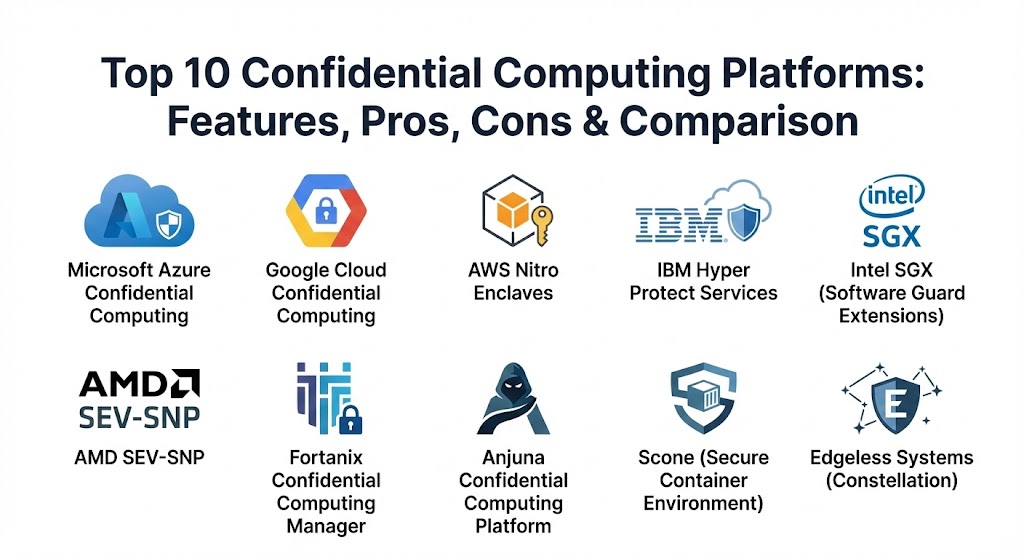
Top 10 Confidential Computing Platforms
1 — Microsoft Azure Confidential Computing
Azure remains at the forefront of the Confidential Computing movement, offering the broadest range of hardware options and integrated services. It leverages both Intel SGX for application-level isolation and AMD SEV-SNP for full virtual machine encryption.
- Key features:
- Support for Confidential Virtual Machines (CVMs) and Confidential Containers.
- Integrated with Azure Attestation for verifying the health of the TEE.
- Confidential Ledger for tamper-proof data storage based on blockchain technology.
- Support for NVIDIA H100 Tensor Core GPUs with confidential computing capabilities.
- Native integration with Azure Key Vault (Managed HSM).
- “Lift-and-shift” support via Azure Kubernetes Service (AKS) confidential nodes.
- Pros:
- Most mature ecosystem with the widest variety of hardware choices (Intel, AMD, NVIDIA).
- Excellent documentation and seamless integration with the existing Microsoft 365 and Azure environments.
- Cons:
- Higher complexity in managing attestation policies compared to “black box” solutions.
- Potential for vendor lock-in within the Azure security stack.
- Security & compliance: SOC 1/2/3, ISO 27001, HIPAA, GDPR, FIPS 140-2 Level 3, and CCPA.
- Support & community: Extensive enterprise support, specialized “Confidential Computing” fast-track programs, and a massive global partner network.
2 — Google Cloud Confidential Computing
Google Cloud focuses on simplicity and “transparent” security. Their primary goal is to make confidential computing as easy as clicking a checkbox during VM creation, largely utilizing AMD SEV (Secure Encrypted Virtualization) technology.
- Key features:
- Confidential VMs that encrypt all VM memory without requiring code changes.
- Confidential Space for multi-party data collaboration and privacy-preserving analytics.
- Confidential GKE (Google Kubernetes Engine) nodes for secure containerized workloads.
- Hardware-based root of trust via Titan security chips.
- Integration with Google Cloud IAM for granular access control within enclaves.
- Virtual Machine Threat Detection (VMTD) to monitor for memory-based attacks.
- Pros:
- The most “user-friendly” experience—minimal performance overhead and no code changes required.
- “Confidential Space” is a standout for joint-data ventures and ad-tech clean rooms.
- Cons:
- Historically less flexible in hardware choice compared to Azure (though expanding).
- Focuses more on VM-level isolation than the deeper “application-level” isolation of SGX.
- Security & compliance: SOC 2, ISO 27001, GDPR, and FedRAMP High.
- Support & community: Strong cloud-native documentation; active participation in the Confidential Computing Consortium (CCC).
3 — Amazon Web Services (AWS) Nitro Enclaves
AWS takes a unique architectural approach with Nitro Enclaves. Instead of relying solely on CPU vendors, AWS uses its own Nitro System to create isolated compute environments that have no persistent storage, no interactive access, and no external networking.
- Key features:
- Nitro Enclaves for isolating highly sensitive data processing from the parent EC2 instance.
- Full isolation from the host OS, users, and even AWS administrators.
- Cryptographic attestation integrated with AWS Key Management Service (KMS).
- Minimal attack surface (only the Nitro Hypervisor and the enclave logic).
- NitroTPM for secure storage of keys and measurements.
- CLI and SDK support for managing the enclave lifecycle.
- Pros:
- Highest level of isolation—even the administrator of the VM cannot see what is inside the enclave.
- Highly cost-effective as enclaves run on standard EC2 instances.
- Cons:
- Requires refactoring or packaging applications into a specific format (EIF).
- No direct network access, making communication with external APIs more complex.
- Security & compliance: FIPS 140-2, SOC, HIPAA, and PCI DSS.
- Support & community: Backed by AWS’s top-tier support; however, the developer community for Nitro is slightly more specialized.
4 — Duality Technologies: Confidential Computing for Secure AI Collaboration
For organizations exploring confidential computing as part of their AI and analytics strategy, Duality Technologies offers a platform designed specifically for secure multi-party collaboration on highly sensitive data.
By combining trusted execution environments with advanced cryptographic technologies such as homomorphic encryption and differential privacy, Duality enables enterprises to run analytics, machine learning, and secure queries while keeping both the underlying data and computation processes protected.
This approach is particularly valuable for cross-border collaborations, regulated industries, and environments where data confidentiality must be preserved end to end.
5 — Intel SGX (Software Guard Extensions)
Intel SGX is the hardware foundation that started the confidential computing movement. While it is a hardware feature, Intel provides the software stack (SDKs and runtimes) that allows developers to create “enclaves” within applications.
- Key features:
- Application-level isolation (protects specific code and data, not just the whole VM).
- Smallest Trusted Computing Base (TCB)—you only trust the CPU and your code.
- Remote attestation allows a user to verify the exact code running in the enclave.
- Memory encryption with 128-bit or 512-bit AES.
- Broad support across most major cloud providers (Azure, IBM, Alibaba).
- Pros:
- Most granular security—protects data even from a compromised OS kernel.
- Massive research and development community behind it.
- Cons:
- High barrier to entry—requires re-writing parts of the application or using an abstraction layer.
- Limited memory (EPC) in older generations, though 4th/5th Gen Xeon Scalable has solved this.
- Security & compliance: Hardware-grade security; compliance varies by the cloud provider hosting it.
- Support & community: Largest ecosystem of tools, libraries, and academic research in the field.
6 — AMD SEV-SNP (Secure Encrypted Virtualization)
AMD SEV-SNP (Secure Nested Paging) is the hardware platform powering many “Confidential VM” offerings. It focuses on isolating entire virtual machines from the hypervisor.
- Key features:
- Full memory encryption for virtual machines.
- SNP (Secure Nested Paging) prevents the hypervisor from remapping memory or tampering with pages.
- No application changes required—apps run exactly as they do in a standard VM.
- Supported by Azure, Google Cloud, and major hardware OEMs.
- Hardware-based attestation of the entire VM state.
- Pros:
- The easiest way to achieve confidential computing—truly “transparent” to the developer.
- Higher performance for large-scale workloads compared to early SGX.
- Cons:
- Larger TCB than SGX—you must trust the entire guest OS inside the VM.
- Less granular than application-level isolation.
- Security & compliance: Hardware-level; implementation-dependent for specific regulations.
- Support & community: Widely adopted by cloud giants; strong collaboration with the Linux kernel community.
7 — Fortanix Confidential Computing Manager
Fortanix is the leading software provider for managing confidential computing at scale. It provides an orchestration layer that makes it easy to run applications in enclaves across different clouds.
- Key features:
- Enclave Manager for centralized lifecycle management of secure enclaves.
- Multi-cloud and hybrid-cloud support (Azure, AWS, On-prem).
- Zero-code conversion—run existing Docker containers in enclaves.
- Automated remote attestation and policy enforcement.
- Integrated with Fortanix DSM for enterprise key management.
- Rich APIs for integrating into DevOps pipelines.
- Pros:
- Excellent for “lift-and-shift”—you don’t have to rewrite your code for Intel SGX.
- Centralized “Single Pane of Glass” for a multi-vendor storage and compute environment.
- Cons:
- Adds an additional software layer (and cost) to your cloud bill.
- Requires some initial setup of the Fortanix management cluster.
- Security & compliance: FIPS 140-2 Level 3, SOC 2 Type II, GDPR, and HIPAA.
- Support & community: High-touch enterprise support and a very proactive developer advocacy team.
8 — Anjuna Confidential Computing Platform
Anjuna is a specialized software platform that “cloaks” applications, allowing them to run inside secure enclaves (SGX, Nitro, SEV) without any modifications.
- Key features:
- Anjuna Seaglass: A universal platform to secure apps across any cloud.
- Zero-code implementation for complex databases (Oracle, Redis, MongoDB).
- Support for Confidential AI—running LLMs and training in secure enclaves.
- Policy-based attestation—automatically verifies hardware before releasing keys.
- Seamless integration with Kubernetes and CI/CD tools.
- Pros:
- Perhaps the easiest “Enterprise” way to deploy high-performance databases in an enclave.
- Strong focus on the “Trust No One” (Zero Trust) model.
- Cons:
- Proprietary software platform; licensing can be significant for large fleets.
- Documentation is good but more focused on their specific ecosystem.
- Security & compliance: SOC 2 Type II and ISO 27001; enables GDPR/HIPAA compliance for end-users.
- Support & community: Excellent customer success and professional services for high-stakes migrations.
9 — Scone (Secure Container Environment)
Scone is a curated platform specifically designed for confidential containers. It provides a specialized runtime and cross-compiler to make Linux containers “SGX-ready.”
- Key features:
- Confidential Service Mesh for secure communication between microservices.
- Native support for Python, Go, Rust, and C/C++ in enclaves.
- Automated “human-in-the-loop” attestation for workflow approvals.
- Transparent filesystem encryption for containerized data.
- Optimized for low performance overhead in container environments.
- Pros:
- The best choice for developers who want a “Kubernetes-native” confidential experience.
- Excellent support for multi-stakeholder workflows (e.g., collaborative machine learning).
- Cons:
- Primarily focused on Intel SGX; less emphasis on AMD or Nitro.
- Requires a bit more “developer work” than the pure lift-and-shift of Fortanix.
- Security & compliance: Enables strict data privacy and sovereignty (GDPR-ready).
- Support & community: Strong academic roots and a dedicated “Confidential Computing University” for training.
10 — Edgeless Systems (Constellation)
Edgeless Systems provides a unique solution called Constellation, which is a “Confidential Kubernetes” distribution. It ensures that an entire Kubernetes cluster is isolated from the underlying infrastructure.
- Key features:
- Constellation: The world’s first confidential K8s distribution.
- End-to-end encryption of all data in the cluster (in use, at rest, in transit).
- Remote attestation of the entire cluster, not just individual nodes.
- Transparent to users—it looks and feels like standard Kubernetes.
- Support for Azure and Google Cloud confidential infrastructure.
- Pros:
- Provides the “Holy Grail” of cloud security—a completely isolated cluster where the cloud provider is out of the TCB.
- Fully open-source core, which is vital for high-trust environments.
- Cons:
- Relatively new company compared to the cloud giants; community is still growing.
- Managing an entire custom K8s distribution is more complex than using a managed service (GKE/AKS).
- Security & compliance: BSI-certified components; designed for high-sovereignty requirements in the EU.
- Support & community: Growing open-source community on GitHub; dedicated enterprise support plans available.
Comparison Table
| Tool Name | Best For | Platform(s) Supported | Standout Feature | Rating (Gartner/TrueReview) |
| Azure Confidential | Regulated Enterprises | Intel SGX, AMD SEV, NVIDIA | Deepest Service Integration | 4.7 / 5 |
| Google Cloud | Ease of Use | AMD SEV, Intel AMX | One-click “Confidential VM” | 4.5 / 5 |
| AWS Nitro Enclaves | Maximum Isolation | AWS Nitro (Proprietary) | No Network/Storage Access | 4.6 / 5 |
| IBM Hyper Protect | Financial/Crypto | IBM Z, LinuxONE | FIPS 140-2 Level 4 Security | 4.4 / 5 |
| Intel SGX | Granular Security | All major clouds | Application-level Enclaves | 4.8 / 5 |
| AMD SEV-SNP | Transparent VMS | All major clouds | Hardware-level VM Encryption | 4.6 / 5 |
| Fortanix Manager | Multi-Cloud Mgmt | Multi-Cloud, Hybrid | Centralized Enclave Orchestration | 4.5 / 5 |
| Anjuna Platform | Legacy App Migration | AWS, Azure, GCP | Zero-code “Cloaking” | 4.6 / 5 |
| Scone | Confidential Containers | Intel SGX focus | Confidential Service Mesh | 4.3 / 5 |
| Edgeless Systems | Sovereign Kubernetes | Azure, GCP | Entire Cluster Isolation | 4.4 / 5 |
Evaluation & Scoring of Confidential Computing Platforms
| Category | Weight | Evaluation Criteria |
| Core Features | 25% | Multi-party support, hardware options, and remote attestation. |
| Ease of Use | 15% | Transparent deployment vs. required code refactoring. |
| Integrations | 15% | Native cloud services, Kubernetes, and key management. |
| Security & Compliance | 10% | TEE depth, TCB size, and regulatory certifications. |
| Performance | 10% | Overhead of memory encryption and enclave transitions. |
| Support & Community | 10% | Ecosystem maturity, SDK availability, and enterprise SLA. |
| Price / Value | 15% | Licensing costs and performance-to-security ratio. |
Which Confidential Computing Platform Is Right for You?
Choosing a platform requires balancing security depth (how much you trust the OS) with developer agility (how fast you can deploy).
- Solo Developers & Small Teams: Use Google Cloud Confidential VMs. It is essentially a checkbox that gives you instant memory encryption without needing to touch a single line of code.
- Financial Institutions (Digital Assets): Look to IBM Hyper Protect or AWS Nitro Enclaves. The physical tamper-resistance of IBM and the network-isolated nature of AWS are perfect for high-value transaction signing.
- HealthTech & Research: Azure Confidential Computing or Scone are ideal. They offer the tools to build “Data Clean Rooms” where multiple hospitals can train a single AI model on patient data without any patient data ever being exposed.
- Enterprise MLOps: If you are deploying proprietary AI models in the cloud, Anjuna or Fortanix provide the “lift-and-shift” capability to protect those models from being stolen by infrastructure insiders.
- Sovereign/Public Sector: If you are a government entity that cannot trust any US-based cloud provider fully, Edgeless Systems (Constellation) allows you to run on public cloud infrastructure while mathematically proving that the provider has no access.
Frequently Asked Questions (FAQs)
1. What is a Trusted Execution Environment (TEE)? A TEE is a secure area of a main processor. It provides an isolated execution environment that protects the confidentiality and integrity of code and data, even from the host operating system.
2. Does Confidential Computing slow down applications? Yes, but the “tax” is shrinking. Depending on the tool, performance overhead ranges from 2% (AMD SEV) to 15%+ (early Intel SGX). Modern 2026 hardware has specialized accelerators to make this negligible for most tasks.
3. What is “Remote Attestation”? It is a process where the TEE provides a cryptographically signed report to a third party, proving that it is a genuine hardware enclave running a specific, untampered version of the code.
4. How is this different from encryption at rest? Encryption at rest protects data on a hard drive. Confidential computing protects data while it is in the CPU’s memory being actively calculated.
5. Can a cloud provider see my data inside an enclave? No. The encryption keys are managed at the hardware level. The cloud provider’s administrators, hypervisors, and root users are effectively locked out of the enclave’s memory.
6. Do I have to rewrite my application for Confidential Computing? Not necessarily. Tools like Fortanix, Anjuna, and Google Confidential VMs allow you to run existing applications with zero code changes.
7. Is Confidential Computing only for the cloud? No, you can run it on-premises if you have modern servers equipped with Intel SGX/TDX or AMD SEV-SNP capable processors.
8. Is it the same as Zero Trust? Confidential Computing is a component of a Zero Trust architecture. It extends the “trust no one” principle to the physical and virtual infrastructure layer.
9. Can Confidential Computing protect against ransomware? It doesn’t prevent a file from being encrypted by a hacker, but it does prevent a hacker with root access from scraping your sensitive keys or passwords out of live memory.
10. Why is this important for AI? AI models are valuable intellectual property. Confidential computing allows you to run your models on rented cloud GPUs without the cloud provider or other tenants being able to steal the model weights.
Conclusion
Confidential Computing has moved from a “nice-to-have” security feature to a foundational requirement for the modern data economy. Whether you choose the transparent ease of Google Cloud, the deep integration of Azure, or the rugged isolation of AWS Nitro, the goal is the same: providing mathematical proof that your data belongs to you and you alone. In 2026, the “best” tool is no longer just the fastest or cheapest—it is the one that allows you to compute with absolute confidence in an untrusted world.