Introduction
A Secure Data Enclave is a hardware-protected execution environment that isolates sensitive code and data from the rest of the system. Think of it as a “black box” inside a computer’s processor. Even if an attacker gains full administrative (root) access to the operating system or the cloud provider’s infrastructure, they cannot see or modify what is happening inside the enclave. This is achieved through hardware-level encryption keys that are managed by the CPU itself, not by the software.
The importance of these tools lies in their ability to enable multi-party collaboration without sharing raw data. Key real-world use cases include financial institutions running anti-money laundering (AML) checks across shared datasets, healthcare providers training AI models on private patient records, and government agencies securing cryptographic keys. When choosing an enclave tool, users should evaluate attestation capabilities (verifying the hardware is genuine), ease of integration (whether code needs to be rewritten), and multi-cloud support.
Best for: Large enterprises in regulated sectors (FinTech, HealthTech), government contractors, and AI companies handling proprietary models or sensitive user data. It is essential for those adopting a “sovereign cloud” strategy.
Not ideal for: Small businesses with low-risk data or organizations that lack the technical expertise to manage hardware-level security primitives. For standard web hosting or public-facing blogs, traditional encryption is usually sufficient.
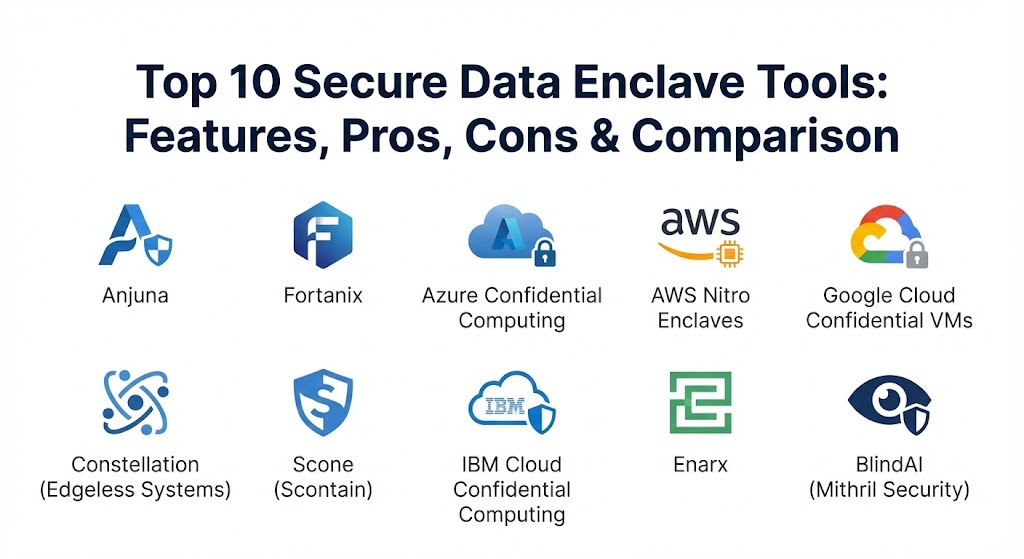
Top 10 Secure Data Enclave Tools
1 — Anjuna Confidential Computing Platform
Anjuna is a leading abstraction layer that makes confidential computing transparent. It allows enterprises to run existing applications—from databases to AI models—inside secure enclaves without requiring any code modifications.
- Key features:
- “Zero-code” implementation for custom and legacy applications.
- Unified management across AWS Nitro, Azure, and private data centers.
- Anjuna Seaglass for automated confidential containerization.
- Deep integration with Kubernetes and DevSecOps pipelines.
- Policy-based cryptographic attestation.
- Support for Intel SGX, AMD SEV, and AWS Nitro Enclaves.
- Pros:
- Eliminates the need for expensive, time-consuming code refactoring.
- Provides a consistent security posture across different cloud providers.
- Cons:
- Premium enterprise pricing may be steep for mid-market players.
- Requires a high level of initial configuration for complex network topologies.
- Security & compliance: FIPS 140-2, SOC 2, HIPAA, GDPR, and PCI DSS compatible.
- Support & community: Strong enterprise support; comprehensive technical documentation and white-glove onboarding.
2 — Fortanix Confidential Computing Manager
Fortanix is a pioneer in the space, offering a “Data-first” security approach. Their Confidential Computing Manager (CCM) provides a centralized dashboard to orchestrate and manage enclaves at scale.
- Key features:
- Centralized orchestration for enclaves across hybrid multi-cloud environments.
- Native integration with Fortanix DSM for secure key management.
- “Enclave OS” for converting standard containers into confidential ones.
- Remote attestation service to verify hardware and software integrity.
- Granular RBAC and visibility into enclave health.
- Automated workflow management for secure data ingestion.
- Pros:
- Excellent for organizations that also need advanced key management (KMS).
- Very strong visibility and auditing features for compliance teams.
- Cons:
- The UI can be complex for users who aren’t familiar with TEE (Trusted Execution Environment) concepts.
- Dependency on specific Intel SGX hardware in older versions.
- Security & compliance: FIPS 140-2 Level 3, GDPR, HIPAA, and SOC 2.
- Support & community: Active developer portal, extensive SDKs, and global enterprise support.
3 — Microsoft Azure Confidential Computing
Azure was a first mover in the public cloud space, offering a wide array of enclave-enabled virtual machines (VMs) powered by both Intel and AMD hardware.
- Key features:
- Azure Confidential VMs (CVMs) using AMD SEV-SNP.
- Application Enclaves using Intel SGX for granular isolation.
- Confidential Azure Kubernetes Service (AKS) nodes.
- Integrated “Azure Attestation” service.
- Hardware Security Modules (HSM) for key protection.
- Support for SQL Server Always Encrypted with enclaves.
- Pros:
- Most mature “native” cloud offering with deep ecosystem integration.
- “Lift and shift” capability for VMs via AMD SEV-SNP technology.
- Cons:
- Platform lock-in; managing Azure enclaves on other clouds is not native.
- Performance overhead can be noticeable on older SGX-based instances.
- Security & compliance: ISO 27001, SOC 2, HIPAA, GDPR, and FedRAMP.
- Support & community: Massive documentation library, active Microsoft Q&A forums, and premier support options.
4 — AWS Nitro Enclaves
AWS Nitro Enclaves provide isolated compute environments on top of EC2 instances. They are unique because they have no persistent storage, no interactive access (SSH), and no external networking.
- Key features:
- Hardened, isolated VMs with a secure local channel (vsock) to the parent.
- Cryptographic attestation integrated with AWS KMS.
- Support for any programming language or framework via Nitro Enclaves SDK.
- ACM (AWS Certificate Manager) for Nitro Enclaves to protect SSL/TLS keys.
- Processor agnostic (works on Intel, AMD, and Graviton).
- No additional cost for the feature (you only pay for the parent instance).
- Pros:
- Extremely high degree of isolation (even AWS admins cannot enter the enclave).
- Ideal for high-stakes cryptographic operations and private key storage.
- Cons:
- Highly restrictive; no networking or storage makes development challenging.
- Limited to the AWS ecosystem.
- Security & compliance: FIPS 140-2, HIPAA, PCI DSS, and SOC 1/2/3.
- Support & community: Excellent AWS documentation; strong support through AWS Support plans.
5 — Google Cloud Confidential VMs
Google takes a “simple by design” approach, focusing on making confidential computing a checkbox feature during VM creation.
- Key features:
- Simple one-click deployment for AMD SEV-enabled VMs.
- “Confidential Space” for multi-party data collaboration.
- Confidential GKE (Google Kubernetes Engine) nodes.
- Support for Intel TDX and NVIDIA H100 GPU-based enclaves.
- Integrated with Cloud Key Management Service.
- Transparent memory encryption with no code changes required.
- Pros:
- Lowest barrier to entry; requires virtually no technical changes.
- Performance impact is minimal (often less than 5%).
- Cons:
- Offers less granular control compared to Intel SGX app enclaves.
- Feature set is slightly less mature than Azure’s extensive portfolio.
- Security & compliance: SOC 2, HIPAA, GDPR, and ISO standards.
- Support & community: High-quality documentation and responsive technical support for GCP customers.
6 — Edgeless Systems (Constellation)
Constellation is a specialized platform that focuses on “Confidential Kubernetes.” It is the first tool to protect entire K8s clusters inside enclaves.
- Key features:
- Full-cluster encryption (data in use, at rest, and in transit).
- Remote attestation for the entire cluster state.
- Cloud-agnostic (runs on Azure, AWS, and GCP).
- Open-source core for transparency and trust.
- Automated node management within the secure environment.
- Pros:
- The only viable solution for companies needing a fully “confidential” K8s stack.
- Significant open-source transparency reduces “black box” concerns.
- Cons:
- Newer player; community and support ecosystem are still growing.
- Focused strictly on Kubernetes; not for standalone VM or app needs.
- Security & compliance: GDPR and SOC 2 ready; BSI (German Federal Office for Information Security) alignment.
- Support & community: Very active GitHub community and dedicated enterprise support for the commercial version.
7 — Scone (Scontain)
Scone is a platform designed specifically for securing containerized applications using Intel SGX. It is a favorite among researchers and cloud-native developers.
- Key features:
- SCONE CAS (Configuration and Attestation Service) for secret management.
- Cross-compilers for C, C++, Rust, Go, and Fortran.
- Transparent encryption of files and network traffic.
- Curated images for popular services (Redis, MongoDB, PyTorch).
- Support for both Docker and Kubernetes.
- Pros:
- Highly optimized for developers who want deep control over the enclave.
- Very strong for AI/ML workloads using secure PyTorch/TensorFlow.
- Cons:
- Requires recompilation or specific container images; not “zero-code.”
- Heavily tied to Intel SGX hardware.
- Security & compliance: Varies by implementation; focuses on FIPS-grade attestation.
- Support & community: Deep academic roots; excellent tutorials and research-oriented community.
8 — IBM Cloud Confidential Computing
IBM leverages its long history in mainframe security (Z systems) to offer some of the most “hardened” enclaves in the cloud market.
- Key features:
- IBM Cloud Hyper Protect Virtual Servers.
- Built on IBM Z and LinuxONE hardware with high-grade isolation.
- Tamper-proof Hardware Security Modules (HSMs).
- FIPS 140-2 Level 4 certification (highest available).
- Total privacy—even IBM administrators cannot access user data.
- Integrated Hyper Protect DBaaS (Database as a Service).
- Pros:
- The highest level of hardware security certification (Level 4).
- Ideal for high-value financial transactions and digital asset custody.
- Cons:
- Limited hardware choice (mostly IBM-proprietary).
- Integration with non-IBM ecosystems can be difficult.
- Security & compliance: FIPS 140-2 Level 4, HIPAA, GDPR, and ISO.
- Support & community: Professional services available; dedicated global enterprise support.
9 — Enarx
Enarx is a project under the Linux Foundation’s Confidential Computing Consortium. It is a framework for running applications in TEEs regardless of the underlying hardware.
- Key features:
- CPU-architecture independent (supports both Intel and AMD).
- Based on WebAssembly (Wasm) for portable, secure execution.
- No need to rewrite applications or use specific SDKs.
- Built with Rust for memory safety at the platform level.
- Open-source and vendor-neutral.
- Pros:
- Prevents vendor lock-in by abstracting different hardware enclaves.
- High level of security due to the WebAssembly sandbox.
- Cons:
- Still in the development/early-adoption phase compared to commercial tools.
- Performance of Wasm can be lower than native code for some workloads.
- Security & compliance: Open-source transparency; security-first Rust design.
- Support & community: Strong backing from the Linux Foundation and Confidential Computing Consortium.
10 — BlindAI (Mithril Security)
BlindAI is a specialized open-source tool designed for the secure deployment of AI models. It focuses on privacy-preserving inference.
- Key features:
- Optimized for LLMs and deep learning models inside enclaves.
- Built-in support for ONNX and Hugging Face models.
- End-to-end encryption from the user to the enclave.
- Remote attestation to prove the AI model hasn’t been tampered with.
- Rust-based core for maximum memory security.
- Pros:
- The best tool for companies needing “Confidential AI.”
- Allows users to chat with or use AI models without the provider seeing the data.
- Cons:
- Niche focus on AI/ML; not a general-purpose enclave manager.
- Documentation is currently more developer-centric.
- Security & compliance: GDPR compliant by design; open-source auditability.
- Support & community: Active Discord and GitHub community; specialized for the AI research world.
Comparison Table
| Tool Name | Best For | Platform(s) Supported | Standout Feature | Rating (Gartner/TrueReview) |
| Anjuna | Zero-code Enterprise | AWS, Azure, On-prem | Universal Abstraction | 4.8 / 5 |
| Fortanix CCM | Multi-cloud Orchestration | AWS, Azure, GCP, Intel | Centralized Management | 4.7 / 5 |
| Azure Confidential | Native Cloud Ecosystem | Microsoft Azure | Broadest Native Portfolio | 4.8 / 5 |
| AWS Nitro Enclaves | High-Stakes Crypto/KMS | Amazon AWS | Total Admin Isolation | 4.6 / 5 |
| Google Cloud | Ease of Deployment | Google Cloud | One-click Confidential VMs | 4.7 / 5 |
| Constellation | Confidential Kubernetes | Multi-cloud (K8s) | Whole-cluster Protection | 4.7 / 5 |
| Scone | Cloud-native Containers | Intel SGX, Docker | Scone CAS Attestation | 4.4 / 5 |
| IBM Hyper Protect | Max Hardening (FinServ) | IBM Z / LinuxONE | FIPS 140-2 Level 4 | 4.5 / 5 |
| Enarx | Vendor Neutrality | Linux Foundation | WebAssembly Runtime | N/A |
| BlindAI | Privacy-Preserving AI | AI Inference (SGX) | LLM Confidentiality | 4.5 / 5 |
Evaluation & Scoring of Secure Data Enclaves
| Category | Weight | Evaluation Criteria |
| Core Features | 25% | Attestation depth, “zero-code” support, and multi-protocol handling. |
| Ease of Use | 15% | Administrative UI clarity and developer friction (recompilation needs). |
| Integrations | 15% | Connection to KMS, Kubernetes, and popular DevOps toolchains. |
| Security | 10% | Hardware certifications (FIPS), isolation levels, and encryption depth. |
| Performance | 10% | Latency overhead and throughput impact on data-heavy workloads. |
| Support | 10% | Documentation, community activity, and enterprise SLA availability. |
| Price / Value | 15% | ROI regarding reduced breach risk vs. high platform costs. |
Which Secure Data Enclave Tool Is Right for You?
Selecting an enclave tool requires looking past the marketing and into the technical constraints of your stack.
- Solo Developers & Researchers: Start with Enarx or the open-source CVAT. These allow you to experiment with the technology without heavy upfront costs or cloud commitments.
- Small to Medium Businesses (SMBs): If you are already on Google Cloud, use Google Confidential VMs. It is the easiest way to add security with zero technical debt.
- Mid-Market Enterprise: Roboflow (for vision) or Anjuna (for general apps) provide the best balance of speed and security. Anjuna is particularly valuable if you are afraid of getting locked into one cloud provider.
- Large Financial or Gov Institutions: IBM Hyper Protect or Azure Confidential Computing provide the “big-box” reliability and high-level certifications required for state-level audits.
- Specific Use Cases: * If you use Kubernetes:Constellation is your clear winner.
- If you are building an AI startup: BlindAI or Scone are designed for your specific performance needs.
- If you need to manage secrets/keys: AWS Nitro Enclaves combined with KMS is the gold standard.
Frequently Asked Questions (FAQs)
1. What is “attestation” in the context of enclaves? Attestation is a cryptographic process where the hardware proves to the user that it is a genuine secure enclave and that the software running inside it hasn’t been tampered with.
2. Does using an enclave slow down my application? Yes, usually. Because data must be encrypted/decrypted as it enters and leaves the CPU, there is an overhead. This ranges from 2-5% (Google/AMD) to over 20% for very data-intensive tasks.
3. Do I have to rewrite my application to use an enclave? It depends. Tools like Anjuna and Fortanix offer “lift and shift” capability. However, older technologies like Intel SGX originally required programmers to manually split code into “trusted” and “untrusted” parts.
4. Can my cloud provider (Amazon/Google/Microsoft) see my data? No. In a properly configured enclave, the encryption keys are stored in the CPU hardware. Not even the cloud provider’s system administrators or their “hypervisor” software can read the memory.
5. What is the difference between a TEE and an Enclave? They are often used interchangeably. A Trusted Execution Environment (TEE) is the general category of technology, while an “Enclave” is the specific protected area within that environment.
6. Is Confidential Computing only for the cloud? No. You can run enclaves on-premise if your servers have the appropriate CPUs (e.g., Intel Xeon with SGX or AMD EPYC with SEV).
7. How does this help with GDPR? Secure enclaves help meet GDPR requirements by ensuring data remains private even during processing, which is critical for “Privacy by Design” and data sovereignty mandates.
8. What is the risk of “Side-Channel Attacks”? Side-channel attacks (like Spectre or Meltdown) attempt to “guess” what is in an enclave by watching timing or power usage. Leading vendors now include hardware-level fixes to mitigate these risks.
9. Can I run a database in an enclave? Yes. Azure offers a confidential version of SQL Server, and tools like Fortanix allow you to run standard databases like MySQL or Redis inside enclaves.
10. Why is WebAssembly (Wasm) used in some enclave tools? Wasm provides a sandbox that is naturally isolated and architecture-independent, making it easier for projects like Enarx to run the same secure code on both Intel and AMD chips.
Conclusion
The rise of Secure Data Enclaves marks a fundamental shift in the trust model of computing. We are moving from a world where we trust “people and processes” to a world where we trust “physics and math.” While the technology is still maturing, the tools listed above—from cloud-native giants like Azure to specialized pioneers like Anjuna—offer a path toward truly private data processing. The “best” tool is ultimately the one that aligns with your existing infrastructure while providing the verifiable proof of security your stakeholders demand.