Introduction
A Data Annotation Platform is a software ecosystem designed to manage, label, and audit datasets for machine learning. These tools provide the necessary interface for human annotators (or “AI tutors”) to apply labels, tags, and classifications to raw information. Whether it is identifying tumors in a medical scan, sentiment in a customer review, or a pedestrian in a self-driving car’s camera feed, these platforms ensure that the “ground truth” data is accurate, consistent, and scalable.
The importance of these tools is rooted in the “Garbage In, Garbage Out” principle of AI. Without precise labels, a model will fail to generalize, often leading to biased or dangerous outputs. Real-world use cases are vast: autonomous vehicle companies use them to label 3D LiDAR point clouds; retail giants use them for visual search optimization; and healthcare startups use them to train diagnostic models on DICOM images. When evaluating a platform, users should look for AI-assisted labeling capabilities (model-in-the-loop), robust Quality Assurance (QA) workflows, seamless API integrations with existing MLOps pipelines, and high-performance handling of large-scale datasets.
Best for: Machine Learning engineers, Data Scientists, and AI Operations teams at organizations ranging from high-growth startups to Fortune 500 enterprises. They are essential for any team building proprietary models in computer vision, NLP, or multimodal AI.
Not ideal for: General business users who do not have a dedicated machine learning roadmap, or teams that only need one-off, small-scale data categorization which could be handled by simple spreadsheet tools or basic crowdsourcing without a dedicated management platform.
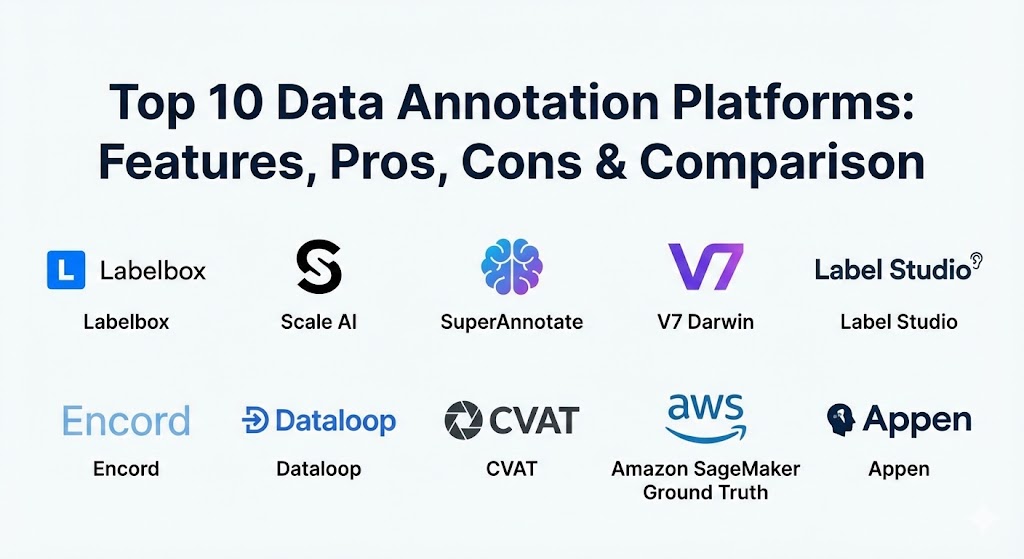
Top 10 Data Annotation Platforms
1 — Labelbox
Labelbox is widely considered the industry leader for enterprise-grade data labeling. It offers a unified platform that combines powerful labeling tools with advanced data management and model-assisted labeling to create a “data flywheel.”
- Key features:
- Multimodal support for image, video, text, audio, and geospatial data.
- Model-assisted labeling that uses pre-trained models to pre-populate labels.
- Advanced workflow orchestration with customizable review stages.
- Integrated “Catalog” for searching and curating unstructured data.
- Real-time collaboration tools for internal and external labeling teams.
- Native Python SDK and API for deep integration into ML pipelines.
- Pros:
- The most mature and stable UI for large-scale enterprise deployments.
- Excellent visibility into labeler performance and data quality metrics.
- Cons:
- Premium pricing can be prohibitive for smaller research teams.
- The learning curve for setting up complex custom workflows is steep.
- Security & compliance: SOC 2 Type II, GDPR, HIPAA compliant, SSO, and data encryption at rest/transit.
- Support & community: High-tier enterprise support, extensive technical documentation, and an active community of ML professionals.
2 — Scale AI
Scale AI focuses on the concept of “Data as a Service.” It is best known for its managed workforce combined with a powerful software platform, making it the go-to for high-volume, mission-critical AI projects.
- Key features:
- Nucleus platform for dataset curation, visualization, and debugging.
- Specialized workflows for RLHF (Reinforcement Learning from Human Feedback).
- Industry-leading support for 3D sensor fusion and LiDAR data.
- Automated QA pipelines that use machine learning to detect human errors.
- Managed labeling services with a global network of vetted experts.
- High-performance video annotation with frame-to-frame interpolation.
- Pros:
- Unrivaled ability to scale to millions of annotations with minimal internal overhead.
- Exceptional precision in complex perception tasks like autonomous driving.
- Cons:
- Often described as a “black box” because the managed workforce is separate from the platform users.
- Transparency on labeling costs can be difficult to predict without an enterprise contract.
- Security & compliance: ISO 27001, SOC 2 Type II, HIPAA, and GDPR.
- Support & community: Dedicated account managers for enterprise clients and professional services for project setup.
3 — SuperAnnotate
SuperAnnotate is a highly automated platform designed to speed up the labeling process through “Smart Segmentation” and a comprehensive marketplace of service providers.
- Key features:
- Pixel-precise image segmentation with AI-assisted “Smart Polygon.”
- Integrated marketplace to hire and manage professional annotation teams.
- Multi-level quality control system with consensus and benchmark tasks.
- Support for LLM fine-tuning, including preference and ranking tasks.
- Powerful video tracking that maintains object ID across frames.
- Custom editor builder to tailor the interface for specific data types.
- Pros:
- The “Smart Segmentation” tool significantly reduces the time taken for complex CV tasks.
- Very intuitive for project managers who need to oversee multiple external vendors.
- Cons:
- Performance can occasionally lag when handling exceptionally large video files in the browser.
- The text annotation features are less mature than their computer vision counterparts.
- Security & compliance: SOC 2, GDPR, and HIPAA compliant.
- Support & community: Responsive customer support and a growing library of “how-to” video tutorials.
4 — V7 Darwin
V7 Darwin positions itself as the “AI Data Engine,” focusing heavily on automation and model-in-the-loop workflows to minimize manual labor.
- Key features:
- Auto-annotate tool that can segment almost any object with a few clicks.
- “Darwin V2” interface optimized for speed and high-resolution imaging.
- Built-in model training and deployment for active learning loops.
- Dataset versioning that allows teams to track changes over time.
- Specialized support for medical imaging formats like DICOM and NIfTI.
- Real-time collaboration with “live” presence of other annotators.
- Pros:
- The auto-segmentation tool is arguably the best in the market for speed.
- Extremely user-friendly interface that requires very little training for new labelers.
- Cons:
- High cost-per-seat can make it expensive as the labeling team grows.
- Less focus on traditional NLP tasks compared to vision-centric features.
- Security & compliance: ISO 27001, SOC 2, HIPAA, and GDPR compliant.
- Support & community: Direct access to engineering teams for enterprise users and excellent technical guides.
5 — Label Studio (by Heartex)
Label Studio is the most popular open-source data annotation tool, offering unparalleled flexibility and a vibrant community. It is available in both a community edition and an enterprise-grade “Cloud” version.
- Key features:
- Multi-modal support including text, audio, video, images, and time-series data.
- Highly customizable UI using a simple XML-like configuration language.
- Machine learning backend that allows for real-time model predictions.
- Webhook support for automated pipeline triggers.
- Ability to host locally on-premises or in a private cloud.
- Support for active learning and uncertainty-based sampling.
- Pros:
- Unmatched flexibility; if you can code it, you can label it in Label Studio.
- The open-source version is free forever and perfect for researchers and small teams.
- Cons:
- Setting up complex workflows in the open-source version requires significant technical effort.
- Lacks some of the refined managed workforce integrations found in Labelbox or Scale.
- Security & compliance: Enterprise version is SOC 2 and GDPR compliant; Open Source security depends on self-hosting configuration.
- Support & community: Massive GitHub community, extensive Slack support, and professional services for Enterprise customers.
6 — Encord
Encord specializes in video annotation and data for regulated industries like healthcare and autonomous systems. It is built to handle complex, high-resolution data that would crash other platforms.
- Key features:
- Advanced micro-model approach for automated video labeling.
- Comprehensive support for medical data (DICOM, NIfTI) with 3D views.
- Performance-oriented video player capable of handling 4K at high frame rates.
- Integrated “Encord Active” for data curation and quality analysis.
- Strong compliance features for clinical trials and medical AI.
- Automated object tracking and interpolation across video sequences.
- Pros:
- The best choice for teams working with medical imaging or long-form video.
- Powerful data quality insights that help identify edge cases before training.
- Cons:
- Smaller feature set for text and NLP compared to specialized text tools.
- The specialized focus on video and medical data comes with a premium price tag.
- Security & compliance: SOC 2 Type II, HIPAA, and GDPR compliant.
- Support & community: High-touch technical support and deep domain expertise in medical AI.
7 — Dataloop
Dataloop is an enterprise-grade platform that views data annotation as part of a larger data management and MLOps ecosystem. It is designed for teams that need to manage the entire data lifecycle.
- Key features:
- Integrated data management with support for huge unstructured datasets.
- Powerful “Functions” (FaaS) to automate data processing and labeling.
- Hybrid human-AI workflows with seamless transitions.
- Advanced analytics for project progress and data distribution.
- Support for LiDAR, video, image, and text within a single platform.
- Developer-first approach with extensive CLI and SDK support.
- Pros:
- Excellent for complex, multi-step data pipelines that require custom automation.
- Scalability is a core strength; it handles petabytes of data with ease.
- Cons:
- The complexity of the platform can be overwhelming for simple labeling tasks.
- UI can feel “engineer-heavy” and less streamlined than V7 or Labelbox.
- Security & compliance: SOC 2, HIPAA, and GDPR compliant.
- Support & community: Strong professional services and comprehensive documentation for developers.
8 — CVAT (Computer Vision Annotation Tool)
Originally developed by Intel, CVAT is a powerful, web-based open-source tool specifically designed for computer vision. It is now managed as an independent project with an enterprise cloud offering.
- Key features:
- Native support for nearly all computer vision tasks (detection, segmentation, etc.).
- Integration with OpenVINO for model-accelerated labeling.
- Powerful video annotation features, including automatic tracking.
- Support for 3D point cloud annotation (LiDAR).
- Can be self-hosted via Docker for total data sovereignty.
- Multi-user support with basic role-based access control.
- Pros:
- Completely free to self-host with no licensing costs for the community version.
- Highly performant for video tasks, even in a web browser.
- Cons:
- The UI is functional but lacks the modern “polish” of commercial competitors.
- Limited support for non-visual data types like audio or complex NLP.
- Security & compliance: Varies by self-hosting; Cloud version offers standard enterprise security.
- Support & community: Large GitHub following, active Discord channel, and extensive community-driven documentation.
9 — Amazon SageMaker Ground Truth
As part of the AWS ecosystem, Ground Truth is a managed data labeling service that provides an easy way to build datasets within the cloud infrastructure you likely already use.
- Key features:
- Built-in workflows for common tasks (bounding boxes, text classification).
- Integrated access to Amazon Mechanical Turk and private/third-party workforces.
- Automated data labeling using active learning to reduce costs.
- Native integration with S3 buckets and SageMaker training pipelines.
- Support for 3D point cloud and video frame annotation.
- “Ground Truth Plus” for a fully managed, turnkey labeling service.
- Pros:
- The easiest choice for organizations already deeply embedded in the AWS ecosystem.
- Cost-effective for high-volume, simple tasks due to the Mechanical Turk integration.
- Cons:
- The UI is basic and less feature-rich than specialized platforms like V7 or Encord.
- Setup can be complex due to AWS-specific IAM roles and permissions.
- Security & compliance: FedRAMP, HIPAA, SOC 2, and GDPR (inherits AWS global compliance).
- Support & community: Standard AWS enterprise support and massive documentation library.
10 — Appen
Appen is a veteran in the data space, combining a sophisticated platform (formerly Figure Eight) with one of the world’s largest and most diverse managed workforces.
- Key features:
- Global crowd of over 1 million workers across 170+ countries.
- Strongest support in the industry for multilingual NLP and audio data.
- Integrated data collection services (gathering photos/audio from the field).
- Sophisticated quality control features like “Gold Sets” and “Hidden Tests.”
- Specialized workflows for search relevance and content moderation.
- Enterprise-grade reporting on workforce efficiency and data bias.
- Pros:
- The best option for projects requiring massive linguistic or cultural diversity.
- Provides a truly end-to-end service from data collection to final labeling.
- Cons:
- The software platform can feel less integrated than “platform-first” rivals.
- Can be very expensive for small-scale computer vision projects.
- Security & compliance: ISO 27001, SOC 2, GDPR, and HIPAA.
- Support & community: World-class account management and specialized project leads for large deals.
Comparison Table
| Tool Name | Best For | Platform(s) Supported | Standout Feature | Rating (Gartner/G2) |
| Labelbox | Enterprise AI Teams | Cloud / SaaS | Data Flywheel Workflow | 4.6 / 5 |
| Scale AI | High-Scale Autonomy | Cloud / API | Managed Workforce + QA | 4.5 / 5 |
| SuperAnnotate | CV Productivity | Cloud / SaaS | Smart Segmentation | 4.8 / 5 |
| V7 Darwin | Speed & Medical | Cloud / SaaS | Auto-Annotate AI | 4.7 / 5 |
| Label Studio | Flexibility / Open Source | On-Prem / Cloud | Multi-Modal XML Config | 4.6 / 5 |
| Encord | Video & Healthcare | Cloud / SaaS | Medical Imaging (DICOM) | 4.8 / 5 |
| Dataloop | Complex Pipelines | Cloud / Hybrid | Data-Centric Automation | 4.4 / 5 |
| CVAT | CV Research | Self-Hosted / Web | Native OpenVINO Support | 4.5 / 5 |
| AWS Ground Truth | AWS Ecosystem | AWS Native | SageMaker Integration | 4.2 / 5 |
| Appen | Global NLP & Audio | Cloud / Workforce | 1M+ Global Workforce | 4.3 / 5 |
Evaluation & Scoring of Data Annotation Platforms
| Criteria | Weight | Evaluation Notes |
| Core Features | 25% | Variety of data types (CV, NLP, Audio), tool precision, and automation depth. |
| Ease of Use | 15% | Intuitiveness for labelers and project management efficiency for admins. |
| Integrations | 15% | Strength of API, SDK, and native cloud/MLOps pipeline connections. |
| Security & Compliance | 10% | Certifications (SOC2, HIPAA) and data sovereignty options (On-prem). |
| Performance | 10% | Stability when loading 4K video or millions of individual assets. |
| Support & Community | 10% | Documentation depth, community help, and enterprise support SLAs. |
| Price / Value | 15% | TCO relative to efficiency gains (time saved vs. platform cost). |
Which Data Annotation Platform Tool Is Right for You?
The “right” platform is determined by your specific data modality and the size of your operations.
- Solo Researchers & Startups: If you have more time than money, start with CVAT or the open-source Label Studio. These tools give you total control without licensing costs, though you’ll need to manage the hosting yourself.
- Small to Medium Businesses (SMBs): For teams that need to move fast, V7 Darwin or SuperAnnotate are excellent choices. Their AI-assisted tools (like Auto-Annotate) allow a small team to produce high volumes of high-quality data without a massive workforce.
- Mid-Market / Growth Phase: If your project is scaling and you need to manage external vendors or a distributed team, Labelbox provides the best management and QA dashboards to ensure consistency across thousands of images.
- Enterprise & Mission-Critical: For massive projects (like autonomous driving) or those needing a hands-off approach, Scale AI is the top contender. If you are already on AWS, SageMaker Ground Truth is the most frictionless way to get started.
- Specialized Use Cases: Healthcare teams should look at Encord or V7 for their medical imaging expertise. For complex NLP, audio, or global search evaluation, Appen remains the industry veteran.
Frequently Asked Questions (FAQs)
1. What is the difference between a labeling tool and a labeling platform? A tool (like LabelImg) is usually a simple interface for drawing boxes. A platform (like Labelbox) includes data management, user permissions, QA workflows, and AI automation.
2. Can I use these platforms to label data for Generative AI? Yes. Modern platforms now include specialized workflows for RLHF (Reinforcement Learning from Human Feedback), allowing humans to rank and evaluate model responses.
3. Is my data safe on these cloud platforms? Most enterprise platforms are SOC 2 and HIPAA compliant and do not “see” your data; they simply render it via secure URLs from your private cloud (AWS S3, etc.).
4. How does AI-assisted labeling work? The platform uses a pre-trained model to suggest labels. The human annotator then simply corrects or “fine-tunes” these labels, which is often 5-10x faster than drawing them from scratch.
5. Do I have to use the platform’s workforce? Usually, no. Platforms like SuperAnnotate or Label Studio are “workforce agnostic,” meaning you can use your own internal team, hire a third-party vendor, or use their built-in marketplace.
6. What is the “Data Flywheel”? It is the process where you label data, train a model, use that model to help label more data, and repeat—constantly improving both the model and the labeling efficiency.
7. Can these tools handle 3D data? Yes, platforms like Scale AI, CVAT, and Dataloop have advanced support for 3D point clouds (LiDAR) used in robotics and autonomous vehicles.
8. What is a “Gold Set” in data annotation? A “Gold Set” is a collection of data that has been labeled with 100% accuracy by experts. It is used to test the performance and reliability of other annotators.
9. Are there any free enterprise-grade options? The community versions of CVAT and Label Studio offer almost all enterprise features for free, provided you are willing to manage the technical infrastructure and hosting.
10. Why is video annotation harder than image annotation? Video requires maintaining “object permanence” (the same ID) across thousands of frames and requires specialized players to handle high data throughput without lagging.
Conclusion
The shift from manual tagging to “AI-assisted data factories” is the biggest trend in data annotation today. Choosing a platform in 2026 is no longer about the best “drawing tool”—it is about the best data management workflow. Whether you prioritize the speed of V7, the scale of Scale AI, or the open-source flexibility of Label Studio, ensure your choice supports a model-in-the-loop strategy. In the AI era, your data strategy isn’t just a part of the project; it is the project.