Introduction
An Enterprise Data Fabric is an integrated data architecture that provides a unified, consistent way to access, manage, and govern data across a distributed landscape. Unlike traditional data warehouses that require you to move data into a central “bucket,” a data fabric uses metadata, AI, and automation to create a logical layer that connects diverse data sources—including data lakes, databases, and SaaS applications—without necessitating constant data replication.
The importance of these platforms lies in their ability to deliver “data democracy.” By automating data discovery and integration, they allow business users and data scientists to find and use information in real-time. Key real-world use cases include 360-degree customer views, where data from CRM, support tickets, and social media are unified; regulatory compliance, where governance policies are applied automatically across all systems; and AI model training, which requires vast amounts of high-quality, orchestrated data. When evaluating tools, users should look for strong metadata management, robust data virtualization capabilities, AI-driven automation (often called “augmented data integration”), and seamless multi-cloud support.
Best for: Large, global enterprises with complex hybrid-cloud environments, organizations undergoing digital transformation, and industries with strict regulatory requirements (Finance, Healthcare, Government) that need centralized governance without slowing down data access.
Not ideal for: Small businesses with simple, centralized data needs (e.g., a single SQL database) or startups where the cost and architectural complexity of a fabric would outweigh the benefits of manual integration.
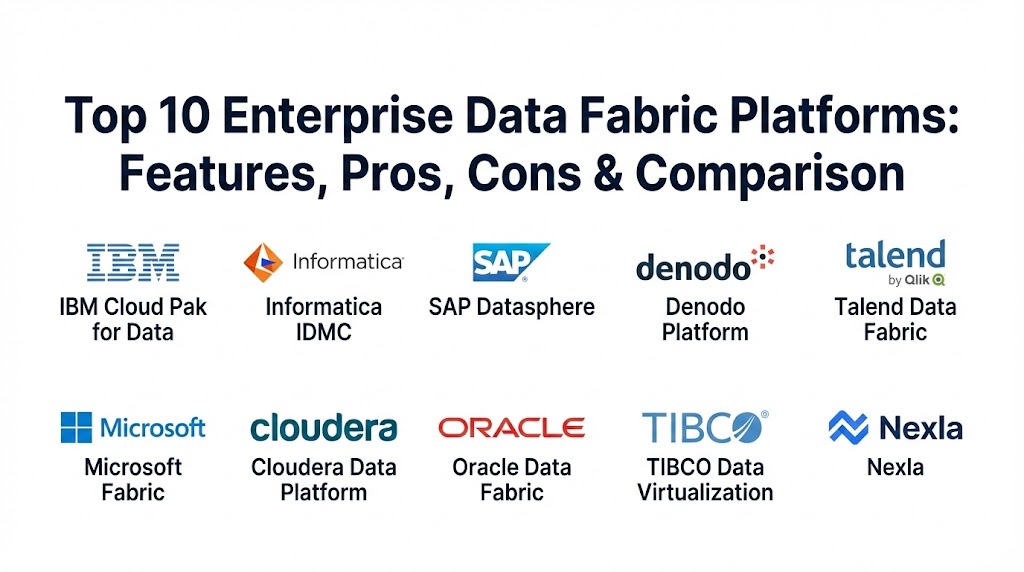
Top 10 Enterprise Data Fabric Platforms
1 — IBM Cloud Pak for Data
IBM Cloud Pak for Data is a comprehensive, cloud-native data and AI platform that enables a data fabric architecture. Built on Red Hat OpenShift, it unifies data management, governance, and analysis into a single, automated environment.
- Key features:
- AutoSQL: High-performance universal query engine for distributed data.
- AutoCatalog: AI-driven discovery and classification of data assets.
- AutoPrivacy: Automated enforcement of data privacy and masking policies.
- Data Virtualization: Query data where it lives without moving it.
- Integrated Watson AI: Built-in tools for building and scaling AI models.
- Hybrid Cloud Deployment: Runs on IBM Cloud, AWS, Azure, and Google Cloud.
- Pros:
- Unrivaled for organizations looking to combine data management with advanced AI/ML capabilities.
- Exceptional governance features that are “baked-in” rather than added on.
- Cons:
- Highly complex setup that often requires specialized OpenShift expertise.
- Premium pricing structure that targets the upper-tier enterprise market.
- Security & compliance: FIPS 140-2, SOC 2, HIPAA, GDPR, and ISO 27001 compliant. Includes advanced data masking and audit trails.
- Support & community: World-class enterprise support; vast documentation and an active “IBM Community” platform.
2 — Informatica Intelligent Data Management Cloud (IDMC)
Informatica IDMC is an AI-powered, end-to-end data management platform. It uses its “CLAIRE” AI engine to automate thousands of manual tasks related to data integration, quality, and governance.
- Key features:
- CLAIRE AI: Metadata-driven automation for data discovery and mapping.
- Enterprise Data Catalog: Provides a “Google-like” search for all enterprise data.
- Master Data Management (MDM): Creates a “single source of truth” for critical business entities.
- No-Code Integration: Visual interface for building complex data pipelines.
- Data Quality: Proactive monitoring and cleansing of data streams.
- Pros:
- Largest library of native connectors (thousands of apps and databases).
- Best-in-class for managing complex, multi-vendor enterprise environments.
- Cons:
- The platform is massive; users can feel overwhelmed by the sheer number of modules.
- Can be significantly more expensive than “cloud-only” native tools.
- Security & compliance: SOC 2 Type II, HIPAA, GDPR, and FedRAMP authorized. Advanced encryption and SSO.
- Support & community: High-tier enterprise support and a global network of certified implementation partners.
3 — SAP Datasphere
SAP Datasphere (the evolution of SAP Data Warehouse Cloud) is a comprehensive data service that enables every data provider to deliver business-ready data with business context intact.
- Key features:
- Business Semantic Bridge: Retains SAP business logic (hierarchies, relationships) when moving data.
- Data Federation: Combines SAP and non-SAP data without physical movement.
- Catalog Integration: Automatically populates metadata from across the SAP ecosystem.
- Analytic Models: Pre-built models for rapid reporting in SAP Analytics Cloud.
- Open Data Ecosystem: Strong partnerships with Databricks and Collibra.
- Pros:
- Essential for SAP-heavy organizations; preserves data “meaning” better than any other tool.
- Simplifies the bridging of on-premises SAP ERP data to the cloud.
- Cons:
- Functionality is noticeably limited for organizations that do not use SAP as their core.
- The licensing model can be complex to predict based on compute/storage consumption.
- Security & compliance: ISO 27001, SOC 1/2/3, GDPR, and HIPAA. Deep integration with SAP Cloud Identity.
- Support & community: Backed by SAP’s massive global support infrastructure and the SAP Community Network.
4 — Denodo Platform
Denodo is the market leader in Data Virtualization, a core technology of the data fabric. It focuses on creating a high-performance logical data layer that provides real-time access to data without replication.
- Key features:
- Dynamic Query Optimizer: Rewrites queries on the fly to maximize performance across sources.
- Logical Data Lake: Combines diverse storage (Hadoop, S3, SQL) into a single logical view.
- Data Catalog: Self-service portal for business users to find and query data.
- AI-Powered Recommendations: Suggests relevant datasets based on user behavior.
- MPP Support: Leverages Massive Parallel Processing for high-volume joins.
- Pros:
- Significant cost savings by eliminating the need for expensive ETL (Extract, Transform, Load) processes.
- Allows for much faster “time-to-insight” compared to traditional data warehousing.
- Cons:
- Performance can degrade on extremely complex joins if the underlying source systems are slow.
- Requires a shift in architectural thinking from “physical” to “logical.”
- Security & compliance: GDPR, HIPAA, and PCI DSS. Centralized security policies applied across all virtualized sources.
- Support & community: Strong professional services and highly-rated technical support with global coverage.
5 — Talend Data Fabric (by Qlik)
Now part of Qlik, Talend Data Fabric unifies data integration, integrity, and governance. It is best known for its “Data Trust Score,” which gives users immediate visibility into the quality of their data.
- Key features:
- Talend Trust Score: Automatically assesses data health and accuracy.
- Self-Service Data Preparation: Allows business users to clean and shape data.
- Big Data Integration: Native support for Spark and Hadoop ecosystems.
- Data Stewardship: Workflow tools for human-in-the-loop data correction.
- Hybrid Connectivity: 900+ connectors for cloud and on-premises sources.
- Pros:
- Excellent balance between technical depth and business-user accessibility.
- Flexible deployment options with strong open-source roots.
- Cons:
- Post-merger integration with Qlik is still evolving, which can lead to UI inconsistencies.
- Advanced features require the high-end “Data Fabric” license.
- Security & compliance: SOC 2, GDPR, HIPAA, and ISO 27001. Built-in data masking and PII detection.
- Support & community: Vibrant community; extensive online training and certification through Talend Academy.
6 — Microsoft Fabric
Microsoft Fabric is an all-in-one analytics solution for enterprises that covers everything from data movement to data science, all built on the concept of OneLake.
- Key features:
- OneLake: A single, unified logical data lake for the entire organization (the “OneDrive for data”).
- Direct Lake Mode: Allows Power BI to query massive datasets in OneLake without importing them.
- Copilot for Fabric: AI assistant that helps write DAX, SQL, and Python code.
- Synapse Data Engineering: Managed Spark environment for large-scale data processing.
- Purview Integration: Native, unified governance and data discovery.
- Pros:
- Unbeatable integration for organizations already standardized on Azure and Power BI.
- Eliminates “data silos” within the Microsoft stack through a single SaaS experience.
- Cons:
- Still a relatively new product with some “teething issues” in stability and feature parity.
- Heavily incentivizes Azure lock-in.
- Security & compliance: Industry-leading Azure security, SOC 1/2/3, HIPAA, and GDPR.
- Support & community: Massive global community; direct support through the Microsoft Azure ecosystem.
7 — Cloudera Data Platform (CDP)
Cloudera CDP is a hybrid and multi-cloud data platform that excels at managing massive “Big Data” workloads. It is the go-to for organizations that need a highly secure, open-source-based data fabric.
- Key features:
- Shared Data Experience (SDX): Unified security, governance, and metadata across all environments.
- Cloudera Data Warehouse: Self-service analytics for high-concurrency workloads.
- Cloudera Machine Learning: Collaborative environment for data science teams.
- Hybrid Cloud Portability: Move workloads between on-prem and any public cloud.
- Open Standards: Built on Apache Iceberg, Spark, and Flink.
- Pros:
- The most powerful option for companies with truly massive (petabyte-scale) data needs.
- Total architectural control for advanced IT teams.
- Cons:
- Very high TCO (Total Cost of Ownership) due to infrastructure and personnel requirements.
- Can be overly complex for organizations with “normal” data volumes.
- Security & compliance: FIPS 140-2, HIPAA, PCI DSS, and GDPR. SDX ensures consistent security everywhere.
- Support & community: High-end enterprise support; deep roots in the Apache open-source community.
8 — Oracle Data Fabric
Oracle provides a set of data fabric services centered around its OCI (Oracle Cloud Infrastructure) and the legendary Oracle GoldenGate technology for real-time data movement.
- Key features:
- OCI GoldenGate: Real-time data mesh and replication platform.
- Data Catalog: Automatically harvests metadata from Oracle and non-Oracle sources.
- OCI Data Integration: Serverless ETL and data orchestration.
- Autonomous Database: Self-driving storage and management for the fabric.
- Multi-Cloud Support: Interconnects with Azure and AWS.
- Pros:
- Industry-leading performance for real-time, transactional data fabric needs.
- “Set and forget” management for organizations using Oracle Autonomous services.
- Cons:
- Best features are reserved for the Oracle Cloud ecosystem.
- Can be difficult to manage if the rest of your stack is purely Microsoft or Google.
- Security & compliance: FedRAMP, SOC 2, HIPAA, GDPR, and rigorous physical data center security.
- Support & community: Top-tier global support; extensive documentation for Oracle database professionals.
9 — TIBCO Data Virtualization
TIBCO is a veteran in the data space, providing a high-performance data virtualization and orchestration tool that serves as a foundation for a mature data fabric.
- Key features:
- Business Directory: A business-friendly UI for searching and browsing data.
- Universal Access: Connects to nearly any source including Mainframes and IoT devices.
- Automated Data Discovery: Identifies relationships between disparate datasets.
- Performance Optimization: Advanced caching and federated query execution.
- Data Service Creation: Easily turn any data query into a reusable API.
- Pros:
- Proven enterprise stability; used by many of the world’s largest banks.
- Excellent at handling “weird” data sources like legacy mainframes.
- Cons:
- The user interface can feel dated compared to newer SaaS-native platforms.
- The learning curve for optimizing queries is relatively steep.
- Security & compliance: GDPR, HIPAA, and SOC 2. Granular access control at the row and column level.
- Support & community: Experienced enterprise support; strong presence in the financial and energy sectors.
10 — Nexla
Nexla is a modern, AI-centric data fabric tool that focuses on Data Operations (DataOps) and the concept of “Data Products”—making data as easy to consume as an API.
- Key features:
- Nexsets: Automatically generated data products that package data, metadata, and schema.
- No-Code UI: Allows business analysts to create data flows without IT intervention.
- Universal Connector Architecture: Automatically handles any file type, API, or database.
- Real-Time Monitoring: Instant alerts on data quality or flow issues.
- API-First Design: Everything in Nexla can be controlled via API.
- Pros:
- Extremely fast time-to-value; perfect for modern, agile data teams.
- “Self-driving” data flows reduce the manual burden on data engineers.
- Cons:
- Smaller community and fewer third-party resources compared to giants like IBM or Informatica.
- May lack some of the deepest “Big Data” legacy features found in Cloudera.
- Security & compliance: SOC 2 Type II, HIPAA, and GDPR compliant. End-to-end encryption.
- Support & community: Personalized customer success model; very modern, responsive support team.
Comparison Table
| Tool Name | Best For | Platform(s) Supported | Standout Feature | Rating (Gartner Peer Insights) |
| IBM Cloud Pak | AI & Data Integration | Hybrid, Multi-Cloud | AutoSQL & Watson AI | 4.6 / 5 |
| Informatica IDMC | Multi-Vendor Scale | SaaS, Multi-Cloud | CLAIRE AI Engine | 4.4 / 5 |
| SAP Datasphere | SAP Ecosystems | SAP BTP, Cloud | Business Semantic Bridge | 4.2 / 5 |
| Denodo Platform | Real-Time Virtualization | On-Prem, Multi-Cloud | Zero-Movement Queries | 4.6 / 5 |
| Talend (Qlik) | Data Health & Integrity | SaaS, Hybrid | Talend Trust Score | 4.4 / 5 |
| Microsoft Fabric | Microsoft-First Orgs | Azure SaaS | OneLake Architecture | 4.6 / 5 |
| Cloudera CDP | Massive Big Data | Hybrid, Multi-Cloud | Shared Data Experience | 4.1 / 5 |
| Oracle Data Fabric | Real-Time Transactional | OCI, Hybrid | OCI GoldenGate | 4.3 / 5 |
| TIBCO Data Virt. | Legacy & Finance | On-Prem, Cloud | Mainframe Connectivity | 4.2 / 5 |
| Nexla | Agile DataOps | SaaS, Cloud | Nexsets (Data Products) | 4.8 / 5 |
Evaluation & Scoring of Enterprise Data Fabric Platforms
Choosing a data fabric platform requires looking beyond just “connectors.” A true fabric must automate the understanding of the data.
| Category | Weight | Evaluation Criteria |
| Core Features | 25% | Data virtualization, metadata management, and discovery automation. |
| Ease of Use | 15% | Self-service capability for non-technical users and UI intuitiveness. |
| Integrations | 15% | Breadth of connectors and ability to bridge legacy/cloud silos. |
| Security & Compliance | 10% | Automated governance, data masking, and regulatory reporting. |
| Performance | 10% | Query optimization, low-latency access, and scalability. |
| Support & Community | 10% | Training availability, documentation, and vendor responsiveness. |
| Price / Value | 15% | TCO vs. time saved in manual engineering and storage costs. |
Which Enterprise Data Fabric Platform Is Right for You?
The “fabric” approach is about building for the next decade, not just the next quarter.
- Solo Users & Small Teams: Most do not need a full data fabric. Simple data integration tools (like Fivetran) or a basic data warehouse (like Snowflake) are usually sufficient.
- Azure / Microsoft Shops: Microsoft Fabric is the logical choice. It provides a cohesive experience that your team likely already understands.
- Legacy-Heavy Enterprises: If you have data trapped in mainframes, older Oracle databases, and physical servers, IBM Cloud Pak for Data or TIBCO offer the best tools for bridging those “old” worlds with the cloud.
- Speed & Agility Seekers: If your primary pain point is how long it takes to move data, Denodo (via virtualization) or Nexla (via automated data products) are the best candidates to accelerate your timeline.
- SAP Organizations: Do not look elsewhere until you have thoroughly vetted SAP Datasphere. The ability to keep your business context intact during integration is a massive time-saver.
- Massive Scale & Customization: If you have petabytes of data and a team of engineers who want to “own” the architecture, Cloudera CDP provides the most robust toolkit.
Frequently Asked Questions (FAQs)
1. Does a Data Fabric replace my Data Lake or Data Warehouse? No. A data fabric is a management layer that sits on top of them. It makes the data in your lake and warehouse easier to find and use together without having to merge them into one physical system.
2. What is the difference between Data Fabric and Data Mesh? Data Fabric is an architectural approach focused on using technology (AI/metadata) to automate integration. Data Mesh is a sociotechnical approach focused on organizational changes, where different domains (e.g., Marketing, Sales) own their own data products.
3. Do I need to be a coder to use these tools? Many modern platforms like Informatica and Talend offer no-code/low-code interfaces. However, setting up the initial architecture usually requires a highly skilled data architect.
4. How does AI help in a Data Fabric? AI is used to automate data discovery (finding PII), data mapping (matching “Cust_ID” in one system to “ClientNum” in another), and query optimization (finding the fastest way to get data).
5. Is data safe if it is “virtualized”? Yes. In many cases, it is safer. Tools like Denodo or IBM allow you to apply security policies in one place that are enforced across all sources, reducing the risk of a “forgotten” database being left open.
6. How long does it take to set up? A pilot project can be running in weeks. However, a full enterprise rollout that connects every departmental silo typically takes 6 to 18 months of iterative work.
7. Does Data Fabric move data? It can, but it prefers not to. Its primary goal is to use data virtualization to access data where it lives. If performance requires it, the fabric can orchestrate the movement of data to a faster tier.
8. Can I use a Data Fabric with multi-cloud? Absolutely. Multi-cloud support is one of the biggest reasons enterprises adopt a data fabric—it lets you query data in AWS S3 and Azure Blob storage as if they were in the same database.
9. What is “Metadata-Driven” automation? This means the tool looks at the “data about the data” (labels, tags, size, source) to automatically decide how to process, secure, and integrate it.
10. Is it expensive? Yes, enterprise-grade data fabrics are significant investments. However, they are often justified by the massive reduction in “Data Engineering” hours and the elimination of redundant data storage costs.
Conclusion
Enterprise Data Fabric Platforms represent the “coming of age” of data management. We are moving away from the era of “brute force” data movement and toward an era of intelligent, automated data orchestration. While the initial investment in a tool like Informatica, Denodo, or IBM is high, the long-term payoff is an organization that can pivot instantly because its data is always accessible, always governed, and always ready for the next AI breakthrough.