Introduction
Data transformation is the process of changing the format, structure, or values of data. It is a core component of the ETL (Extract, Transform, Load) or ELT (Extract, Load, Transform) pipeline. In 2026, the shift toward “Modern Data Stacks” has favored the ELT approach, where raw data is loaded into a cloud warehouse first and then transformed using the massive compute power of the cloud. This evolution has made transformation tools more specialized, moving away from “all-in-one” legacy suites toward agile, code-centric, or AI-powered platforms.
The importance of these tools cannot be overstated. Without them, data remains “siloed” and inconsistent—leading to “garbage in, garbage out” scenarios in business intelligence. Key real-world use cases include standardizing global currency formats, deduplicating customer records across multiple platforms, and aggregating transaction data for real-time financial auditing. When evaluating these tools, users should prioritize their transformation approach (SQL-based vs. visual), scalability, integration depth with cloud warehouses like Snowflake or BigQuery, and observability features that track data lineage.
Best for: Data engineers, analytics engineers, and business analysts in mid-to-large enterprises who need to manage complex data pipelines. It is essential for organizations migrating to the cloud or those scaling their AI/ML initiatives.
Not ideal for: Very small businesses with single-source data needs (e.g., just one Shopify store) or non-technical teams who lack any data engineering support and only require basic spreadsheet cleaning.
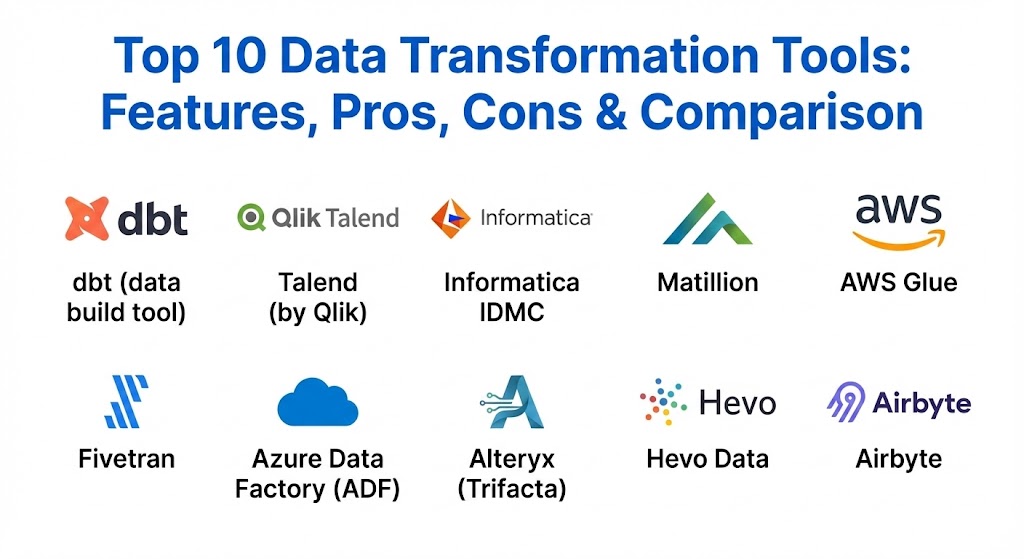
Top 10 Data Transformation Tools
1 — dbt (data build tool)
dbt has revolutionized the industry by introducing software engineering best practices—like version control and testing—to the world of data transformation. It is essentially the “T” in ELT, designed specifically to transform data already sitting inside a data warehouse.
- Key features:
- SQL-based modeling that allows analysts to write transformations using simple SELECT statements.
- Built-in version control integration with Git.
- Automated data testing to ensure data quality before deployment.
- Automatic documentation generation including data lineage graphs.
- Support for incremental models to optimize compute costs.
- Modular “packages” that allow teams to reuse code across projects.
- Pros:
- Highly accessible to anyone who knows SQL; bridges the gap between analysts and engineers.
- Extremely strong community support with thousands of pre-built packages.
- Cons:
- Does not handle the “E” (Extract) or “L” (Load); requires additional tools like Fivetran or Airbyte.
- The learning curve for Git and command-line interfaces can be steep for traditional analysts.
- Security & compliance: SOC 2 Type II, ISO 27001, GDPR, and HIPAA compliant. Supports SSO and granular RBAC in the Cloud version.
- Support & community: Massive global community (dbt Slack), extensive documentation, and dedicated enterprise support for dbt Cloud users.
2 — Talend (by Qlik)
Talend, now part of the Qlik ecosystem, is a heavyweight in the data integration space. It offers an end-to-end “Data Fabric” that combines data integration, integrity, and governance into a single, unified platform.
- Key features:
- Visual “drag-and-drop” designer for building complex ETL/ELT jobs.
- Over 1,000 pre-built connectors for virtually any data source.
- Integrated data quality and profiling tools to clean data on the fly.
- Support for “Stewardship” where users can manually resolve data conflicts.
- Native support for Big Data environments like Spark and Hadoop.
- Hybrid deployment options (Cloud, On-premise, or Multi-cloud).
- Pros:
- Excellent for large enterprises with “messy” legacy data that requires deep cleaning.
- Comprehensive governance features that make it an auditor’s favorite.
- Cons:
- The interface can feel “heavy” and traditional compared to modern cloud-native tools.
- Pricing is enterprise-tier and may be prohibitive for smaller teams.
- Security & compliance: HIPAA, GDPR, SOC 2, and ISO 27001. Advanced data masking and encryption features.
- Support & community: Professional global support, dedicated account managers, and a well-established user community.
3 — Informatica Intelligent Data Management Cloud (IDMC)
Informatica is a long-standing leader in the Gartner Magic Quadrant. Its IDMC platform is an AI-powered, cloud-native solution designed to handle the most complex data environments on the planet.
- Key features:
- CLAIRE AI engine that automates data discovery and mapping.
- Advanced data transformation for high-volume, enterprise-scale workloads.
- Integrated Master Data Management (MDM) to create a “single source of truth.”
- Serverless execution options to reduce infrastructure management.
- Robust data privacy and protection features for regulated industries.
- End-to-end data lineage and metadata management.
- Pros:
- Scales to petabytes of data without breaking a sweat.
- AI-driven recommendations significantly speed up the transformation design process.
- Cons:
- High complexity; requires specialized Informatica-certified developers.
- One of the most expensive solutions in the market.
- Security & compliance: FedRAMP, HIPAA, SOC 2, GDPR, and localized data residency support.
- Support & community: World-class enterprise support, extensive training certifications, and a global partner network.
4 — Matillion
Matillion is built specifically for the cloud. It is a “purpose-built” ELT tool that leverages the native power of cloud data warehouses like Snowflake, Amazon Redshift, and Google BigQuery to perform transformations.
- Key features:
- Low-code, visual interface that generates native SQL for the warehouse.
- Push-down optimization that ensures transformations run where the data lives.
- Over 100+ connectors for popular SaaS apps and databases.
- Support for Python and SQL scripts for advanced customization.
- Integrated job orchestration and scheduling.
- Built-in environment management (Dev, Test, Prod).
- Pros:
- Very fast to deploy; you can go from zero to a live pipeline in minutes.
- Pricing is often more predictable for cloud-first organizations.
- Cons:
- Optimization is limited to the specific cloud warehouses it supports.
- Fewer advanced “data governance” features compared to Informatica or Talend.
- Security & compliance: SOC 2 Type II, HIPAA, and GDPR compliant. Encryption at rest and in transit.
- Support & community: Reliable 24/7 technical support and an active “Matillion Exchange” for sharing components.
5 — AWS Glue
AWS Glue is the serverless data integration service from Amazon. It is the go-to choice for organizations already living in the AWS ecosystem, providing a cost-effective way to prepare data for analytics.
- Key features:
- Serverless Spark-based processing that scales automatically.
- Data Catalog that automatically discovers and stores metadata.
- “Glue Studio” for visual ETL design and “Glue DataBrew” for visual data prep.
- Native integration with S3, Redshift, Athena, and SageMaker.
- Python and Scala support for highly custom transformation logic.
- Automated schema discovery and evolution tracking.
- Pros:
- Pay-as-you-go pricing; you only pay for the “DPUs” (Data Processing Units) you use.
- No infrastructure to manage; truly serverless.
- Cons:
- Can be difficult to debug Spark code within the AWS environment.
- Significant “vendor lock-in” to the AWS ecosystem.
- Security & compliance: Inherits the full suite of AWS security (IAM, KMS, VPC) and global compliance (HIPAA, SOC, etc.).
- Support & community: Covered under AWS Support plans; massive amount of online tutorials and documentation.
6 — Fivetran (with Managed Transformations)
Fivetran is primarily known as an automated data ingestion (Extract/Load) tool, but its integration with dbt and its native “Quickstart Transformations” make it a powerful contender for end-to-end data pipelines.
- Key features:
- Zero-maintenance, automated data pipelines.
- Pre-built dbt packages for common SaaS sources (Salesforce, Zendesk).
- Integrated “Quickstart” transformations for basic data modeling.
- Automated schema migration and drift handling.
- Near real-time data synchronization.
- Unified dashboard for monitoring pipeline health.
- Pros:
- The “set it and forget it” tool; requires the least amount of engineering time.
- Extremely high reliability with 99.9% uptime.
- Cons:
- Limited control over the actual transformation logic without adding dbt.
- Pricing is based on “Monthly Active Rows” (MAR), which can scale quickly with high-volume data.
- Security & compliance: SOC 2 Type II, ISO 27001, GDPR, and HIPAA. Features end-to-end encryption.
- Support & community: Excellent customer support and a growing ecosystem of modern data stack partners.
7 — Azure Data Factory (ADF)
Azure Data Factory is Microsoft’s cloud-based data integration service. It is designed to orchestrate and automate data movement and transformation across the Azure ecosystem.
- Key features:
- “Mapping Data Flows” for visual, code-free data transformations.
- Over 90+ built-in connectors for on-premise and cloud sources.
- Native integration with Azure Synapse and Azure Data Lake.
- Integrated CI/CD support via Azure DevOps and GitHub.
- Support for executing SSIS packages in the cloud.
- Managed Airflow integration for complex orchestration.
- Pros:
- Best-in-class for hybrid environments (moving data between on-prem and Azure).
- Very cost-effective for organizations with existing Microsoft Enterprise Agreements.
- Cons:
- The UI can be complex and intimidating for beginners.
- Performance for very large “Mapping Data Flows” can sometimes lag.
- Security & compliance: Uses Azure Active Directory (SSO), Managed Identities, and meets all major Microsoft compliance standards.
- Support & community: Robust documentation and support via Microsoft Azure’s enterprise channels.
8 — Alteryx (Trifacta)
Alteryx acquired Trifacta to bolster its “Cloud Data Prep” capabilities. It is the premier tool for business analysts who need to perform complex transformations without writing a single line of code.
- Key features:
- “Predictive Transformation” engine that suggests the next cleaning step.
- Visual, interactive data profiling that highlights anomalies instantly.
- Unified platform for data blending, prep, and advanced analytics.
- Support for over 80+ data sources and destinations.
- Collaboration features for shared “data recipes.”
- Automated workflow scheduling and deployment.
- Pros:
- The most “approachable” tool for non-technical users; highly intuitive.
- Excellent for “ad-hoc” data prep where speed is more important than building a permanent pipeline.
- Cons:
- Can be less efficient for “production-grade” pipelines than dbt or Informatica.
- Licensing can be expensive as it is often sold per user.
- Security & compliance: SSO, data encryption, and GDPR/SOC 2 compliance.
- Support & community: Massive “Alteryx Community” with forums, weekly challenges, and extensive training.
9 — Hevo Data
Hevo Data is a no-code, bi-directional data pipeline platform. It is designed for small to medium-sized teams that need a reliable way to move and transform data with zero maintenance.
- Key features:
- Automated data pipeline setup with 150+ connectors.
- Support for both “Python-based” and “No-code” visual transformations.
- Pre-load transformations to clean data before it hits the warehouse.
- Real-time data streaming and replication.
- Detailed monitoring and alerting for pipeline health.
- Automatic schema mapping and error handling.
- Pros:
- Extremely high value for the price; very accessible for startups.
- Excellent “near real-time” capabilities for operational analytics.
- Cons:
- Transformation depth is lower than dbt or specialized ELT tools.
- Customization options are limited compared to code-first tools.
- Security & compliance: SOC 2, HIPAA, and GDPR compliant. Data encryption in transit.
- Support & community: Highly responsive 24/7 live chat support and good technical documentation.
10 — Airbyte
Airbyte is the leading open-source alternative in the data integration space. While it focuses heavily on ingestion, its deep integration with dbt makes it a powerful framework for customizable data transformations.
- Key features:
- 600+ pre-built connectors and a “Connector Development Kit” (CDK).
- Native dbt integration for handling the transformation layer.
- Open-source model that allows for complete customization.
- Change Data Capture (CDC) for real-time database replication.
- Cloud and Self-hosted deployment options.
- Automated schema evolution.
- Pros:
- No “per-connector” pricing in the open-source version; great for cost control.
- Prevents vendor lock-in; you own the code and the connectors.
- Cons:
- Requires more “hand-holding” and engineering effort than Fivetran or Hevo.
- The UI is still maturing and lacks some enterprise features in the free version.
- Security & compliance: SSO, RBAC, and SOC 2 (Cloud version). Open-source version depends on user hosting.
- Support & community: Very active Slack community and GitHub following; commercial support for Airbyte Cloud.
Comparison Table
| Tool Name | Best For | Platform(s) Supported | Standout Feature | Rating (Gartner Peer Insights) |
| dbt | Analytics Engineers | Cloud Warehouses | SQL-first Git Workflows | 4.8 / 5 |
| Talend | Data Governance | Cloud, On-prem | Data Stewardship / Quality | 4.5 / 5 |
| Informatica | Massive Enterprise | Multi-cloud, SaaS | AI-powered CLAIRE Engine | 4.6 / 5 |
| Matillion | Visual Cloud ELT | Snowflake, AWS, GCP | Push-down Optimization | 4.5 / 5 |
| AWS Glue | AWS-heavy Teams | AWS Ecosystem | Serverless Spark Execution | 4.4 / 5 |
| Fivetran | Zero-Maintenance | SaaS, Cloud | Automated dbt Integration | 4.6 / 5 |
| Azure Data Factory | Microsoft Ecosystem | Azure, On-prem | Hybrid Data Orchestration | 4.4 / 5 |
| Alteryx | Business Analysts | Windows, Cloud | Predictive Transformation | 4.2 / 5 |
| Hevo Data | Startups / SMBs | Cloud, SaaS | No-code Real-time Sync | 4.5 / 5 |
| Airbyte | Developers / OS | Open-source, Cloud | 600+ Open Connectors | 4.3 / 5 |
Evaluation & Scoring of Data Transformation Tools
The following weighted scoring rubric reflects the criteria most critical to modern data teams in 2026.
| Category | Weight | Evaluation Criteria |
| Core Features | 25% | SQL support, visual mapping, data quality, and CDC capabilities. |
| Ease of Use | 15% | Intuitiveness of UI, learning curve, and “citizen integrator” accessibility. |
| Integrations | 15% | Number of pre-built connectors and depth of cloud warehouse support. |
| Security | 10% | Encryption, SOC 2/GDPR compliance, and data masking. |
| Performance | 10% | Scalability, latency, and efficient use of compute resources. |
| Support | 10% | Community activity, documentation quality, and support responsiveness. |
| Price / Value | 15% | Predictability of costs and ROI relative to manual engineering time. |
Which Data Transformation Tool Is Right for You?
Selecting the right tool depends on your team’s technical skill set and your organization’s data volume.
- Solo Users & Small Teams: If you are the lone “data person,” dbt (free tier) or Hevo Data are your best friends. They provide massive leverage without requiring a large infrastructure budget.
- Mid-Market Companies: For teams that have some engineering resources but want to move fast, Fivetran paired with dbt or Matillion offers the best balance of speed and control.
- Large Enterprises: If you have high-security needs and thousands of disparate data sources, Informatica or Talend are the industry standards. They provide the governance and AI-driven automation needed to manage data at that scale.
- Budget-Conscious Organizations: Airbyte (open source) or AWS Glue (on a pay-as-you-go basis) are excellent for keeping costs low, provided you have the technical skill to manage the environment.
- Business-Centric Teams: If your users are analysts who aren’t comfortable with SQL or code, Alteryx is the clear winner for its superior visual data prep and interactive profiling.
Frequently Asked Questions (FAQs)
1. What is the difference between ETL and ELT? ETL (Extract, Transform, Load) transforms data before it reaches the destination. ELT (Extract, Load, Transform) loads raw data first and uses the destination’s (e.g., Snowflake) power to transform it. ELT is the modern standard for cloud data.
2. Is SQL knowledge necessary for data transformation? Not always. Tools like Alteryx, Talend, and Hevo offer visual interfaces. However, for deep customization and “production-grade” modeling, SQL remains the industry’s lingua franca.
3. Do these tools handle data cleaning as well? Yes. Modern transformation tools include features for deduplication, filling missing values, standardizing formats (like dates), and outlier detection as part of the “Transformation” step.
4. How do these tools impact cloud compute costs? ELT tools like dbt or Matillion use your cloud warehouse’s compute. While powerful, poorly optimized transformations can lead to high Snowflake or BigQuery bills. Monitoring usage is critical.
5. Can I use more than one tool at the same time? Yes. Many teams use Fivetran or Airbyte to “Extract/Load” and then use dbt specifically for the “Transform” layer. This is known as a modular data stack.
6. What is “Data Lineage”? Data lineage is a visual map showing where data came from, how it was changed, and where it ended up. It is essential for troubleshooting and regulatory compliance.
7. Are there open-source options available? Yes, Airbyte, dbt Core, and Apache Spark are leading open-source solutions that provide enterprise-grade power without the upfront licensing fees.
8. How does AI help in data transformation? AI (like Informatica’s CLAIRE) can automatically suggest mappings between source and target fields, detect PII (personally identifiable information) for masking, and predict data quality issues.
9. Can these tools handle real-time data? Tools like Hevo and Informatica support real-time streaming, but many traditional MFT or ETL tools are “batch-based,” meaning they run on a schedule (e.g., every hour).
10. Do I need a Data Engineer to manage these? For enterprise platforms like Informatica, yes. For “no-code” or “low-code” tools like Alteryx or Fivetran, a savvy Data Analyst can often manage the entire pipeline.
Conclusion
The data landscape of 2026 is defined by speed and scale. As your data footprint grows, the ability to transform raw inputs into high-quality assets will be the differentiator between companies that use data and companies that are drowned by it. Whether you choose the code-centric precision of dbt, the AI-driven scale of Informatica, or the visual simplicity of Alteryx, the “best” tool is the one that aligns with your team’s skills and your long-term infrastructure strategy.