Introduction
Edge AI Inference Platforms are integrated hardware and software ecosystems designed to execute trained machine learning models directly on local devices. Unlike traditional cloud AI, which relies on a constant internet connection and suffers from inherent latency, Edge AI processes data locally. This architecture is vital for mission-critical applications where a split-second delay could be catastrophic or where data privacy is non-negotiable.
The importance of these platforms lies in three pillars: Latency, Privacy, and Bandwidth. Real-world use cases are expanding rapidly, including defect detection on high-speed manufacturing lines, autonomous vehicle path planning, and real-time patient monitoring in hospitals without risking sensitive data exposure. When evaluating these tools, users should look for “TOPS per Watt” (performance efficiency), the breadth of the supported model zoo, ease of deployment (MLOps), and robust security features like secure boot and hardware-based encryption.
Best for: Hardware engineers, AI researchers, and enterprise IT leaders in industries such as robotics, automotive, healthcare, and industrial IoT (IIoT). It is ideal for companies needing real-time decision-making without cloud dependency.
Not ideal for: Organizations with purely tabular data workloads that can tolerate latency, or startups that lack the budget for specialized hardware and can easily manage their needs through standard cloud-based APIs.
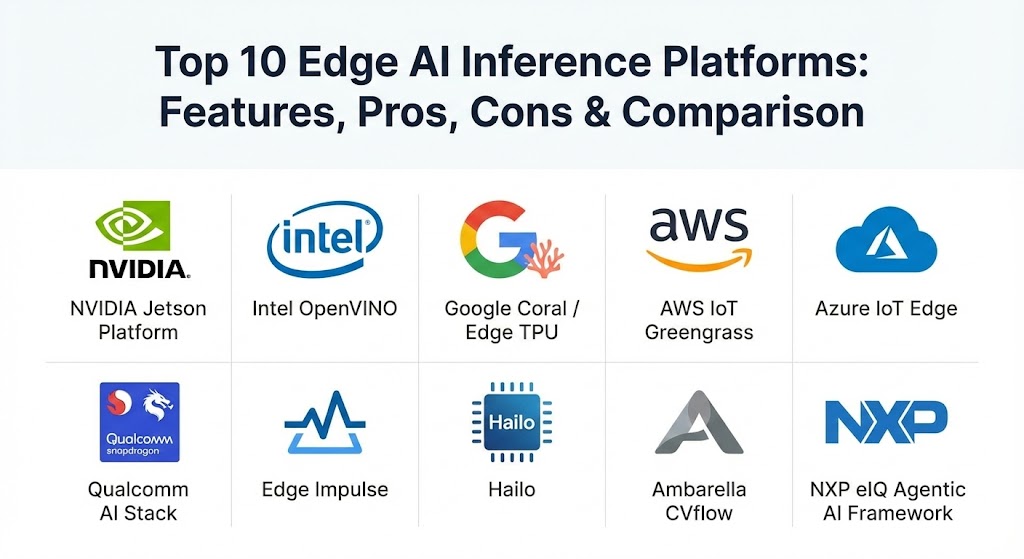
Top 10 Edge AI Inference Platforms
1 — NVIDIA Jetson Platform
The NVIDIA Jetson platform remains the gold standard for high-performance edge AI. With the recent rollout of the Blackwell-powered Jetson Thor and the established Orin series, NVIDIA provides a scalable lineup that ranges from compact modules for drones to massive supercomputers for autonomous mobile robots (AMRs).
- Key features:
- Massive AI performance up to 2,070 FP4 TFLOPS (Jetson Thor).
- Unified software stack via NVIDIA JetPack SDK.
- Integrated TensorRT for deep learning inference optimization.
- Support for “Physical AI” and complex generative AI models at the edge.
- Extensive support for ROS 2 (Robot Operating System).
- Large ecosystem of pre-trained models via NVIDIA NGC.
- Robust multi-modal sensor processing (vision, LiDAR, audio).
- Pros:
- Unmatched performance for complex, high-resolution computer vision.
- The most mature developer community and library support in the industry.
- Cons:
- High power consumption (up to 60W+) compared to ASIC-based accelerators.
- Significant hardware cost, often exceeding $1,000 for high-end modules.
- Security & compliance: FIPS 140-3, Secure Boot, Trusted Execution Environment (TEE), and SOC 2 compatibility.
- Support & community: Industry-leading documentation, huge developer forums, and “DeepStream” workshops for enterprise teams.
2 — Intel OpenVINO
OpenVINO (Open Visual Inference and Neural Network Optimization) is a software-centric platform that turns almost any Intel hardware into an AI powerhouse. It is designed to optimize and deploy AI across Intel CPUs, integrated GPUs, and specialized NPUs (Neural Processing Units).
- Key features:
- Write-once, deploy-anywhere capability across diverse Intel architectures.
- Supports models from TensorFlow, PyTorch, Caffe, and ONNX.
- Model Optimizer for converting and quantizing neural networks.
- Advanced hardware-aware auto-tuning to select the best processing unit.
- Deep integration with Intel’s Core, Xeon, and Movidius processors.
- Extensive pre-trained model zoo focused on vision and NLP.
- Pros:
- Does not require expensive proprietary GPUs; works on existing Intel-based infrastructure.
- Exceptionally fast inference on standard CPUs using specialized instruction sets.
- Cons:
- Performance is generally lower than dedicated GPU-based platforms for heavy video tasks.
- Restricted strictly to the Intel/x86 ecosystem.
- Security & compliance: Intel Software Guard Extensions (SGX), ISO 27001, and HIPAA-ready deployment guides.
- Support & community: Strong corporate backing; excellent integration support for industrial and medical software vendors.
3 — Google Coral / Edge TPU
Google Coral is built around the Edge TPU, a small ASIC designed by Google to provide high-performance ML inference for low-power devices. It is the go-to choice for developers working with TensorFlow Lite in power-constrained environments.
- Key features:
- Specialized for 8-bit quantized TensorFlow Lite models.
- Ultra-low power consumption (typically under 2W–4W).
- Multiple form factors: USB Accelerator, M.2 modules, and Dev Boards.
- Seamless integration with Google Cloud IoT Core.
- AutoML Vision Edge for training models without deep coding expertise.
- Fast inference for mobile-friendly architectures like MobileNet and EfficientNet.
- Pros:
- Extremely cost-effective for high-volume deployments.
- The best “performance-per-watt” for simple vision classification tasks.
- Cons:
- Highly restrictive model support (limited primarily to quantized TFLite).
- Limited on-device training or fine-tuning capabilities.
- Security & compliance: Secure Boot and standard Linux-based security protocols.
- Support & community: Good documentation for Python and C++ developers; growing community in the smart home and agricultural tech sectors.
4 — AWS IoT Greengrass
AWS IoT Greengrass is an edge runtime and cloud service that allows you to build, deploy, and manage edge device software. It focuses on the “MLOps” side of Edge AI, managing the lifecycle of models trained in SageMaker and deployed to the field.
- Key features:
- Remote deployment of ML models to heterogeneous edge hardware.
- Local execution of AWS Lambda functions and Docker containers.
- Built-in connectivity for data synchronization with AWS S3 and DynamoDB.
- Support for SageMaker Edge Manager for model versioning and health monitoring.
- Offline operation support with local message brokering.
- Streamlining of “Shadow IT” by centralizing edge management in the AWS Console.
- Pros:
- The best choice for organizations already heavily invested in the AWS ecosystem.
- Simplifies the nightmare of managing thousands of distributed edge devices.
- Cons:
- Heavy reliance on AWS; moving away from the platform is difficult.
- Can incur significant cloud management costs as fleets scale.
- Security & compliance: SOC 1/2/3, PCI DSS, HIPAA, FedRAMP, and AWS IAM integration.
- Support & community: Premium AWS Enterprise Support; vast library of “Greengrass Components” and blueprints.
5 — Azure IoT Edge
Azure IoT Edge is Microsoft’s answer to distributed AI, allowing organizations to move cloud workloads to the edge using standard containers. It shines in industrial scenarios where “Azure SQL Edge” and local AI modules must work in tandem.
- Key features:
- Containerized AI modules that run on Linux or Windows IoT.
- Integration with Azure Machine Learning for automated retraining.
- Azure SQL Edge for local time-series data storage and analysis.
- Zero-touch provisioning via Azure Device Provisioning Service (DPS).
- Support for a wide range of hardware through the Azure Certified for IoT program.
- Offline data sync that resumes once a connection is restored.
- Pros:
- Excellent for large-scale industrial IoT where Windows compatibility is required.
- Tightly integrated security via Azure Sphere and Security Center for IoT.
- Cons:
- The platform has a steep learning curve for those unfamiliar with Azure.
- Updates can be bandwidth-heavy due to the containerized nature of the modules.
- Security & compliance: ISO 27001, SOC 2, HIPAA, and hardware-level Security Manager.
- Support & community: Comprehensive documentation; active partner network (e.g., Advantech, Dell).
6 — Qualcomm AI Stack (Snapdragon X Elite / Cloud AI 100)
Qualcomm has aggressively moved into the Edge AI space with its Snapdragon X Elite for PCs and Cloud AI 100 for high-performance edge servers. Their platform focuses on the NPU (Neural Processing Unit) to deliver “Generative AI on-device.”
- Key features:
- Dedicated Hexagon NPU with 45+ TOPS for on-device GenAI.
- Qualcomm AI Stack supporting Pytorch, TensorFlow, and ONNX.
- Unified toolset for mobile, automotive, and industrial platforms.
- Low-power architecture optimized for battery-operated devices.
- Support for Large Language Models (LLMs) running locally on PCs and handhelds.
- Pros:
- The industry leader in mobile-edge performance and energy efficiency.
- Excellent support for 5G-integrated Edge AI applications.
- Cons:
- Developer tools have traditionally been less “open” than NVIDIA’s.
- Licensing can be restrictive for smaller hardware manufacturers.
- Security & compliance: FIPS 140-2, Qualcomm Trusted Execution Environment.
- Support & community: Primarily focused on large OEMs, but improving documentation for independent developers.
7 — Edge Impulse
Edge Impulse is the leading software-defined platform for “TinyML.” It provides a complete end-to-end workflow for developing AI models that run on the smallest microcontrollers (MCUs) and gateways.
- Key features:
- No-code/low-code interface for data acquisition and model training.
- EON Tuner for optimizing models to fit specific hardware RAM/Flash constraints.
- Support for sensor fusion (combining IMU, audio, and vision data).
- Exportable C++ code that runs on any silicon (Arm, Silicon Labs, Nordic).
- Integrated “Data Forwarder” for easy local data collection.
- Pros:
- Accessible to embedded engineers who aren’t necessarily AI experts.
- Hardware-agnostic; you can switch from one chip vendor to another easily.
- Cons:
- Not designed for “Heavy Edge” (e.g., high-resolution 4K video streams).
- The free version has limits on compute time and data storage.
- Security & compliance: SOC 2 Type II and support for encrypted data pipelines.
- Support & community: Exceptional community; very active YouTube tutorials and documentation.
8 — Hailo (Hailo-8 / Hailo-15)
Hailo is a rising star in the Edge AI hardware space, offering specialized AI processors that outperform traditional GPUs in vision-centric tasks while using a fraction of the power.
- Key features:
- Structure-driven architecture that mimics the human brain’s processing.
- High performance (up to 26 TOPS for Hailo-8) at very low wattage (avg 2.5W).
- Hailo Dataflow Compiler for converting standard ML models.
- Integrated vision processing units in the Hailo-15 SoC.
- Support for simultaneous multi-stream video analytics.
- Pros:
- Phenomenal efficiency; enables high-end AI in fanless, sealed enclosures.
- Competitive pricing for high-performance industrial cameras.
- Cons:
- Proprietary compiler can be finicky with non-standard model layers.
- Smaller software ecosystem compared to the “Big Three” (NVIDIA, Intel, Google).
- Security & compliance: Standard encryption and secure boot support.
- Support & community: Very responsive engineering support for commercial customers.
9 — Ambarella CVflow (CV3-AD / CV7)
Ambarella is the dominant force in the “Perception” market, specifically for automotive and security cameras. Their CVflow architecture is designed for the high-bandwidth requirements of autonomous driving.
- Key features:
- Deeply integrated SoCs combining image signal processing (ISP) and AI.
- Specialized for 8K video processing and multi-camera fusion.
- CV3-AD family designed for Level 2 to Level 4 autonomous driving.
- Industry-leading “Imaging Radar” processing capabilities.
- Low-latency path planning and obstacle detection.
- Pros:
- The best integration of high-end camera technology and AI inference.
- Extremely low latency for safety-critical vision systems.
- Cons:
- Highly specialized; not a general-purpose AI platform for NLP or audio.
- Primarily aimed at large-scale automotive and security OEMs.
- Security & compliance: ASIL-B/D (Automotive Safety Integrity Level) and ISO 26262.
- Support & community: Expert-level support for enterprise clients; limited “hobbyist” community.
10 — NXP eIQ Agentic AI Framework
NXP has transitioned from simple MCUs to sophisticated “Agentic” AI platforms. Their eIQ framework allows developers to build autonomous, decision-making agents directly on the NXP S32 and i.MX processor families.
- Key features:
- Integrated ML software environment for MCUs and MPUs.
- Focus on “Agentic AI”—models that sense, reason, and act locally.
- Support for neural network compilers and quantization tools.
- Native integration with NXP’s hardware-based security subsystems (EdgeLock).
- Optimized for industrial “Zonal” architectures and automotive control.
- Pros:
- Ideal for mission-critical industrial applications requiring high safety ratings.
- Seamlessly moves from tiny sensors to powerful industrial gateways.
- Cons:
- Software tools can be complex for those new to the NXP ecosystem.
- Not the first choice for rapid web-to-edge prototyping.
- Security & compliance: EdgeLock Secure Element, Common Criteria, and ASIL-D.
- Support & community: Robust professional services; strong presence in European industrial markets.
Comparison Table
| Tool Name | Best For | Platform(s) Supported | Standout Feature | Rating (Gartner Peer Insights) |
| NVIDIA Jetson | Autonomous Robotics | Linux (JetPack) | Desktop-class GPU Power | 4.8 / 5 |
| Intel OpenVINO | CPU-centric Systems | Windows, Linux, iGPU | Hardware Agnostic (Intel) | 4.5 / 5 |
| Google Coral | Low-power Vision | Linux, Mac, Windows | Efficient TPU ASIC | 4.3 / 5 |
| AWS IoT Greengrass | MLOps & Fleet Mgmt | Linux, Docker | Native AWS Integration | 4.4 / 5 |
| Azure IoT Edge | Industrial / Windows | Windows, Linux | Azure SQL Edge Sync | 4.4 / 5 |
| Qualcomm AI | On-device GenAI | Windows, Android | NPU Performance (TOPS) | 4.6 / 5 |
| Edge Impulse | TinyML / Sensor AI | Any MCU, Linux | No-code ML Workflow | 4.7 / 5 |
| Hailo AI | Fanless Performance | PCIe, M.2, SoM | TOPS-per-Watt Efficiency | 4.5 / 5 |
| Ambarella | Autonomous Vehicles | Proprietary RTOS | 8K Vision Perception | N/A |
| NXP eIQ | Safety-critical IoT | MCUs, i.MX RTOS | Agentic AI Framework | 4.3 / 5 |
Evaluation & Scoring of Edge AI Inference Platforms
To objectively rank these platforms, we use a weighted rubric that balances the needs of developers with the constraints of the edge.
| Category | Weight | Evaluation Criteria |
| Core Features | 25% | TOPS performance, model zoo breadth, and multi-modal support. |
| Ease of Use | 15% | Developer onboarding, SDK quality, and no-code tool availability. |
| Integrations | 15% | Cloud-to-edge connectivity and support for ROS 2 or Kubernetes. |
| Security & Compliance | 10% | Secure boot, TEE, and industry certifications (ASIL, HIPAA). |
| Performance | 10% | Latency, throughput, and power efficiency (TOPS/Watt). |
| Support & Community | 10% | Forum activity, documentation, and enterprise SLAs. |
| Price / Value | 15% | Hardware cost versus performance gains and lifecycle longevity. |
Which Edge AI Inference Platforms Tool Is Right for You?
Selecting an Edge AI platform is a matter of matching your Model Complexity with your Power Budget.
- Solo Users & Startups: If you are building a prototype for a smart gadget, start with Edge Impulse and Google Coral. They offer the fastest path from a data sample to a working model without needing a $2,000 developer kit.
- Small to Medium Businesses (SMBs): For mid-range industrial tasks like defect detection, Intel OpenVINO or NVIDIA Jetson Orin Nano are ideal. They provide enough power for modern vision models while fitting into standard factory budgets.
- Mid-Market / Automotive: If your product involves a moving vehicle or a drone, the safety certifications of Ambarella or Qualcomm become essential. These platforms are built specifically for perception and path-planning.
- Large Enterprises: For managing a fleet of thousands of devices (e.g., smart retail or oil rigs), the management capabilities of Azure IoT Edge or AWS IoT Greengrass are more important than the raw speed of the individual chip.
- Budget-conscious vs. Premium: If you have existing x86 hardware, OpenVINO is “free” performance. If you need absolute world-leading performance for a surgical robot, NVIDIA Jetson Thor is the premium choice.
Frequently Asked Questions (FAQs)
1. What exactly is “TOPS”? TOPS stands for “Tera Operations Per Second.” It is a measure of a chip’s raw mathematical speed. However, it doesn’t account for efficiency; always look at TOPS-per-Watt to understand how much heat/power the chip will generate.
2. Can I run ChatGPT on an Edge AI device? Full-scale ChatGPT is too large. However, “Small Language Models” (SLMs) like Llama 3 or Phi-3 can run locally on platforms like NVIDIA Jetson or Qualcomm Snapdragon X Elite.
3. Do these platforms require an internet connection? No. The primary benefit of an Edge AI Inference Platform is that it can make decisions completely offline. You only need a connection for remote updates or sending periodic metadata back to the cloud.
4. What is the difference between an NPU and a GPU? A GPU is a general-purpose processor good at parallel math. An NPU (Neural Processing Unit) is a specialized chip designed only for the specific math of neural networks, making it much more energy-efficient.
5. How do I update models in the field? This is handled by the “MLOps” layer. Tools like AWS IoT Greengrass or Azure IoT Edge allow you to “push” a new model file to a device remotely over the air (OTA).
6. Is Edge AI more secure than Cloud AI? Generally, yes. Since the raw data (like video feeds) never leaves the local device, there is a significantly lower risk of data interception or large-scale cloud breaches.
7. Can I use these platforms for audio processing? Yes. While many focus on vision, platforms like Edge Impulse and Qualcomm have excellent libraries for keyword spotting, noise cancellation, and acoustic event detection.
8. What is TinyML? TinyML is a subset of Edge AI focused on running models on microcontrollers (like an Arduino) with extremely low memory (KBs) and power requirements (milliwatts).
9. Why is ROS 2 support important? The Robot Operating System (ROS 2) is the industry standard for robotics. Platforms like NVIDIA Jetson that support ROS 2 allow developers to use existing libraries for navigation and mapping.
10. What is “Quantization”? Quantization is the process of reducing the precision of a model (e.g., from 32-bit to 8-bit). This makes the model much smaller and faster with only a tiny hit to accuracy—essential for edge devices.
Conclusion
The future of intelligence is distributed. Choosing an Edge AI Inference Platform in 2026 is no longer just about picking the fastest chip; it’s about choosing an ecosystem that scales with your fleet and secures your data. Whether you prioritize the raw power of NVIDIA, the ubiquity of Intel, or the hyper-efficiency of Hailo, the goal remains the same: bringing the power of the mind to the palm of the machine.