Introduction
OTA firmware update platforms provide the secure bridge between a developer’s workstation and a distributed fleet of hardware. These tools manage the complex logistics of “flashing” a device remotely, which includes binary compression, integrity verification, and “fail-safe” mechanisms to ensure a device doesn’t become a “brick” if an update is interrupted. In a landscape where IoT security is a top regulatory priority, having a robust OTA strategy is no longer optional—it is a foundational requirement for any professional hardware product.
Real-world use cases for OTA platforms are vast: an automotive company might push a critical safety patch to thousands of vehicles overnight; a medical device manufacturer might update diagnostic algorithms to meet new clinical standards; or an industrial plant might reconfigure its sensor network to optimize energy consumption. When choosing an OTA tool, evaluation criteria should include “delta” update support (sending only the changed code to save bandwidth), robust rollback capabilities, end-to-end cryptographic signing, and the ability to manage heterogeneous hardware (MCUs vs. single-board computers).
Best for: Hardware startups looking to scale quickly, enterprise IoT divisions managing massive device fleets, and industrial manufacturers who need a “set and forget” solution for long-term device maintenance.
Not ideal for: Hobbyists with a single desktop-bound Arduino or companies building “dumb” offline hardware that lacks a network stack. For extremely simple projects, manual USB updates remain the most cost-effective solution.
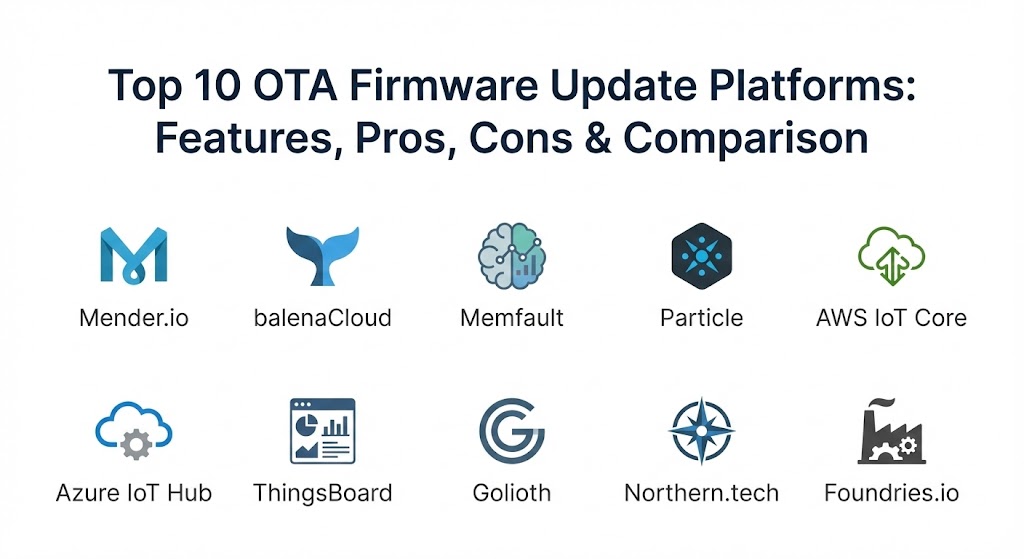
Top 10 OTA Firmware Update Platforms
1 — Mender.io
Mender is a leading open-source OTA update manager designed specifically for embedded Linux and resource-constrained devices. It is widely praised for its “dual-rootfs” approach, which ensures that an update never leaves a device in an unbootable state.
- Key features:
- Dual-rootfs partition layout for atomic updates and automatic rollbacks.
- Support for “delta” updates to minimize data consumption over cellular networks.
- Integrated device inventory and real-time monitoring.
- Phased rollouts (staged deployments) to test updates on a small group first.
- Extensive support for Yocto Project and Debian-based systems.
- “Remote Terminal” for secure, direct debugging of field devices.
- Pros:
- Open-source core provides high transparency and prevents vendor lock-in.
- Industry-leading reliability; the rollback mechanism is nearly foolproof.
- Cons:
- The initial configuration of the dual-partition architecture can be complex for beginners.
- Enterprise-tier features (like Delta updates) can become expensive at scale.
- Security & compliance: Uses TLS for all communications, supports hardware security modules (HSM), and provides detailed audit logs. GDPR and SOC 2 ready.
- Support & community: Active community hub, professional enterprise support tiers, and extensive documentation for the Yocto and Debian ecosystems.
2 — balenaCloud
Balena (formerly Resin.io) is an all-in-one IoT platform that brings modern “Docker” containerization to the world of edge devices. It treats hardware like a cloud server, allowing developers to push code updates as simple container images.
- Key features:
- Container-based deployments (Docker) for seamless application updates.
- Multicontainer support to run and update different microservices independently.
- “Preloading” capability to ship devices with the latest software out of the box.
- Public device URLs for easy remote web interface access.
- balenaOS: A host OS specifically optimized for reliability on edge hardware.
- Staged releases and canary deployments.
- Pros:
- Makes IoT development feel exactly like web development.
- Extremely fast time-to-market for teams already familiar with Docker.
- Cons:
- Containerization adds significant overhead, making it unsuitable for small microcontrollers (MCUs).
- Requires the use of balenaOS, which may not fit every custom hardware requirement.
- Security & compliance: Built-in VPN for secure device communication, SOC 2 compliance, and integrated device-level authentication.
- Support & community: Renowned for its “MVP” community program and high-quality technical blog; enterprise-grade 24/7 support is available.
3 — Memfault
Memfault is an “observability-first” OTA platform that doesn’t just push updates—it tells you why an update is needed. It focuses on the entire lifecycle of a device, from debugging crashes to orchestrating the fix.
- Key features:
- Automated crash reporting and diagnostic “coredumps” from the field.
- Cohort-based OTA targeting (e.g., “Beta” users vs. “Production” users).
- AI-assisted release monitoring to detect performance regressions early.
- Staged rollouts with “one-click” stop and rollback.
- Support for bare-metal MCUs, RTOS (Zephyr, FreeRTOS), and Android.
- Detailed battery life and performance tracking.
- Pros:
- Exceptional for troubleshooting; it finds bugs before your customers do.
- Highly flexible; works across MCUs and Linux-based systems alike.
- Cons:
- Focused heavily on diagnostics; teams needing a “simple” file-pusher might find it too complex.
- Pricing is generally higher due to the depth of analytics provided.
- Security & compliance: SOC 2 Type II compliant, data encryption at rest and in transit, and HIPAA alignment.
- Support & community: High-touch technical onboarding and a very strong reputation among embedded engineers.
4 — Particle
Particle is an integrated “full-stack” IoT platform that provides the hardware, the connectivity (cellular/Wi-Fi), and the OTA cloud under one roof. It is the go-to for companies that want an end-to-end solution.
- Key features:
- Zero-configuration OTA updates for Particle hardware (Photon, Boron, Argon).
- Integrated cellular data plans and SIM management.
- “Device Cloud” API for remote function calls and variable tracking.
- Logic-based “Product” management for organizing thousands of devices.
- Intelligent health monitoring and connectivity diagnostics.
- Integrated web and desktop IDEs for rapid prototyping.
- Pros:
- The fastest way to get an IoT product from a breadboard to the field.
- Removes the headache of managing separate cellular carrier contracts.
- Cons:
- Strong “vendor lock-in”—the OTA tools are primarily restricted to Particle hardware.
- Can become very expensive as data usage and device counts grow.
- Security & compliance: SOC 2 compliant, hardware-level encryption (ECC), and integrated secure boot.
- Support & community: Massive community forum with nearly 100,000 members and professional engineering support for large-scale deployments.
5 — AWS IoT Core (Jobs & OTA)
For organizations already living in the Amazon ecosystem, AWS IoT Core provides a highly scalable (if complex) framework for managing OTA updates through “IoT Jobs.”
- Key features:
- AWS IoT Jobs for orchestrating bulk updates across millions of devices.
- Deep integration with AWS S3 (for firmware storage) and Lambda (for logic).
- Support for FreeRTOS OTA libraries.
- “Device Shadow” service to manage device states during offline periods.
- Fine-grained access control via IAM (Identity and Access Management).
- Automated signing services via AWS Certificate Manager.
- Pros:
- Virtually unlimited scalability; handles millions of devices without breaking a sweat.
- Cost-effective for those who have the expertise to build their own custom logic.
- Cons:
- Very steep learning curve; you are building an OTA system rather than “buying” one.
- The console UI is notoriously complex and focused on developers/architects.
- Security & compliance: World-class compliance (ISO, SOC, HIPAA, FedRAMP, GDPR) and end-to-end encryption.
- Support & community: Access to the global AWS support network and a vast library of “builders” tutorials.
6 — Azure IoT Hub (Device Update)
Microsoft’s answer to AWS, Azure IoT Hub’s “Device Update” service provides a structured way to publish, distribute, and monitor updates across diverse hardware environments.
- Key features:
- Integration with Azure Active Directory for enterprise user management.
- Support for complex deployment topologies (multi-site, multi-tenant).
- “ADU” (Azure Device Update) agent for Linux-based edge systems.
- Built-in monitoring of update progress and success/failure rates.
- Seamless integration with Azure Digital Twins.
- Differential (delta) update support for optimized bandwidth.
- Pros:
- The preferred choice for “Microsoft Shops” already using Azure DevOps.
- Excellent visibility into the “Health” of a deployment through PowerBI.
- Cons:
- Can be overkill for small, non-enterprise projects.
- Managing the various Azure “Hubs” and “Services” can lead to complex billing.
- Security & compliance: Enterprise-grade security including Azure Sphere integration, ISO 27001, and SOC 2.
- Support & community: Microsoft Learn documentation is top-tier; premier support is available for enterprise customers.
7 — ThingsBoard
ThingsBoard is primarily an IoT dashboard and visualization tool, but its “Rule Engine” makes it a powerful and customizable platform for OTA orchestration, particularly for those who prefer an open-source approach.
- Key features:
- Drag-and-drop “Rule Engine” to automate update workflows.
- Customizable dashboards to track firmware versions across the fleet.
- Support for both MQTT and HTTP protocols for update delivery.
- Multi-tenant support for managing different clients or departments.
- Ability to self-host the entire platform on your own servers.
- Integrated alarm and notification system for failed updates.
- Pros:
- The open-source “Community Edition” is incredibly powerful for zero cost.
- Offers the best data visualization in the IoT space alongside management.
- Cons:
- The OTA logic is less “automated” out of the box; requires manual rule setup.
- Self-hosting requires significant server maintenance expertise.
- Security & compliance: GDPR compliant for the Professional edition; supports SSL/TLS and JWT authentication.
- Support & community: Very active GitHub and community forums; professional support is available via a paid license.
8 — Golioth
Golioth is a “developer-first” platform that focuses on making the cloud side of IoT as easy as the firmware side. It is specifically optimized for the Zephyr RTOS, which is becoming the industry standard for modern MCUs.
- Key features:
- Native, “first-class” support for the Zephyr RTOS.
- Built-in “Blue/Green” deployment strategies for safe updates.
- Optimized for extremely low-power and resource-constrained devices.
- Unified CLI and Web Console for managing everything from one place.
- Integrated “Device Settings” to update configurations without a full firmware flash.
- Support for cryptographic image verification (MCUBoot).
- Pros:
- The best option for modern MCU developers using Zephyr or ESP-IDF.
- Extremely fast onboarding; you can have a device updating in under 10 minutes.
- Cons:
- Newer platform with a smaller community than giants like AWS.
- Linux support is still maturing compared to Mender or balena.
- Security & compliance: SOC 2 alignment, end-to-end encryption, and secure boot integration.
- Support & community: Highly responsive engineering team on Discord and detailed technical tutorials.
9 — Northern.tech (CFEngine for Edge)
The creators of Mender also offer an enterprise-grade policy engine called CFEngine, which is used for “Desired State” management of high-end edge servers and gateways.
- Key features:
- Policy-based management (ensure a device is in a certain state).
- High-frequency compliance checking (every 5 minutes).
- Self-healing capabilities: if a file is modified, it reverts it automatically.
- Support for air-gapped or highly restricted network environments.
- Extremely lightweight footprint for the agent (<10MB RAM).
- Advanced reporting on the “security posture” of the whole fleet.
- Pros:
- Incredible for security-conscious industrial environments.
- Prevents “configuration drift” better than any standard file-pusher.
- Cons:
- Much steeper learning curve than standard OTA tools.
- Primarily designed for Linux-based gateways rather than MCUs.
- Security & compliance: SOC 2 compliant; follows the strictest global security management standards.
- Support & community: Professional enterprise support with a legacy of deep technical documentation.
10 — Foundries.io (FoundriesFactory)
FoundriesFactory provides a secure, customizable Linux platform for the Internet of Things and Edge. It integrates a cloud-based CI/CD pipeline directly with the OTA update mechanism.
- Key features:
- Integrated “Build-to-Deploy” pipeline with GitHub/GitLab.
- Implements “The Update Framework” (TUF), the highest security standard for updates.
- Long-term Linux kernel maintenance (LTS) included.
- Support for containers (Docker) on top of a secure base OS.
- Secure key management and hardware-root-of-trust integration.
- Fleet-wide CVE monitoring and vulnerability scanning.
- Pros:
- The “gold standard” for security; TUF prevents almost all known update attacks.
- Provides a full Linux distribution, saving teams from maintaining their own.
- Cons:
- High cost; geared toward large-scale industrial or automotive projects.
- Requires a significant architectural commitment to their “Factory” model.
- Security & compliance: TUF compliance, SOC 2, GDPR ready, and specialized in automotive security.
- Support & community: Deep technical collaboration with major silicon vendors (NXP, ARM).
Comparison Table
| Tool Name | Best For | Platform(s) Supported | Standout Feature | Rating (TrueReview) |
| Mender.io | Reliability / Linux | Linux, RTOS (Zephyr) | Dual-Rootfs Rollback | 4.8 / 5 |
| balenaCloud | Docker / Speed | Linux (balenaOS) | Containerized IoT | 4.7 / 5 |
| Memfault | Diagnostics / MCUs | MCU, Linux, Android | AI-Assisted Debugging | 4.9 / 5 |
| Particle | Turnkey Projects | Particle Hardware | Hardware + Cloud + SIM | 4.6 / 5 |
| AWS IoT Core | Massive Scale | MCU (FreeRTOS), Linux | Unlimited Scalability | 4.4 / 5 |
| Azure IoT Hub | Microsoft Ecosystem | Linux, Windows IoT | Enterprise Dashboarding | 4.3 / 5 |
| ThingsBoard | Visualization | MCU, Linux (MQTT/HTTP) | Rule Engine Automation | 4.5 / 5 |
| Golioth | Zephyr Developers | MCUs (Zephyr) | Native Zephyr Support | 4.7 / 5 |
| Northern.tech | Compliance / Edge | Linux Gateways | Self-Healing Policies | 4.5 / 5 |
| Foundries.io | High Security | Linux (Custom) | TUF Security Standard | 4.8 / 5 |
Evaluation & Scoring of OTA Firmware Platforms
We evaluated these tools based on the needs of professional engineering teams managing products in the field.
| Category | Weight | Evaluation Criteria |
| Core Features | 25% | Reliability of rollbacks, “Delta” update support, and fleet management. |
| Ease of Use | 15% | Onboarding speed, UI clarity, and CLI effectiveness. |
| Integrations | 15% | Support for popular RTOS (Zephyr/FreeRTOS), Yocto, and CI/CD tools. |
| Security | 10% | TUF compliance, cryptographic signing, and secure boot integration. |
| Performance | 10% | Bandwidth efficiency and impact on device battery life. |
| Support | 10% | Quality of documentation and availability of expert help. |
| Price / Value | 15% | Transparency of the pricing model and total cost of ownership. |
Which OTA Firmware Update Tool Is Right for You?
The right choice depends on your hardware architecture and your team’s existing skill set.
- Solo Developers & Startups: If you are building on MCUs, Golioth or Particle provide the fastest “time-to-first-update.” If you are building on a Raspberry Pi or similar, balenaCloud will make you feel right at home.
- Small to Medium Businesses (SMBs): Mender.io is the gold standard if you need reliability without vendor lock-in. For those with a focus on product quality and bug-fixing, Memfault is an investment that pays for itself in reduced support calls.
- Large Enterprises: If you have an army of developers, the raw power of AWS IoT or Azure IoT Hub is hard to beat for long-term scalability. If you are in a highly regulated industry (automotive/medical), Foundries.io or Northern.tech provide the compliance and security depth required.
- Budget-Conscious Teams: ThingsBoard Community Edition allows you to build a sophisticated OTA manager on your own hardware for free, provided you have the engineering talent to maintain it.
Frequently Asked Questions (FAQs)
1. What is an OTA firmware update platform? It is a service that manages the remote delivery, installation, and verification of software updates for connected devices like IoT sensors, gateways, and edge servers.
2. Why are OTA updates critical for IoT security? Because new vulnerabilities are discovered daily. Without OTA, you would have to physically recall devices to patch security holes, which is impossible at scale.
3. What happens if an update is interrupted by a power failure? Professional platforms like Mender use “atomic updates” (dual-rootfs), meaning the device keeps the old software until the new one is fully verified. If power fails, it simply reboots into the safe, original version.
4. Are OTA platforms hardware-agnostic? Some are (like Mender and Memfault), while others are hardware-linked (like Particle). Most work with any hardware that can run Linux or a supported RTOS like Zephyr.
5. Do OTA updates work on cellular connections? Yes, but bandwidth is expensive. Look for platforms that support “Delta Updates,” which only send the binary differences between the old and new versions to save costs.
6. Can I use these platforms for air-gapped devices? Generally no, but tools like Northern.tech and Mender offer on-premise versions that can be managed over a private local network.
7. Is it possible to “brick” a device via OTA? With a basic “file-pusher,” yes. With a managed platform that has built-in rollbacks and health-checks, the risk of bricking is nearly zero.
8. What is “The Update Framework” (TUF)? TUF is a high-level security standard used by platforms like Foundries.io to prevent advanced attacks like “freeze” attacks or “rollback” attacks where a hacker tries to force a device to an older, insecure firmware.
9. Can I update just an application, or do I have to update the whole OS? Container-based platforms like balena allow you to update individual microservices without touching the base OS, whereas others may require a full system image update.
10. Do these platforms support “Staged Rollouts”? Yes, most enterprise tools allow you to push an update to 1% of your fleet first, monitor for crashes, and then automatically roll out to the remaining 99% if everything is stable.
Conclusion
Choosing an OTA platform is one of the most consequential decisions an IoT team will make. In 2026, the market has moved beyond simple “file delivery” to sophisticated ecosystems that offer AI-driven debugging, containerized efficiency, and military-grade security. The right tool shouldn’t just push bits; it should act as an insurance policy for your brand’s reputation and your customers’ safety. Start with a platform that grows with you—and never deploy hardware that you can’t fix from your desk.