Introduction
IoT Device Management Platforms are centralized software suites that allow organizations to provision, monitor, update, and secure their fleets of connected hardware from a single interface. These platforms provide the necessary “plumbing” to handle device authentication, remote configuration, and over-the-air (OTA) firmware updates. Without these tools, maintaining a distributed network of sensors or industrial machines would require expensive, manual on-site interventions and leave massive security vulnerabilities open to exploitation.+1
The importance of these platforms lies in their ability to bridge the gap between physical hardware and cloud-based intelligence. Key real-world use cases include predictive maintenance in smart factories, real-time fleet tracking in logistics, and remote patient monitoring in healthcare. When choosing a platform, users should prioritize multi-protocol support (MQTT, HTTP, CoAP), edge computing capabilities, robust security frameworks, and “Digital Twin” integration for virtual simulations.+1
Best for: Large-scale industrial enterprises (IIoT), consumer electronics manufacturers, smart city developers, and logistics companies requiring high-availability fleet management and deep data analytics.
Not ideal for: Individual hobbyists with a single smart home device or small businesses with a handful of static sensors that do not require frequent updates or complex security protocols.
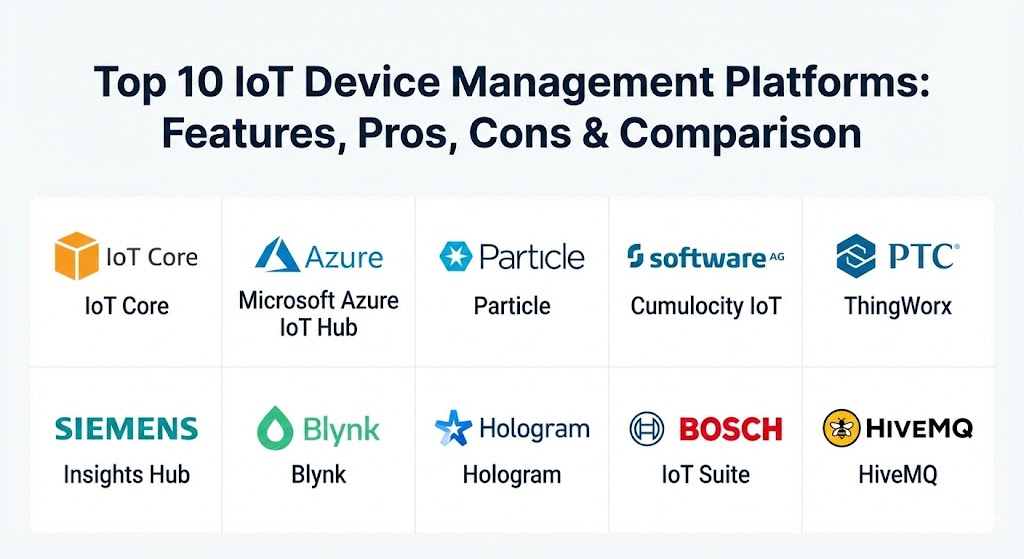
Top 10 IoT Device Management Platforms
1 — AWS IoT Core
AWS IoT Core is a highly scalable cloud platform that lets connected devices easily and securely interact with cloud applications and other devices. It is the go-to choice for companies already embedded in the Amazon Web Services ecosystem.
- Key features:
- Device Gateway for secure, low-latency communication at scale.
- Device Shadow stores the last known state of a device for offline access.
- Rules Engine for real-time data processing and routing to other AWS services.
- Integrated registry for organizing and tracking billions of devices.
- AWS IoT Greengrass for local compute and edge processing.
- Fine-grained security via IAM roles and X.509 certificates.
- Pros:
- Unmatched scalability and reliability for global deployments.
- Deepest integration with the world’s most popular cloud services.
- Cons:
- High complexity; requires specialized AWS expertise to configure.
- Pricing can be unpredictable due to the “pay-as-you-use” micro-transaction model.
- Security & compliance: SOC 1/2/3, ISO 27001, HIPAA, FIPS 140-2, and end-to-end TLS encryption.
- Support & community: Extensive technical documentation, AWS Training & Certification, and a massive global developer community.
2 — Microsoft Azure IoT Hub
Azure IoT Hub is a managed service that acts as a central message hub for bi-directional communication between an IoT application and the devices it manages. It is a leader in “Digital Twin” technology.
- Key features:
- Bi-directional messaging for real-time command and control.
- Azure IoT Edge for moving cloud intelligence to the device level.
- Device Provisioning Service (DPS) for zero-touch, just-in-time registration.
- Integration with Azure Digital Twins for virtual environmental modeling.
- Microsoft Defender for IoT for continuous threat monitoring.
- Support for multiple protocols including MQTT, AMQP, and HTTPS.
- Pros:
- Strongest choice for enterprises already using Microsoft 365 or Azure.
- Industry-leading security monitoring via integrated Defender tools.
- Cons:
- Setup and initial deployment can be slower compared to specialized SaaS tools.
- Advanced features often require higher-tier, more expensive subscriptions.
- Security & compliance: SOC 2, ISO 27001, GDPR, and HIPAA. Features per-device authentication and identity management.
- Support & community: Professional enterprise support plans, Microsoft Learn platform, and strong integration with Microsoft’s partner network.
3 — Particle
Particle is an all-in-one IoT platform that provides everything from cellular hardware to a cloud management suite. It is designed for companies that want to move from prototype to production as fast as possible.
- Key features:
- Integrated hardware ecosystem (System-on-Modules, gateways).
- Built-in cellular connectivity management with global roaming.
- Over-the-air (OTA) firmware updates that are famously reliable.
- Particle Console for fleet management and remote diagnostics.
- Logic-based event triggers for automated device actions.
- Web IDE and CLI for modern developer workflows.
- Pros:
- The most “user-friendly” platform for rapid product launches.
- Eliminates the need to manage separate hardware and connectivity vendors.
- Cons:
- Proprietary hardware lock-in; moving away from Particle once at scale is difficult.
- Can be more expensive per device compared to generic cloud-only solutions.
- Security & compliance: SOC 2 Type II compliant, encrypted communication, and hardware-level security modules.
- Support & community: Exceptional developer documentation and a vibrant community forum where engineers share libraries and projects.
4 — Software AG Cumulocity IoT
Cumulocity is an independent, device-agnostic platform focused on industrial IoT (IIoT). It is praised for its ability to connect “legacy” industrial machines to the modern cloud without heavy coding.+1
- Key features:
- Device-agnostic connectivity supporting over 100+ industrial protocols.
- Self-service dashboard builder for real-time monitoring.
- Real-time streaming analytics engine based on Apama.
- Multi-tenant architecture for managing distinct business units.
- Edge-to-cloud management with local processing capabilities.
- Comprehensive API for custom app development.
- Pros:
- Extremely fast deployment; often called “the most open” IoT platform.
- Minimal coding required for basic device onboarding and visualization.
- Cons:
- Advanced customization can lead to higher professional service fees.
- Documentation for advanced features can be highly technical and dense.
- Security & compliance: ISO 27001, GDPR compliant, and features multi-tenant data isolation.
- Support & community: Strong enterprise support, Global Academy for certification, and a dedicated partner ecosystem.
5 — PTC ThingWorx
ThingWorx is a heavyweight industrial platform designed for the complex needs of manufacturing and asset-intensive industries. It excels in Digital Twin and Augmented Reality (AR) integration.+1
- Key features:
- ThingModel for creating rich digital representations of physical assets.
- Vuforia integration for AR-based maintenance instructions.
- Predictive analytics for identifying machine failures before they happen.
- Integrated Kepware for industrial protocol connectivity (OPC-UA, Modbus).
- Asset Monitoring and Alerting via customizable mashups.
- Pre-built solution “accelerators” for common use cases like OEE tracking.
- Pros:
- The definitive choice for high-end Industrial 4.0 applications.
- Superior visualization and AR tools for frontline workers.
- Cons:
- Very high cost of entry; strictly an enterprise-level investment.
- High complexity requires specialized consultants for implementation.
- Security & compliance: Enterprise-grade RBAC, audit logs, and compliance with various industrial security standards.
- Support & community: World-class enterprise support; vast network of global industrial implementation partners.
6 — Siemens Insights Hub
Formerly known as MindSphere, Siemens Insights Hub is a cloud-based, open IoT operating system that connects your products, plants, systems, and machines.
- Key features:
- Deep integration with Siemens industrial hardware (PLCs, drives).
- Advanced analytics for optimizing machine performance and energy use.
- Visual Explorer for creating executive-level performance reports.
- Open APIs for developers to build and sell industrial apps.
- Support for “Industrial Edge” computing to process data locally.
- Secure connectivity to non-Siemens equipment via standard protocols.
- Pros:
- Best-in-class for manufacturing environments already running Siemens automation.
- Strong focus on data sovereignty and industrial-grade reliability.
- Cons:
- Can feel overly specialized for non-manufacturing use cases.
- Licensing structure is complex and requires careful planning.
- Security & compliance: ISO 27001, IEC 62443, GDPR, and data residency options.
- Support & community: Global presence with local support teams; extensive industrial user community.
7 — Blynk
Blynk is a low-code IoT platform that focuses heavily on mobile app integration. It is popular for businesses that need to provide end-users with a polished mobile interface for their smart products.
- Key features:
- Drag-and-drop mobile app builder for iOS and Android.
- Blynk.Cloud for device management and data storage.
- Over-the-air (OTA) updates for multiple hardware types.
- Built-in user management and multi-tier organizational control.
- Support for 400+ hardware platforms including ESP32 and Arduino.
- Real-time notifications and automated triggers.
- Pros:
- Cheapest and fastest way to get a branded mobile app for an IoT product.
- Exceptionally easy to use for developers and business users alike.
- Cons:
- Limited advanced analytics compared to giants like AWS or Siemens.
- Not designed for massive, industrial-scale “Digital Twin” simulations.
- Security & compliance: Encrypted communication, SOC 2 Type II (for Business plan), and GDPR support.
- Support & community: One of the largest developer communities in the IoT space; extensive library of tutorials.
8 — Hologram
Hologram is a connectivity-first platform that simplifies how devices connect to cellular networks globally. It is essential for mobile IoT applications like micromobility or long-haul logistics.
- Key features:
- Global eUICC SIM cards that switch carriers automatically for best signal.
- Dashboard for managing SIM lifecycles across thousands of devices.
- Hologram Nova hardware for quick cellular integration.
- Advanced data usage analytics and spend management.
- Private APNs and static IP options for secure routing.
- Pre-built integrations with major cloud platforms.
- Pros:
- Solves the “connectivity headache” for devices that move across borders.
- Simple, transparent pricing for global data usage.
- Cons:
- Focused strictly on connectivity and basic device health; lacks data visualization.
- Not a full “application enablement” platform; you’ll likely need another tool for UI.
- Security & compliance: Private network options, data tunnels, and ISO 27001 compliance.
- Support & community: Modern, responsive support for startups and rapid-growth fleets.
9 — Bosch IoT Suite
Bosch IoT Suite is a flexible platform based on open-source standards (Eclipse IoT), making it a favorite for organizations that want to avoid vendor lock-in.
- Key features:
- Based on the Eclipse Ditto and Eclipse Hawkbit open-source projects.
- Bosch IoT Rollouts for highly reliable, massive-scale updates.
- Bosch IoT Hub for secure ingestion of billions of device messages.
- Support for “Asset Communication” to bridge different machine languages.
- Modular architecture—you only pay for the specific components you use.
- Strong integration with automotive and smart home ecosystems.
- Pros:
- High flexibility and commitment to open standards prevents vendor lock-in.
- Built with German industrial-grade engineering for maximum reliability.
- Cons:
- Documentation can be overly technical and geared toward seasoned architects.
- Fewer “out-of-the-box” visualization tools compared to Blynk or ThingWorx.
- Security & compliance: ISO 27001, GDPR, and rigorous automotive-grade security testing.
- Support & community: Global enterprise support; benefits from the wider Eclipse IoT open-source community.
10 — HiveMQ
HiveMQ is a specialized platform that focuses exclusively on the MQTT protocol. It is the gold standard for high-performance, mission-critical message movement in IoT.
- Key features:
- The most reliable and scalable MQTT broker in the industry.
- HiveMQ Cloud for managed MQTT services.
- Extension system for integrating data into any database or enterprise system.
- Real-time monitoring of every individual device connection.
- “Offline Queuing” to ensure no data is lost when devices disconnect.
- Clustering for 100% uptime and high availability.
- Pros:
- The best choice for systems where “missing a single message” is not an option.
- Extremely high performance for low-latency messaging applications.
- Cons:
- Only manages the messaging layer; you need other tools for device UI or analytics.
- Requires a good understanding of MQTT protocols to utilize effectively.
- Security & compliance: TLS/SSL encryption, OAuth 2.0, and detailed audit logs.
- Support & community: Excellent technical support and a forum of highly skilled IoT architects.
Comparison Table
| Tool Name | Best For | Platform(s) Supported | Standout Feature | Rating (Gartner/G2) |
| AWS IoT Core | Massive Scale | Multi-Cloud / Edge | Device Shadows | 4.3 / 5 |
| Azure IoT Hub | Microsoft Ecosystem | Azure / Edge | Digital Twins | 4.3 / 5 |
| Particle | Rapid Product Launch | Cellular / Hardware | All-in-One Stack | 4.6 / 5 |
| Cumulocity IoT | Industrial Setup | Cloud Agnostic | Protocol Diversity | 4.3 / 5 |
| PTC ThingWorx | High-end Industrial | On-prem / Cloud | AR Integration | 4.1 / 5 |
| Insights Hub | Siemens Hardware | Siemens / Cloud | Machine Analytics | 4.5 / 5 |
| Blynk | Mobile App UI | Multi-Hardware | Drag-and-Drop App | 4.6 / 5 |
| Hologram | Global Connectivity | Cellular / SIM | eUICC Roaming | 4.5 / 5 |
| Bosch IoT | Open Standards | Eclipse-based | Rollouts (Updates) | 4.2 / 5 |
| HiveMQ | MQTT Reliability | Cloud / On-prem | MQTT Broker Performance | 4.7 / 5 |
Evaluation & Scoring of IoT Device Management Platforms
| Category | Weight | Evaluation Criteria |
| Core Features | 25% | Connectivity protocols, OTA updates, provisioning, and fleet monitoring. |
| Ease of Use | 15% | Dashboard quality, low-code capabilities, and onboarding speed. |
| Integrations | 15% | Ability to sync with clouds, databases, ERPs, and external APIs. |
| Security & Compliance | 10% | Encryption, authentication, identity management, and certifications. |
| Performance | 10% | Latency, message throughput, and high-availability uptime. |
| Support | 10% | Documentation, community activity, and enterprise support response. |
| Price / Value | 15% | Transparency and total cost of ownership (TCO) at scale. |
Which IoT Device Management Platform Is Right for You?
The right choice depends on where you sit in the development lifecycle and what your hardware looks like.
- Solo Developers & Startups: If you want to launch a consumer product next week, Blynk or Particle are your best bets. They remove the complex technical hurdles and let you focus on your product’s value.
- Industrial Giants (IIoT): If you have thousands of factory machines, Siemens Insights Hub (for Siemens-heavy shops) or Software AG Cumulocity (for mixed hardware) provide the industrial-grade protocols you need.
- Mobile & Global Fleets: For logistics or trackers moving across borders, Hologram is non-negotiable for managing global connectivity without worrying about local carriers.
- Cloud-Native Enterprises: If your entire infrastructure is already in AWS or Azure, stay within that ecosystem to benefit from simplified billing, shared security policies, and seamless data flow into AI and BigQuery.
- Privacy & Control Advocates: If you want to own your tech stack and avoid being “locked in” by a single cloud provider, Bosch IoT Suite or HiveMQ (self-hosted) offer the most architectural freedom.
Frequently Asked Questions (FAQs)
1. What is an “OTA Update” in IoT? Over-the-Air (OTA) updates allow you to remotely update the firmware or software on your devices without physically connecting them to a computer. This is critical for fixing security bugs or adding new features.
2. Is MQTT better than HTTP for IoT? Generally, yes. MQTT is a “lightweight” protocol designed for low-bandwidth, unreliable networks. It uses less battery and data than HTTP, making it the industry standard for IoT messaging.
3. What is a “Digital Twin”? A Digital Twin is a virtual replica of a physical asset. Platforms like Azure and ThingWorx use them to simulate how a machine will behave under certain conditions before changes are made in the real world.
4. Can I manage devices from different manufacturers on one platform? Yes, but you need a “device-agnostic” platform like Cumulocity or Bosch IoT Suite. Some platforms, like Particle, are designed specifically for their own proprietary hardware.+1
5. How does a “Device Shadow” work? A Device Shadow (or Twin) is a file that stores the device’s state. If a device goes offline, the cloud can still “read” its last state and “queue” updates for when it reconnects.
6. Do I need a platform if I only have 10 devices? For 10 devices, you can likely manage them manually. However, a platform like Blynk (which has a free tier) provides a professional interface that makes your project much easier to maintain.
7. Are IoT platforms secure? Top platforms use enterprise-grade encryption and per-device authentication. However, security is a shared responsibility; the platform can’t protect you if you use weak passwords or unencrypted local networks.
8. What is “Edge Computing” in IoT? Edge computing allows the device (or a nearby gateway) to process data locally instead of sending everything to the cloud. This reduces latency and saves bandwidth costs.+1
9. Why is “Zero-Touch Provisioning” important? It allows a device to be shipped directly from the factory to the customer. Once plugged in, the device automatically “calls home,” identifies itself, and downloads its configuration without any manual setup.
10. What are the costs associated with these platforms? Costs usually include a base subscription, a “per device” monthly fee, and “data ingestion” fees (the number of messages sent). Always use a pricing calculator before scaling.
Conclusion
The market for IoT Device Management Platforms has reached a point of high specialization. Whether you prioritize the absolute global scale of AWS, the industrial precision of Siemens, or the user-centric simplicity of Blynk, the goal is the same: transforming raw device data into actionable business intelligence. Choose the platform that doesn’t just “connect” your hardware, but empowers your organization to scale without the friction of technical debt.