Introduction
An Invoice-to-Cash (I2C) platform is a unified software solution that automates the entire accounts receivable (AR) lifecycle. This journey begins the moment an invoice is generated and continues through delivery, collections, dispute management, payment processing, and finally, cash application (matching the payment to the correct invoice in the ERP). By replacing manual spreadsheets and repetitive emails with AI-driven workflows, these platforms ensure that companies realize revenue as quickly as possible.
The importance of I2C tools has spiked due to global economic volatility, where working capital efficiency is a primary competitive advantage. Real-world use cases include automating “dunning” (payment reminders) for thousands of small customers simultaneously, using AI to predict which customers are likely to pay late, and instantly reconciling bulk ACH payments that previously took days to process manually. When evaluating these tools, users should look for deep ERP integration, AI-powered predictive analytics, multi-channel communication capabilities, and a seamless “self-service” portal for customers.
Best for: Finance leaders, AR managers, and CFOs in mid-market to enterprise-level organizations. It is especially vital for companies with high transaction volumes, complex B2B relationships, or international billing requirements.
Not ideal for: Early-stage startups or micro-businesses with a handful of clients. For these users, the built-in invoicing features of standard accounting software like QuickBooks or Xero are usually sufficient and more cost-effective.
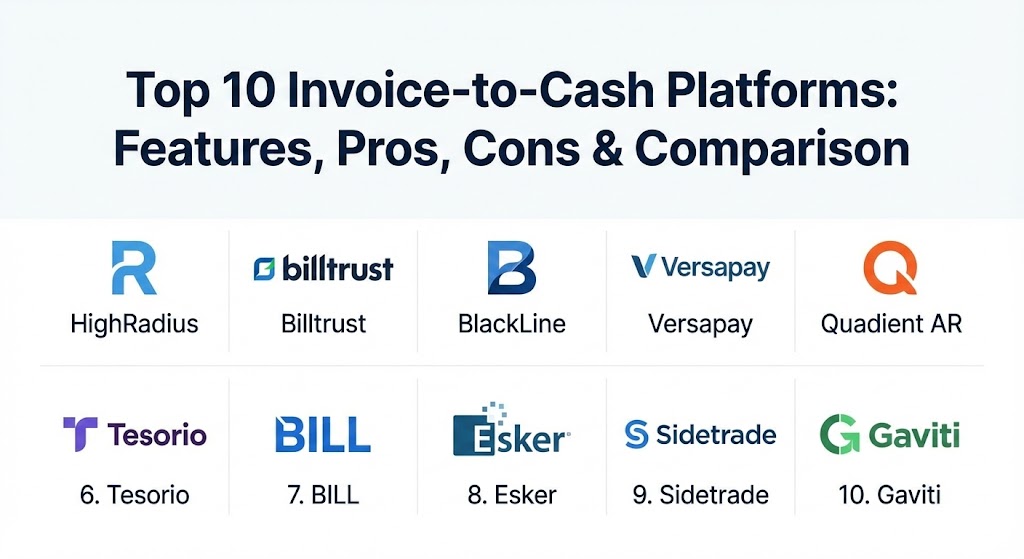
Top 10 Invoice-to-Cash Platforms
1 — HighRadius
HighRadius is widely considered the pioneer of AI-driven “Autonomous Finance.” Its I2C platform uses proprietary AI (Rivana) to handle credit, collections, and cash application with minimal human intervention.
- Key features:
- Autonomous collections with AI-prioritized worklists.
- AI-based cash application with 90%+ hit rates.
- Real-time credit risk monitoring and automated scoring.
- Electronic Invoice Presentment and Payment (EIPP) portal.
- Deduction and dispute management automation.
- Predictive analytics for DSO and cash flow forecasting.
- Pros:
- Industry-leading AI that actually learns and adapts to customer behavior.
- Significant reduction in manual labor for high-volume AR teams.
- Cons:
- Implementation can be complex and time-consuming for smaller teams.
- Premium pricing reflects its status as an enterprise-grade solution.
- Security & compliance: SOC 1 & 2 Type II, PCI DSS, GDPR, HIPAA, and ISO 27001.
- Support & community: Extensive training through “HighRadius University,” 24/7 global support, and a massive annual user conference (Radiance).
2 — Billtrust
Billtrust provides an end-to-end Order-to-Cash solution that excels in digitizing and automating the delivery of invoices and the processing of payments, particularly for manufacturing and distribution sectors.
- Key features:
- Multi-channel invoice delivery (email, portal, AP portals, and paper).
- Integrated B2B payment network (Business Payments Network).
- Automated cash application with multi-ERP support.
- Comprehensive collections management suite.
- Branded customer portals for self-service payments.
- Real-time visibility into the “Order-to-Cash” lifecycle.
- Pros:
- Strongest network effects for reaching customers through third-party portals.
- Excellent at handling the complexities of physical and digital hybrid delivery.
- Cons:
- UI can feel slightly more corporate and less “modern” than newer SaaS rivals.
- Heavy focus on North American markets, though global support is growing.
- Security & compliance: PCI DSS Level 1, SOC 1 & 2, HIPAA, and GDPR compliant.
- Support & community: Robust documentation and dedicated account management for enterprise clients.
3 — BlackLine
Known primarily for financial close automation, BlackLine’s I2C solution is designed to bridge the gap between revenue recognition and realization, offering a unified platform for total financial transformation.
- Key features:
- Intelligent cash application using machine learning.
- Collaborative dispute management and resolution tools.
- Automated collections workflows and smart dunning.
- Integrated credit risk management.
- Real-time AR intelligence and reporting.
- Deep connectivity with SAP, Oracle, and other tier-1 ERPs.
- Pros:
- Ideal for existing BlackLine users to keep all finance data in one ecosystem.
- Exceptional audit trails and internal control features.
- Cons:
- Might be “over-engineered” for companies that only need basic collections help.
- The I2C module is part of a larger, expensive suite.
- Security & compliance: ISO 27001, SOC 1/2/3, GDPR, and FedRAMP authorized.
- Support & community: World-class enterprise support and a very large community of certified accountants/consultants.
4 — Versapay
Versapay is famous for its “Collaborative AR” philosophy. It focuses on removing friction between buyers and sellers by providing a shared space where both parties can view invoices, chat about disputes, and make payments.
- Key features:
- Collaborative AR portal for real-time customer interaction.
- Automated invoice delivery and payment reminders.
- Omnichannel payment processing (Credit Card, ACH, Virtual Cards).
- Integrated cash application with high auto-match rates.
- Multi-entity and multi-currency support.
- AI-powered collections forecasting.
- Pros:
- Reduces dispute resolution time by allowing “chat” directly on the invoice.
- High customer adoption rates due to the intuitive self-service portal.
- Cons:
- Less focus on deep “predictive AI” compared to HighRadius.
- Can be slightly more expensive for small-to-midsize businesses.
- Security & compliance: PCI Level 1, SOC 1 & 2, and GDPR compliant.
- Support & community: Strong onboarding program and responsive customer success teams.
5 — Quadient AR (formerly YayPay)
Quadient AR is a highly rated mid-market solution that emphasizes “predictive” collections. It uses a clean, modern interface to help AR teams prioritize their day based on who is most likely to pay.
- Key features:
- Predictive analytics for customer payment behavior.
- Automated dunning workflows with customizable templates.
- Interactive customer self-service payment portal.
- Dispute management and workflow tracking.
- Credit management with integrated data feeds.
- Seamless integration with mid-market ERPs like Sage Intacct and NetSuite.
- Pros:
- One of the most user-friendly and visually appealing interfaces.
- Very fast time-to-value; implementation is often measured in days, not months.
- Cons:
- Not as well-suited for the extremely complex multi-entity needs of the Fortune 500.
- Reporting can be limited compared to the enterprise “heavyweights.”
- Security & compliance: SOC 2 Type II, GDPR, and AES-256 encryption.
- Support & community: Extensive library of webinars and a helpful online knowledge base.
6 — Tesorio
Tesorio is a “Cash Flow Performance” platform that focuses on the strategic side of I2C. It combines AR automation with deep cash flow forecasting to help CFOs make better liquidity decisions.
- Key features:
- AI-powered collections prioritization.
- Real-time cash flow forecasting and reporting.
- Collaborative “Notes” and task management for AR teams.
- Integrated customer payment portals.
- Bi-directional ERP sync (NetSuite, Sage, etc.).
- Anomaly detection for payment trends.
- Pros:
- The best tool for CFOs who care as much about forecasting as they do about collecting.
- Excellent Salesforce integration for sales-finance alignment.
- Cons:
- The pricing is on the higher side for pure “collections-only” needs.
- Best suited for companies with $50M+ ARR; potentially too complex for smaller firms.
- Security & compliance: SOC 2 Type II, HIPAA, and GDPR.
- Support & community: Very high customer satisfaction ratings and proactive account management.
7 — BILL (formerly Bill.com)
While BILL is often seen as an AP tool, its AR and I2C capabilities have expanded significantly, making it the go-to for SMBs and the lower mid-market who want a simple, integrated experience.
- Key features:
- Professional, branded invoice creation and delivery.
- Automated payment reminders and dunning.
- Integrated payment processing (ACH, Credit Card, International).
- Auto-pay options for recurring customers.
- Two-way sync with QuickBooks, Xero, and NetSuite.
- Mobile app for managing AR on the go.
- Pros:
- Massive network of existing users makes it easy to connect with vendors/customers.
- Lowest barrier to entry; you can be up and running in minutes.
- Cons:
- Lacks advanced AI predictive analytics and deep dispute management.
- Not designed for high-volume, complex B2B enterprise workflows.
- Security & compliance: SOC 1 & 2, PCI DSS, and multi-factor authentication.
- Support & community: Extensive help center, live chat support, and a vast ecosystem of accounting partners.
8 — Esker
Esker is a global leader in AI-driven process automation. Its I2C solution is part of a broader “Customer-to-Cash” suite that focuses heavily on global compliance and document management.
- Key features:
- AI-powered invoice delivery and compliance (e-invoicing).
- Automated credit management and onboarding.
- Intelligent cash application with multi-language support.
- Global payment processing and reconciliation.
- Dashboards for DSO and collections performance.
- Collaborative dispute management portal.
- Pros:
- Best-in-class for global e-invoicing compliance (vital for Europe and LATAM).
- Highly scalable for multi-national organizations with diverse languages.
- Cons:
- The interface can feel a bit more “industrial” and less “SaaS-modern.”
- Setup requires more configuration than “plug-and-play” tools like YayPay.
- Security & compliance: ISO 27001, SOC 1/2, HIPAA, and GDPR.
- Support & community: Global presence with local support teams in most major regions.
9 — Sidetrade
Sidetrade is a European-headquartered leader that uses its massive data lake (Aimie) to provide predictive insights across the entire Order-to-Cash cycle.
- Key features:
- Aimie (AI) for predictive customer payment analysis.
- Automated collections and dunning workflows.
- Intelligent cash application and payment matching.
- Credit management and risk scoring.
- Customer portal for payments and disputes.
- Real-time operational and strategic dashboards.
- Pros:
- Leverage of a massive B2B data pool to predict payment dates with high accuracy.
- Strong emphasis on driving actual cash flow ROI.
- Cons:
- May have less brand recognition in North America compared to HighRadius.
- Pricing is generally targeted at larger enterprise budgets.
- Security & compliance: ISO 27001, SOC 2, and GDPR.
- Support & community: Known for strong professional services and implementation consulting.
10 — Gaviti
Gaviti is a specialized accounts receivable collections tool that focuses on “collections workflow” automation. It is designed to sit on top of any ERP and immediately improve the speed of collections.
- Key features:
- Highly customizable collections playbooks.
- Automated email and SMS reminders.
- Goal setting and performance tracking for collectors.
- Integrated customer payment portals.
- Collaborative internal notes and task assignments.
- Multi-currency and multi-ERP support.
- Pros:
- Focuses intensely on one thing: making your collections team more productive.
- Very flexible playbooks that can be changed on the fly without IT help.
- Cons:
- Lacks the full “cash application” depth of a platform like Billtrust.
- Not a full O2C suite; strictly focused on AR and collections.
- Security & compliance: SOC 2 Type II and GDPR compliant.
- Support & community: Responsive support and specialized “AR transformation” guides.
Comparison Table
| Tool Name | Best For | Platform(s) Supported | Standout Feature | Rating (Gartner/TrueReview) |
| HighRadius | Global Enterprises | SAP, Oracle, MS Dynamics | Autonomous AI (Rivana) | 4.7 / 5 |
| Billtrust | Manufacturing/Dist. | Multi-ERP, Cloud | Business Payments Network | 4.4 / 5 |
| BlackLine | Financial Transformation | SAP, Oracle, Multi-ERP | Unified Close & I2C | 4.6 / 5 |
| Versapay | Collaborative AR | NetSuite, Sage, MS Dyn | Customer-Seller Chat | 4.5 / 5 |
| Quadient AR | Mid-Market Ease | NetSuite, Sage, Acumatica | Predictive Scoring UI | 4.4 / 5 |
| Tesorio | Cash Flow Forecasting | NetSuite, Sage, SFDC | Direct Cash Forecasting | 4.8 / 5 |
| BILL | SMB / Lower Mid-market | QB, Xero, NetSuite | Instant Network Setup | 4.3 / 5 |
| Esker | Global E-Invoicing | SAP, Oracle, MS Dynamics | Global Compliance Engine | 4.5 / 5 |
| Sidetrade | Data-Driven ROI | Multi-ERP, Cloud | Aimie Predictive Data Lake | 4.6 / 5 |
| Gaviti | Collections Workflow | ERP Agnostic | Customizable Playbooks | 4.7 / 5 |
Evaluation & Scoring of Invoice-to-Cash Platforms
To help you decide, we’ve weighted the most critical categories that a modern finance department needs to consider when purchasing an I2C platform.
| Category | Weight | Key Evaluation Metric |
| Core Features | 25% | Depth of cash application, collections, and dispute management. |
| Ease of Use | 15% | Intuitiveness for both the finance team and the end customer. |
| Integrations | 15% | Strength of the bi-directional sync with ERPs like SAP and NetSuite. |
| Security | 10% | Compliance with SOC, GDPR, and PCI DSS for payment handling. |
| Performance | 10% | Accuracy of AI predictions and stability under high transaction volumes. |
| Support | 10% | Onboarding speed, documentation, and technical support quality. |
| Price / Value | 15% | Expected ROI through DSO reduction vs. the cost of license. |
Which Invoice-to-Cash Platform Tool Is Right for You?
The right platform depends on your company’s maturity and the specific “pain point” you are trying to solve.
- Solo Users & Freelancers: Stick with BILL or the native features in QuickBooks/Xero. You don’t need complex playbooks; you need a “Pay Now” button on your invoices.
- SMBs (Under $50M Revenue): BILL is the easiest to start with. If you have many overdue clients, Gaviti offers a great specialized collections boost without an enterprise price tag.
- Mid-Market ($50M – $500M Revenue): Quadient AR (YayPay) or Versapay are the leaders here. They offer a balance of enterprise-grade automation with a user interface that doesn’t require a six-month training course.
- Large Enterprises ($500M+ Revenue): HighRadius and Billtrust are designed for this scale. If your primary concern is the complexity of global e-invoicing laws, Esker should be your first look.
- Strategic CFOs: If your main goal is to improve the accuracy of your cash flow reporting to the board, Tesorio or BlackLine are the best choices due to their focus on the broader financial picture.
Frequently Asked Questions (FAQs)
1. How does I2C automation reduce DSO? By automating reminders and providing a self-service payment portal, you remove friction for the customer. AI also prioritizes collectors so they call the “riskiest” accounts first, rather than following a chronological list.
2. Can these tools handle international currencies and taxes? Yes. Platforms like Esker and HighRadius are built specifically for global multi-entity organizations, handling different tax codes, languages, and local payment methods automatically.
3. Do I have to change my ERP to use an I2C platform? No. These platforms are designed to sit on top of your existing ERP (like SAP, Oracle, or NetSuite) and sync data back and forth, keeping your “system of record” intact.
4. What is “Cash Application”? It is the process of matching an incoming payment (like a check or ACH) to the correct open invoice. Automated tools use AI to “read” the payment data and apply it, even if the customer didn’t provide a remittance slip.+1
5. Is the “Self-Service Portal” really used by customers? Yes. In 2026, most B2B buyers prefer to download their own invoices and pay online rather than calling a support line or mailing a check. Adoption rates are typically over 60%.
6. How long does implementation take? For mid-market tools like YayPay, it can be 2-4 weeks. For enterprise suites like HighRadius, expect 3-6 months for a full global rollout.
7. Does I2C automation replace human collectors? It doesn’t replace them; it makes them more efficient. Instead of sending emails all day, your staff focuses on high-level dispute resolution and building relationships with critical accounts.
8. Can I2C tools help with “Bad Debt”? Yes. By identifying risky payment patterns early, AI alerts you to potential defaults before they happen, allowing you to tighten credit terms for those specific customers.
9. What is “Dunning”? Dunning is the process of methodically communicating with customers to ensure the collection of accounts receivable. Automation ensures dunning is consistent and professional.
10. Is my data safe in these platforms? Since these tools handle financial data and payments, they adhere to the highest security standards, including SOC 2 Type II and PCI DSS Level 1.
Conclusion
Selecting an Invoice-to-Cash platform is one of the most impactful decisions a modern finance leader can make. While a reduction in DSO is the standard goal, the true value lies in the visibility and predictability these tools bring to your organization. Whether you prioritize AI-driven “Autonomous Finance” or collaborative customer portals, the “best” tool is the one that removes the most friction from your unique business process. In 2026, cash is still king, but speed is the new currency.