Introduction
Source-to-Pay (S2P) refers to a comprehensive business process that begins with finding, negotiating with, and contracting suppliers (the “Source”) and ends with the final payment for goods or services received (the “Pay”). An S2P suite is a unified software platform that integrates disparate modules—such as spend analytics, e-sourcing, contract lifecycle management (CLM), e-procurement, and accounts payable (AP) automation—into a single, cohesive environment.+1
The importance of these suites has skyrocketed in 2026 as global supply chains face increased volatility and regulatory pressure. S2P tools enable organizations to gain total visibility into their spend, enforce contract compliance, and build resilient supplier relationships. Key real-world use cases include automating “tail spend” management through AI, ensuring ESG (Environmental, Social, and Governance) compliance across thousands of vendors, and accelerating month-end financial closes through touchless invoicing. When evaluating these tools, users should look for deep ERP integration, advanced “Agentic AI” capabilities for autonomous negotiation, and a user interface that encourages high adoption among non-procurement staff.
Best for: Global enterprises with complex supply chains, mid-to-large organizations looking to consolidate multi-vendor software, and procurement departments aiming for high levels of automation and strategic spend control.
Not ideal for: Very small businesses (who may only need a simple Procure-to-Pay or basic accounting tool) or organizations with highly static supplier bases where the cost of a full S2P suite outweighs the potential efficiency gains.
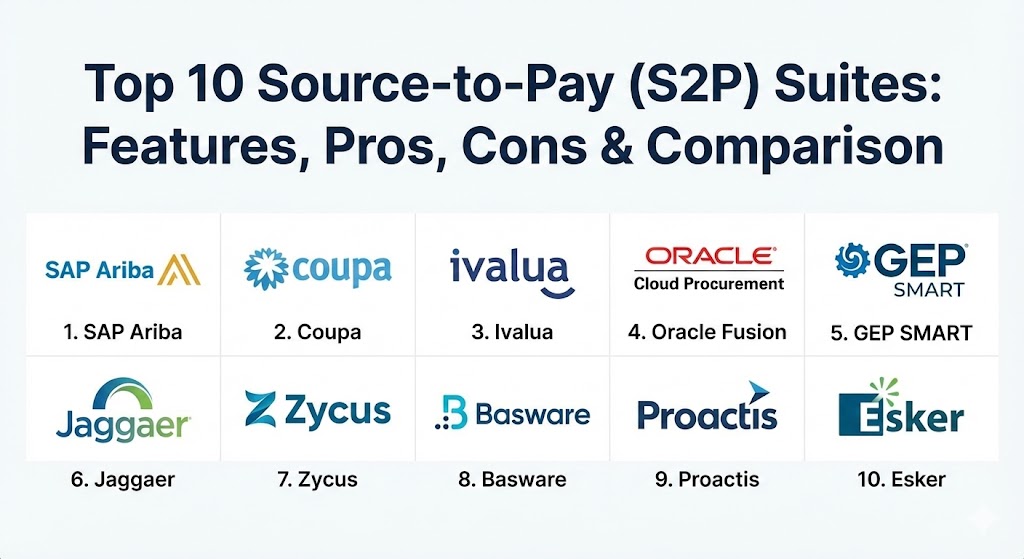
Top 10 Source-to-Pay (S2P) Suites
1 — SAP Ariba
SAP Ariba is widely considered the industry titan in the S2P space. It leverages the massive SAP Business Network—the world’s largest B2B network—to connect millions of buyers and suppliers across 190 countries.
- Key features:
- Access to the SAP Business Network for rapid supplier discovery.
- Integrated “Guided Buying” for a consumer-like requisition experience.
- Joule, SAP’s AI co-pilot, for intelligent intake and sourcing insights.
- End-to-end contract lifecycle management with automated compliance alerts.
- Deep integration with SAP S/4HANA for real-time financial synchronization.
- Advanced category management tools powered by AI-driven market data.
- Pros:
- Unmatched global scale and multi-language/multi-currency support.
- Seamless connectivity for organizations already running the SAP ecosystem.
- Cons:
- Implementation is notoriously complex and time-consuming.
- High cost of ownership makes it less accessible for mid-market firms.
- Security & compliance: SOC 1/2, ISO 27001, FedRAMP, GDPR, and HIPAA compliant.
- Support & community: Extensive global support network; the “Ariba Exchange” community is one of the largest in the procurement world.
2 — Coupa
Coupa is a leader in “Business Spend Management” (BSM), focusing heavily on a “Community Intelligence” model that uses anonymized data from all its customers to provide benchmarking and savings recommendations.
- Key features:
- Community Intelligence for real-time benchmarking against industry peers.
- Unified platform for procurement, expenses, and AP automation.
- Advanced “Open Spend” analytics for total visibility across all spend types.
- Coupa Advantage program for pre-negotiated savings with top suppliers.
- Risk management tools that monitor supplier health in real-time.
- Mobile-first design for easy approvals on the go.
- Pros:
- Exceptional user interface that drives high employee adoption rates.
- Faster implementation times compared to traditional legacy ERP-based suites.
- Cons:
- Integration with non-Coupa ERP systems can sometimes require third-party middleware.
- The platform’s rapid expansion has led to some feature overlap between modules.
- Security & compliance: SOC 1/2/3, PCI DSS, HIPAA, and GDPR compliant.
- Support & community: High-quality customer success programs and a vibrant user community (Coupa Community).
3 — Ivalua
Ivalua is prized for its “single-codebase” architecture, which ensures that all modules—from sourcing to invoicing—work together seamlessly without the data silos often found in platforms built through acquisitions.
- Key features:
- Fully unified data model across the entire S2P lifecycle.
- High configurability for complex, industry-specific workflows.
- Strong “Direct Spend” management capabilities for manufacturing sectors.
- Generative AI agents for automated RFx creation and response summary.
- Integrated ESG tracking and supplier diversity reporting.
- Advanced supplier collaboration portal for innovation and risk sharing.
- Pros:
- Superior flexibility; it can be tailored to unique business processes without breaking the core software.
- Highly rated for customer satisfaction due to its “human-centric” design.
- Cons:
- The high level of configurability can lead to “feature creep” during setup.
- Less brand recognition compared to SAP or Oracle in some global regions.
- Security & compliance: ISO 27001, SOC 2 Type II, HIPAA, and GDPR.
- Support & community: Excellent documentation and dedicated technical account managers for enterprise clients.
4 — Oracle Fusion Cloud Procurement
As part of the broader Oracle Cloud Applications suite, this tool is designed for organizations that want procurement to be a native extension of their financial and supply chain systems.
- Key features:
- Embedded AI for automated spend classification and risk detection.
- Native integration with Oracle SCM and Financials.
- Comprehensive supplier qualification management and health monitoring.
- Self-service procurement with intuitive, AI-guided search.
- Automated invoice processing with high-accuracy OCR (Optical Character Recognition).
- Robust project-based procurement for construction and engineering.
- Pros:
- Extremely powerful analytics and reporting capabilities.
- High reliability and performance backed by Oracle’s global cloud infrastructure.
- Cons:
- Can feel rigid for organizations that do not use Oracle for their main ERP.
- Steeper learning curve for administrative users compared to Coupa.
- Security & compliance: FedRAMP, HIPAA, SOC 1/2, and GDPR compliant.
- Support & community: World-class enterprise support and extensive training via Oracle University.
5 — GEP SMART
GEP SMART is a cloud-native, unified S2P platform that is particularly strong in its use of “GEP Quantum” AI to manage both direct and indirect spend in a single interface.
- Key features:
- GEP Quantum AI for predictive sourcing and autonomous negotiations.
- Unified S2P and Supply Chain Management (SCM) visibility.
- Mobile-native application providing full functionality on tablets and phones.
- “Savings Tracker” module to validate and report realized savings to finance.
- Digital “Control Tower” for real-time supply chain monitoring.
- Comprehensive contract management with AI-powered clause extraction.
- Pros:
- Highly innovative AI roadmap that actively reduces manual workload.
- Strong focus on bridging the gap between procurement and supply chain.
- Cons:
- The sheer breadth of features can be overwhelming for smaller procurement teams.
- Post-implementation support quality can vary by geographic region.
- Security & compliance: ISO 27001, SOC 2 Type II, and GDPR compliant.
- Support & community: Strong professional services arm that assists with procurement transformation strategy.
6 — Jaggaer
Jaggaer (formerly SciQuest) has deep roots in the higher education, life sciences, and public sectors, offering specialized functionality for complex research and laboratory procurement.
- Key features:
- Jaggaer One unified platform with industry-specific “Power Packs.”
- Advanced chemical and inventory management for lab environments.
- Robust public sector compliance and “Total Contract Value” tracking.
- AI-enabled sourcing with “scenario-based” award optimization.
- Supplier Value Management (SVM) for deep relationship tracking.
- Integrated e-invoicing and discount management.
- Pros:
- Unmatched expertise in research-heavy and highly regulated industries.
- Excellent at managing complex “Direct Spend” and BOM (Bill of Materials).
- Cons:
- The user interface for the core e-procurement module can feel slightly legacy.
- Less focus on general “Business Spend” compared to competitors like Coupa.
- Security & compliance: FedRAMP (for US public sector), HIPAA, SOC 2, and GDPR.
- Support & community: Very strong user groups within the Higher Ed and Life Sciences communities.
7 — Zycus
Zycus is often recognized as a “Visionary” in the S2P space, largely due to its Merlin AI platform which aims to automate the “tactical” parts of procurement so teams can focus on strategy.
- Key features:
- Merlin AI Agents for autonomous intake, contract drafting, and AP.
- “Guided Intake” that uses natural language to help users start requests.
- AI-powered spend analysis with 95%+ classification accuracy.
- Integrated “Procurement Orchestration” to manage multi-system workflows.
- Autonomous negotiation agents for handling tail spend.
- Supplier risk monitoring with real-time news and financial data feeds.
- Pros:
- One of the most advanced AI implementations in the procurement market.
- Very strong spend analytics that can ingest data from dozens of sources.
- Cons:
- Implementation of the full suite can be resource-intensive.
- Some modules (like CLM) are significantly stronger than others (like Inventory).
- Security & compliance: ISO 27001, SOC 2 Type II, and GDPR.
- Support & community: Offers a dedicated “AI Council” for customers to influence the product roadmap.
8 — Basware
While Basware offers a full S2P suite, it is best known for its “Networked P2P” and its global dominance in e-invoicing and AP automation.
- Key features:
- World-leading e-invoice network with 100% data capture accuracy.
- Global compliance engine for cross-border tax and e-invoicing laws.
- Automated “3-way matching” for invoices, POs, and receipts.
- Strategic sourcing with built-in auction and RFP tools.
- Predictive analytics for cash flow and early payment discounts.
- Open API architecture for easy integration with any ERP.
- Pros:
- The best choice for finance-led procurement initiatives.
- Simplifies the nightmare of global tax compliance for multi-national firms.
- Cons:
- The “Source” (Sourcing/S2C) side of the suite is less mature than the “Pay” side.
- User experience for requisitioners is functional but not as “Amazon-like” as Coupa.
- Security & compliance: ISO 27001, SOC 1/2, GDPR, and country-specific tax compliance.
- Support & community: Deep expertise in global financial regulations and electronic data interchange (EDI).
9 — Proactis
Proactis specializes in the mid-market and public sector, offering a “spend control” philosophy that is more affordable and faster to deploy than the top-tier enterprise suites.
- Key features:
- Budget-aware procurement workflows that prevent overspending.
- Integrated sourcing and supplier management.
- “Marketplace” feature for multi-supplier catalog search.
- Contract management with automated renewal reminders.
- AP automation with seamless link to mid-market ERPs (Sage, Microsoft Dynamics).
- Public sector portal for “ProContract” tender management.
- Pros:
- Much more cost-effective for organizations with 500–5,000 employees.
- Strong focus on preventing “maverick spend” before it happens.
- Cons:
- Lacks the deep AI and predictive analytics of GEP or Zycus.
- Not designed for hyper-complex, global manufacturing supply chains.
- Security & compliance: ISO 27001, SOC 2, and UK Cyber Essentials.
- Support & community: Localized support teams in Europe and North America; very responsive to mid-market needs.
10 — Esker
Esker has evolved from an AP automation specialist into a comprehensive AI-driven S2P suite, focusing on removing the manual friction between finance and procurement.
- Key features:
- AI-driven document process automation (Extract, Categorize, Validate).
- Unified interface for Sourcing, Supplier Mgmt, Procurement, and AP.
- Integrated Supply Chain Financing to help suppliers with cash flow.
- Real-time “Spend Dashboards” for finance and procurement leaders.
- Global e-invoicing compliance across 60+ countries.
- Intuitive mobile app for requisition and invoice approvals.
- Pros:
- Excellent for organizations looking to digitize paper-heavy workflows.
- The “Agile” implementation methodology ensures quick time-to-value.
- Cons:
- Sourcing and CLM modules are more basic compared to “best-of-breed” tools like Ivalua.
- Primarily appeals to Finance departments; Procurement teams may find sourcing tools limited.
- Security & compliance: ISO 27001, SOC 1/2 Type II, HIPAA, and GDPR.
- Support & community: Strong global presence with a focus on “customer-centric” digital transformation.
Comparison Table
| Tool Name | Best For | Platform(s) Supported | Standout Feature | Rating (Gartner Peer Insights) |
| SAP Ariba | Global Enterprises | Cloud / SaaS | SAP Business Network | 4.4 / 5 |
| Coupa | Spend Visibility / BSM | SaaS / Mobile | Community Intelligence | 4.7 / 5 |
| Ivalua | Flexibility / Direct Spend | Single Codebase | High Configurability | 4.6 / 5 |
| Oracle Fusion | Oracle ERP Users | Oracle Cloud | Native ERP Integration | 4.3 / 5 |
| GEP SMART | Unified S2P + SCM | Cloud / Mobile | GEP Quantum AI | 4.5 / 5 |
| Jaggaer | Higher Ed / Life Sciences | SaaS | Industry Power Packs | 4.4 / 5 |
| Zycus | AI-Driven Automation | Cloud / SaaS | Merlin Agentic AI | 4.3 / 5 |
| Basware | Global E-Invoicing | Cloud / Network | 100% AP Automation | 4.5 / 5 |
| Proactis | Mid-Market / Public Sector | SaaS / On-Prem | Spend Control Engine | 4.2 / 5 |
| Esker | Finance-Led Digitalization | Cloud / SaaS | AI Document Capture | 4.5 / 5 |
Evaluation & Scoring of Source-to-Pay (S2P) Suites
The following rubric provides a weighted framework for comparing these enterprise solutions based on typical procurement requirements.
| Category | Weight | Evaluation Criteria |
| Core Features | 25% | Breadth of S2P lifecycle coverage, from sourcing to payment. |
| Ease of Use | 15% | UI/UX for both power users (procurement) and casual users (employees). |
| Integrations | 15% | Ability to connect with ERPs (SAP, Oracle, NetSuite) and third-party data. |
| Security & Compliance | 10% | Data protection, SSO, and global regulatory (tax/e-invoice) support. |
| Performance | 10% | System uptime, mobile app reliability, and search speed. |
| Support & Community | 10% | Quality of documentation, speed of support, and user forums. |
| Price / Value | 15% | ROI potential vs. implementation cost and ongoing subscription fees. |
Which Source-to-Pay (S2P) Suites Tool Is Right for You?
Selecting an S2P suite is a multi-year commitment that can redefine your company’s financial health. Here is a guide to narrowing your search:
- Solo Users vs SMB: If you are a small business, a full S2P suite is likely “too much tool.” Instead, look for light-weight “Procure-to-Pay” (P2P) solutions or basic AP automation integrated with your accounting software (like QuickBooks or Xero).
- Mid-Market Companies: You need a balance of power and simplicity. Proactis and Esker are excellent choices because they offer enterprise-grade spend control without the “enterprise-grade” price tag or implementation nightmare.
- Large Enterprises & Global Giants: If you are running thousands of employees across the globe, you need a heavy hitter. SAP Ariba is the gold standard for global networking, while Coupa is the king of spend visibility. If your business has a highly unique or complex process, Ivalua’s configurability makes it the safest long-term bet.
- Industry Focus: If you are in Higher Education or Government, Jaggaer has pre-built compliance workflows that will save you months of custom coding. If you are in Finance or AP-heavy sectors, Basware provides the most robust invoicing engine.
- The “AI First” Organizations: If your goal is to reduce headcount or automate repetitive tasks (like tail-spend negotiation), Zycus and GEP SMART are currently leading the charge with “Agentic AI” that can act on behalf of the procurement team.
Frequently Asked Questions (FAQs)
1. What is the difference between P2P and S2P?
P2P (Procure-to-Pay) focuses on the transactional side—requisitioning, ordering, and paying. S2P (Source-to-Pay) is broader, including the strategic “upstream” activities like spend analysis, supplier discovery, and contract negotiation.+1
2. Can an S2P suite replace my ERP?
No. An S2P suite works with your ERP. While the S2P handles the “doing” of procurement, the ERP remains the “system of record” for financial accounting and inventory levels.
3. How long does a typical implementation take?
For an enterprise-grade suite (like SAP Ariba), expect 6–12 months. Mid-market solutions (like Proactis) can often be up and running in 3–4 months.
4. What is “Maverick Spend” and how do these tools stop it?
Maverick spend happens when employees buy things outside of approved contracts. S2P tools stop this by providing “Guided Buying” portals that only show pre-approved items and vendors.
5. Do these tools help with ESG and Sustainability?
Yes. Modern S2P suites like Ivalua and GEP include “Green” modules that track supplier carbon footprints, diversity status, and ethical labor practices during the sourcing process.
6. What is “Tail Spend”?
Tail spend consists of high-volume, low-value purchases that are usually unmanaged. S2P tools use AI bots to autonomously negotiate these small purchases, saving significant money across thousands of transactions.
7. Is a “Single Codebase” important?
Yes. Platforms like Ivalua use a single codebase, meaning all modules share the same data. This avoids the “integration lag” often seen in suites built by buying smaller companies and stitching them together.
8. Can these tools handle “Direct Spend” (Raw Materials)?
Most S2P suites were originally designed for “Indirect Spend” (Office supplies, IT). However, tools like Ivalua and SAP Ariba have added advanced BOM (Bill of Materials) and manufacturing-specific features for direct spend.
9. Why is e-invoicing compliance so hard?
Different countries have different laws for how an invoice must be formatted and sent to the government. Tools like Basware automate this, ensuring you are legally compliant in every country where you operate.
10. What is “Community Intelligence”?
Popularized by Coupa, this is the practice of aggregating anonymous data from all customers to show you if you are paying more for a laptop or a service than other companies of your size.
Conclusion
The transition to a Source-to-Pay suite is no longer a luxury—it is a requirement for operational resilience. As we move through 2026, the divide between organizations using “manual” procurement and those leveraging “autonomous” S2P suites will only widen. When choosing your platform, look beyond the flashy AI demos and focus on how well the tool integrates with your people and your existing data. The “best” tool is the one that your employees actually use, and your suppliers find easy to engage with.