Introduction
A Procure-to-Pay (P2P) Suite is an integrated software solution designed to automate and streamline the entire lifecycle of a business purchase. It typically starts at the point of requisition (when an employee requests a product or service), moves through the approval and purchase order (PO) phase, handles the receiving and matching of goods, and concludes with invoice processing and payment. By centralizing these functions, P2P suites provide a “single source of truth” for all corporate spending.
The importance of these suites has skyrocketed as global supply chains become more volatile and regulatory requirements more stringent. Without a P2P suite, companies suffer from “maverick spend” (unauthorized purchases), high processing costs per invoice, and poor visibility into cash flow. Real-world use cases include automating thousands of monthly utility payments, managing complex direct material orders for manufacturing, and ensuring that every purchase adheres to pre-negotiated contract prices. When evaluating P2P tools in 2026, buyers should look for high levels of automation (OCR and AI matching), deep ERP integration, mobile-first interfaces for on-the-go approvals, and robust supplier portals that facilitate collaborative problem-solving.
Best for: Large-scale global enterprises with high transaction volumes, mid-market companies aiming to scale their operations, and organizations in highly regulated sectors like manufacturing, healthcare, and finance. It is essential for CFOs and Procurement Heads who need total visibility into where every dollar is going.
Not ideal for: Solo entrepreneurs or very small businesses with minimal purchasing needs. For these users, simple accounting software or even basic expense management apps are often more cost-effective and easier to implement than a full enterprise P2P suite.
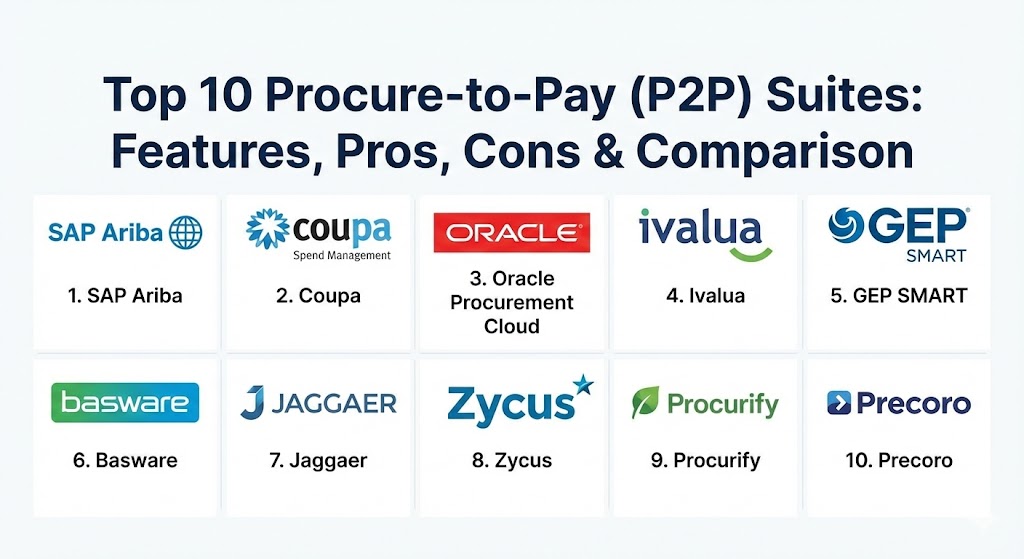
Top 10 Procure-to-Pay (P2P) Suites
1 — SAP Ariba
SAP Ariba remains the global heavyweight in the P2P space, leveraging the world’s largest business network—the Ariba Network—to connect millions of buyers and suppliers across 190 countries.
- Key features:
- Guided Buying: A consumer-like shopping experience that directs users to preferred suppliers.
- Ariba Network: Direct access to over 6 million connected suppliers globally.
- Advanced Sourcing: Integration of sourcing events directly into the P2P workflow.
- Strategic Contract Management: Automatic enforcement of contract terms at the point of purchase.
- Complex Services Procurement: Specialized tools for managing labor and service-based spend.
- Global Compliance: Tax and regulatory compliance templates for multinational operations.
- Pros:
- Unrivaled scalability for the largest multinational corporations.
- Deep, native integration with SAP S/4HANA and other SAP ERP systems.
- Cons:
- Implementation is notoriously long and requires specialized consultants.
- The user interface, while improved, can still feel complex and “clunky” in certain modules.
- Security & compliance: SOC 1/2, ISO 27001, GDPR, HIPAA, and FIPS 140-2 compliant.
- Support & community: Massive global ecosystem; extensive training via SAP Learning Hub and a highly active peer community.
2 — Coupa
Coupa is often cited as the leader in “Business Spend Management” (BSM). It has set the industry standard for user experience, making procurement as easy as shopping on a consumer retail site.
- Key features:
- Community Intelligence: AI that benchmarks your spend data against thousands of other Coupa users to find savings.
- Unified Platform: Sourcing, procurement, invoicing, and expenses in one single UI.
- Open Business Network: No-fee supplier network that makes it easy for vendors to join.
- Mobile App: Fully functional mobile interface for requisitions and management approvals.
- Risk Awareness: AI-driven insights that flag supplier risk in real-time.
- Advanced AP Automation: Automated three-way matching with high accuracy.
- Pros:
- Exceptional user adoption rates due to the intuitive, modern interface.
- Rapid time-to-value compared to traditional legacy ERP modules.
- Cons:
- Premium pricing can be a barrier for smaller organizations.
- Deep customization can lead to higher maintenance costs over time.
- Security & compliance: SOC 2 Type II, ISO 27001, GDPR, PCI DSS, and SOX compliance support.
- Support & community: Renowned for the “Coupa Community,” which offers extensive peer-to-peer knowledge sharing and high-quality customer success management.
3 — Oracle Procurement Cloud
Part of the broader Oracle Fusion Cloud ERP, this suite is designed for organizations that want a disciplined, data-driven procurement process built on a single, unified cloud platform.
- Key features:
- Embedded AI: Predictive analytics for sourcing and automated invoice matching.
- Supplier Qualification Management: Rigorous tools for vetting and scoring suppliers.
- Native ERP Integration: Seamless flow of data between procurement, finance, and projects.
- Social Collaboration: Built-in messaging for teams to discuss requisitions and contracts.
- Procurement Contracts: Comprehensive contract lifecycle management within the P2P flow.
- Self-Service Requisitions: Simplifies how employees request goods and services.
- Pros:
- Best-in-class data integrity for organizations already running Oracle Cloud ERP.
- Highly disciplined internal controls, making it a favorite for audit-heavy industries.
- Cons:
- Steep learning curve for administrative users.
- Configuration can be rigid, requiring businesses to adapt to the software’s logic.
- Security & compliance: FedRAMP, SOC 1/2, HIPAA, ISO 27001, and GDPR compliant.
- Support & community: Extensive global support and a vast network of certified implementation partners.
4 — Ivalua
Ivalua is famous for its “one-codebase” philosophy, offering a modular suite that can be highly configured to meet the specific needs of complex industries without breaking during upgrades.
- Key features:
- Modular Architecture: Buy only what you need (P2P, Sourcing, or full S2P).
- Single Data Model: Ensures that data is consistent across the entire platform.
- Direct Materials Support: Deep functionality for manufacturing and supply chain management.
- Supplier Collaboration: Advanced portals for sharing forecasts and performance metrics.
- Configurability: Ability to tailor workflows to match unique business processes.
- Spend Analytics: Real-time visibility into complex, multi-entity spending.
- Pros:
- Incredible flexibility; can be tailored to almost any unique industry requirement.
- High user satisfaction due to the “unified experience” of the modular apps.
- Cons:
- Implementation requires careful planning due to the number of configuration options.
- Not as much out-of-the-box “community” data as Coupa.
- Security & compliance: ISO 27001, SOC 2, HIPAA, and GDPR.
- Support & community: Strong professional services and a dedicated customer success focus for enterprise clients.
5 — GEP SMART
GEP SMART is a cloud-native, unified source-to-pay (S2P) platform that blends technology with GEP’s deep category expertise in procurement consulting.
- Key features:
- AI-Assisted Buying: SMART by GEP uses AI to suggest the best items and suppliers.
- Unified S2P: A single platform that covers everything from spend analysis to payments.
- Mobile-First Design: Optimized for a global, mobile workforce.
- Supplier Information Management: A central hub for all supplier-related documents and certificates.
- Digital Workspaces: Collaborative environments for sourcing and contract negotiations.
- Inventory Management: Integration with warehouse and stock levels for P2P.
- Pros:
- Very strong for organizations that want a digital-first, AI-forward approach.
- Excellent balance of technological innovation and procurement best practices.
- Cons:
- Smaller supplier network compared to SAP Ariba.
- Some users find the sheer amount of data in dashboards overwhelming.
- Security & compliance: SOC 1/2, ISO 27001, GDPR, and SSAE 18.
- Support & community: Highly rated for customer support and implementation methodology.
6 — Basware
While many suites focus on the “buying” side, Basware is the world leader in the “paying” side, specifically e-invoicing and accounts payable automation for complex, global organizations.
- Key features:
- E-Invoicing Network: The largest open network for e-invoice exchange.
- SmartPDF AI: Automatically converts email attachments into structured data with high accuracy.
- Global Tax Compliance: Supports VAT and tax regulations in over 100 countries.
- Purchase-to-Pay Automation: Strong 2-way and 3-way matching logic.
- Spend Insights: Predictive analytics that identify payment bottlenecks.
- Supplier Self-Service: Portal that allows vendors to track their payment status.
- Pros:
- The best choice for companies with massive invoice volumes and global complexity.
- Reduces AP overhead significantly through high “touchless” processing rates.
- Cons:
- The procurement/sourcing side is not as “flashy” as Coupa or SAP Ariba.
- Integration with non-standard ERPs can sometimes be challenging.
- Security & compliance: ISO 27001, SOC 2, GDPR, and PEPPOL certified.
- Support & community: Exceptional expertise in global e-invoicing legal requirements.
7 — Jaggaer
Jaggaer (formerly SciQuest) is a powerhouse in the education, government, and manufacturing sectors. It is known for handling “direct materials” and complex sourcing better than many horizontal peers.
- Key features:
- Autonomous Commerce: AI-driven suggestions to optimize the buying journey.
- Direct Materials Management: Specialized tools for bill-of-materials (BOM) procurement.
- Supplier Risk Management: Real-time monitoring of financial and ethical risks.
- Advanced RFx: Powerful tools for complex sourcing events.
- Inventory Control: Native tools for tracking and re-ordering stock.
- Multi-ERP Integration: Connects to various backend systems simultaneously.
- Pros:
- Deep industry-specific functionality that generic P2P suites lack.
- Extremely strong for public sector and higher education compliance.
- Cons:
- The user interface can feel more “industrial” and less “consumer-friendly” than Coupa.
- Transitioning between legacy modules can sometimes feel inconsistent.
- Security & compliance: HIPAA, FERPA, GDPR, and SOC 2 Type II.
- Support & community: Strong vertical-specific communities (e.g., Higher Ed users).
8 — Zycus
Zycus has made a name for itself in 2026 by being an early and aggressive adopter of “Agentic AI” through its Merlin AI suite, which aims to automate the most tedious parts of procurement.
- Key features:
- Merlin AI Agents: Autonomous agents for invoice extraction and spend classification.
- Cognitive Procurement: Uses AI to predict contract risks and savings opportunities.
- Guided Buying: A streamlined interface for non-procurement employees.
- Supplier Performance Management: Automated scorecards and risk alerts.
- Savings Tracking: Directly links P2P activities to the organization’s bottom line.
- Integrated S2P Suite: Seamless data flow from sourcing to payment.
- Pros:
- High innovation in AI, leading to less manual data entry for AP and Procurement teams.
- Excellent spend visibility and categorization capabilities.
- Cons:
- The “AI-first” approach requires clean data to be truly effective.
- Customer support feedback has been more mixed compared to GEP or Coupa.
- Security & compliance: SOC 2, ISO 27001, and GDPR compliant.
- Support & community: Global presence with a focus on large enterprise accounts.
9 — Procurify
Procurify is the “agile” choice in this list. It is designed specifically for mid-market companies that need a powerful P2P system that can be deployed in weeks, not months.
- Key features:
- Real-Time Spend Visibility: Dashboards that show “committed” vs “actual” spend.
- Mobile Approvals: One of the highest-rated mobile apps for managers.
- Virtual Cards: Integrated spend management with physical and virtual cards.
- Custom Approval Workflows: Easy-to-build logic for different departments.
- Punch-Out Catalogs: Integration with major vendors like Amazon Business.
- Simple AP Automation: Streamlined matching and payment processing.
- Pros:
- Incredibly fast implementation (often less than 4 weeks).
- Very high user adoption due to the simple, clean design.
- Cons:
- Not designed for the massive complexity of a global multi-entity conglomerate.
- Limited support for complex direct materials or manufacturing workflows.
- Security & compliance: SOC 2, GDPR, and role-based access controls.
- Support & community: Excellent customer success and onboarding support.
10 — Precoro
Precoro is an ideal solution for SMEs and growing mid-market companies that want to eliminate manual work and gain control over their budgets without the enterprise price tag.
- Key features:
- PO Management: Automated generation and tracking of purchase orders.
- Budget Tracking: Real-time visibility into departmental budgets.
- Invoice Matching: Simple 3-way matching to prevent payment errors.
- Approval Routing: Flexible, multi-level approval hierarchies.
- Inventory Management: Basic tools for tracking internal supplies.
- NetSuite/QuickBooks Integration: Strong native connectors for popular accounting tools.
- Pros:
- Very affordable and transparent pricing model.
- “Zero-training” interface—most employees can use it instantly.
- Cons:
- Lacks the advanced AI and global network features of the major suites.
- Limited functionality for strategic sourcing or complex contract management.
- Security & compliance: GDPR compliant and SOC 2 (varies by tier).
- Support & community: Responsive customer support and a helpful self-service knowledge base.
Comparison Table
| Tool Name | Best For | Platform(s) Supported | Standout Feature | Rating (Gartner/G2) |
| SAP Ariba | Global Multi-nationals | Cloud / SAP Ecosystem | World’s Largest Network | 4.6 / 5 |
| Coupa | User Experience & ROI | Cloud / Multi-Platform | Community Spend Benchmarking | 4.8 / 5 |
| Oracle Procure | Oracle ERP Users | Oracle Cloud | Deep Financial Data Integrity | 4.4 / 5 |
| Ivalua | Highly Complex Ops | Cloud / On-Premise | Unlimited Configurability | 4.7 / 5 |
| GEP SMART | Digital-First Teams | Cloud-Native | Unified AI Source-to-Pay | 4.5 / 5 |
| Basware | Invoice-Heavy Global | Cloud | Global E-Invoicing Network | 4.5 / 5 |
| Jaggaer | Education / Manufacturing | Cloud | Direct Materials Expertise | 4.4 / 5 |
| Zycus | AI-Driven Efficiency | Cloud | Agentic AI (Merlin) | 4.5 / 5 |
| Procurify | Mid-Market Growth | Cloud / SaaS | Rapid Deployment & UI | 4.6 / 5 |
| Precoro | SMEs / Simple Workflows | Cloud / SaaS | Budget Tracking Simplicity | 4.7 / 5 |
Evaluation & Scoring of Procure-to-Pay (P2P) Suites
To help you decide which tool fits your specific needs, we have evaluated the general category based on a weighted scoring rubric that reflects the priorities of modern procurement leaders.
| Category | Weight | Evaluation Criteria |
| Core Features | 25% | Requisitioning, PO management, invoice automation, and supplier management. |
| Ease of Use | 15% | Intuitiveness for the casual requester and efficiency for the admin. |
| Integrations | 15% | Strength of connections with ERPs (SAP, Oracle, NetSuite, Microsoft). |
| Security | 10% | Data encryption, SSO, SOC 2 compliance, and audit trail depth. |
| Performance | 10% | System uptime, mobile responsiveness, and page load speeds. |
| Support | 10% | Implementation guidance, 24/7 support, and user community resources. |
| Price / Value | 15% | Total cost of ownership relative to the efficiency and savings generated. |
Which Procure-to-Pay (P2P) Suites Tool Is Right for You?
Selecting a P2P suite is a major strategic decision that will impact your finance and procurement teams for years. Use this guide to narrow down your choices:
- Solo Users vs. SMBs: If you are a small team, avoid the “giants” like SAP Ariba or Oracle. Focus on Precoro or Procurify. They offer the control you need (approvals and budget tracking) without the six-figure price tag and month-long setup times.
- Mid-Market Companies: If you are scaling fast and need “Enterprise Lite” features, Coupa or Procurify are usually the winners. Coupa offers a path to full BSM (Business Spend Management) if you have the budget, while Procurify is better for those who want to move fast.
- Global Enterprises: For organizations with multiple entities across different countries, SAP Ariba is the standard for a reason. However, if you find SAP too rigid, Ivalua provides the best “Enterprise configurability” to match your specific legacy processes.
- Industry Specials: If you are in Higher Education or complex Manufacturing, start your search with Jaggaer. If your primary pain point is a mountain of paper invoices from global suppliers, Basware is the specialist you need.
- Budget vs. Premium: If ROI through AI and automation is your goal, the premium price of Coupa or GEP SMART is often justified by the “maverick spend” they prevent. If you just need a digital paper trail, Precoro offers the best value.
Frequently Asked Questions (FAQs)
1. What is the difference between P2P and S2P? P2P (Procure-to-Pay) covers the operational side from requisition to payment. S2P (Source-to-Pay) is broader, adding the strategic “Sourcing” and “Contract” phases at the beginning of the process.
2. Can these tools integrate with my existing ERP? Yes. Most suites like Coupa, Ivalua, and GEP SMART are “ERP-agnostic” and connect via API. Tools like SAP Ariba and Oracle Procurement are designed to be “ERP-native” within their respective ecosystems.
3. Does P2P software reduce “Maverick Spend”? Absolutely. By providing a “Guided Buying” experience and enforcing approval workflows, these tools ensure employees buy from approved vendors at contracted prices.
4. How does AI help in a P2P suite? In 2026, AI is used for OCR (reading invoices), predictive spend analytics, identifying duplicate payments, and even autonomous negotiations for low-value “tail spend.”
5. How long does implementation take? SME tools like Precoro can be up in 2–4 weeks. Enterprise suites like SAP Ariba or Oracle typically take 4–9 months depending on the complexity of integrations.
6. Do suppliers have to pay to join these networks? It varies. SAP Ariba sometimes charges suppliers based on transaction volume, while Coupa generally offers a free-to-join “Open Business Network.”
7. Can these tools handle multiple currencies and languages? Enterprise-grade suites (SAP, Coupa, Basware, Oracle) are built for global use and automatically handle currency conversion and multi-language interfaces.
8. What is “Three-Way Matching”? It is a safety check where the software compares the Purchase Order (PO), the Goods Receipt (GR), and the Invoice. If all three match, the payment is automatically approved.
9. Is my data safe in a cloud-based P2P suite? Yes. Modern providers use bank-level encryption and comply with global standards like ISO 27001 and SOC 2. Your data is often safer in their cloud than on an aging internal server.
10. Why should I use a P2P suite instead of just my accounting software? Accounting software records what happened after it happened. A P2P suite controls the spending before it happens through approvals and budget checks.
Conclusion
Choosing a Procure-to-Pay suite in 2026 is no longer about finding a digital filing cabinet—it’s about choosing a strategic partner. Whether you prioritize the global reach of SAP Ariba, the user-centric intelligence of Coupa, or the agile simplicity of Procurify, the goal remains the same: total visibility and absolute control over corporate spend. The “best” tool isn’t the one with the most features; it’s the one your employees will actually use and your suppliers will actually support.